

When we talk about performance at work, the conversation often revolves around outcomes: targets achieved, goals delivered, metrics met.
But beneath those outcomes lies something far more influential, and often overlooked.
The quality of conversations managers have with their teams.
Research shows that managers account for at least 70% of the variance in employee engagement, making their day-to-day interactions one of the most powerful drivers of performance.
And yet, when it comes to coaching, there's often a disconnect.
What organizations call coaching is frequently a mix of feedback, quick advice, or 1:1s that don't quite happen as planned.
At the same time, the global coaching industry has grown to $5.34 billion, reflecting just how seriously organizations are beginning to take it.
The intent is clearly there.
But the practice doesn't always follow.
Because coaching, when done well, is not an additional task. It becomes part of how work happens: how employees think through challenges, build capability, and grow into their roles.
This post is designed to help you move from intention to practice, with frameworks, real scenarios, and ways to measure whether coaching is actually making a difference.
Before we go deeper, it helps to clearly define what coaching really means in a workplace context, and just as importantly, what it does not.
What Is Employee Coaching?
Employee coaching is a structured, ongoing dialogue between a manager or internal coach and an employee, designed to build skills, close performance gaps, and support career growth through purposeful conversation.
Here's what makes it different from every other development conversation: the coach guides, but the employee drives. A coaching conversation ends with the employee owning the next step, not waiting to be told what to do. That shift in ownership is the whole point.
Coaching is about helping someone develop their capabilities to perform tasks and solve problems on their own, not directing or instructing them. Advising someone is not coaching them. Asking questions that help them think their way to a better answer is.
That shift in how managers show up reframes coaching from a soft-skill add-on to a core business discipline. If the quality of manager conversations drives team performance, then coaching is not optional.
Coaching rarely exists in isolation. In most workplaces, it overlaps with mentoring, managing, and feedback, often to the point where the lines blur. Understanding where coaching stands among these is what makes it effective in practice.
Coaching vs Mentoring vs Managing vs Feedback: A Four-Way Comparison
Coaching is one of four distinct development approaches managers use, and confusing them is one of the most common reasons L&D programs underdeliver.
Coaching gets bundled with mentoring, managing, and feedback in most organizations. They are not the same thing.
| Approach | Time Horizon | Direction | Best For | Frequency | Typical Owner |
|---|---|---|---|---|---|
| Coaching | Short to medium term | Employee-led | Performance gaps, skill building, goal achievement | Weekly or biweekly | Direct manager or internal coach |
| Mentoring | Long term | Mentor-led | Career path, industry wisdom, professional network | Monthly | Senior leader or external mentor |
| Managing | Ongoing | Manager-led | Deliverables, deadlines, coordination | Daily or weekly | Direct manager |
| Feedback | Episodic | Bidirectional | Behavior correction, recognition, course adjustment | As needed | Manager, peers, 360 |
A manager telling you what to do is management. A manager asking questions that help you figure out what to do is coaching. The best managers know when to switch modes.
For HR teams building a coaching culture, teaching managers this distinction in training is a prerequisite. See also: 360-degree feedback as structured input that sharpens coaching conversations.
Once we understand what coaching is and isn't, the next question becomes obvious: does it actually make a measurable difference? The data suggests that it does, and in more ways than most organizations expect.
Why Coaching Matters: 6 Measurable Benefits Backed by Data
The business case for coaching doesn't require much persuasion. The return numbers do the work.
1. Higher Retention
Employees who feel actively supported in their growth are significantly less likely to leave. Coaching is the primary mechanism through which managers create that feeling, and the retention impact follows.
2. Faster Skill Ramp
Research consistently shows that companies with structured coaching practices report shorter time-to-competency for new roles and recently promoted employees compared to those relying on informal development alone.
3. Stronger Manager Effectiveness
HBR's analysis of manager development programs consistently identifies coaching skill as the highest-return competency. Managers who coach regularly report better team communication, stronger psychological safety, and higher performance scores.
4. Improved eNPS and Workforce Sentiment
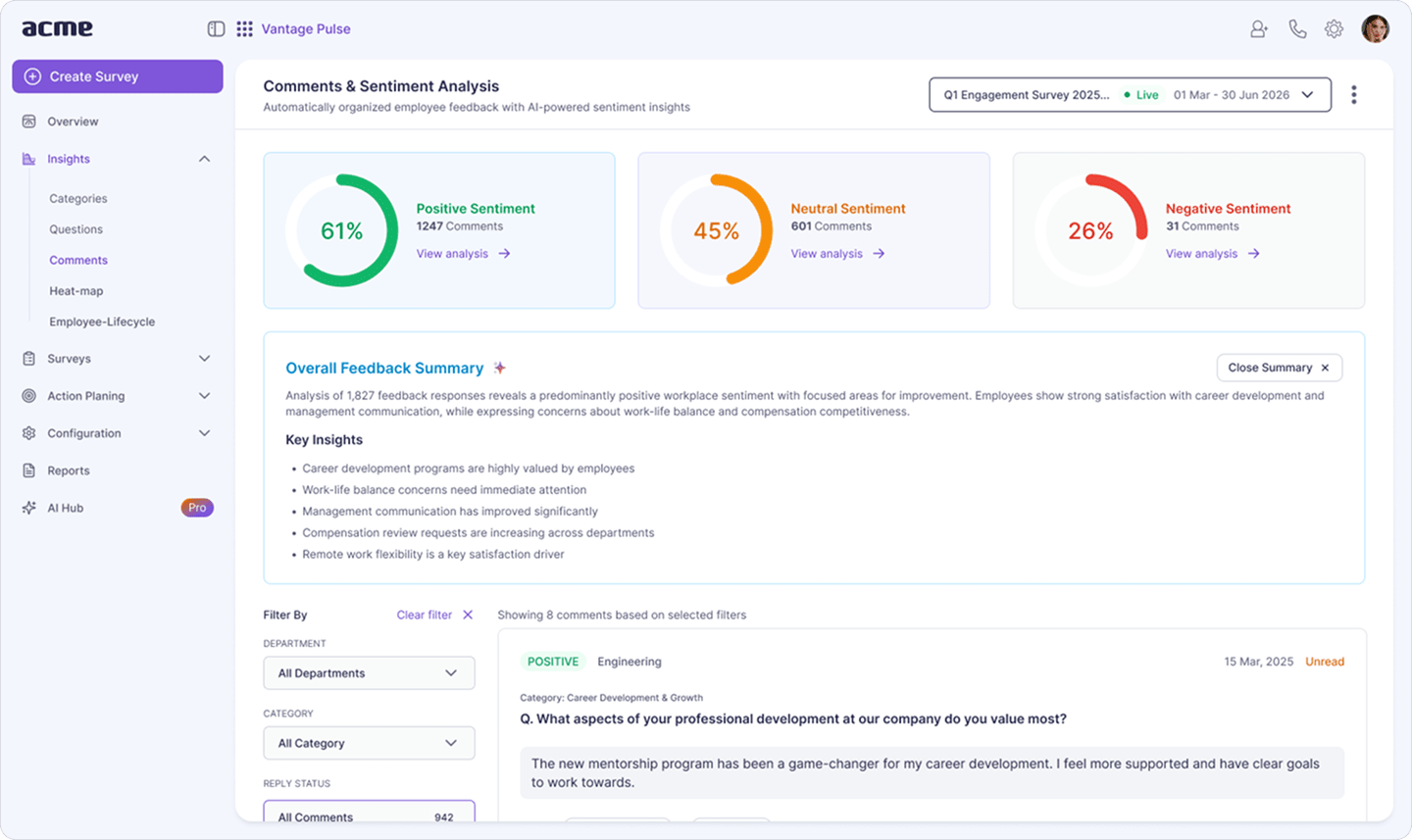
Employee Net Promoter Score (eNPS) measures how likely employees are to recommend their workplace. Organizations that run structured coaching programs see measurable eNPS improvements within 6 to 12 months. Coaching surfaces what pulse surveys can't: the performance anxieties, career questions, and capability gaps that erode confidence before they show up as turnover.
Running eNPS surveys before and after a coaching rollout reveals whether managers are genuinely shifting how their teams experience growth. Sentiment analysis on open-ended responses shows, in employees' own words, whether those conversations are actually happening.
5. 5.7x Return on Investment
A Manchester Inc. study of Fortune 500 executives found a 5.7x return on coaching investment, accounting for productivity gains, reduced attrition, and stronger manager performance. If you're treating coaching as a line-item L&D cost rather than a performance investment, you're measuring it wrong.
6. Reduced Regrettable Turnover
The employees most likely to leave are often the ones who aren't growing. High-potential employees without a coaching relationship are more likely to seek employee development opportunities elsewhere. Employee satisfaction improves measurably when people feel their growth is actively supported.
Knowing that coaching matters is one thing. Doing it consistently and effectively is another. This is where frameworks become useful. They bring structure to conversations that would otherwise depend entirely on individual manager style.
Six Employee Coaching Frameworks Every HR Leader Should Know
A coaching framework turns a good intention into a repeatable practice. Without one, coaching conversations drift, managers talk more than they should, and the same issues resurface session after session.
For most organizations, GROW is the right default: simple enough for new coaches, flexible enough to work across performance, development, and career conversations. CLEAR and OSKAR are better suited for senior leadership development and post-setback recovery respectively.
| Framework | Author/Origin | What It Stands For | Best Use Case | Session Length |
|---|---|---|---|---|
| GROW | Sir John Whitmore | Goal, Reality, Options, Will/Way Forward | Goal-setting, performance coaching, general 1:1s | 30–60 min |
| CLEAR | Peter Hawkins | Contract, Listen, Explore, Action, Review | Leadership coaching, complex behavioral change | 45–90 min |
| OSKAR | McKergow & Jackson | Outcome, Scaling, Know-how, Affirm and Action, Review | Post-setback coaching, solution-focused development | 30–60 min |
| FUEL | Zenger Folkman | Frame, Understand, Explore, Lay out a plan | Manager-to-employee performance conversations | 30–45 min |
| 5 C's | Coaching literature | Clarity, Commitment, Communication, Curiosity, Courage | Conversational quality check across all frameworks | Embedded |
| 80/20 Rule | Active listening principle | Coach talks 20%, employee speaks 80% | Quality standard applied across all frameworks | Embedded |
Two of these deserve a closer look because they generate the most manager confusion.
The 5 C's are a quality standard for the conversation itself, not a sequenced process. Clarity: do both parties agree on what success looks like? Commitment: does the employee own the agreed action? Communication: is the conversation honest and two-way? Curiosity: is the coach asking questions that open new thinking? Courage: are both parties willing to address what the conversation actually surfaces?
The 80/20 rule is the most useful self-diagnostic a manager has. If you're talking for more than 20 percent of the session, you've shifted from coaching to advising.
Not all coaching conversations look the same. The context, whether someone is struggling, stepping into a new role, or preparing for growth, shapes how coaching should show up. Looking at real scenarios makes this easier to apply.
Six Employee Coaching Scenarios and the Right Approach for Each
Different coaching situations require different frameworks and different cadences. The biggest mistake organizations make is treating all coaching as the same conversation.
| Scenario | Recommended Framework | Cadence | Success Signal |
|---|---|---|---|
| Coaching an underperformer | GROW or FUEL | Weekly for 60–90 days | Measurable behavior change on identified gaps |
| Coaching a high-potential | GROW or CLEAR | Biweekly | Expanded scope, increased confidence, promotion readiness |
| Coaching after a promotion | FUEL | Weekly for first 90 days | Role clarity established, key relationships built |
| Coaching for career growth | OSKAR or CLEAR | Monthly | Career plan documented, skills roadmap active |
| Coaching a remote or hybrid employee | GROW | Weekly video 1:1s | Coachee reports feeling supported, not isolated |
| Coaching after returning from leave | OSKAR | Weekly for first 60 days | Smooth reintegration, workload adjustment agreed |
Three scenarios worth unpacking:
Coaching an underperformer. This is the scenario most managers avoid longest and most frameworks are built to handle. The instinct is to fix the problem directly. The coaching instinct is to diagnose it collaboratively. Don't delay: the longer it waits, the harder the relationship becomes.
Coaching a high-potential. High-potential coaching is about expanding, not fixing. Your job isn't to solve their challenges. It's to ask the questions that help them see their own path through.
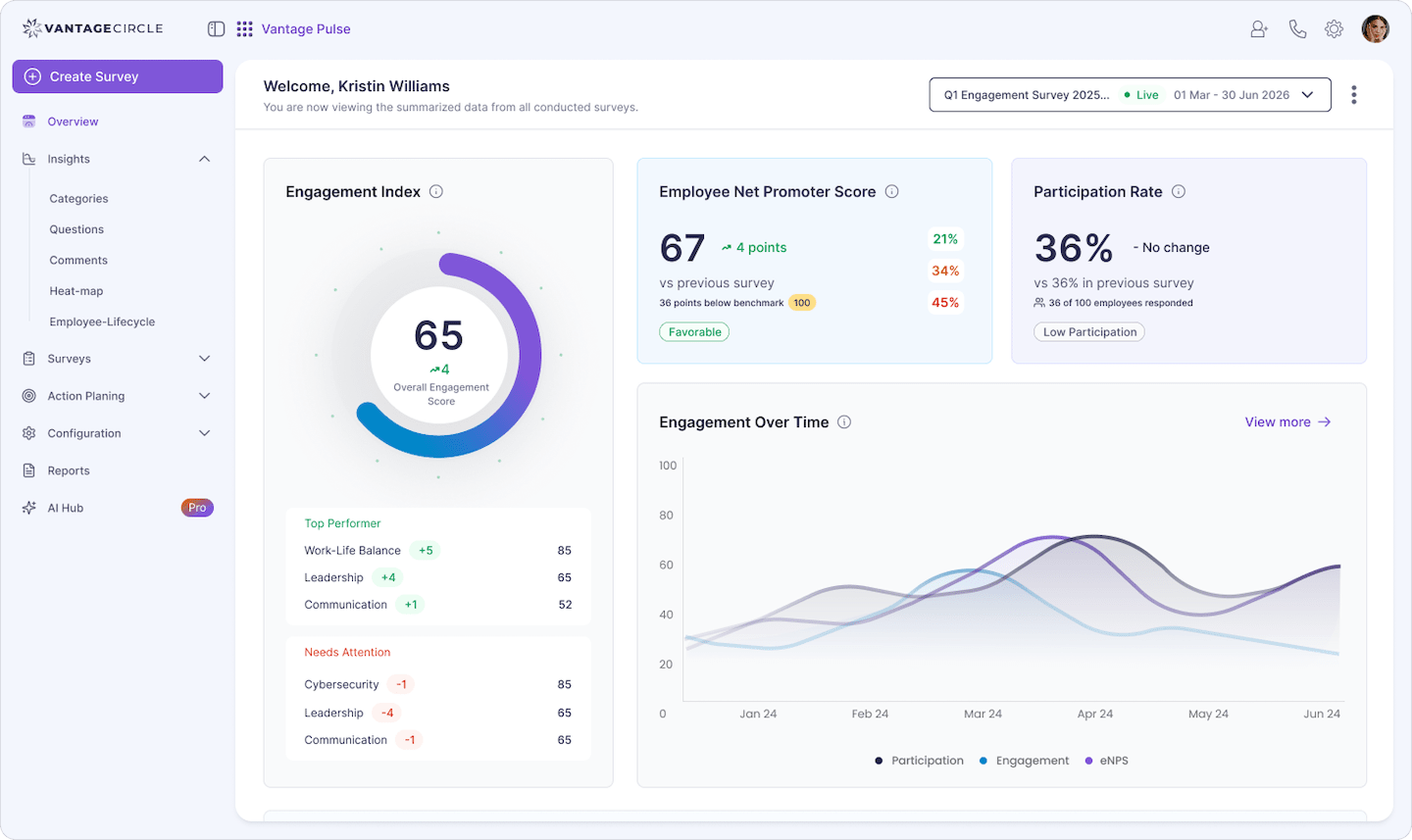
Coaching a remote or hybrid employee. Remote employees often won't tell their manager when 1:1s feel rushed or transactional. That silence is the signal. Anonymous pulse responses give coachees a safe channel to flag coaching gaps before the relationship deteriorates.
Understanding coaching at an individual level is only part of the equation. For it to create real impact, it needs to be built into how the organization operates, consistently, not occasionally.
How to Build an Employee Coaching Program in 7 Actionable Steps
A coaching program is not a policy document. It's an operating rhythm that managers, HR, and L&D teams maintain together, every week.
1. Set clear coaching goals tied to business outcomes. Start with outcomes, not activities. What are you coaching toward? Reduced regrettable turnover? Accelerated promotions? Stronger employee productivity? The program's design follows from the outcome it serves. Goal-setting for employees needs to be built into the intake process.
2. Train managers in core coaching skills. Most managers have never been trained to coach. Coaching requires asking questions instead of giving answers, listening instead of directing. Invest in manager training programs before setting coaching expectations.
3. Choose a framework (default to GROW). Simple enough for new coaches, flexible enough for most scenarios. Introduce CLEAR, OSKAR, and FUEL once managers are comfortable with the basics.
4. Set the cadence: weekly 30-minute 1:1s. Coaching without cadence is not coaching. Monthly is too sparse to build trust. Weekly creates the feedback loop that makes it work.
5. Document with a coaching plan template. A written plan makes the development agreement visible and accountable. It also serves as evidence in performance management conversations when progress stalls.
6. Measure with eNPS and pulse surveys. Lagging indicators tell you whether coaching worked. Leading indicators tell you whether it's happening. Track session completion rate, goal completion rate, and eNPS delta between coached and non-coached populations.
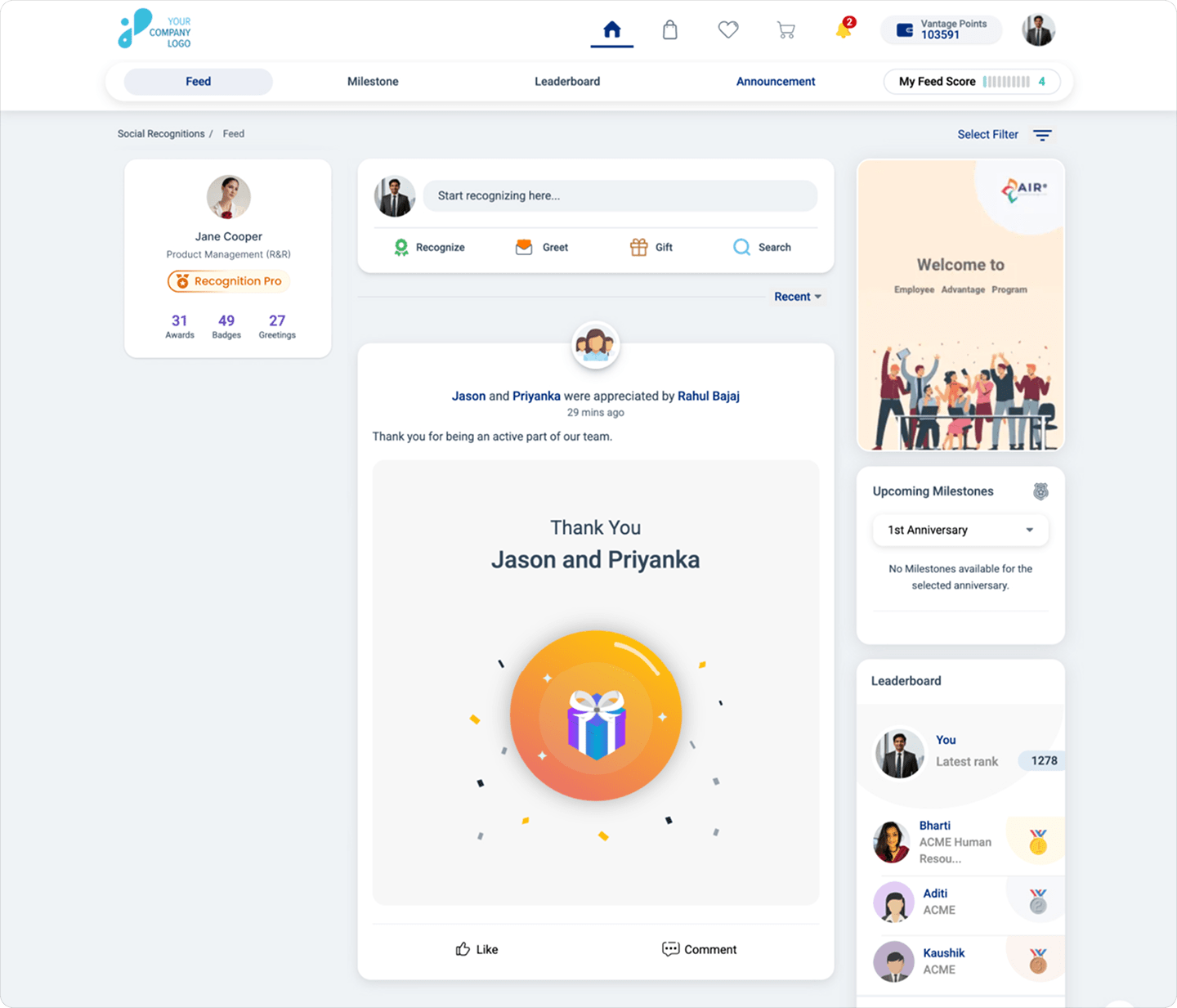
7. Recognize coaching milestones. Coaching wins are invisible by default. Recognizing a coachee's skill milestone and tagging it to a "growth mindset" core value makes the coaching loop visible to the whole team. Platforms like Vantage Rewards let managers link recognition to core values, turning private development into a public cultural signal.
Frameworks provide structure, but the effectiveness of coaching ultimately comes down to how managers show up in those conversations. That's where core coaching skills make the difference.
5 Coaching Skills Every Manager Needs
Coaching skill is different from management skill, and most managers need deliberate training to develop it.
01
Active Listening
Listening to understand, not to respond. When someone describes a problem, most managers immediately start solving it. Coaching requires staying in the question longer: what's actually going on? What hasn't been said yet? A 12-point eNPS gap between two similarly-sized teams almost always traces back to differences in manager listening quality.
02
Powerful Questions
"What have you tried?" generates more productive thinking than "Have you tried X?" The first invites ownership. The second invites compliance. Build a repertoire of open questions and you'll transform the quality of your 1:1s faster than any other single change.
03
Specific, Behavior-Based Feedback
Feedback in coaching is observation, not verdict. "You interrupted the client twice in that meeting" is more actionable than "you need to work on your communication." See: constructive feedback examples. When peers recognize behaviors like "helped me think through a difficult decision," it surfaces informal coaching capacity across the organization.
04
Goal Alignment
Every coaching conversation should connect the employee's development goal to a team or organizational outcome. That connection is what makes coaching feel relevant, and what makes managers sustain it when calendars get crowded.
05
Follow-Through and Accountability
Coaching without accountability is just conversation. The commitment made at the end of each session and the review of that commitment at the start of the next is where most programs quietly fail. See also: Constructive criticism as a complementary skill.
At this point, one question naturally follows: how do you know if coaching is actually working? Because without measurement, even the most well-intentioned efforts can remain invisible.
How to Measure Coaching Effectiveness
Measurement separates a genuine coaching program from a well-intentioned calendar practice.
If you can't answer "how many coaching sessions happened last quarter, and did they produce anything measurable?", you don't have a coaching program. You have a scheduling intention.
Leading indicators (coaching is happening):
- Session completion rate: target 80 percent or higher of scheduled sessions held
- Goal completion rate per coachee per quarter
- Coachee self-reported coaching quality score
Lagging indicators (coaching is working):
- eNPS lift in coached populations vs. control groups at 6 and 12 months
- Retention improvement among coached employees vs. organizational average
- Time-to-productivity for new hires and recently promoted employees
- Employee engagement scores before and after program launch
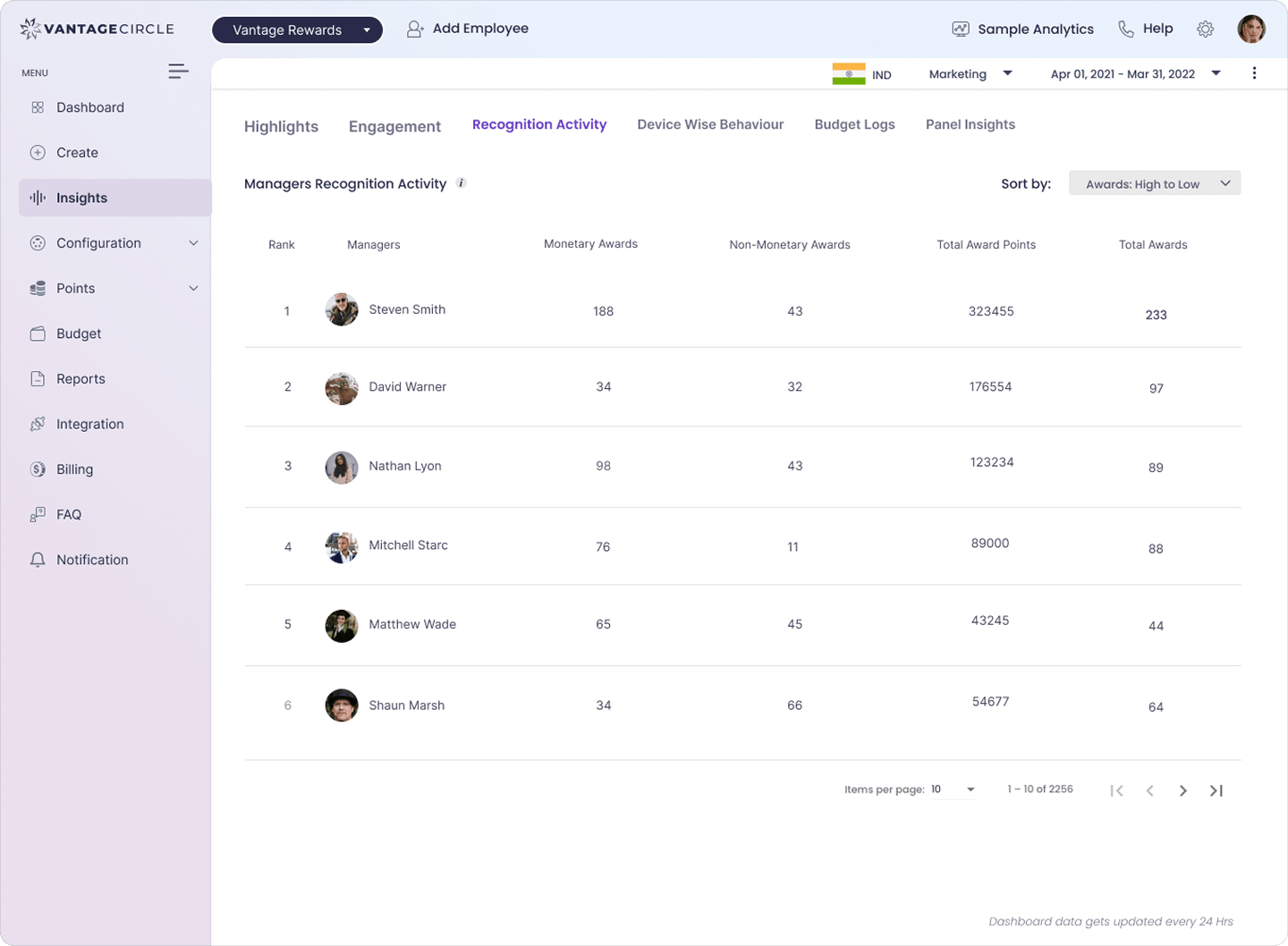
Recognition signals move fastest. Filtering recognition data by tags like "growth," "learning," or "coaching" reveals which managers run an active coaching practice and which only show up for scheduled 1:1s. That gap in the data is exactly where your coaching program is leaking.
Frequently Asked Questions
What Is Employee Coaching?
Employee coaching is a structured, ongoing development process where a manager or internal coach works one-on-one with an employee to build skills, address performance gaps, and support career growth. Unlike training, coaching is personalized to one person's context and goals. Unlike managing, it focuses on capability, not deliverables.
What Are the 5 C's of Coaching?
The 5 C's of coaching are Clarity, Commitment, Communication, Curiosity, and Courage. They describe the conversational qualities that make a coaching session effective, regardless of which framework the coach uses. Together, they ensure both parties leave the session with shared clarity, genuine ownership, and the honesty required for real development.
What Is the 80/20 Rule in Coaching?
The 80/20 rule in coaching means the coach speaks approximately 20 percent of the time, and the employee speaks 80 percent. If you're talking for more than 20 minutes in a 30-minute session, the conversation has shifted from coaching to advising.
What Are the 7 P's of Coaching?
The 7 P's of coaching are Purpose, Presence, Process, Practice, Partnership, Progress, and Performance. Purpose anchors the coaching relationship in a clear development goal. Presence describes the quality of attention the coach brings. Process is the chosen framework. Practice is the application of learning between sessions. Partnership is the coaching relationship itself. Progress tracks movement toward the goal. Performance connects coaching outcomes to organizational results.
What Is the Difference Between Coaching and Mentoring?
Coaching focuses on present performance and near-term skill development. Mentoring focuses on long-term career development and accumulated wisdom. Coaching is typically led by the employee's direct manager. Mentoring is typically provided by a senior leader outside the reporting line. Both are valuable. Neither replaces the other.
How Often Should Managers Coach Employees?
A weekly 30-minute 1:1 is the recommended minimum. Monthly is too infrequent to build trust or maintain accountability. Weekly creates the consistent feedback loop that allows both manager and employee to adjust in real time.
What Makes a Good Employee Coaching Plan?
A good employee coaching plan documents the employee's development goals, the agreed framework, the session cadence, progress milestones, and success measures. Written collaboratively, reviewed each session, updated when goals shift. It transforms an informal conversation into a documented commitment.
Vantage Influencers Podcast
"When we approach a shortcoming as a knowledge gap, we can enter a coaching role: here's your intention, here's the behavior — how can we bring the two closer together?"
— Amber Vanderburg, Business Coach & Former HR Director
Listen to the EpisodeMake Coaching Part of How Your Organization Runs
The organizations that benefit most from coaching are not necessarily the ones that invest the most in training.
They are the ones that make coaching part of their everyday rhythm: through consistent conversations, visible recognition of growth, and systems that reinforce the behavior over time.
Because coaching is not something that happens only when performance drops.
It is how strong organizations build capability, continuously and at scale.
See what building a coaching culture looks like in practice.
Written by