I've spent years studying what truly keeps employees engaged, and the answer often surprises companies. While competitive salaries matter, they're rarely the whole story. A thoughtful acknowledgment from leadership, the flexibility to balance work and personal life, or opportunities to grow professionally: these moments carry no price tag yet create a lasting impact. Intangible rewards tap into intrinsic motivation, fostering a sense of purpose that financial incentives alone can't replicate.
In this guide, we'll break down what intangible rewards are, show you 20+ real workplace examples, compare them with tangible and intrinsic rewards, and walk you through a step-by-step framework for building a high-impact intangible rewards program.
Intangible rewards are non-monetary, psychological, and experiential benefits. It can take the form of public recognition, career growth opportunities, autonomy, and flexible work arrangements.
What are Intangible Rewards? (Definition and Meaning)
Intangible rewards are non-monetary incentives that lack direct financial value but deliver significant emotional and psychological impact. They include rewards and recognition, career development, autonomy, purpose, belonging, and workplace flexibility.
The goal of intangible rewards is to motivate employees, strengthen retention, and reinforce cultural behaviors without direct financial cost. Unlike tangible rewards (bonuses, raises), intangible rewards build sustained intrinsic motivation and emotional connection to the organization.
We've all experienced moments when our contributions were recognized or when we were trusted with greater responsibility. These instances create meaningful connections between us and our work. They reinforce our sense of purpose, build loyalty, and drive discretionary effort, the kind of performance that can't be purchased with a paycheck.
Key Characteristics of Intangible Rewards:
- Non-Material in Nature: They hold no direct financial component but deliver significant emotional value.
- Recognition-Based: They center on appreciation, acknowledgment, and validation of contributions.
- Long-Term Influence: They build sustained intrinsic motivation rather than temporary satisfaction.
- Employee-Centric: They're designed to make team members feel valued, respected, and engaged.
- Culture-Shaping: They reinforce the specific behaviors and values an organization wants to see repeated.
Intangible rewards are sometimes called intangible benefits, intangible incentives, or non-monetary recognition. They are all referring to the same core concept: rewarding employees through experience, meaning, and acknowledgment rather than money.
Intangible Rewards vs. Tangible Rewards: Key Differences
Understanding the difference between tangible and intangible rewards is critical for HR leaders designing a total rewards strategy. Here's a direct comparison:
| Dimension | Tangible Rewards | Intangible Rewards |
|---|---|---|
| Definition | Monetary or physical items with measurable financial value | Non-monetary experiences, recognition, and psychological benefits |
| Examples | Bonuses, salary increases, gift cards, merchandise, stock options | Public recognition, mentorship, autonomy, flexible work, career growth |
| Cost to Organization | Direct budget allocation required | Low or zero direct cost (high design effort) |
| Motivation Type | Extrinsic - driven by external reward | Intrinsic - driven by internal fulfillment and purpose |
| Duration of Impact | Short-term boost; satisfaction fades quickly (hedonic adaptation) | Long-term; builds cumulative engagement and loyalty |
| Best Used For | Hitting measurable targets, milestone bonuses, competitive hiring | Reinforcing culture, sustaining engagement, retention, daily motivation |
| Scalability | Budget-constrained; scales linearly with headcount | Highly scalable; recognition culture multiplies without linear cost |
| Risk if Overused | Creates entitlement; employees expect escalating rewards | Can feel hollow if not authentic or paired with fair base compensation |
The takeaway: The most effective employee recognition programs combine both. Tangible rewards mark milestones and measurable achievement. Intangible rewards sustain the daily culture of appreciation that keeps people engaged between those milestones.
Intangible Rewards vs. Intrinsic Rewards: What HR Leaders Need to Know
These two terms are often confused but they're not the same:
- Intangible rewards are things the organization provide, such as employee recognition, flexibility, mentorship, autonomy, and career paths. They are designed and delivered by the company, even though they are non-monetary.
- Intrinsic rewards are the internal feelings an employee experiences, like personal satisfaction, pride in mastery, and enjoyment of the work itself. These come from within; the organization cannot directly "give" them.
So, what’s the relationship between intangible rewards and intrinsic rewards? Well-designed intangible rewards trigger intrinsic motivation. When a manager publicly recognizes an employee's work, the recognition is the intangible reward; the feeling of pride and belonging the employee experiences is the intrinsic reward.
HR leaders should design intangible rewards systems that reliably activate intrinsic motivation rather than replace it with external validation.
Types of Intangible Rewards in the Workplace
Based on our work with organizations across industries, intangible rewards fall into five core categories. Each addresses a different psychological need:
1. Recognition and Appreciation (Public and Private)
A thoughtful "thank you" or public acknowledgment can profoundly impact employee morale. Recognition validates employees' efforts and motivates continued excellence.
How Recognition Helps:
- Elevates morale and job satisfaction
- Nurtures a culture of appreciation and collaboration
- Strengthens emotional connection to the organization
According to a Gallup workplace survey, the most memorable recognition comes most often from an employee's manager (28%), followed by a high-level leader or CEO (24%).
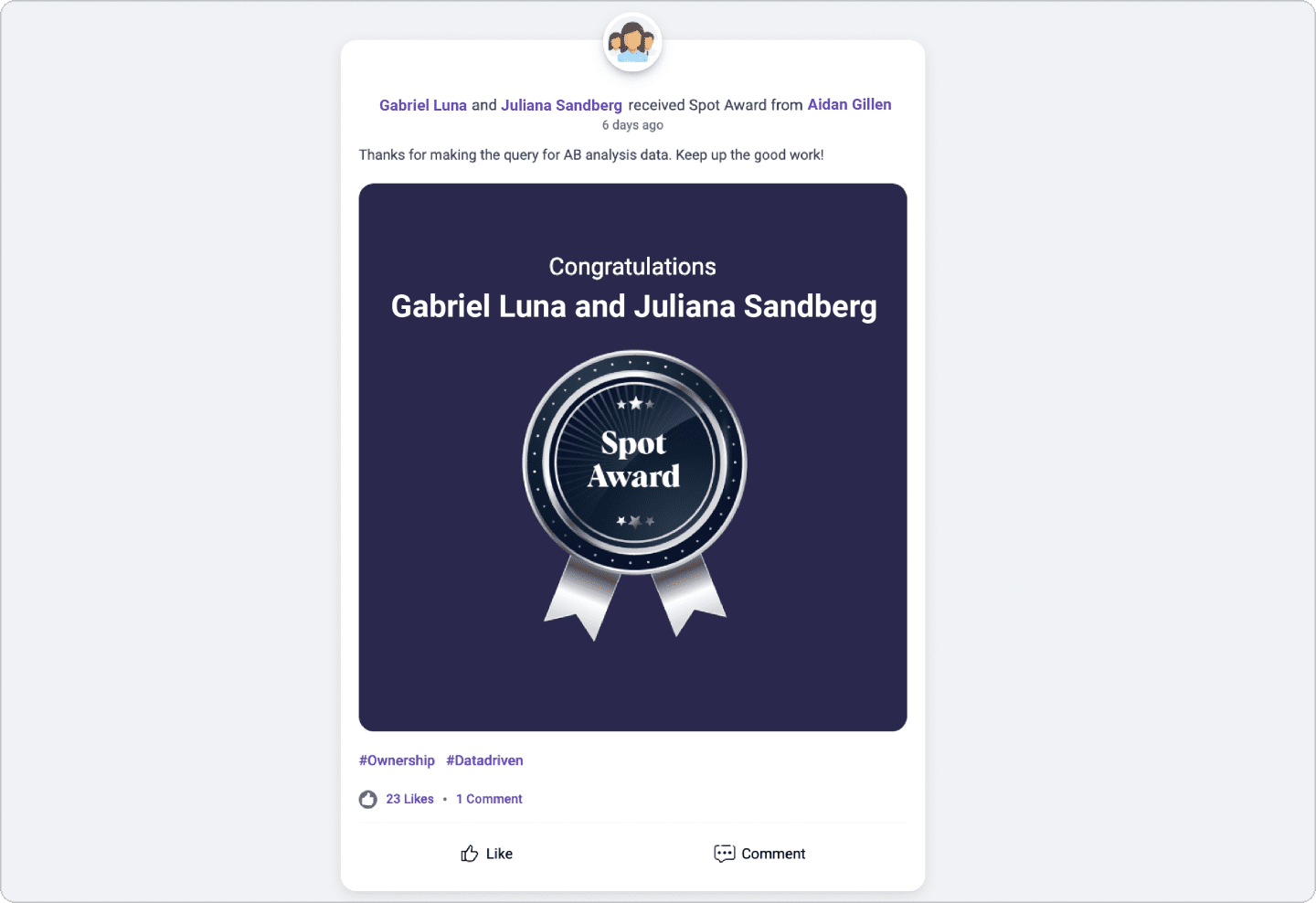
When recognition is delivered on a company-wide social feed — with likes, comments, and shares — it replicates the social psychology of acknowledgment at enterprise scale. Platforms like Vantage Recognition make this possible by pairing public recognition with core values tagging, so every "thank you" reinforces the specific behaviors the culture needs.
2. Career Development and Growth Opportunities
Today's professionals seek career advancement and skill-building. Providing learning opportunities, mentorship, and leadership roles demonstrates organizational investment in employees' futures.
According to EdAssist, 84% of employees cited tuition assistance as an essential factor in joining their companies.
How Career Development Helps:
- Expands skills and professional capabilities
- Boosts employee retention and loyalty
- Empowers employees to embrace new challenges and stretch assignments
3. Autonomy and Work Flexibility
The ability to harmonize professional responsibilities with personal needs ranks among today's most valued workplace benefits. Remote work options, flexible scheduling, compressed workweeks, and additional time off demonstrate trust and prevent burnout.
How Autonomy and Flexibility Help:
- Enhance mental wellbeing and productivity
- Encourage long-term organizational commitment
- Reduce workplace stress and absenteeism
- Signal trust in employees' judgment and self-management
Companies that implement flexible work schedules or offer "work from anywhere" options show they value employees as whole people — not just workers.
4. Sense of Purpose and Organizational Pride
Employees who understand how their work connects to a larger mission are more engaged and resilient. Purpose is one of the most powerful — and most overlooked — intangible incentives available to HR teams.
How Purpose Helps:
- Provides meaning beyond daily task execution
- Increases resilience during organizational change
- Attracts mission-aligned talent who stay longer
Organizations that consistently communicate "why the work matters" — not just "what needs to get done" — see measurably higher engagement scores.
5. Belonging, Inclusion, and Psychological Safety
Employees thrive when they feel respected, valued, and safe to speak up. A supportive, inclusive workplace environment is one of the most valuable intangible benefits an organization can offer.
How Belonging Helps:
- Builds team cohesion and trust
- Minimizes workplace conflict and stress
- Enables innovation by reducing fear of failure
- Enhances overall job satisfaction and engagement
30+ Intangible Rewards Examples for Employees
Here are practical, implementable, intangible rewards organized by category. Use this as a checklist to audit what your organization currently offers and where you have gaps:
Recognition and Appreciation
- Public shout-outs in team meetings or all-hands calls
- Peer-to-peer recognition through a company-wide social feed
- Handwritten thank-you notes from managers or executives
- Core values badges displayed permanently on employee profiles
- "Employee of the Month" spotlight shared company-wide with a personal story
Career Development and Growth
- Mentorship pairing with a senior leader outside the employee's direct team
- Conference or workshop sponsorship for professional development
- Stretch assignments on high-visibility cross-functional projects
- Internal promotion pathways with transparent criteria
- Lunch-and-learn sessions where employees teach their expertise
Autonomy and Flexibility
- Flexible work hours (no fixed 9-to-5)
- Remote or hybrid work options
- Compressed workweeks (e.g., 4x10 schedule)
- "No-meeting" days to protect deep work time
- Autonomy over project approach - define the what, let the employee choose the how
Purpose and Organizational Pride
- Impact reports showing how individual work contributes to company goals
- Volunteer time off (VTO) for causes employees care about
- Mission briefings connecting daily work to customer outcomes
- Founder or CEO office hours for open Q&A
Belonging and Inclusion
- ERG (Employee Resource Group) support with executive sponsorship
- New hire buddy programs for onboarding belonging
- Team rituals (weekly wins, virtual coffee chats, milestone celebrations)
- Psychological safety workshops for managers
- Anonymous feedback channels with visible follow-through
Intangible Rewards Examples for Remote and Hybrid Teams
- Virtual recognition walls where distributed teams celebrate wins asynchronously
- Flexible time zone policies respecting local work hours
- Home office stipend decisions left to the employee (autonomy over setup)
- Virtual mentorship circles across geographies
Intangible Rewards Examples for Frontline and Field Workers
- On-site recognition boards in break rooms or common areas
- Manager walk-around appreciation that is in-person, specific, and immediate
- Scratch cards and QR codes for instant recognition moments (e.g., Vantage Circle's Phygital Recognition)
- Shift scheduling flexibility and preference-based rostering
Why Intangible Rewards Matter More Than You Think: The Data
What do employees expect from their workplace? They don't simply work for compensation. They seek meaning, recognition, and growth. These intangible rewards are crucial in sustaining engagement and organizational commitment.
Intangible Rewards and Employee Retention
By implementing thoughtful intangible rewards, companies create environments where employees feel valued and motivated to stay. LinkedIn's Global Talent Trends report shows that 77% of companies focus on enhancing employee experience to increase employee retention. Intangible compensation, such as career pathing, recognition, and flexibility, is the core of that experience.
How Intangible Rewards Improve Retention:
- Foster long-term organizational commitment over transactional loyalty
- Build stronger emotional connections to the company and its mission
- Reduce turnover by addressing the root causes of disengagement and not just the symptoms
Intangible Rewards and Engagement: What the Research Shows
When employees feel valued and appreciated, they consistently demonstrate higher engagement. Recognition, development opportunities, and workplace flexibility contribute significantly to job satisfaction.
Companies with high-recognition cultures report 94% positive workplace sentiment vs. 78% in emerging recognition cultures, a 16-point gap driven almost entirely by intangible recognition practices. Source: Vantage Circle x Great Place to Work Study
This isn't a marginal difference. Organizations in the top quartile of recognition culture see measurably higher retention, productivity, and internal mobility, all driven by intangible rewards that cost a fraction of salary increases.
However, employee satisfaction through intangible rewards can only be achieved when recognition is given in adequate measure. Insufficient recognition and limited growth opportunities rank among the top reasons employees leave organizations.
Tangible vs. Intangible Rewards: When to Use Each
The question shouldn’t be whether to use "tangible or intangible." It should ask "when does each type create the most impact?" Here's a practical decision framework:
| Scenario | Best Reward Type | Why |
|---|---|---|
| Hitting a quarterly sales target | Tangible (bonus, commission) | Measurable outcome deserves measurable reward |
| Consistently mentoring junior team members | Intangible (public recognition, leadership title) | Behavioral pattern, not a one-time event |
| Completing a critical project under deadline | Both (spot award + public recognition) | Celebrate the outcome and the effort |
| Demonstrating company values daily | Intangible (values badge, peer recognition) | Reinforces culture; monetary reward would feel transactional |
| 5-year work anniversary | Both (gift + personalized milestone celebration) | Milestone deserves both emotional and material recognition |
| Navigating a difficult client situation | Intangible (manager acknowledgment, stretch assignment) | Builds confidence and signals trust for future challenges |
The AIRe Framework: Balancing Appreciation, Incentivization, Reinforcement, and eMotional Connect
Vantage Circle's proprietary AIRe Framework gives HR teams a structured lens for designing recognition programs that balance all four drivers of effectiveness:
- Appreciation: Acknowledging effort and contribution (intangible: recognition, praise, visibility)
- Incentivization: Rewarding measurable outcomes (tangible: bonuses, awards, rewards points)
- Reinforcement: Repeating and scaling desired behaviors (intangible: values tagging, badges, leaderboards)
- eMotional Connect: Building personal, human connections (intangible: milestone celebrations, life event greetings, personalized messages)
Most organizations over-index on Incentivization (tangible rewards) and under-invest in the other three quadrants. The AIRe Framework helps HR leaders audit where their current program is strong, where it's weak, and how to rebalance toward a sustainable mix.
Want to see how Vantage Recognition powers intangible recognition?
How to Build an Intangible Rewards Program: Step-by-Step
As we have worked with organizations across industries, we've identified the steps that separate successful intangible rewards programs from failed experiments:
Step 1: Audit Your Current Recognition Gaps
Before adding new programs, understand what's working and what's missing. Map your current rewards against the five intangible reward categories (Recognition, Growth, Autonomy, Purpose, Belonging) and identify where employees feel underserved.
Audit checklist:
- Do all employees (not just top performers) receive recognition at least monthly?
- Are managers trained and equipped to deliver meaningful, specific recognition?
- Do remote, hybrid, and frontline employees have equal access to recognition?
- Is recognition tied to your company's core values, or is it generic?
- Do you have data on recognition frequency by team, department, and manager?
Tools like Vantage Recognition's Managerial Insights Dashboard surface under-recognized employees automatically to alert managers. The AI-powered Recognition Identifier flags contributors who deserve but haven't received recognition.

Step 2: Define Intangible Reward Categories for Your Culture
Not every organization needs the same intangible rewards. A remote-first tech company will prioritize autonomy and async recognition. A hospital system will prioritize purpose and on-site appreciation. Define 3-5 priority categories based on your workforce demographics, industry, and culture goals.
How to choose:
- Survey employees on what makes them feel most valued (recognition, growth, flexibility, or purpose)
- Analyze exit interview data for patterns in "what was missing"
- Benchmark against industry norms, but design for your specific culture
Step 3: Train Managers to Deliver Intangible Recognition
Managers are the delivery mechanism for intangible rewards. Invest in training managers to give recognition that is:
- Specific: "Your analysis in the Q3 report changed how we approached the client" (not "great job")
- Timely: within 24–48 hours of the contribution
- Visible: shared publicly where peers can see and amplify it
- Values-aligned: tagged to the specific company value the behavior demonstrated
Step 4: Measure Intangible Reward Effectiveness (Key Metrics)
What gets measured gets managed. Track these metrics to assess whether your intangible rewards program is actually working:
| Metric | What It Measures | Target |
|---|---|---|
| Recognition frequency per employee/month | Is recognition reaching everyone? | 1+ per employee per month |
| Manager participation rate | Are managers actively recognizing? | 80%+ of managers recognizing monthly |
| eNPS (Employee Net Promoter Score) | Overall employee sentiment | Trending upward quarter-over-quarter |
| Voluntary turnover rate | Are people staying? | Below industry benchmark |
| Recognition distribution by department | Is recognition equitable across teams? | No department below 50% of company average |
Common Mistakes HR Teams Make with Intangible Rewards
Recognition That Feels Generic or Performative
"Great job, team!" said to everyone, every time, means nothing. Generic recognition is worse than no recognition. It signals that leaders aren't paying attention. Every intangible reward should be specific to the individual, the contribution, and the impact.
Inconsistency Across Managers and Teams
It is the most common failure. Some managers recognize frequently, others never do. Employees who barely receive recognition disengage even when the overall company program is strong.
Ignoring Frontline and Remote Employees
If your intangible rewards program only works for desk-based employees with email access, you're leaving out the workforce segments that need recognition most. Phygital solutions (scratch cards, QR codes, on-site boards) and async digital platforms ensure every employee is included.
Intangible Rewards and Compensation Strategy: The Total Rewards View
Intangible rewards don't replace fair compensation; they complement it. The most effective total rewards strategies treat intangible compensation as a formal pillar alongside base pay, variable pay, and benefits.
For global organizations, the line between tangible and intangible shifts by geography. What feels like a generous reward in one country may fall flat in another. SOLI-adjusted recognition (Standard of Living Index) ensures that the perceived value of any reward, whether monetary or otherwise, remains equitable across 100+ countries.
The strategic value of intangible rewards is highest for organizations where:
- Compensation budgets are constrained but engagement goals are ambitious
- Culture and employer brand are key competitive advantages
- Retention of experienced talent matters more than hiring volume
- The workforce spans multiple geographies, time zones, or work modalities
Building a Culture Where Intangible Rewards Drive Real Results
As we have learned, intangible rewards aren't optional. They're essential components of a thriving, engaged workforce. Employees seek more than compensation; they desire recognition, growth opportunities, and supportive environments.
Organizations prioritizing these non-monetary rewards create cultures where team members feel valued, empowered, and motivated to excel.
While competitive compensation remains important, intangible rewards forge the emotional connections that keep employees genuinely invested. The most successful workplaces inspire, recognize, and support employees throughout their professional journeys.
In the end, we would like to ask your leadership team: Do you have a formal intangible rewards strategy? Or are you leaving non-monetary recognition to chance?
Frequently Asked Questions about Intangible Rewards
What is an example of an intangible reward?
A common example of an intangible reward is public recognition from a manager during a team meeting. When a leader specifically acknowledges an employee's contribution, explaining what they did and why it mattered, it validates effort, builds confidence, and motivates the entire team.
What are tangible and intangible rewards?
Tangible rewards are monetary or physical incentives with measurable financial value, such as bonuses, salary increases, gift cards, stock options, and merchandise. Intangible rewards are non-monetary benefits that deliver psychological and emotional value, such as recognition, career growth, autonomy, flexibility, and a sense of belonging.
What are wellbeing intangible rewards?
Wellbeing intangible rewards are non-monetary benefits that support employees' physical, mental, and emotional health. Examples include flexible work hours that reduce burnout, mental health days, access to wellness programs, psychological safety in team environments, and manager check-ins focused on wellbeing rather than task status.
How do intangible rewards affect career choices and income?
Intangible rewards often influence career decisions more than salary. Employees frequently choose (or stay at) organizations offering strong mentorship, career growth paths, autonomy, and recognition culture, even when competing offers pay more. Over time, intangible rewards like skill development, stretch assignments, and leadership visibility accelerate career progression, which indirectly increases lifetime earning potential.

This article is written by Nilotpal M Saharia. Nilotpal M Saharia is a Senior Content Marketing Specialist & R&R Strategist at Vantage Circle, with 7 years of expertise in marketing, HR, and content strategy.
Connect with Nilotpal on LinkedIn.