Navigating Today's Hiring Challenges in the Corporate World
Episode Overview
Eric Ly opened the conversation by pointing to a shift already reshaping the workplace: the tug-of-war between leaders pushing employees back into the office and a workforce that has grown used to remote flexibility. He argued that many executives have valid reasons for wanting people back, including mentorship and easier collaboration, but undoing entrenched remote habits is proving difficult. He also flagged how incoming Gen Z workers add another layer of complexity, since they prioritize flexibility, protected personal time, and constant learning opportunities in ways earlier generations didn't emphasize as strongly.
He also addressed how hiring itself is changing as more companies bring on employees they may never meet in person, a trend that raises the stakes for verifying who candidates really are and whether their qualifications hold up. Looking ahead, he expects artificial intelligence to reshape recruiting on two fronts: sharper two-way matching between employers and candidates, and more personalized onboarding delivered at scale. In his view, this shift won't eliminate the role of recruiters, but it should free them to focus on the parts of hiring that machines still handle poorly.
Episode Highlights
- Eric traced how the return-to-office push collides with a workforce that has adapted to remote schedules, noting that some executive motivations, like mentorship and in-person collaboration, are legitimate even as the transition creates friction.
- He described Gen Z's entry into the workforce as a turning point, pointing to their emphasis on flexibility, protected personal time, and continuous learning as priorities that differ sharply from previous generations.
- On remote hiring, he explained that employers increasingly bring people onto their teams without ever meeting them in person, which raises the importance of verifying identity, background, and qualifications before day one.
- He connected this shift to his own advice for organizations: invest in tools that can personalize the candidate experience at scale rather than relying on generic, one-size-fits-all recruiting processes.
- Looking at where hiring technology is headed, he pointed to AI-driven matching as one of the most promising developments, enabling a more precise two-way fit between what employers need and what candidates want.
- He also expects AI to reshape onboarding by making it more personalized without adding headcount, freeing recruiters to focus on judgment calls and relationship-building that automation still can't replicate.
About the Guest
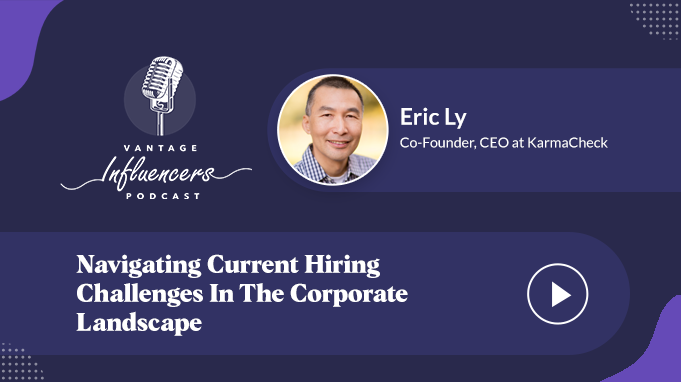
Eric Ly, Co-Founder and CEO at KarmaCheck
Eric Ly is an entrepreneur focused on combining innovative products, technology, and business models to build successful companies. He was a co-founder of LinkedIn, where he helped build a platform that changed how professionals connect online, and before that worked as a software engineer and founder across blockchain, event, and management technology ventures. At KarmaCheck, he leads a team building the next generation of background screening and identity verification, using proprietary technology and data partnerships to give employers a faster, more candidate-friendly way to verify who they're hiring.
Host
Susmita Sarma, Vantage Influencers Podcast Host
What You Will Learn
- Why the push to return to the office is colliding with a workforce accustomed to remote flexibility
- How Gen Z's priorities around flexibility, personal time, and learning are reshaping workplace expectations
- Why background and identity verification is becoming more critical as remote hiring increases
- How companies can personalize the candidate experience at scale using the right recruiting technology
- Where AI is likely to have the biggest impact on candidate matching and onboarding
- Why recruiters are unlikely to be replaced by AI, but their role will shift toward judgment-driven tasks
Key Topics & Timestamps
| Timestamp | Topic |
|---|---|
| 00:00 | Cold open: the state of recruitment and the challenges businesses face in finding and retaining talent |
| 01:13 | What's keeping Eric busy and excited in today's evolving work environment |
| 01:45 | Lessons from working at major technology companies and how they shaped his approach to entrepreneurship |
| 03:37 | The biggest challenges aspiring entrepreneurs face in the early stages of building a company |
| 04:26 | The most pressing recruitment and talent acquisition challenges businesses face today, including the return-to-office debate |
| 05:56 | An overview of KarmaCheck and how it addresses hiring and verification challenges in a remote-first world |
| 08:16 | Actionable advice for organizations looking to refine their hiring and recruitment strategies |
| 09:34 | Reflecting on co-founding LinkedIn and its role in transforming HR and recruiting technology |
| 10:54 | Where AI is headed next in hiring: candidate matching and personalized onboarding at scale |
Full Transcript
Click to read the full episode transcript
Welcome to the Vantage HR Influencers Podcast. This podcast is sponsored by Vantage Circle, the simple and AI-powered rewards and recognition platform for employee engagement. The landscape of recruitment is constantly changing and businesses face a multitude of challenges when it comes to finding and retaining top talents. In the next few minutes, we'll delve into these challenges and explore innovative strategies and solutions to strive in the race for exceptional talents.
Susmita Sarma: Hello listeners, you are tuned into the Vantage HR Influencers Podcast. I'm your host, Susmita. In today's episode, we have an exciting discussion ahead as we delve into the ever-evolving landscape of talent acquisition. Our conversation will encompass a wide spectrum ranging from the future of hiring to the evolving phase of entrepreneurship in the hands of the future workforce. But first, let's get to know our guest a bit better. Joining us is Eric Ly, the co-founder and CEO at KarmaCheck. Welcome to our show, Eric.
Eric Ly: Hey, nice to be here. Thanks for having me.
Susmita Sarma: Brilliant, Eric. So, before we dive into the fascinating questions that we have lined up for today, I'd love to start by asking you what's keeping you busy and excited these days.
Eric Ly: Oh, there's a lot of change happening in the work environment. So it's been pretty interesting keeping up with the changes and the innovations and trying to figure out what is the future of work. In this kind of post-pandemic world, lots of things have changed.
Susmita Sarma: And growing from your extensive experience at some prominent technology giants, such as co-founding LinkedIn, and now leading KarmaCheck, could you elaborate on the key insights that you have gained and how these experiences have influenced your approach to launching your own ventures?
Eric Ly: Yeah, great question. I think one of the things that technology companies have been known for is really innovating on the culture of work and the way that work is going. Technology workers have been hard to attract historically, and so employers must really try their best to offer various ways to motivate workers and keep them at their workplaces. So I think tech companies could be a model of innovative work practices and culture, and that continues, I would say, after the pandemic as well, as we find our new world. For me, as someone on the employer's side, we try to really look at new practices, new ways of working, and all the things that are impacting work culture today.
Susmita Sarma: Yeah, so those things are the driving force, we can say, behind your decision to become an entrepreneur. We'd like to know if you can highlight some of the most formidable challenges you have encountered during the early stages of your entrepreneurial journey.
Eric Ly: Yeah, for sure. I think one thing that comes to mind is that there's definitely been different generations of workers that go through the workforce. Perhaps most recently, you see Gen Z workers really coming into the workforce, and I've experienced this personally. They have a very different set of priorities than previous generations, and a different way of working. They value flexibility, they value their personal time, and they also value learning because they're starting out in their careers, so learning is important for them.
Susmita Sarma: Yeah, so talking about challenges, most aspiring entrepreneurs grapple with the initial hurdles, and your insights would be invaluable in shedding light on this transformative phase. So from your perspective, Eric, what were the most pressing challenges that businesses face today in the realm of recruitment and talent acquisition?
Eric Ly: Well, yeah, you know, I think there's been a lot of talk recently about CEOs trying to get workers back into the office. As you know, the pandemic was just a couple of years ago, and that really caused a lot of folks to have to work from home, especially if they didn't need to show up at the office to work on things. Now that a lot of time has passed, I think CEOs have felt that it's time to get people back in the office for some valid reasons, to help people be more productive, help them learn, and provide mentorship. It really is a challenge for a lot of employers who have to deal with employees who have gotten used to the advantages of working from home and remote work. So I think that's a pretty big topic these days.
Susmita Sarma: And if you'd like to talk about solutions, speaking of innovative solutions, I'd like to spotlight KarmaCheck and its role in settling these hiring and recruitment obstacles. Could you provide our listeners with an overview of what KarmaCheck is all about and how it addresses some of these challenges?
Eric Ly: Yeah, happy to cover that. I think one of the things to realize is that the world is always moving forward, so it's hard to go back to the way things were, with people working five days a week in the office, nine to five. I think we're heading towards either a purely remote work culture, which is kind of shocking to say, or maybe a more moderate hybrid approach, where people spend time working remotely and also spend certain days of the week, especially when there's a reason to go in and have meetings and collaborate, showing up in the office with other workers. At KarmaCheck, the way that we help is that we're seeing, definitely, the trend towards hiring people remotely, which is to say that a lot of times employers may not even meet the people in person that they bring onto their team, which is also, I think, a pretty significant change. So at KarmaCheck, what we do is provide background checks and other kinds of verifications, and that's becoming more important in this virtual world, especially when employers don't have a chance to meet their employees before they get hired. A company like KarmaCheck can provide those verifications, such as assuring someone's identity, assuring their background, and confirming they have the qualifications to do the job, without the employer being able to meet the worker at the time of hire, which is happening more and more these days.
Susmita Sarma: Yeah, it's evident that with your wealth of knowledge, you can definitely provide some valuable guidance to organizations looking to refine their talent acquisition strategies. So what actionable advice would you offer to organizations seeking to enhance their hiring and recruitment processes, drawing from your experience and expertise?
Eric Ly: Well, with the new generation, I do believe there's definitely an interest around personalizing the experience for workers. There are all sorts of technologies these days coming onto the market that are really helping to create that personalized experience, but also doing it at scale, which I think is really valuable as well. So I would encourage employers and organizations to look at tools where they can really cater to and bring on the talent they need, because it is a competitive market out there. Whoever has those tools and processes to help bring on that great experience for candidates is really going to win more than organizations that rely on traditional methods that don't scale as much, even if they are personalized.
Susmita Sarma: Yeah, we'll be talking about the trends that are coming up in this whole field of hiring and recruitment, but before that, Eric, you are a co-founder of LinkedIn. LinkedIn was, I think, founded in the year 2002, right?
Eric Ly: Yeah, it's hard to believe it's been more than 20 years now.
Susmita Sarma: That's right. So you are one of the founding members, right?
Eric Ly: Yes, that's correct.
Susmita Sarma: That must be a great experience for you, isn't it? Would you like to tell us something about it?
Eric Ly: Yeah, I mean, I think LinkedIn was one of the first wave of companies that really tried to bring some innovative ideas and technology to the growth of recruiting, and kind of the momentum around doing it at scale. We tried to deliver what was possible in terms of the use of technology, and I think that really helped transform the HR and recruiting landscape. I do believe that going into the future, there's going to be even more opportunities, such as AI, to help improve the recruiting, hiring, and onboarding experience for organizations.
Susmita Sarma: Yeah, and if we talk about the future of hiring and recruiting, I think AI will make it to the top of the list.
Eric Ly: It will. I think there are some really interesting areas where this AI technology can help. For example, matching candidates with jobs and getting much better at that, to really provide a two-way quality match between the employer and the candidate. I think that's really going to be one of the exciting areas to watch for in the future. I think another area is really just the whole onboarding experience, and how that can be personalized through automation and AI, again to provide a personalized experience, but also to do it at scale, and to help ease the burden that recruiters have onboarding candidates. There's still room for recruiters to focus in on those areas where machines don't do well, but it can certainly alleviate a lot of the burdens that come with the more common scenarios that exist.
Susmita Sarma: Yeah, your perspectives are truly valuable, Eric. Thanks for the enlightening response. Before we wrap up this session, it would be great if you could share the best ways for our audience to stay connected with you and stay updated on your latest endeavors.
Eric Ly: Well, LinkedIn is actually a great way, because we definitely try to provide updates on the feed on LinkedIn. So I hope people will find me there and choose to connect with me on LinkedIn.
Susmita Sarma: Thank you so much, Eric, for sharing your invaluable insights and experiences with us today.
Eric Ly: Thank you so much. That's great. It has been truly an enlightening conversation.
Susmita Sarma: And to our listeners, if you found this discussion as captivating as I did, and if you want to connect with Eric or keep up with his work, please check the podcast description for links and contact details. Stay tuned for more such engaging conversations in our future episodes. And until next time, take care. Thank you.
FAQ
What does Eric Ly see as the biggest hiring challenge companies face right now?
He points to the tension between executives pushing for a return to the office and employees who have grown accustomed to remote flexibility, noting that while leaders often have valid reasons like mentorship and collaboration, reversing established remote habits is proving difficult.
How is Gen Z changing what companies need to offer in the workplace?
Gen Z workers prioritize flexibility, protected personal time, and continuous learning opportunities more heavily than previous generations, pushing employers to rethink policies built around traditional five-day, in-office schedules.
Why is background and identity verification becoming more important in hiring?
As more companies hire remotely and may never meet a candidate in person, verifying someone's identity, background, and qualifications becomes essential to making a confident hiring decision without face-to-face contact.
Where does Eric Ly expect AI to have the biggest impact on recruiting?
He expects AI to improve two-way matching between employers and candidates and to make onboarding more personalized at scale, while still leaving recruiters to handle the judgment-based parts of hiring that machines can't replicate.
Related Reading
Also listen on