Personalizing Learning at Scale with Assessments and Impact Metrics
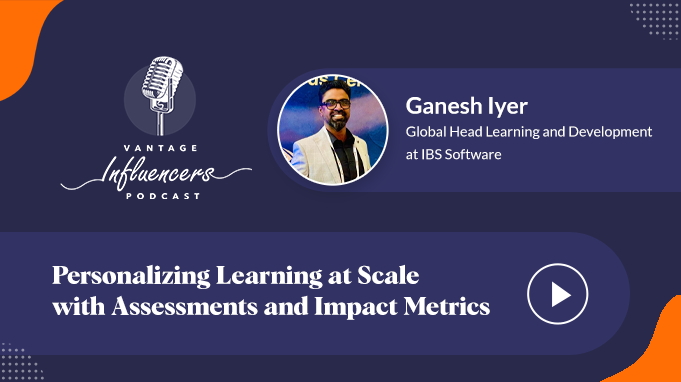
Episode Overview
Ganesh Iyer opens by challenging a common assumption: that personalization in learning is mostly a content problem. He argues it's really a combination problem, one that blends role, preferred learning style, and content into a single system, rather than just stocking a catalog and letting employees browse. He traces how self-directed learning accelerated after the pandemic, and describes building an ecosystem that blends role-based recommendations, style-based recommendations, hackathons and coding challenges for hands-on learners, and traditional classroom sessions for people who still learn best in a room together. The real shift, he says, is happening now: AI agents layered on top of that ecosystem are pushing personalization down to the level of individual micro-modules, closing the gap between what organizations think they're offering and what employees actually experience.
Iyer spends much of the conversation reframing assessments, arguing they shouldn't be treated as compliance checkboxes or gatekeeping hurdles but as developmental tools employees actually want to complete. He walks through a capability program built around a competency framework, paired learning recommendations, and assessments, where reframing the assessment as an accomplishment worth celebrating pushed completion rates to 80 to 90 percent. On measuring impact, he pushes back on the idea of a single universal metric, describing how his team ties different training types to different signals, from squad-level productivity data to manager scorecards and attrition trends, depending on what kind of behavior change is realistic to expect. He closes by predicting that AI will keep compressing how quickly assessments can be built and will eventually factor into hiring decisions themselves, assessing both technical and cultural fit before someone even joins.
Episode Highlights
- Personalization isn't just about giving employees a content catalog. It's a combination of role, preferred learning style, and delivery format, and getting that mix right is what actually closes the intent-to-experience gap.
- Assessments work best as developmental tools, not compliance checkboxes. Reframing a transformation program's assessment as an accomplishment to celebrate pushed completion to 80-90 percent.
- Detailed, individualized assessment feedback, delivered in language people understand, matters more than a pass or fail score. Reattempts are built around a learning recommendation, not a same-day retake.
- There's no single metric for learning impact. Squad-level productivity data, manager scorecards, and attrition trends each signal behavior change differently depending on the type of training.
- AI is already running as agents across onboarding, product training, and culture modules, and it's central to effective micro-learning because it can guide learners to the right module and explain why it matters.
- Over the next three to five years, assessments are likely to expand into hiring decisions themselves, assessing technical and cultural fit before someone joins, as AI compresses assessment-creation time from a week to a couple of hours.
About the Guest
Ganesh Iyer, Global Head of Learning and Development at IBS Software
Ganesh Iyer heads learning and development at IBS Software, where he leads enterprise capability programs spanning technical training, leadership development, and AI-enabled learning agents. He began his career in IT training with MIT Limited before joining IBS Software, where he has spent more than 19 years, moving from a trainer role into leading the L&D function since 2017. His work centers on competency frameworks, assessment-led development, and connecting learning investment to measurable business outcomes.
Connect with Ganesh on LinkedIn
Host
Riha Jaishi, Vantage Influencers Podcast Host
What You Will Learn
- Why most personalization efforts still feel generic to employees, and what closes that gap
- How to reposition assessments as developmental tools instead of compliance checkboxes
- How to translate assessment results into individualized learning paths and reattempt cycles
- Which impact metrics actually signal behavior change instead of just knowledge gained
- Where AI genuinely improves personalized learning, and where the hype outruns the value
- How assessments and impact metrics could reshape hiring and workforce planning in the next 3-5 years
Key Topics & Timestamps
| Timestamp | Topic |
|---|---|
| 00:00 | Introduction and episode setup |
| 01:23 | Ganesh Iyer's career journey in learning and development |
| 02:38 | Why personalization intent and employee experience don't match |
| 07:30 | Reframing assessments beyond compliance checkboxes |
| 12:26 | Translating assessment scores into personalized learning paths |
| 17:20 | Impact metrics that signal real behavior change |
| 21:17 | Where AI adds genuine value in personalized learning, and where it's overhyped |
| 25:48 | Assessments and impact metrics over the next three to five years |
Full Transcript
Click to read the full episode transcript
Welcome to the Vantage Influencers podcast. This podcast is sponsored by Vantage Circle, the simple and effective recognition platform for employee engagement.
Riha Jaishi: Hello, everyone. Welcome back to another episode of the Vantage HR Influencers podcast. I'm your host, Ria, and today we're diving into a topic that is revolutionizing how we approach learning and development: personalizing learning at scale with assessments and impact metrics. As organizations strive to enhance employee engagement, the one-size-fits-all approach to learning no longer works. Today's workforce demands learning experiences that are tailored to their individual needs, career goals, and personal aspirations. But how can we provide this level of personalization while maintaining scalability? To help us explore this, I'm joined by Ganesh Iyer, Global Head of Learning and Development at IBS Software. Welcome to the show, Ganesh. It's a pleasure to have you with us today.
Ganesh Iyer: Thank you so much, Ria, and thanks for the invite. I'm happy to share my perspective on this very exciting and interesting topic.
Riha Jaishi: That's great. We are equally delighted, Ganesh. So, to kick things off, can you briefly take us through your professional journey so far? We are eager to learn about your journey.
Ganesh Iyer: Thank you. So, I head learning and development at IBS Software. I started my career with a company called MIT Limited, which is more into IT education. All through my career, spanning about 22 to 23 years, I was into IT training. After about three years of that experience, I wanted to come back to Kerala, and I decided to join IBS Software. It's been 19-plus years, and I'll complete my 20th year in July 2026. It's been a very exciting journey. I started as a trainer here and moved through various roles, and in 2017, I moved into the role of heading learning and development.
Riha Jaishi: That's such an interesting journey, Ganesh. Thank you for sharing your experience. So, now, with your permission, I'd like to delve into our topic further. Shall we?
Ganesh Iyer: Yeah, please.
Riha Jaishi: Okay, great. So, Ganesh, most organizations say they personalize learning, yet employees still feel it's generic. Why do you think there is such a gap between intent and experience?
Ganesh Iyer: Yeah, it's a great question. I think there are multiple elements to this. One is about what personalization actually means: is it about the role, or is it about the learning style that people prefer, or is it about the content we create for different audiences? I think it's a combination of the learning style and the role that the person is in. Organizations really need to identify the patterns in which learning can be effective, and by effective I mean what is most relevant to the person.
If I take one example from this area, self-learning has been a big trend for about the last 15 years or so. Post-COVID, the learning industry has seen a tremendous shift, with a lot of new technology introduced into the field of self-learning, which has made experiential learning available to people in a very different way than it was pre-COVID. So many organizations feel that making a bunch of catalog content available to people will help them choose what they want, which is one way of personalizing learning.
For us, we look at a combination: we recommend certain learning programs to people based on their role, and we also recommend programs based on the learning style they prefer. We have an e-learning ecosystem where people can choose from multiple platforms, and even if they don't find learning content on any of these platforms, they can go and pick up learning from a portal of their choice, with a reimbursement process in place. And there's a set of people who like to learn in a very different way, more experiential; for them, we create an environment like a hackathon or a coding-challenge kind of setup. There's also classroom training, which is a very traditional method but still popular because it connects a lot of people. So it's a combination of the learning approach and how you make content available specific to the role. That combination works well for us in offering a personalized approach.
But there's a big shift happening now with AI being introduced into that space. We're now able to make personalization go deeper, with AI agents layered on top of the learning experience, helping people navigate to the very micro-module they actually want to understand, which gives a much deeper level of personalization.
Riha Jaishi: Ganesh, I think that's a great point where you mentioned the combination of learning approaches. That seems central to closing the gap between intent and experience. The variations you mentioned, the e-learning portal, choosing from the catalog, experiential learning, are things HR leaders should keep exploring so there's no such gap. Okay, great, so now moving ahead: assessments are often seen as compliance checkboxes or entry barriers. How should organizations rethink the role of assessments in a modern learning ecosystem, Ganesh?
Ganesh Iyer: Yeah, excellent. I think assessment is very close to my heart, primarily because we use assessment quite a lot in our day-to-day work. We use it as a key tool for developmental exercises across every phase of the different developmental initiatives we take, whether it's a transformation program, a leadership program, or a capability development program. Assessment sits at the heart of that initiative. It's very powerful, and the reason is that it lets people assess themselves rather than the organization assessing someone else's capability.
It's also about how you place assessment within the organization's ecosystem. If an organization decides to use assessment as a way to identify poor performers and take them out, then naturally that's not going to be perceived well, and people will find ways to get the right score instead. It's about how you actually position it. What worked well for us is that we use assessment heavily in the L&D space, purely for developmental exercises.
One good example: we ran an AI transformation program, and AI is everywhere now, but there are still layers in every organization who are a bit afraid to get into that space, partly because they're worried about job safety, and a lot of people still feel AI can take away a lot of jobs. We know that's not the case; everyone needs to go along with it to stay relevant. The way we introduced this transformation program was with a competency framework: for each competency level, there's a learning recommendation, and there's also an assessment as part of it. We wanted the assessment there so people would feel great about having learned and completed it, achieved it, and we asked people to celebrate that accomplishment. So the fear of taking an assessment, we were able to convert into a sense of accomplishment.
Very naturally, in that program phase, we had around 80 to 90 percent of people completing it, which is very significant. No other initiative had touched that many people in our organization. I've also heard a lot of my peers talk about the difficulty of running such programs and getting acceptance from people, so we believe this is a good number to have achieved. So what I'm trying to say is assessment isn't just a compliance tick-box; we should use it well for developmental exercises. It's about looking at assessment as something that helps both the employee and the organization. Of course, assessment also throws up a lot of data points that can be used to understand organizational strengths from a skill-inventory or manpower-planning perspective. But the core focus always has to be on letting each individual decide what they want to do with their assessment and how it helps them.
Riha Jaishi: Those are some amazing insights on assessments, Ganesh. Okay, so now moving ahead, Ganesh: how do you translate assessment scores into meaningful learning paths rather than just giving recommendations?
Ganesh Iyer: Yeah, great question. If I take my own experience, we've been using assessment for at least the last seven to eight years as a key instrument to institutionalize any capability change or transformation program we want to run in our organization. In terms of how we look at assessment results, we let individuals go to whichever platform we've chosen for the assessment. One of our key asks to platform providers is to give as much detail as possible on how the assessment result came out, so it can give the individual a perspective on which areas they've been able to excel in and which areas they haven't done as well in. And we're able to tell them that in language they understand.
We want that analysis to be accurate, and that's where we invest heavily, both in terms of time, effort, and cost, in finding the right platform that can actually do this job well. Many of our assessments are very hands-on rather than theoretical; they let people try out something they've learned, closely linked to their day-to-day job. And sometimes that's an aspirational job. For example, I might be a senior developer now but taking a solution-architect assessment, which is a next-level role, so I need to demonstrate the capability and skill set required to move into that role. That kind of scenario-based assessment gives feedback closely linked to the key capabilities a person should have when performing that role, both areas of improvement and areas of strength.
We let individuals know their areas of improvement, and if the areas of improvement are higher than areas of strength, or if a certain percentage of improvement areas are identified for a given assessment, we have a guideline in place. We don't call someone and tell them they failed the assessment or that they passed but still aren't good at something, because we've created a process where people can reattempt it. When I say reattempt, they're not doing it the very next day; there's usually a learning recommendation they need to go through first, focused on the areas that need improvement, and once they complete that, they retake the assessment. That's the lens we look at it through. It's purely developmental and growth-oriented, linking the assessment result to the subject and the action to be taken.
Riha Jaishi: Ganesh, you've given some amazing pointers here about linking assessment scores to meaningful learning paths. One particular aspect worth mentioning is revealing areas of strength and improvement in the employee's own language, that seems crucial to how it connects to the further improvement path. Okay, so now moving ahead: which impact metrics actually indicate whether learning is changing behavior, and not just knowledge?
Ganesh Iyer: Yeah, great question. This is something every L&D leader is trying to showcase to the leadership team. I'd say it's difficult to have one common scale to apply to all kinds of learning initiatives. You need to decide on the way behavior change or the needle movement should be presented for different kinds of training programs. Some programs won't give an immediate result; they only give long-term benefits. Some programs amplify confidence, which can start showing results in areas you may not be able to directly measure. Some hard-skill training, you may see results on day one after the training. So it's difficult to apply the same scale or the same measure to assess how the needle is moving across all training.
The strategy we use: we're not too keen on doing this for every program, but we do it for programs with higher investment, higher effort, and higher people involvement. Because we're a software product company running the agile way of managing products, we have long metrics thrown off by the system that link directly to a person's productivity. So if a squad is undergoing a program, checking the squad's performance on a particular parameter after a given point in time is one way to indicate whether there's been movement or improvement based on the training they've undergone. And if it's a leadership or people-manager training, that can start reflecting in the attrition rate or the employee-satisfaction survey, because we use the Great Place To Work survey and a manager scorecard. That scorecard is one indicator of how well managers engage their employees, both from a day-to-day work point of view and from a career perspective: dialogue, engagement, meaningful work, and good career conversations. So we look at multiple touch points where training can actually make an impact, and based on that we create metrics and share them. We don't use one common scale or process; it's much more diversified and varies based on the scale of the training.
Riha Jaishi: Those are some important metrics you've discussed there, Ganesh. Okay, so moving ahead: as AI promises hyper-personalized learning journeys, where does AI genuinely add value, and where is it overhyped? What do you think, Ganesh?
Ganesh Iyer: I think AI is disrupting everywhere, and it has brought so many benefits into the learning space. A lot of learning tools have evolved with the help of AI, and I've seen a lot of training companies now moving into becoming tech companies. They're not leaning as heavily on trainers and coaches anymore; instead they lean on a smaller number of coaches and trainers. It's a big shift happening in the space. For an organization like ours, it's important that we look at technology like AI, which is evolving fast, and catch hold of it and use it in the right places so it actually gives us results. We've piloted some of this and been quite successful. We've already created at least 10-plus agents covering everything from onboarding to product training to culture aspects, for example, someone traveling abroad needs to go through mandatory training on managing multicultural aspects. Agents for all of that have been created by the HR team and are already in play.
So that's one way we're already on this journey. We're also now looking at our tool partners, using our LXP's AI capability a lot, from curating programs to reporting, and there are even AI coaches in place that help people interact, identify the right learning path, and customize their learning journey. I think it's changing the way learning has been pursued before. It helps people look at very micro-module-based learning rather than longer learning formats, because with reels and Instagram being so popular, micro-modules have become a more accepted norm of training than longer videos, documents, or articles. For micro-learning to be effective, it's important that someone guides the learner, and AI can do that job well: it can let the learner navigate to the right kind of learning module and be more descriptive about why they should be looking at it.
Riha Jaishi: Ganesh, these examples you've given about AI being beneficial in designing learning programs, how it's used, and how AI has diversified learning, show that we're really moving away from the one-size-fits-all approach, especially with AI in the picture. So we're pretty much done with that, right?
Ganesh Iyer: Yeah, absolutely.
Riha Jaishi: Great. Okay, so before we wrap up the session, Ganesh, looking ahead, how do you see assessments and impact metrics reshaping the future of workplace learning over the next three to five years? What's your perspective on this?
Ganesh Iyer: I think it will evolve fast. For us, at least, this is going to be one of the critical elements in workforce-capability decisions, and our strategic investment in skills will heavily depend on the insights coming from assessment reports. I think assessment will also become key to hiring decisions, in terms of role fitment. This has already been something of a trend, though not every organization has heavily utilized it yet, but with AI skill sets, there's a possibility we can assess a person from both a technical-fitment and a cultural-fitment perspective before they even come in.
So I think it will expand beyond where it is now. Because AI capability is also being built into almost all assessment platforms now, from curating the assessment onward. In the past, creating a test would take at least about a week, from creating the blueprint to structuring the test to creating the pool of questions minimally required to start an assessment. Now we can do it in a couple of hours, and assessment providers are capable of that because they're also heavily built on AI. They have trained models that let them make use of that very effectively.
Riha Jaishi: Ganesh, those are some important perspectives you've shed light on, and it shows how assessments and impact metrics are really going to evolve significantly in the years ahead. It's going to dominate, and its importance is going to increase with time.
Ganesh Iyer: Yeah.
Riha Jaishi: Okay, you're about to say something?
Ganesh Iyer: No, I was just endorsing what you said.
Riha Jaishi: Thank you. Okay, great. So, Ganesh, we've finally come to the end of our podcast session. Thank you so much for joining us today and sharing your incredible insights. It's been more than a pleasure hearing your wonderful perspectives on the personalized approach to learning, with a focus on assessments and impact metrics. We truly appreciate your time and expertise, and I'm sure everyone tuning into this session is inspired and walking away with a wealth of information.
Ganesh Iyer: Excellent. Thanks so much. Thank you once again, Ria.
Riha Jaishi: And to our listeners, thank you for tuning in. We hope you found today's conversation as enlightening as we did. So until next time, take care, and we'll see you soon.
Thanks for listening to the Vantage Influencers podcast. Be sure to subscribe on Apple Podcasts, Spotify, and our Vantage Circle YouTube channel for the latest episodes.
FAQ
What is the difference between personalizing learning by role versus by learning style?
Role-based personalization tailors content to what someone needs to do in their job, while style-based personalization tailors delivery to how they prefer to learn, whether that's self-paced e-learning, hands-on formats like hackathons, or traditional classroom sessions. Ganesh Iyer argues effective personalization combines both rather than treating them as separate tracks.
How can organizations make assessments feel less like compliance checkboxes?
By linking assessments to a clear developmental purpose and celebrating completion as an accomplishment rather than treating it as a pass or fail gate. In one transformation program, that reframing helped push completion rates to 80-90 percent.
What metrics actually show that training changed behavior, not just knowledge?
There's no single universal metric. Signals vary by training type, from squad-level productivity data and manager scorecards to attrition trends and employee-satisfaction survey results, depending on what kind of change is realistic to expect from that specific program.
Will AI-driven assessments play a role in hiring in the future?
Ganesh Iyer expects assessments to expand beyond internal development into hiring decisions, helping organizations evaluate both technical and cultural fit before someone joins, as AI continues to shrink the time needed to build and run assessments.
Related Reading
Also listen on