
Empathy in the workplace stops being a soft skill the moment it shows up in your engagement scores, your attrition reports, and your manager-effectiveness reviews. The 2025 Businessolver State of Workplace Empathy report estimated billions in avoidable turnover costs at organizations where empathy is absent, and Catalyst research found that 76% of employees with empathetic senior leaders reported being engaged at work.
This article skips the platitudes. Below: a working definition, 5 evidence-backed examples of empathy in the workplace, 5 manager scripts you can use this week, a 5-question diagnostic for HR leaders, and a measurement system that makes empathy visible in the data.
Empathy in the workplace is the practiced skill of recognizing, understanding, and responding to colleagues' thoughts and emotions in a way that guides decisions and behavior. It shows up as active listening, seeing another person's perspective, and supportive action. Organizations where leaders practice empathy consistently report higher engagement, lower attrition, and stronger trust and openness scores.
Key Takeaways
- What Is Empathy in the Workplace
- Why Empathy Matters: 4 Measurable Outcomes
- 5 Evidence-Backed Examples of Empathy at Work
- 5 Actionable Manager Scripts
- 5-Question Empathy Diagnostic for HR Leaders
- How to Measure Empathy in Your Organization
- 6 Warning Signs of Low Empathy
- Empathy Fatigue and How to Prevent It
- 4-Step Empathy Training Program for Managers
What Is Empathy in the Workplace?
We talk about empathy constantly. But what does it actually mean when you are managing a team, running a pulse survey, or designing a recognition program?
Empathy in a workplace context is the capacity to accurately perceive another person's perspective and emotional state, then use that understanding to shape how you respond. It is different from sympathy. Sympathy is feeling pity for someone. Empathy is shared understanding followed by informed action.
In simpler terms: sympathy says "that's tough." Empathy says "I understand why that's tough, and here's what I'm going to do about it."
Researchers distinguish three forms that matter most for HR leaders:
| Type | What it does | Example phrase |
|---|---|---|
| Cognitive empathy | Understanding how a colleague thinks or sees a situation | "I can see why that deadline felt unfair from your side." |
| Emotional empathy | Feeling what a colleague feels | "I can hear how exhausted you are right now." |
| Compassionate empathy | Acting on that understanding to reduce the burden | "Let me take one item off your plate this week." |
As you build your team's empathy muscle, think of these three as a sequence, not a menu. Cognitive empathy without action stays theoretical. Compassionate empathy without accurate perception produces misplaced help. The order matters: understand first, feel second, act third.
For the relationship between empathy and emotional intelligence at work, see our full article on building EQ skills in leadership roles.
Why Empathy in the Workplace Matters: 5 Measurable Outcomes
You already know empathy is important. But can you take it to your leadership team with numbers? The research makes a strong case.
Empathy is a behavior you reinforce, not a personality trait you recruit for. These four outcomes come from industry research published in 2021–2025.
Why empathy in the workplace matters
76%
Higher engagement with empathetic leaders
50%
Lower voluntary attrition risk
21%
Higher revenue per empathetic-led team
88%
Say empathy makes leaders more effective
Sources: Catalyst, Businessolver (2025), DDI Global Leadership Forecast, EY (2023)
The bottom line: if you can measure it, you can build a case for it. And if you can build a case for it, you can get the budget and manager buy-in to actually change it. For broader strategies, see our article on employee engagement strategies.
Vantage Influencers Podcast
"Making others feel emotionally included means perceiving and understanding the significance of their emotions — and then expressing empathy, respect, and admiration, both verbally and nonverbally."
Sunita Wazir, Senior Global Wellbeing Manager, Unilever
Listen to the Episode5 Evidence-Backed Examples of Empathy in the Workplace
What does empathy actually look like on a Tuesday morning, in a Slack thread, or during a performance review? Not the workshop version. The real one.
Each example below includes a ready-to-use phrase and the anti-pattern to avoid.
1. Acknowledging a Teammate's Life Event Before the Standup Starts
A team member's parent was recently hospitalized. Before the daily standup, their manager sends a private message: "I know things have been difficult at home. We'll keep things short today."
Ready-to-use phrase: "Before we get into updates, I want you to know I'm aware of what you're managing at home. We've got your back." Anti-pattern: Proceeding without acknowledgment and asking for a status update first.
2. Reframing Tone in a Written Message Before Sending
A manager drafts a Slack reply to a missed deadline. It sounds accusatory. They rewrite it to ask a question first: "What's getting in the way?" The original message blamed. The rewritten one opens a problem-solving conversation.
Ready-to-use phrase: "Walk me through what happened on this." Anti-pattern: Sending the first draft of a correction without reading it for tone.
3. Defending an Absent Colleague's Intent in a Meeting
In a cross-functional review, another team criticizes a colleague's decision. Their manager steps in: "Let me give you the context behind that call before we draw conclusions." Defending intent when the person cannot defend themselves builds trust and openness across the whole team.
Ready-to-use phrase: "Let me give you the full picture on this one." Anti-pattern: Staying silent to avoid conflict, leaving the absent person's reputation undefended.
4. Inviting the Quietest Voice First in a Brainstorming Session
The manager deliberately calls on the quietest team member before the most senior or most vocal contributors. This disrupts the default power dynamic and signals that every contribution is valued.
Ready-to-use phrase: "Before we open the floor, I want to hear from you first, since you've been closest to this problem." Anti-pattern: Opening to general discussion and letting the loudest voices set the agenda.
5. Naming the Unspoken Concern in a Stakeholder Call
Tension is building in a leadership review. Someone names it directly: "I sense we are avoiding a question in this room. Let me name it so we can address it." Naming the underlying concern turns a surface-level conversation into a productive one.
Ready-to-use phrase: "There's an elephant in the room here. Let me name it." Anti-pattern: Pushing through the agenda without addressing what everyone is sensing.
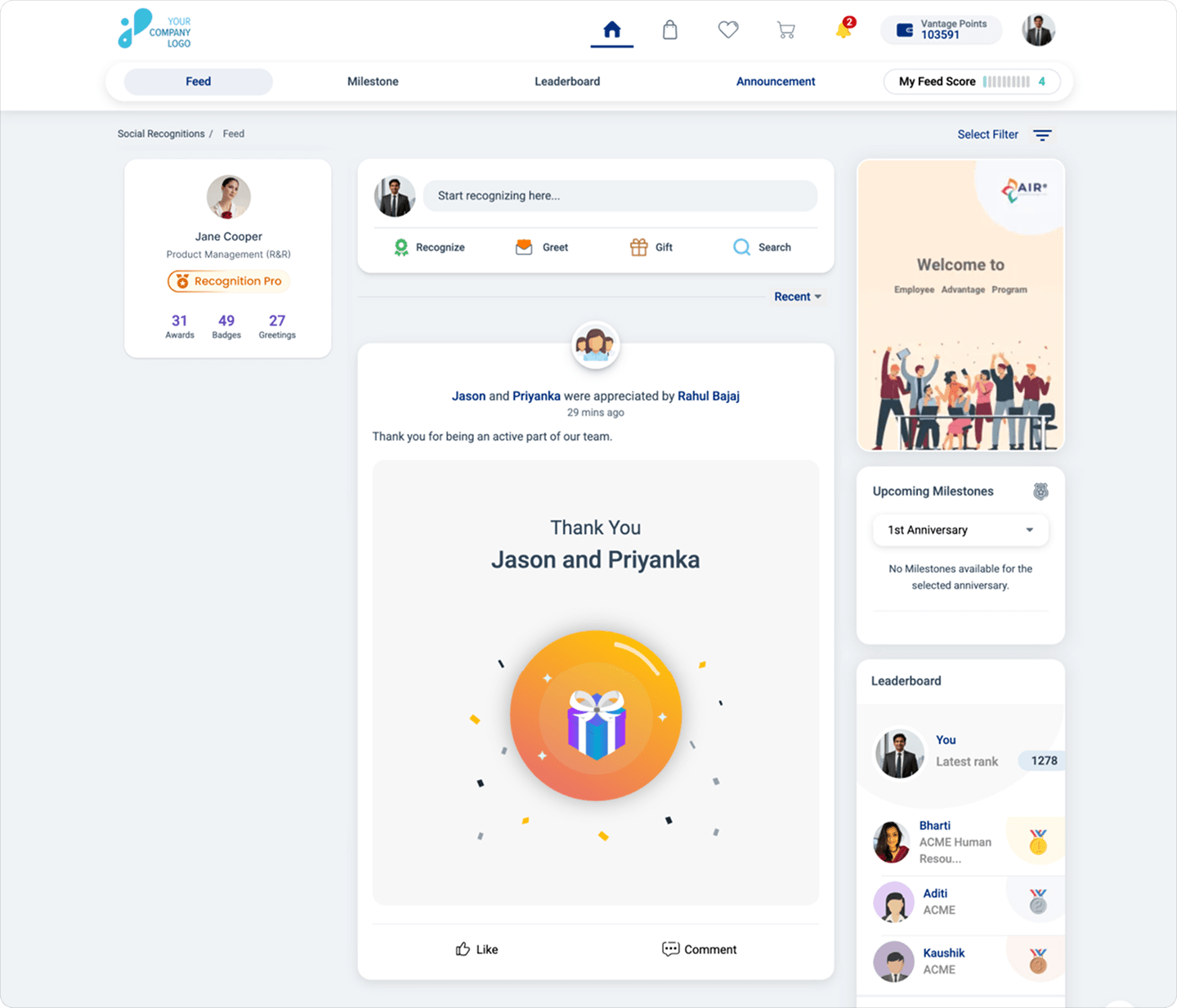
Peer-to-peer recognition programs make these moments visible. When teammates tag each other for acts of care in a shared feed, empathetic behavior becomes a team norm, not a one-time event.
How to Show Empathy at Work: 5 Actionable Manager Scripts
Knowing the theory is one thing. But how do you actually say it in the moment, when a report is upset, when a deadline has slipped again, or when you are the one delivering hard news?
You can use each of the scripts below word-for-word or adapt them to your style. Each follows a four-part format: setup, opener, listening move, close.
The hardest part isn't the words. It's the pause before them.
Script 1: When a Teammate Misses a Deadline
Most managers lead with the miss. Empathetic ones lead with the person.
Setup: A report missed a commitment for the second time this quarter.
Opener: "I noticed the deadline slipped again, and I want to understand what's happening before we talk about the work itself. Is this week harder than usual for reasons I might not know?"
Listening move: Wait. Do not fill the silence. Let them name the issue.
Close: "Thank you for telling me. Here is what I can do from my side. What do you need from me?"
Script 2: During a 1:1 After a Difficult Quarter
Numbers can wait. How your team is actually doing cannot.
Setup: The team missed targets. Morale is low.
Opener: "Before we review the numbers, I want to ask: how are you actually doing? Not the work version of that question."
Listening move: Reflect back what you hear. "So what I'm hearing is..."
Close: "Let's separate what happened from what comes next. What one thing would make next quarter feel more manageable?"
Script 3: When Pushing Back on a Leadership Decision
You can't always change the decision. You can always change how it lands.
Setup: A leadership directive landed badly with the team. A report challenges the manager.
Opener: "I hear the frustration, and I want to be honest with you. I have the same concerns. Here is the context I've been given."
Listening move: "What specifically is hardest to accept about this decision?"
Close: "I cannot change the decision, but I can make sure your concern reaches the right person. Is that what you want me to do?"
Script 4: When an IC Raises Burnout
Telling a manager you're burnt out takes courage. The response needs to match that.
Setup: A high-performer discloses they are close to burnout.
Opener: "I'm glad you told me. That takes trust. Before anything else: what has to stop immediately?"
Listening move: "What is the thing that feels most unsustainable right now?"
Close: "Let's make one concrete change this week. No general commitments."
Script 5: When Delivering Hard Performance Feedback
Direct feedback and empathy aren't opposites. Done right, directness is a form of respect.
Setup: A report is underperforming and needs direct feedback.
Opener: "I want to have a conversation about your work, and I want to start from a place of respect for what you bring. I'm going to be direct because I think you deserve that."
Listening move: "Before I say more, what is your read on how the last few months have gone?"
Close: "Here is what success looks like by [date]. I am committed to supporting that. What do you need from me to get there?"
For the listening techniques behind these scripts, see our article on active listening skills.
5-Question Empathy Diagnostic for HR Leaders
How do you know if your organization has an empathy problem? Not because someone complained in a town hall, but because the data is quietly saying so?
Use this diagnostic before you build a program. It relies on observable data points you already have access to, not self-reported assessments that people answer the way they think they should.
Answer each question for your organization
0 of 5 answered
1. Do managers cancel 1:1s more than twice per quarter in any team?
Where to look: Calendar data or HRIS logs
2. Are recognition rates from managers to ICs below 20% in any department?
Where to look: Recognition analytics dashboard
3. Does any team show a "my manager cares" eNPS sub-score below 40?
Where to look: Pulse survey responses
4. Has anonymous Pulse comment sentiment trended negative for two consecutive cycles?
Where to look: Pulse sentiment analysis
5. Is peer-to-peer recognition below 10% of total recognitions in any business unit?
Where to look: Peer recognition data
How to Measure Empathy in Your Organization
Here's the honest reason empathy stays symbolic in most organizations: it is never connected to a measurement system. You cannot manage what you cannot see.
The good news is you already have three things to track. You just need to know what to look for.
Behavioral Signal: Recognition Tagging on Core Values
When recognitions are tagged to a value like "Care" or "Empathy," every shout-out becomes a data point you can track by manager and by quarter. A manager with zero empathy-tagged recognitions in a quarter is a red flag, not a vague concern.
Survey Signal: eNPS Sub-Question and Sentiment Analysis
The "My manager genuinely cares about my wellbeing" eNPS sub-question gives you a direct number per team. Pair it with sentiment analysis on open-text Pulse comments to see whether the language is shifting toward "supportive" or "distant."
System Signal: Manager-to-IC Recognition Frequency
How often managers recognize their direct reports is a proxy for empathetic attention. Department breakdowns show you which teams are modeling it and which go quiet.
| Signal | Tool | Cadence | Threshold |
|---|---|---|---|
| Core-value tagging rate | Recognition analytics | Monthly | Fewer than 1 empathy tag per manager per month = flag |
| eNPS care sub-score | Employee pulse survey | Quarterly | Score below 40 = action needed |
| Peer recognition rate | Platform data | Monthly | Fewer than 15% of total = flag |
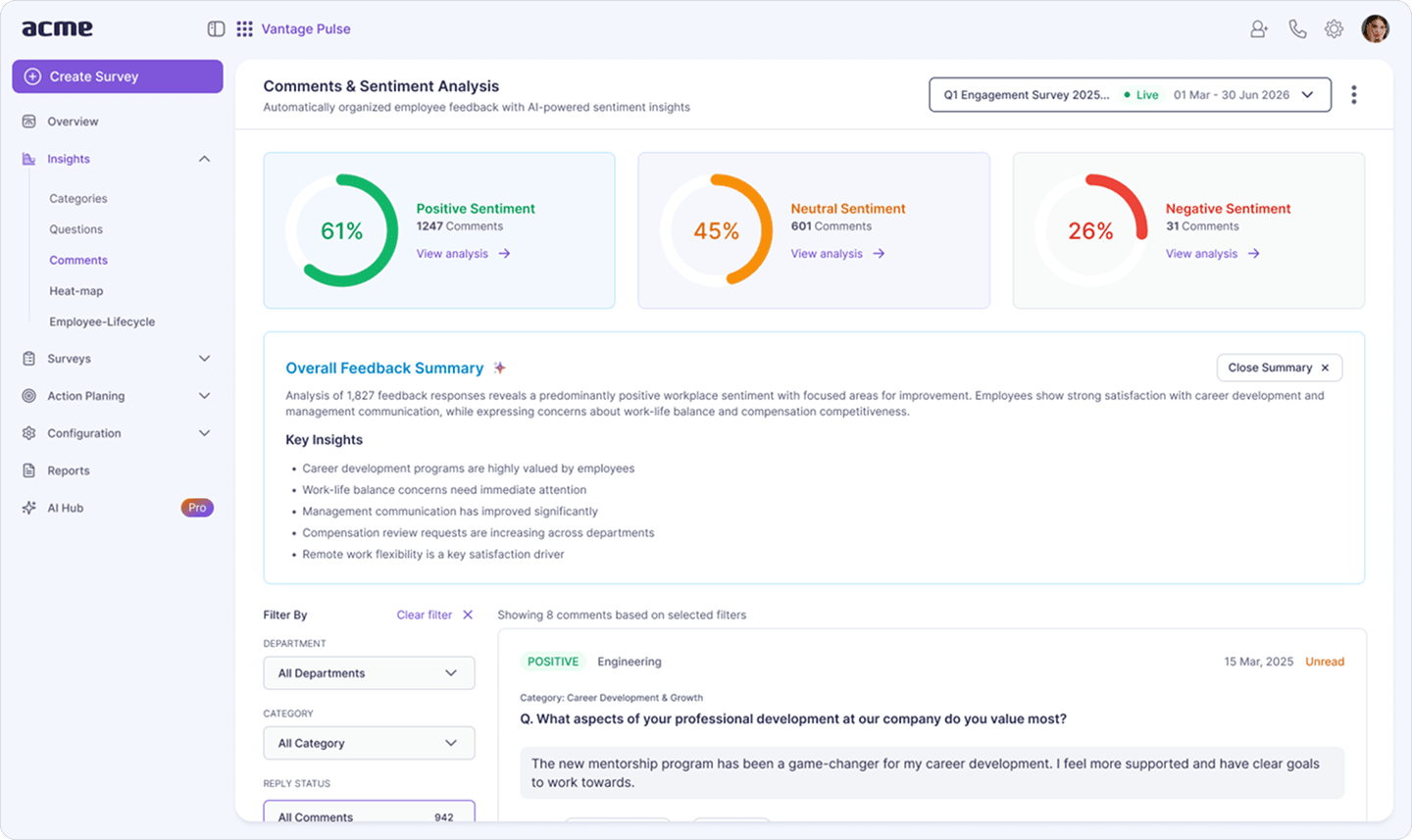
For the methodology behind eNPS measurement, see our full article on eNPS surveys.
Lack of Empathy in the Workplace: 6 Warning Signs
Have you ever looked at your engagement data and sensed something was off, even before the numbers told you? That feeling usually has a source. Low empathy rarely announces itself. It surfaces in the following six patterns, each observable without a survey:
- Recurring 1:1 cancellations: employees stop bringing problems when they expect to be rescheduled.
- We-versus-they language in cross-team channels: "they dropped the ball again" signals empathy hasn't crossed team lines.
- Low cross-team recognition rates: if 90% of recognitions stay inside the same team, there are invisible walls between groups.
- Toxicity in anonymous Pulse comments: repeated phrases like "no one listens" or "I feel invisible" won't come up in person.
- Two consecutive declines in "manager cares" pulse scores: one bad cycle is noise. Two is a trend.
- Recognition flowing only downward: peer-to-peer recognition near zero means empathetic acknowledgment is top-down only.
Catching these early gives HR leaders a 60-to-90-day head start before the patterns become exit interview themes.
Empathy Fatigue and Performative Empathy: How to Stay Genuine
Two things quietly kill empathy in organizations: fatigue and performance. Empathy fatigue happens when managers are expected to keep showing up emotionally without recovery time. Performative empathy is what fills the gap: "we see you" in a town hall, unchanged workloads by Monday.
Three practices that prevent it from taking hold:
- Empathy budgeting. Acknowledge that managers can only give so much and schedule recovery time. One-on-one meetings should not run back-to-back across the full week.
- HRBP co-listening. Have HR Business Partners (HRBPs) conduct skip-level conversations quarterly, so the empathy load does not rest on one manager's shoulders alone.
- Peer-recognition rotation. Use recognition campaigns to rotate who extends recognition and who receives it, so empathy does not always flow from the same people.
Distinction worth making: Empathy fatigue is not a lack of empathy. Even empathetic managers can burn out from continuous emotional labor. Build renewal into the system, not just extraction from it.
4-Step Empathy Training Program for Managers
Most empathy training fails. Not because the content is wrong, but because it is delivered as a one-day workshop and then left to individual managers to figure out on their own.
A program that actually creates lasting change runs over six weeks and connects each step to something you can observe and measure.
1. Week 1: Self-Awareness Assessment Managers complete a short behavioral self-assessment: how often they cancel 1:1s, how they respond to emotional disclosures, and how they deliver hard feedback. Not graded. It reveals blind spots before skill-building begins.
2. Weeks 2–3: Active Listening Practice Managers practice three moves in real 1:1s: reflecting back what they hear, asking "what kind of support do you need?" before offering solutions, and naming unspoken concerns. They log one practice moment per session.
3. Weeks 4–5: Role-Reversal Simulations Groups of four to six managers run structured scenarios using the five scripts above. Each manager plays the direct report role in at least one scenario. Playing the other role changes the felt experience of the exchange.
4. Week 6 Onward: Reinforcement Through Recognition After training, empathetic behaviors get reinforced through recognition. When managers receive peer or upward recognition that references care or listening, those moments show up in your data. Pulse word cloud analysis shows whether language about managers shifts from "distant" to "supportive" over the following quarter.
How Vantage Circle Turns Empathy Into a Measurable Signal
Most organizations declare empathy a value. Few measure it. Vantage Circle closes that gap with two tools that make empathetic behavior visible in the data.
Vantage Pulse tracks the "my manager cares" eNPS sub-score at team and department level. Its sentiment analysis reveals whether open-text comments are trending toward "supportive" or "distant," anonymously, so employees tell you what they actually think.
Vantage Rewards makes empathy recognizable. Every time a colleague is tagged for "Care" or "Support" in the recognition feed, it creates a data point HR can track by manager, by department, and by quarter.
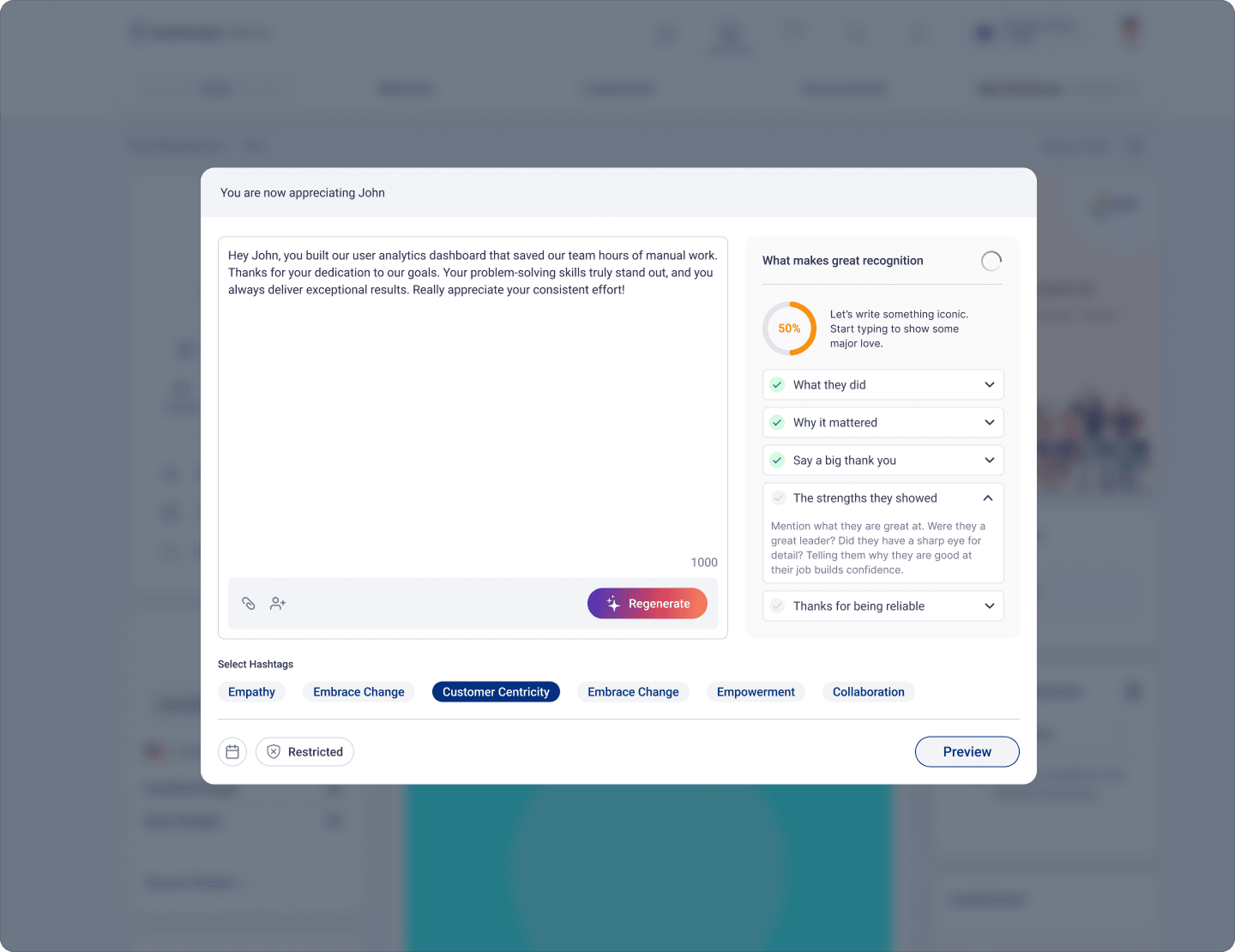
Recommended Resource: See how Vantage Pulse measures the "my manager cares" signal across your organization.
Frequently Asked Questions
What Are 5 Examples of Empathy in the Workplace?
Five concrete examples: acknowledging a teammate's personal crisis before starting a meeting, rewriting an accusatory Slack message before sending it, defending an absent colleague's intent in a cross-functional review, inviting the quietest voice first in a brainstorm, and naming an unspoken concern aloud in a stakeholder call.
How Do You Show Empathy in the Workplace?
Practice three behaviors consistently: listen before advising, name what you observe without judgment ("I can see this has been a hard week"), and follow through with one concrete action. Without action, empathy sounds supportive but changes nothing.
What Are the 3 A's of Empathy?
The 3 A's are Awareness (noticing someone is struggling), Acknowledgment (naming it to them directly), and Action (doing something that reduces the burden). All three matter. Skip one and the other two don't land.
What Is Empathy in 3 Words?
Perceive. Understand. Respond.
How Do You Build Empathy in Remote Teams?
Remote teams lose the passive signals: body language, tone in a hallway. Replace them deliberately: weekly async check-ins with an emotional context option, manager scripts adapted for chat or video, and a peer recognition feed where empathetic moments stay visible.
The Bottom Line
Empathy shows up in manager scripts, in how a deadline gets moved, in whether the quietest voice gets heard. The organizations that actually build it are the ones that measure it, through eNPS signals, recognition data, and Pulse comments, not annual surveys.

Supriya is a Content Marketing Lead at Vantage Circle, where she writes on employee engagement, recognition, workplace communication, and culture. She spent the earlier part of her career in corporate communications at Burson, ESPN Star Sports, and CBRE, advising organizations on the messages employees actually hear.
Connect with Supriya on LinkedIn.