Most organizations know employee engagement matters. Far fewer know what to actually do about it. They run the annual survey. They share the results in a town hall. They launch a new initiative. And six months later, the numbers look the same.
Here is the reality: only 20% of employees globally are engaged at work, according to Gallup's State of the Global Workplace 2026 report. That means 4 in 5 employees are going through the motions. And the cost of that disengagement? Approximately $10 trillion in lost productivity in 2025, or 9% of global GDP.
The gap between knowing engagement matters and knowing how to build it is where most HR strategies fall apart. This article closes that gap.
Employee engagement strategies are structured, repeatable actions organizations use to strengthen employees' emotional connection to their work, team, and company mission. Effective strategies target five core levers: recognition, development, communication, well-being, and managerial quality. When applied consistently, they reduce turnover, lift productivity by up to 18%, and increase profitability by 23% (Source: Gallup Q12 Meta-Analysis, 11th Edition).
Below are 25 proven strategies, organized by lever, so you can identify your biggest gap and start there. Let's explore.
Key Takeaways
- The five levers Gallup says drive most of the variance in team engagement
- 25 proven strategies organized across 9 categories, from recognition to onboarding
- Why a clear AI integration roadmap is the most underestimated engagement issue of 2026
- A 6-step framework and a 30-day quick-start plan you can implement this quarter
- How to measure engagement beyond the annual survey
What is an Employee Engagement Strategy?
An employee engagement strategy is a carefully structured plan designed to create an environment where employees feel emotionally connected to their work, colleagues, and the organization as a whole.
Unlike reactive perks or annual survey cycles, an effective strategy aligns with the company's values, culture, and business goals. It makes engagement sustainable rather than seasonal.
A well-crafted strategy serves multiple purposes. It aims to deliver the core objectives of employee engagement:
- Improve employee satisfaction
- Increase employee motivation
- Strengthen organizational culture
- Boost retention
- Enhance productivity
When implemented correctly, it becomes a competitive advantage for the organization and a genuine invitation for employees to become part of the company's journey.
In 2000, Campbell Soup had lost over half its market value, with employee engagement at an all-time low. When a new CEO took charge, he made employee engagement the centerpiece of his turnaround strategy. He listened to employees, built accountability at every level, and committed to a long-term culture shift. During his tenure (2001 to 2011), Campbell's cumulative total shareholder return was roughly 64%, nearly five times the S&P 500's 13% return over the same period. That is what a deliberate engagement strategy can do.
Why Employee Engagement Strategies Matter in 2026
The business case for engagement has never been clearer.
| Metric | Highly Engaged Teams |
|---|---|
| Profitability | 23% higher |
| Productivity | 18% higher |
| Employee Turnover | 43% lower (low-turnover organizations) |
| Customer Ratings | 10% higher |
Source: Gallup Q12 Meta-Analysis, 11th Edition
But the data also reveals something more uncomfortable. In 2025, manager engagement fell from 27% to 22%, the sharpest single-year drop Gallup has recorded. When managers disengage, teams follow. And a foundational driver of engagement, whether employees know what is expected of them at work, has been falling steadily since 2020.
This is not a morale problem. It is a structural one. And it requires a structural response. The 25 strategies below give HR leaders a framework to build that kind of deliberate, results-driven engagement.
25 Employee Engagement Strategies That Drive Results
Category 1: Recognition and Appreciation
Recognition is the highest-leverage driver of engagement. It costs less than compensation adjustments, works faster than culture programs, and has an immediate impact on how employees feel about their work.
1. Build a Multi-Tiered Recognition Program
A multi-tiered recognition program covers daily, monthly, and annual recognition milestones. It ensures no contribution is too small to acknowledge and no tenure milestone goes unnoticed.
The most effective programs categorize recognition into three tiers: immediate spot awards for in-the-moment appreciation, monthly or quarterly team awards, and annual ceremonies tied to business impact. Each tier serves a different psychological need.
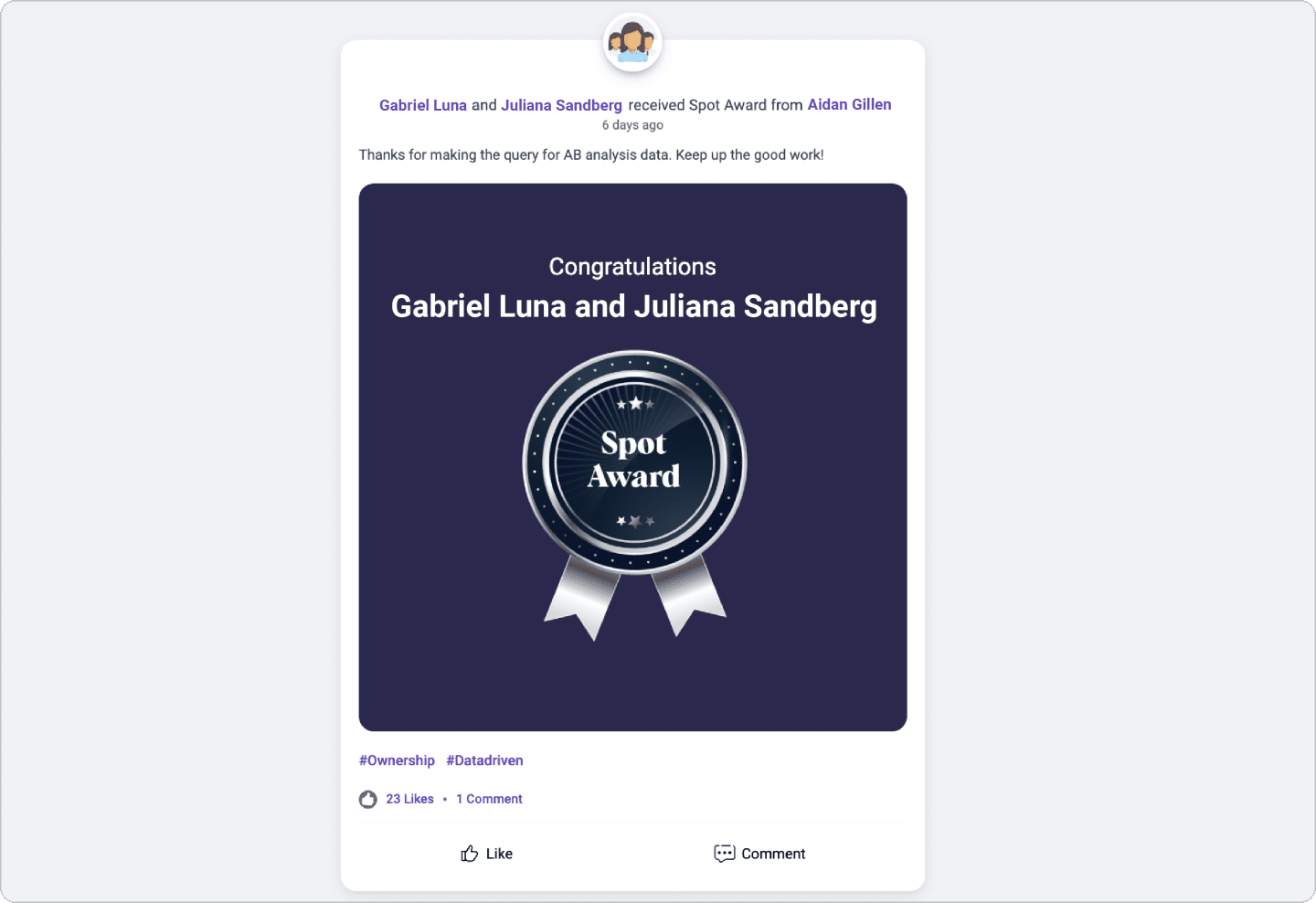
A platform like Vantage Recognition supports all three through spot awards that managers can issue in seconds to long-service milestones that trigger automatically at work anniversaries.
2. Tie Every Recognition to a Core Company Value
Recognition that is tagged to a company value does two things at once. It appreciates the individual and reinforces the cultural behavior you want repeated.
When a manager recognizes someone for "customer obsession" or "ownership," that behavior becomes visible to the entire organization through a social feed. Over time, values stop being words on a wall and start being things employees actually do.
3. Launch Peer-to-Peer Recognition
Manager-to-employee recognition is necessary but not sufficient. Peer-to-peer recognition fills the gap between formal review cycles with daily moments of appreciation from colleagues who see each other's work up close.
Organizations that enable peer recognition see it become self-sustaining. The more employees receive it, the more they are likely to give it.
4. Celebrate Long-Service Milestones
Work anniversaries are one of the most underused engagement moments in most organizations. An employee hitting their 5th or 10th year deserves more than an auto-generated email.
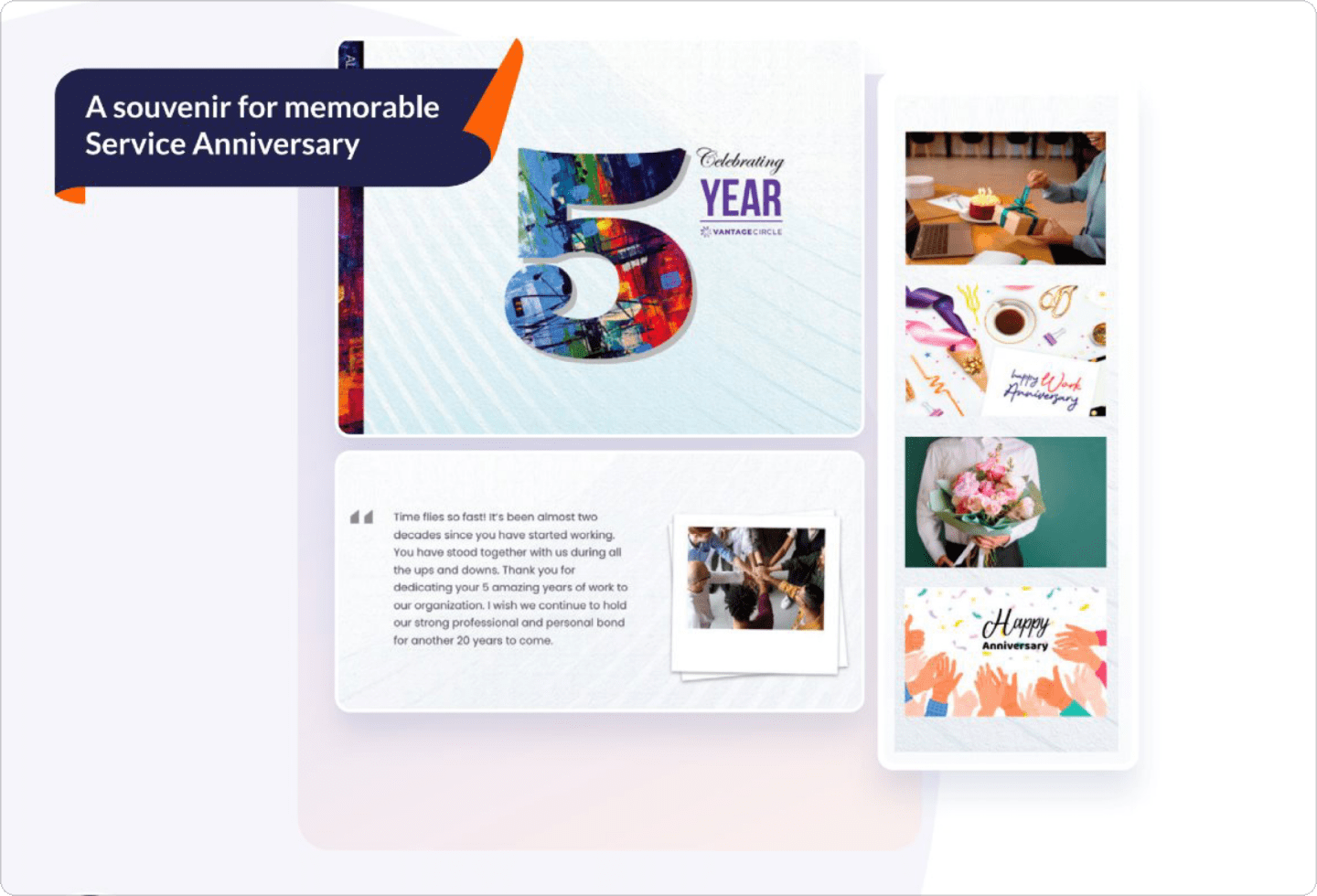
Automated long-service award programs through Vantage Recognition ensure no milestone is missed. They give employees the choice of how they want to be celebrated: publicly on the recognition feed, privately, or with a reward from a curated catalog.
Recommended Read: How to Build an Employee Recognition Program That Actually Works
Category 2: Manager Development
Managers account for 70% of the variance in team-level engagement, according to Gallup's Q12 meta analysis report. No other organizational lever comes close. Investing in managers is not a soft initiative. It is the highest-return engagement investment HR can make.
5. Retrain Managers as Coaches, Not Taskmasters
The traditional manager role (assign tasks, review outputs, escalate problems) is not built for engagement. The coaching model is.
A manager who coaches asks questions instead of giving answers. They focus on what the employee needs to succeed, not just what the business needs to deliver. Gallup's research shows that manager training improves team performance metrics by 20% to 28%.
The shift starts with training. HR can run coaching skills workshops, introduce structured 1:1 agendas, and hold managers accountable for engagement metrics on their teams.
Recommended Read: The Manager's Role in Employee Engagement: What the Research Says
6. Standardize Weekly One-on-Ones with a 3-Question Agenda
Most managers either skip 1:1s entirely or turn them into project check-ins. Neither approach builds engagement.
A structured 30-minute weekly 1:1 with three fixed questions changes that:
- How are you doing, not just on work, but overall?
- What is blocking you right now?
- What support do you need from me this week?
These questions open the door to honest conversation before frustration becomes disengagement.
7. Give Managers Real-Time Team Engagement Data
Managers cannot improve engagement they cannot see. When engagement data sits only in an annual HR report, by the time the manager reads it, the problem has already grown.
Implement a platform that gives your managers continuous visibility into their team's engagement data, eNPS trends, sentiment from open-ended feedback, and movement since the last pulse. With real-time data, a manager whose team's scores have dropped can act on it the same week, not wait for the next quarterly review. Vantage Pulse is built for this kind of continuous, pulse-based feedback.
Category 3: Communication and Transparency
Trust is the foundation of engagement. Transparency is how trust is built at scale. Employees who feel informed and included in the company's direction are significantly more likely to stay engaged through uncertainty.
8. Hold Regular All-Hands Meetings with Two-Way Q&A
Monthly or quarterly all-hands meetings give leadership visibility and give employees a forum to ask questions they would not ask in a performance review.
The key word is "two-way." A broadcast-style all-hands where leadership presents and employees watch is a missed opportunity. Build in structured Q&A time. Use anonymous question submissions if your culture needs them. Share answers to questions you did not have time to address in a follow-up email.
9. Share Business KPIs and Progress Openly
When employees see the numbers their work contributes to (revenue, customer satisfaction, product growth), they stop feeling like cogs and start feeling like contributors.
Share high-level KPIs in all-hands meetings. Show progress quarterly. When targets are missed, explain why. Employees handle difficult news far better than they handle silence.
10. Communicate a Clear AI Integration Roadmap
This is the most underestimated engagement issue of 2026. According to Gallup's workplace AI research, only 26% of employees say their organization has communicated a clear plan for integrating AI into their work. The other 74% are navigating a significant workplace transition without guidance. That ambiguity drives anxiety. Anxiety drives disengagement.
HR and leadership need to be explicit about what AI will change, what it will not change, and how employees will be supported through the transition. Gallup's data shows that employees whose managers actively support AI adoption are 1.7 times more likely to use AI frequently at work.
Category 4: Development and Growth
11. Build Personalized Career Development Plans
Employees who see a clear path forward stay. Employees who feel stuck leave.
Personalized development plans start with a simple conversation: What does this employee want to achieve in the next 12 months, and what does the organization need them to develop? The plan bridges those two answers.
According to LinkedIn's 2024 Workplace Learning Report, 70% of employees say learning improved their sense of connection to their company. 80% said it gave them a greater sense of purpose at work. Development is not a retention perk. It is an engagement engine.
Here is how to make development plans work:
- Assess each employee's current skills and growth areas through 1:1 conversations
- Offer role-specific learning tracks through an LMS or external platform
- Pair employees with mentors who can provide guidance alongside formal learning
- Fund external certifications and courses for skills the organization needs
12. Promote Internal Mobility Before External Hiring
When a role opens up, the default is often to post it externally. But internal mobility is one of the most powerful signals an organization can send: we invest in our own people.
Internal mobility programs encourage employees to apply for open roles, cross-functional projects, or stretch assignments within the company. The result is not just better retention. It is better engagement among people who see a future with the organization.
13. Establish Mentorship Programs Across Functions
Mentorship is one of the few engagement initiatives that benefits both parties. The mentor develops coaching and leadership skills. The mentee gets guidance, visibility, and a sense of belonging.
Cross-functional mentorship is especially powerful. When a product manager mentors someone from operations, both build a broader view of the organization. That breaks down silos. And silos are one of the quietest killers of engagement in large companies.
14. Dedicate Time for Skill Development Each Quarter
Training events and learning platforms are not enough on their own. Employees need protected time to actually use them.
In 2025, 59% of CHROs told Gallup that employee development is what their organization struggles with most. That figure is up 16 percentage points from the year before. The gap is not awareness. It is execution. Organizations that schedule dedicated learning time (even two to four hours per month) see meaningfully higher participation than those that leave it to employees to find time themselves.
Category 5: Continuous Feedback and Listening
15. Replace Annual Surveys with Quarterly Pulse Surveys
Annual engagement surveys give you a rearview mirror. Pulse surveys give you a windscreen.
Short, focused surveys of three to five questions, run quarterly or monthly, capture shifts in employee sentiment while there is still time to act. They build a culture of listening that employees notice. When employees see their feedback lead to visible changes, survey participation increases over time.
At Vantage Circle, we have incorporated pulse surveys into our own culture and found that anonymous responses dramatically improve the honesty of feedback we receive.
A key strategy is to listen to people to get their feedback proactively. Leveraging a variety of channels, including 1:1 conversations, focus groups, and more formal surveys, ensures you are getting diverse and ongoing feedback. Once you have these insights, you need to use them to inform your plans, measure progress, and provide updates. Finally, if there are areas you cannot progress in, it is important to tell people.
Mark Edgar
Chief People Officer, WAJAX
16. Measure eNPS as Your Engagement Benchmark
The employee Net Promoter Score (eNPS) asks one question: "How likely are you to recommend working here to a friend or colleague?" The score is calculated by subtracting the percentage of detractors from the percentage of promoters.
eNPS is not a complete picture of engagement. But it is a consistent, comparable signal that every manager and leader can understand. Tracking it monthly alongside pulse survey data gives HR a clear trendline to present to leadership.
17. Close the Feedback Loop Within 30 Days
Collecting feedback without acting on it is worse than not collecting it at all. It signals to employees that their opinions are gathered for reporting purposes, not for change.
Commit to a 30-day feedback loop: survey, analyze, share findings with managers, announce the top three actions the organization will take in response, and set a timeline. According to Lattice's 2025 State of People Strategy Report, 51% of HR respondents say sharing survey feedback with managers, and helping them course-correct, is the single highest-impact engagement action HR can take.
Category 6: Well-Being and Work-Life Balance
18. Implement a Total Well-Being Program
Well-being is not just a gym membership. A meaningful wellness program addresses physical, mental, and financial health together.
Physical wellness initiatives like step challenges and fitness goals build community and reduce burnout simultaneously. Mental health support through counseling access and EAPs reduces absenteeism. Financial wellness resources address the stress that affects productivity far more than most organizations acknowledge.
At Vantage Circle, upon implementing Vantage Fit (our in-house wellness platform), we observed a measurable increase in employees' enthusiasm to stay active and engaged. Team-based wellness challenges, in particular, turned individual health goals into shared experiences.
19. Offer Flexible Work Arrangements as a Standard Policy
Flexibility is no longer a perk. It is a baseline expectation for a large and growing share of the workforce. Yet Lattice's 2025 data shows that globally, only 27% of organizations offer remote work options, and only 29% offer flexible time off.
The organizations that treat flexibility as a standard policy, not an exception to be negotiated, see measurably higher engagement scores, especially among employees with caregiving responsibilities.
Define what flexibility looks like in your organization. Put it in writing. Train managers to support it consistently rather than applying it differently across teams.
20. Launch an Employee Assistance Program (EAP)
An Employee Assistance Program provides employees with confidential access to counseling, mental health support, and resources for managing stress, financial difficulties, or personal crises.
EAPs are one of the most cost-effective wellness investments an organization can make. The return comes in reduced absenteeism, lower turnover among employees facing difficult life events, and a signal that the company genuinely cares about employees as people.
Category 7: Culture and Inclusion
21. Establish Employee Resource Groups with Real Budget and Visibility
Employee Resource Groups (ERGs) give employees from shared backgrounds or identities a structured space to connect, advocate, and contribute to company culture. But ERGs only drive engagement when they have budget, leadership sponsorship, and visibility.
An ERG that meets in a conference room with no allocated resources and no executive champion is a frustration exercise, not an engagement driver. Fund them. Connect them to business strategy. Celebrate their initiatives publicly.
22. Tie CSR Initiatives to Employee Choice
Employees want to work for companies that contribute to positive change. But the most engaging CSR programs are the ones employees choose and participate in, not the ones selected by a committee.
Use surveys to identify which social causes matter most to your workforce. Then build programs around those causes.
During her tenure at PepsiCo, Indra Nooyi introduced a philosophy called Performance with Purpose (PwP), built on four pillars: strong financial returns, better nutrition, environmental responsibility, and support for employees and communities. After implementing PwP, PepsiCo's net revenue increased by 80% and its stock outperformed both the Consumer Staples Index and the S&P 500.
Category 8: Innovation and Autonomy
23. Allocate Exploration Time for Creative Projects
An environment that values creativity leads to fresh ideas and more engaged employees. When people feel intellectually stimulated at work, their sense of purpose deepens.
One of the most well-known examples: Google's "20% time" policy, which allows employees to dedicate 20% of their work hours to personal projects that could benefit the company. This approach produced Gmail, created by Paul Buchheit as a side project, and Google News, developed by Krishna Bharat.
You do not need Google's scale to apply this principle. Start with two hours per week or one dedicated "innovation afternoon" per month.
24. Create a Formal Idea Submission System
Encouraging innovation verbally is not enough. Employees need a visible, low-friction process to submit ideas. They also need to see what happens to those ideas after submission.
Build a simple system: a form, a review process, a timeline for feedback, and a public board where ideas are tracked. When an idea is implemented, celebrate it by name and credit the person who submitted it.
Category 9: Onboarding and Belonging
25. Design a Purposeful Onboarding Journey
First impressions are lasting ones. A purposeful onboarding process helps new hires understand the company's mission, values, and culture from day one. Not just the HR paperwork.
At Vantage Circle, we developed a comprehensive 3-day induction program that transforms traditional onboarding into an engaging journey. New hires leave orientation with a clear understanding of their role, established relationships with peers and managers, and a connection to the company's vision. The impact on early-stage engagement has been significant.
A purposeful onboarding journey has four practical components:
- An onboarding buddy assigned on day one. Buddies answer the small questions new hires hesitate to ask their manager and accelerate cultural integration.
- A structured first week with pre-scheduled introductions to cross-functional partners, not just immediate teammates. New hires who meet ten colleagues in week one ramp faster than those who meet two.
- 30-60-90 day check-ins between the new hire, their manager, and HR. Each check-in covers role clarity, blockers, and what is and is not working in the onboarding itself.
- An onboarding feedback loop built on an employee onboarding survey run at day 30 and day 90. The findings become the foundation for refining the process continuously.
How to Build an Employee Engagement Strategy: 6 Steps
Having a list of strategies is useful. Having a framework to choose and sequence the right ones for your organization is what makes the difference between scattered initiatives and a coherent strategy.
Step 1: Assess Your Current Engagement Levels
You cannot build a strategy without knowing where you stand.
Start with an employee engagement survey. Use a validated framework like Gallup's Q12 or a custom pulse survey that covers the key drivers: role clarity, recognition frequency, development opportunity, manager relationship, and sense of purpose.
Look at your lagging indicators too. Turnover rates, absenteeism data, and exit interview themes tell you what engagement surveys may not yet show.
Recommended Read: 45 Employee Engagement Survey Questions That Actually Get Honest Answers
Step 2: Set Measurable Engagement Objectives
Vague goals produce vague results. Define objectives that are specific and time-bound.
Examples:
- Increase eNPS from 20 to 35 within two quarters
- Reduce voluntary turnover by 10% in the next 12 months
- Achieve 70% recognition coverage (percentage of employees who receive recognition each month) within six months
These objectives will guide your strategy, focus your budget, and give you clear metrics to present to leadership.
Step 3: Identify Your Top Three Priority Levers
Trying to fix everything at once dilutes impact. After your engagement assessment, you will likely see patterns: a recognition gap, a manager capability problem, a development deficit.
Pick the top three areas where improvement would have the greatest downstream effect on your business. Build your first-year strategy around those three levers.
Step 4: Equip Managers to Execute at Team Level
No engagement strategy survives contact with a disengaged manager. Whatever initiatives HR designs at the organizational level need a manager to make them real on the ground.
Train managers on the specific skills each initiative requires. A recognition program without manager participation stalls. A pulse survey without manager follow-up erodes trust. Build manager capability into every initiative from the start.
Step 5: Run Frequent Pulse Surveys
The best way to sustain an engagement strategy is to build a culture of continuous feedback. Quarterly pulse surveys give HR and managers the data to course-correct before small problems become retention events.
We incentivize survey participation at Vantage Circle and have found consistently that higher participation rates lead to better data. And better data leads to better decisions.
Step 6: Measure, Share, and Adapt Quarterly
Engagement strategy is not a one-time project. The workplace evolves. Workforce expectations shift. What worked for a team of 50 may not scale to 500.
Review your engagement metrics every quarter. Share the results with managers and leadership. Celebrate progress. Acknowledge gaps honestly. Adjust the plan based on what the data shows.
Employee Engagement Strategy: 30-Day Quick-Start Plan
If your organization does not have a structured engagement strategy today, this plan gives you a first-month roadmap.
| Week | Focus | Key Actions | Success Metric |
|---|---|---|---|
| Week 1 | Baseline | Launch a 5-question pulse survey covering recognition, clarity, development, well-being, and manager relationship. Share results with managers within 7 days. | Response rate above 60% |
| Week 2 | Recognition | Set up a peer recognition channel. Ask every manager to send at least one specific, values-linked recognition to each team member this week. | Recognition rate per employee per week |
| Week 3 | Clarity | Each manager runs a 30-minute 1:1 with a structured 3-question agenda. Focus: expectations, blockers, support needed. | 1:1 completion rate across teams |
| Week 4 | Development | Manager has one career conversation with each direct report. Document one growth goal per employee. | Percentage of employees with a documented development goal |
| Day 30 | Measure and Share | Run second pulse survey using the same 5 questions. Share Week 1 vs. Day 30 comparison with leadership and managers. | Delta in engagement score; participation rate |
How to Measure Employee Engagement
Engagement is only improvable if it is measurable. And it is only trustworthy if you are using the right instruments.
| Method | What It Measures | Best Cadence |
|---|---|---|
| eNPS (Employee Net Promoter Score) | Loyalty and likelihood to recommend the organization as a place to work | Monthly |
| Pulse Survey (3 to 5 questions) | Real-time sentiment on specific engagement drivers | Weekly or fortnightly |
| Annual Engagement Survey | Comprehensive baseline across all engagement dimensions | Annually |
| Stay Interview | Individual retention risk and motivation drivers | Quarterly for high performers |
| Voluntary Turnover Rate | Lagging indicator of systemic disengagement | Monthly |
| Manager 1:1 Quality Score | Relationship health between manager and direct reports | After each 1:1 cycle |
A few principles to follow:
Do not rely on a single number. One eNPS score or one annual survey average hides more than it reveals. Break results down by team, tenure, location, and role.
Close the loop visibly. When employees see their feedback lead to a named action within 30 days, participation rates in the next survey increase. When they see no follow-through, participation drops and trust erodes.
Track trends, not snapshots. A pulse survey score of 65 means little on its own. A pulse survey score that has moved from 58 to 65 over three quarters means the strategy is working.
In The End
Employee engagement is not a program you launch and mark complete. It is a continuous commitment to building an environment where employees feel valued, heard, and connected to something larger than their individual task list.
The 25 strategies in this article address the full spectrum of what drives engagement: recognition, manager development, communication, growth, feedback, well-being, culture, innovation, and onboarding. You do not need to implement all 25 at once. Start with your biggest gap, build a measurable plan around it, and add levers over time.
Organizations that treat engagement as a strategic priority see the results. Organizations that treat it as an annual survey exercise get exactly that: a survey.
See how Vantage Circle helps HR leaders build engagement cultures that drive measurable results. Book a Demo
FAQs
What are the most effective employee engagement strategies?
The most effective employee engagement strategies address the five core drivers: recognition, managerial quality, career development, open communication, and well-being. Gallup's research consistently shows that manager behavior accounts for 70% of the variance in team-level engagement. So if you have to start with one lever, invest in manager training and coaching capability first.
How do you measure employee engagement?
Measure employee engagement through a combination of pulse surveys (3 to 5 questions, run monthly or quarterly), an annual comprehensive survey using a validated framework like Gallup's Q12, and eNPS tracked monthly. Supplement with qualitative signals: stay interviews, exit interview themes, and manager 1:1 feedback. Break every metric down by team and tenure to spot patterns a company-wide average would hide.
What are the 4 pillars of employee engagement?
The four pillars most widely cited in research are: clarity (employees know what is expected of them), connection (employees have strong relationships with their team and manager), contribution (employees see how their work connects to organizational purpose), and growth (employees have opportunities to develop their skills and advance). A strong engagement strategy addresses all four.
How can managers improve employee engagement?
Managers improve engagement through three repeatable behaviors: setting clear expectations and revisiting them regularly, giving specific and timely recognition tied to observed behavior, and holding genuine weekly 1:1s focused on the employee's growth and blockers, not just task status. Gallup's research shows that even basic manager training improves team performance by 20% to 28%.
What is the role of HR in employee engagement?
HR designs the strategy, builds the infrastructure, equips managers with tools and data, and holds the organization accountable to engagement goals. But HR cannot execute engagement at the team level alone. The most effective approach is an HR-manager partnership: HR sets the framework, managers deliver it in daily interactions. When HR equips managers with team-level engagement data and structured follow-up steps, course corrections happen faster, survey fatigue drops, and employees see their feedback turn into action.
How often should employee engagement surveys be conducted?
Annual surveys provide a comprehensive baseline but leave too much time between signals. The most effective organizations run quarterly pulse surveys of 3 to 5 questions alongside an annual comprehensive survey. This cadence catches engagement shifts early enough to act on them before they become retention events.
What is an employee engagement action plan?
An employee engagement action plan is a structured document that translates survey findings into specific, time-bound initiatives. It identifies the top three engagement gaps, assigns ownership for each action, sets measurable targets, and includes a review timeline. An action plan without a follow-up date is just a list of good intentions.
What causes low employee engagement?
Low employee engagement is most commonly caused by unclear role expectations, poor manager relationships, lack of recognition, limited growth opportunities, and a disconnect between the employee's work and the organization's purpose. Gallup's data shows that fewer than one in three employees feel strongly connected to their company's mission. Weak culture, unclear expectations, and limited recognition are the three most frequently cited drivers of detachment.

Nilotpal M Saharia is an Assistant Manager, Content Marketing at Vantage Circle and a recognition-and-rewards (R&R) strategist with 9 years of experience spanning Marketing, HR, and content strategy. He helps HR leaders turn employee recognition and leadership research into practical workplace programs.
Connect with Nilotpal on LinkedIn.