The email is not the problem. The reaction to it is.
A manager reads critical feedback and fires back. An employee hears a performance note and immediately gets defensive. Two teams disagree on priorities, and a routine discussion turns personal. None of these situations require more technical expertise. They require emotional intelligence: the ability to recognize what is happening internally, read what is happening around you, and choose what to do next.
It shapes how feedback lands, how conflict gets resolved, and how well teams collaborate under pressure. Psychologists Peter Salovey and John Mayer introduced the concept in 1990, and Daniel Goleman brought it to a business audience in his 1995 book Emotional Intelligence: Why It Can Matter More Than IQ. Here are the 5 components, where they show up at work, and what the research says about building EQ on your team.
Jump to:
- What is emotional intelligence?
- Why it matters at work
- The 5 components of EI
- Where EI shows up most
- How to build EI on your team
- Signs of high and low EI
- FAQ
What Is Emotional Intelligence in the Workplace?
Emotional intelligence (EI), also called EQ, is the ability to perceive, evaluate, and respond to emotions, your own and other people's, in ways that support rather than undermine your working relationships. IQ determines whether you can perform a job's technical requirements; EI determines how well you perform alongside other people.
EI is not about being warm or likable. It is about self-awareness, self-regulation, and the social skill to build the working relationships that make high performance possible.
Why Emotional Intelligence Matters at Work
In Working with Emotional Intelligence (1998), Goleman's review of competency models from 121 organizations found that emotional competencies made up 67% of the abilities deemed essential for effective performance. His Harvard Business Review article the same year, drawing on 188 companies, found EI roughly twice as important as IQ and technical skills across job levels, and accounting for nearly 90% of the difference between star and average performers in senior roles.
The World Economic Forum's Future of Jobs Report 2025 lists "empathy and active listening" among the core skills employers most value in 2025, alongside analytical thinking and creative thinking.
At a team level, recognition is one of the few places where EI becomes observable. The Recognition Effect, a Vantage Circle and Great Place To Work study of 5.7 million employees (2025), found that teams in recognition-driven cultures show 92% retention compared to 76% where recognition is limited or inconsistent. The same study found that 55% of employees do not feel truly recognized at work. The way people recognize one another reveals whether empathy and social skill are actually showing up in daily work. A manager who names the specific behavior and why it mattered is demonstrating both. One who defaults to generic praise is not.
The 5 Components of Emotional Intelligence
Daniel Goleman's framework breaks emotional intelligence into 5 components, each building on the last. The first 2 are inward-facing (how you manage yourself); the final 3 are outward-facing (how you navigate relationships).
| Component | What It Looks Like | A Workplace Example |
|---|---|---|
| Self-Awareness | Recognizing how your emotions influence your decisions and the people around you | A manager notices they become short with the team under deadline pressure and names it before a high-stakes meeting |
| Self-Regulation | Managing impulses and responding rather than reacting, especially under pressure | An employee receives critical feedback in a performance review and pauses before responding instead of becoming defensive |
| Empathy | Understanding what a colleague is experiencing from their frame of reference, not your own | A team lead notices a usually engaged employee has gone quiet and checks in privately rather than flagging it in a group call |
| Motivation | Staying driven by internal goals and purpose rather than external rewards alone | A sales rep who misses a quarterly target creates their own review process instead of waiting for a manager to intervene |
| Social Skills | Building and sustaining relationships through clear communication, active listening, and constructive conflict management | A project lead keeps two departments with competing priorities aligned by facilitating structured conversations rather than letting friction accumulate |
1. Self-Awareness
Self-awareness is the ability to recognize your emotions as they arise and understand how they shape your behavior, judgments, and working relationships. A manager who notices their patience thinning before a high-stakes conversation can choose how to respond. One who does not notice will let the emotion drive the conversation anyway. It is the foundation component: you cannot regulate what you have not first recognized.
2. Self-Regulation
Self-regulation is the ability to manage your emotional impulses under pressure so that responses are considered rather than reactive. A leader with strong self-regulation does not send the sharp email at 11 p.m. after a bad project review. They draft it, set it aside, and come back to it in the morning. That pause is what keeps trust intact when stakes are high.
3. Empathy
Empathy is the ability to understand another person's perspective and emotional state without losing your own. In the workplace, it is what enables a manager to deliver difficult feedback in a way that motivates rather than deflates, or to recognize that a remote employee's silence in a meeting is disengagement rather than agreement.
Catalyst's 2021 empathy research found that employees with empathic managers report higher engagement (76%) than those with less empathic managers (32%), and that women with highly empathic managers are less likely to report burnout. Employees who feel genuinely understood are more likely to surface problems before they become exit decisions. The manager who notices a behavioral change early is usually the one who was paying attention long before it became visible.
4. Motivation
Motivation, in Goleman's framework, refers to intrinsic drive: genuine interest in the work and in improving at it, rather than motivation tied primarily to external reward. Employees high in this component set their own goals, remain optimistic after setbacks, and stay productive without needing external pressure to perform. When a restructure lands or a product gets shelved, they recalibrate faster than those whose drive depends on external validation.
5. Social Skills
Social skills are the outward-facing result of the previous 4 components: clear communication, active listening, and the ability to navigate conflict constructively across functions and seniority levels. Employees with strong social skills are not necessarily the most extroverted in the room. They are the ones who leave conversations with more alignment than they started with.
Where Emotional Intelligence Shows Up Most at Work
Giving and Receiving Feedback
Feedback is where EI creates or destroys trust faster than almost any other interaction. A manager who delivers feedback without self-awareness tends toward vagueness, poor timing, or language that triggers defensiveness rather than reflection. An employee who receives feedback without self-regulation tends to shut down or argue rather than absorb the information.
Giving and receiving effective feedback requires both sides to engage their EI actively. For managers, that means naming the specific behavior and its impact rather than generalizing about personality: "the presentation lacked a clear recommendation" rather than "you are not organized." For employees, it means pausing before defending and asking a clarifying question before responding.
Navigating Difficult Work Relationships
The difference between high and low EI in a difficult relationship is not whether someone feels the friction. Both do. The difference is whether they can hold their position without attacking the person, and hear the other side without personalizing it. High EI does not make conflict disappear. It keeps it at the level of disagreement rather than resentment.
Anonymous feedback channels give employees a safe place to flag relationship friction that is affecting their work, without the visibility risk of naming it in a team setting. Vantage Pulse's anonymous response feature surfaces that signal so managers can act on it before it becomes a retention problem.
Adapting to Change
Change is where self-regulation and motivation are tested most visibly. High EI does not mean being unbothered by it. It means naming what is difficult, managing the emotional response, and still showing up effectively while it unfolds. Managers set the tone by modeling exactly that combination: honest about the difficulty, steady in behavior.
Responding to Setbacks and Failure
A shelved project, a missed target, or a failed pitch will happen. Employees high in EI take each setback as a data point, identify what is within their control, and adjust. Those lower in EI tend to internalize the failure or externalize it onto teammates, and both patterns show up in how teams run retrospectives. A high-EI team asks "what did we learn." A low-EI team asks "whose fault."
How to Build Emotional Intelligence on Your Team
EI can be developed. Richard Boyatzis's longitudinal research at Case Western Reserve University found that EI competencies improve measurably with intentional practice over time. The 4 practices below address all 5 components and require no formal training program to implement.
| Practice | For Individuals | For Managers |
|---|---|---|
| Active Listening | Paraphrase what a colleague says before responding; avoid preparing your reply while they are still talking | Establish a no-interruptions norm in team meetings; rotate who opens each discussion so everyone leads eventually |
| Structured Feedback | Ask for specific, behavioral feedback after every significant project, not only at annual review time | Use the SBI framework (Situation, Behavior, Impact), developed by the Center for Creative Leadership, for every piece of feedback given or received; make the format consistent, not personality-dependent |
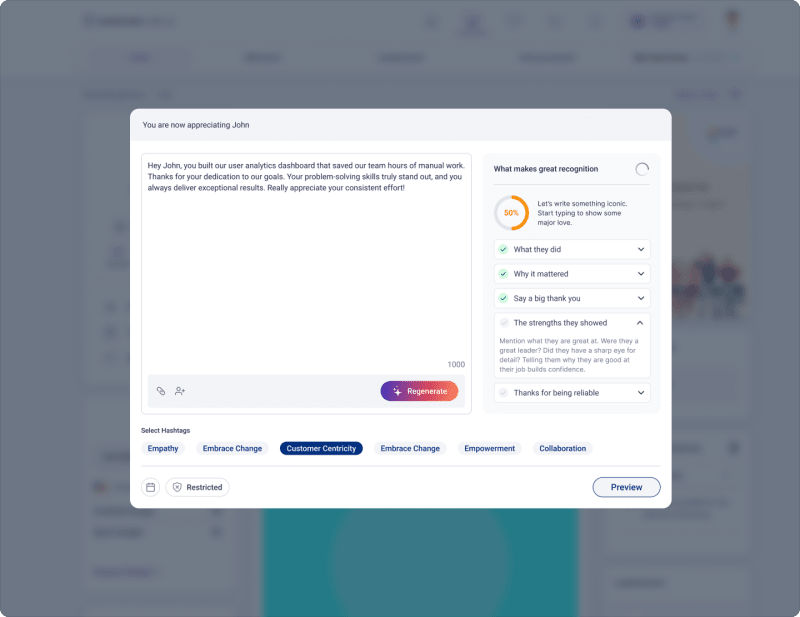
| Recognition Habits | Recognize a peer's specific contribution in writing at least once a week, naming the behavior and its impact rather than just the outcome | Build recognition into the team's rhythm around project milestones, not only year-end reviews or annual awards |
| Self-Regulation Check-Ins | Before a high-stakes conversation, pause and name the emotion you are walking in with | Apply an overnight rule to difficult written communications: draft and revisit the next morning before sending; model this openly so the team adopts it too |
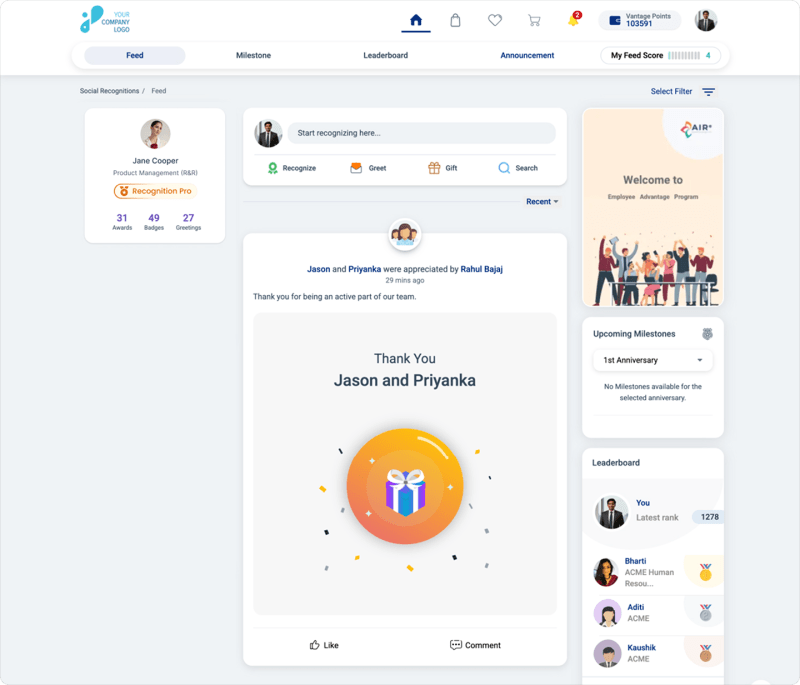
The recognition habit is the most underestimated of the 4. Empathy is difficult to teach as an abstract concept but easier to practice when recognition is built into the team's rhythm. Vantage Circle's State of Recognition and Rewards 2025 found that employees who receive consistent, meaningful recognition report 18 percentage points higher motivation and 16 percentage points higher intent to stay.
At a global digital infrastructure company operating across 190+ countries, recognition had been primarily manager-driven with little peer-to-peer visibility. After implementing Vantage Circle, peer-to-peer recognition increased by 185%, with one recognition happening every two minutes across the workforce. When these capabilities are built into the daily rhythm rather than reserved for performance reviews, teams demonstrate them at scale. Read the case study.
Vantage Circle's recognition platform supports exactly this model: peer-to-peer and manager recognition tied to specific behaviors and company values, visible to the whole team rather than delivered in private where it cannot build culture.
Tracking recognition frequency, pulse sentiment, and eNPS over rolling quarters offers a proxy for how effectively teams are communicating and responding to friction. A team where recognition is frequent, specific, and evenly spread is practicing EI at a cultural level.
Signs of High (and Low) Emotional Intelligence at Work
High EI is visible in daily behavior well before it appears in performance reviews.
Signs of high emotional intelligence at work:
- Gives feedback that is specific, behavioral, and timed for when the recipient can absorb it
- Asks clarifying questions before forming a judgment in a conflict
- Recognizes when their emotional state is affecting their judgment and names it before acting
- Adjusts how they communicate based on what works for each person
Signs of low emotional intelligence at work:
- Reacts to feedback by defending or deflecting rather than listening first
- Defaults to blame during setbacks rather than engaging with root cause
- Interrupts or dismisses contributions in group settings
- Holds workplace relationships at a surface level, avoiding friction rather than resolving it
- Behaves inconsistently depending on who is watching
The clearest signal of low EI in a manager is that inconsistency. When a team cannot predict how their manager will respond, they stop bringing real problems to them.
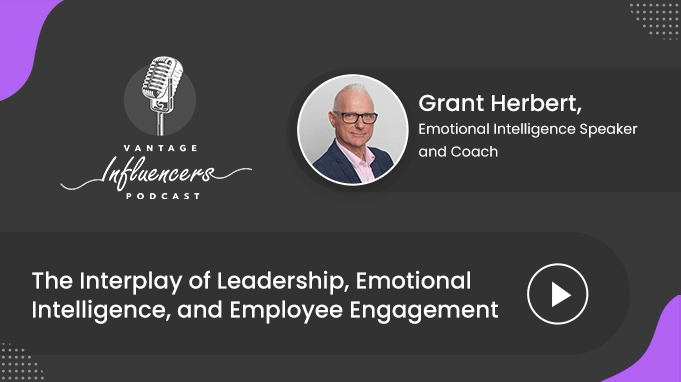
Vantage Influencers Podcast
"An emotionally intelligent leader will provide an environment where people will engage themselves."
— Grant Herbert, Founder & Global Managing Partner, People Builders
Listen to the EpisodeFrequently Asked Questions
What are the 5 C's of emotional intelligence?
There is no single standardized version of the 5 C's. One common practitioner shorthand maps loosely onto Goleman's framework: Self-Awareness (sometimes called Consciousness), Composure (self-regulation), Compassion (empathy), Communication (social skills), and Commitment (motivation). The labels vary by trainer and context. Goleman's original five-component model is more widely used in academic and organizational research; the 5 C's format circulates more in coaching and management training.
What are 7 signs of low emotional intelligence?
The 7 most observable signs of low EI in the workplace are: reacting to feedback with defensiveness or blame rather than listening first; difficulty sustaining collaborative working relationships over time; poor listening skills, including talking over others or redirecting conversations; trouble recognizing when your emotional state is affecting your judgment; taking criticism as a personal attack rather than as information; inconsistent behavior depending on who you are speaking to or what the stakes are; and struggling to name or describe your own emotions when under pressure.
Can you give me 10 examples of emotional intelligence?
10 concrete examples of EI in practice:
- A manager delivers critical feedback privately rather than in a team setting.
- An employee pauses before replying to a sharp email.
- A team lead checks in with a quiet colleague rather than assuming disengagement.
- A leader acknowledges a wrong call in a retrospective.
- An HR director names the emotional difficulty of a restructure before delivering the logistics.
- A peer recognizes a colleague by naming the specific behavior and its impact, not just the result.
- A manager adjusts their communication style based on what works for each direct report.
- An employee acknowledges feeling nervous before a presentation rather than performing false confidence.
- A team agrees on how to raise disagreements before a project starts.
- An employee asks for clarification before forming a judgment in a conflict.
Conclusion
Emotional intelligence is a skill set, not a fixed trait. It improves with deliberate practice and shows up not in what people say about themselves in annual reviews, but in how they give feedback, handle conflict, and recognize one another in the moments that matter.
Organizations that build EI into their team rhythm, through structured feedback, specific recognition, and tools that make those practices consistent, are the ones where it compounds over time rather than staying a training-day concept.
Vantage Circle's recognition and feedback tools help teams practice emotional intelligence consistently, not just talk about it. See how peer recognition, 360-degree feedback, and anonymous pulse surveys make EI visible and measurable at the team level.

Supriya is a Content Marketing Lead at Vantage Circle, where she writes on employee engagement, recognition, workplace communication, and culture. She spent the earlier part of her career in corporate communications at Burson, ESPN Star Sports, and CBRE, advising organizations on the messages employees actually hear.
Connect with Supriya on LinkedIn.