

Most pulse surveys ask the wrong questions. They measure what's easy to measure such as satisfaction scores, happiness ratings, generic sentiments. However, they often miss what actually matters: the early warning signs that a good employee is about to leave, the friction points that kill engagement, or the culture gaps that undermine your strategy.
The truth is, generic questions give generic insights. And generic insights don't truly drive action. HR leaders end up with dashboards full of data but no clear path forward, no obvious next step, no reason to invest in change. This guide flips that approach. Instead of collecting opinions, we're uncovering the friction points, opportunities, and patterns that point to real interventions. Each of the 35 questions here is built around one simple rule: if a low score wouldn't trigger a specific action or conversation, the question doesn't belong on your survey.
What Is a Pulse Survey?
A pulse survey is a quick and frequent questionnaire designed to gather real-time feedback from employees on specific topics. Unlike those lengthy annual engagement surveys that can have over 50 questions and take weeks to analyze, pulse surveys usually consist of just 5 to 15 questions, providing valuable insights in just a few days.
According to Gallup research, organizations that conduct frequent employee surveys see 14.9% lower turnover rates and 10% higher customer loyalty scores compared to those relying solely on annual surveys.
Why Pulse Survey Questions Matter for HR Leaders
The quality of your pulse survey questions directly determines the quality of insights you receive. Poorly worded questions produce ambiguous data that HR cannot act on. Well-crafted questions, however, reveal specific intervention points.
Consider these scenarios:
- Vague question: "Are you satisfied with your job?" → Low score tells you nothing specific to fix.
- Actionable question: "Do you have the tools and resources needed to do your job effectively?" → Low score signals a resource allocation problem HR can address.
Strategic benefits of well-designed pulse survey questions:
Real-time insights: Pulse surveys offer a continuous stream of employee feedback, allowing organizations to monitor and respond to sentiment, satisfaction, and engagement levels in real-time rather than waiting for annual survey cycles.
Improved Employee Engagement: Regular check-ins demonstrate that the organization values employee voices, fostering a sense of involvement and commitment, which can lead to higher engagement and retention rates.
Agility and Responsiveness: Frequent pulse surveys enable organizations to quickly identify and address emerging issues or concerns before they escalate, promoting a more agile and responsive approach to improving the employee experience.
Data-driven decision-making: Pulse surveys provide a wealth of data-driven insights to inform strategic decisions around policies, programs, and initiatives to enhance employee satisfaction, well-being, and engagement.

How to Choose the Right Pulse Survey Questions

Selecting the right pulse survey questions requires strategic thinking about what HR needs to measure and act upon.
1. Determine the Objective
Before drafting questions, establish clear goals for what you want to learn from the survey. Common objectives include measuring engagement levels, gauging satisfaction with management, identifying pain points, or gathering feedback on specific policies or initiatives. Aligning your questions to your objectives will ensure you obtain actionable data.
2. Choose Specific, Direct Questions
Vague or ambiguous questions can lead to unreliable data. Frame questions clearly and straightforwardly, leaving no room for interpretation. For example, instead of asking, "How satisfied are you?" try to ask, "On a scale of 1-5, how satisfied are you with our training opportunities?"
3. Decide on Open-Ended vs. Scaled Questions
Open-ended questions allow for deeper insights but can be time-consuming to analyze. Closed-ended questions with rating scales (e.g., Likert scales) provide quantifiable data but lack nuance. Often, the best approach blends both:
- Open-ended: "What could we do to improve the onboarding process for new hires?"
- Likert Scale: "On a scale of 1-5, how clear are you about your career path at our company?" (1 = Not at all clear, 5 = Very clear)
- You can even pair scaled and open-ended items: "If you rated your satisfaction lower than a 4, please explain why."

The key is keeping the survey focused and strategic - ask only what you truly need to know. Don't overload employees with too many questions, which could lead to survey fatigue and lower response rates. The ideal length of a pulse survey is between 5-15 questions!
According to SHRM research, surveys with 10 or fewer questions have 30% higher completion rates than longer surveys.
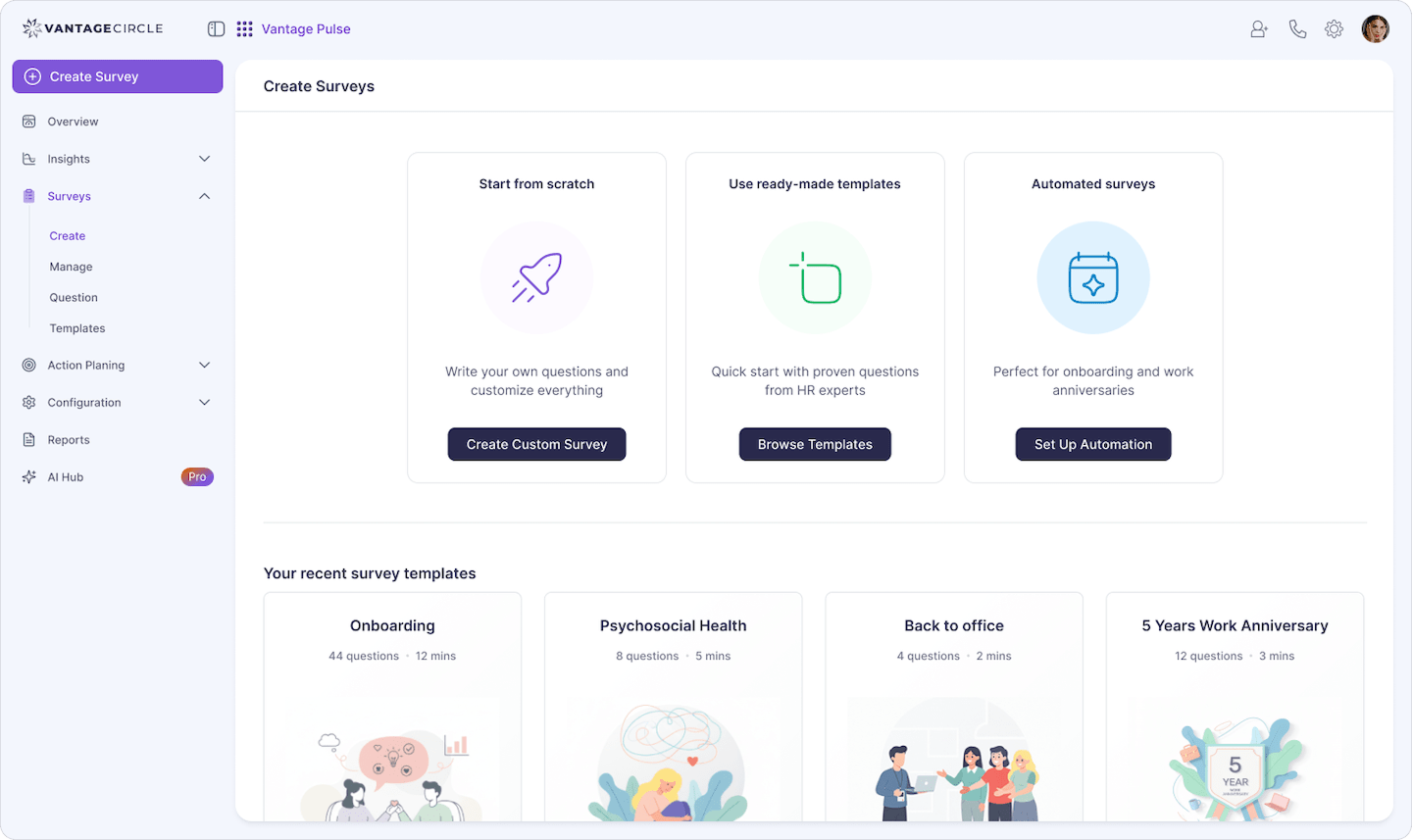 Vantage Pulse survey creation dashboard lets HR leaders build and launch pulse surveys across engagement, onboarding, and custom employee experience touchpoints.
35 Pulse Survey Questions by Category
Employee pulse surveys are a type of employee engagement survey that organizations use to evaluate the overall employee experience by collecting relevant feedback from the workforce.
It is a quick, simple, and effective way to improve employee engagement by assessing the organization's strengths and weaknesses. A good employee pulse survey will assist you in measuring employee engagement by analysing your workplace's strengths and weaknesses. It allows you to see real-time insights by analysing engagement trends over time.
Quick Reference: All 35 Questions
| # | Question | Category | Scale Type |
|---|---|---|---|
| 1 | Do you think that your work and contributions are valued by the company? | Employee Experience | Likert 1-5 |
| 2 | How likely is it that you would recommend this company to your friends, family, or others? | Employee Experience | eNPS 0-10 |
| 3 | How frequently do you feel stressed or burnt out due to your work? | Employee Experience | Likert 1-5 |
| 4 | Are you satisfied with the job security that the company provides? | Employee Experience | Likert 1-5 |
| 5 | Do you think you have a good work-life balance in your current position at the company? | Work-Life Balance | Likert 1-5 |
| 6 | Do you believe the company has a reasonable leave policy that meets your needs? | Work-Life Balance | Likert 1-5 |
| 7 | Do you frequently miss significant life events because of office hours or work obligations? | Work-Life Balance | Yes/No |
| 8 | Do you feel that your manager is transparent and fair with the decisions they make? | Leadership | Likert 1-5 |
| 9 | How strongly do you agree that your manager gives your opportunities to grow and develop? | Leadership | Likert 1-5 |
| 10 | How satisfied are you with the current leadership style of this company? | Leadership | Likert 1-5 |
| 11 | How satisfied are you with your current compensation and benefits package? | Compensation | Likert 1-5 |
| 12 | Do you feel that you are suitably incentivized for putting up a great performance? | Compensation | Likert 1-5 |
| 13 | How likely are you to choose great benefits over greater pay? | Compensation | Likert 1-5 |
| 14 | Do you think that the current company culture is diverse & inclusive enough? | Diversity & Inclusion | Likert 1-5 |
| 15 | How likely is it that a new diverse employee will feel welcomed and safe at this company? | Diversity & Inclusion | Likert 1-5 |
| 16 | How confident are you that the current pay, benefits, or compensation being offered to you is not based on discrimination? | Diversity & Inclusion | Likert 1-5 |
| 17 | How strongly do you feel connected to the company values and mission? | Company Culture | Likert 1-5 |
| 18 | Do you feel that the current work environment is positive, healthy, and conducive to your success? | Company Culture | Likert 1-5 |
| 19 | In your opinion, would you consider the company to be innovative and dynamic? | Company Culture | Likert 1-5 |
| 20 | How strongly do you agree that your manager offers valuable and timely feedback about your performance? | Internal Communications | Likert 1-5 |
| 21 | How frequently do you think the company keeps you up to date on major developments and decisions? | Internal Communications | Likert 1-5 |
| 22 | Do you feel like there is a transparent and honest communication flow happening between you and your peers? | Internal Communications | Likert 1-5 |
| 23 | Are you comfortable approaching your manager about any work-related issues or mistakes? | Internal Communications | Likert 1-5 |
| 24 | Do you see yourself working in this company 5 years from now? | Career Goals | Likert 1-5 |
| 25 | Do you feel that this company supports and advances your career journey? | Career Goals | Likert 1-5 |
| 26 | How often do you get to put your skills and knowledge to use in your current job role? | Career Goals | Likert 1-5 |
| 27 | According to you, how effective was remote or hybrid work for increasing your productivity? | Flexibility & Remote | Likert 1-5 |
| 28 | Do you think that this company should shift permanently to a remote or Hybrid arrangement? | Flexibility & Remote | Yes/No |
| 29 | Do you think that remote work has made you feel more connected to your team members? | Flexibility & Remote | Likert 1-5 |
| 30 | How often does your manager acknowledge or appreciate you for doing a good job? | Rewards & Recognition | Likert 1-5 |
| 31 | Do you think your team celebrates each other's personal achievements in real-time? | Rewards & Recognition | Likert 1-5 |
| 32 | In your experience, do special milestones (such as work anniversaries) receive appropriate recognition from your peers and managers? | Rewards & Recognition | Likert 1-5 |
| 33 | Do you believe that your health and well-being are a top priority for the company? | Health & Well-being | Likert 1-5 |
| 34 | How often do you feel disconnected from your peers and manager? | Health & Well-being | Likert 1-5 |
| 35 | In your experience, how beneficial is the current corporate wellness program? | Health & Well-being | Likert 1-5 |
Employee Experience

Improving employee satisfaction is a tricky problem. However, understanding the drivers of employee engagement is the first step towards enhancing it. You can start by building a baseline of how your employees feel about their current employee experience by using these pulse survey questions.
1. Do you think that your work and contributions are valued by the company?
2. How likely is it that you would recommend this company to your friends, family, or others?
3. How frequently do you feel stressed or burnt out due to your work?
4. Are you satisfied with the job security that the company provides?
Work-Life Balance

Work schedules that are too rigid are a no-no for today's millennial workforce. The modern worker seeks to balance their professional and personal lives without hampering the other. However, this is easier said than done. That is why you should include more pulse survey questions that assess current work-life balance:
1. Do you think you have a good work-life balance in your current position at the company?
2. Do you believe the company has a reasonable leave policy that meets your needs?
3. Do you frequently miss significant life events because of office hours or work obligations?
Leadership

Here's the deal. A leader's job is not to tell someone what to do. It is the leader's responsibility to understand what is required, to listen to new perspectives, and to decide on the best course of action. Include some pulse survey questions like the ones below to help you understand whether you have influential leaders leading your team:
1. Do you feel that your manager is transparent and fair with the decisions they make?
2. How strongly do you agree that your manager gives your opportunities to grow and develop?
3. How satisfied are you with the current leadership style of this company?
Compensation And Benefits
Offering incredible compensation and benefits has always been a sure-fire way for businesses to keep employees (and potential employees) satisfied. But the benefits industry, which includes everything from huge bonuses to free snacks, can appear difficult and vast to navigate. That is why, with the help of these pulse survey questions, it is critical to understand what employees truly want from the company.
1. How satisfied are you with your current compensation and benefits package?
2. Do you feel that you are suitably incentivized for putting up a great performance?
3. How likely are you to choose great benefits over greater pay?
Diversity And Inclusion

Not surprisingly, today's modern workforce prioritizes diversity and inclusion when deciding where to work. Thus, unless you are serious about making some feasible changes to accommodate a diverse workforce, you will struggle to attract and retain the industry's star players.
The best way to start is to ensure that your company is as diverse and inclusive as you believe. We recommend that you begin by conducting a critical DE&I-based pulse survey with your employees.
1. Do you think that the current company culture is diverse & inclusive enough?
2. How likely is it that a new diverse employee will feel welcomed and safe at this company?
3. How confident are you that the current pay, benefits, or compensation being offered to you is not based on discrimination?
Company Culture

When several competitors are offering exorbitant salaries, incredible perks, and benefits to top talent, an amazing company culture is the one factor that will set a company apart. While perks and benefits are nice, shiny, and sought, culture is one of the cornerstones of your business. That is why it is critical to determine whether your company culture inspires your employees to bring their best selves to work:
1. How strongly do you feel connected to the company values and mission?
2. Do you feel that the current work environment is positive, healthy, and conducive to your success?
3. In your opinion, would you consider the company to be innovative and dynamic?
Internal Communications
Strong internal communication is a powerful medium to bridge the gap between the cultural, geographical, and other diversity that every employee brings to the workplace. It can bring people together and motivate them to work towards a common goal— which is the growth and success of the company.
In today's world of work-from-home stints, it's vital to keep communication flowing smoothly, quickly, and efficiently. Here are some sample pulse survey questions to assist you in getting the feedback you need from your employees:
1. How strongly do you agree that your manager offers valuable and timely feedback about your performance?
2. How frequently do you think the company keeps you up to date on major developments and decisions?
3. Do you feel like there is a transparent and honest communication flow happening between you and your peers?
4. Are you comfortable approaching your manager about any work-related issues or mistakes?
Career Goals
A significant component of an employee's professional life is timely training and career development. Without it, the fundamental motive for working is debatable. Especially in today's competitive market, employees are always looking to upskill and progress quickly. To keep in tune with their career expectations, HR leaders can ask the following pulse survey questions:
1. Do you see yourself working in this company 5 years from now?
2. Do you feel that this company supports and advances your career journey?
3. How often do you get to put your skills and knowledge to use in your current job role?
Flexibility And Remote Working

When it comes to remote work, the dreaded efficiency slump becomes even harder to manage. Without face-to-face interaction, discussions, or meetings, it is difficult to predict, diagnose, and manage the inevitable drop in productivity. As an HR professional, you must first ask your employees about their thoughts on remote work experiences using the following pulse survey questions:
1. According to you, how effective was remote or hybrid work for increasing your productivity?
2. Do you think that this company should shift permanently to a remote or Hybrid arrangement?
3. Do you think that remote work has made you feel more connected to your team members?
Rewards And Recognition

Recognizing an employee can boost productivity, reduce employee turnover, and inspire loyalty. Thus, to attract and retain top talents, rewards and recognition must be considered an organizational necessity.
When it comes to getting appreciated, employees want it to be instantaneous, public, and impactful. If you are an HR leader, it is critical to ask your employees whether they are being recognized in a meaningful manner:
1. How often does your manager acknowledge or appreciate you for doing a good job?
2. Do you think your team celebrates each other's personal achievements in real-time?
3. In your experience, do special milestones (such as work anniversaries) receive appropriate recognition from your peers and managers
Health And Well-being

According to a Deloitte report, while 80 percent of companies said employee well-being would be important or very important for their success over the next 12-18 months, only 12 percent said they were very prepared to address this issue.
The first step is to take the relevant feedback from people who'll actually be affected by the health plan. Your employees. Here are some pulse survey questions that will help you understand the current state of your company's employee wellness:
1. Do you believe that your health and well-being are a top priority for the company?
2. How often do you feel disconnected from your peers and manager?
3. In your experience, how beneficial is the current corporate wellness program?
Pulse Survey Examples: 3 Ready-to-Use Templates
Here are three ready-to-deploy pulse survey templates you can customize for your organization. Each template is designed for a specific cadence and purpose.
Template 1: Quick Weekly Pulse (3 Questions)
Purpose: Fast sentiment check-in for weekly monitoring
When to use: Best for organizations wanting real-time sentiment tracking without survey fatigue.
| # | Question | Scale |
|---|---|---|
| 1 | On a scale of 0-10, how likely are you to recommend this company as a great place to work? | eNPS 0-10 |
| 2 | I have the tools and support I need to do my job effectively this week. | Likert 1-5 |
| 3 | What one thing could we improve to make your work easier next week? | Open-ended |
Recommended cadence: Every Friday or end of sprint
Analysis tip: Track eNPS trends week-over-week. A drop of 2+ points signals a potential issue worth investigating.
Template 2: Monthly Engagement Pulse (8 Questions)
Purpose: Comprehensive monthly check-in covering engagement, leadership, and culture
When to use: Ideal for most organizations seeking balanced insight without overwhelming respondents.
| # | Question | Scale |
|---|---|---|
| 1 | I feel my work is valued by my manager. | Likert 1-5 |
| 2 | I have clarity on what is expected of me in my role. | Likert 1-5 |
| 3 | My manager provides timely and constructive feedback. | Likert 1-5 |
| 4 | I have opportunities to learn and grow in my role. | Likert 1-5 |
| 5 | I can maintain a healthy work-life balance here. | Likert 1-5 |
| 6 | I feel comfortable speaking up with ideas or concerns. | Likert 1-5 |
| 7 | I see myself working here two years from now. | Likert 1-5 |
| 8 | What would make you more likely to stay with this company long-term? | Open-ended |
Template 3: Quarterly Deep Dive (15 Questions)
Purpose: Comprehensive assessment across all engagement drivers
When to use: Best for quarterly strategic reviews, annual planning input, or pre/post-initiative measurement.
| # | Question | Category | Scale |
|---|---|---|---|
| 1 | My work contributions are valued by the company. | Employee Experience | Likert 1-5 |
| 2 | I would recommend this company as a great place to work. | Employee Experience | eNPS 0-10 |
| 3 | I experience manageable stress levels in my role. | Work-Life Balance | Likert 1-5 |
| 4 | The company's leave policy meets my needs. | Work-Life Balance | Likert 1-5 |
| 5 | My manager is transparent and fair in decisions. | Leadership | Likert 1-5 |
| 6 | My manager provides growth opportunities. | Leadership | Likert 1-5 |
| 7 | My compensation is fair for my role and performance. | Compensation | Likert 1-5 |
| 8 | The company culture is diverse and inclusive. | Diversity & Inclusion | Likert 1-5 |
| 9 | I feel connected to the company mission. | Company Culture | Likert 1-5 |
| 10 | My manager provides timely performance feedback. | Internal Communications | Likert 1-5 |
| 11 | Company communications are transparent and honest. | Internal Communications | Likert 1-5 |
| 12 | This company supports my career growth. | Career Goals | Likert 1-5 |
| 13 | I use my skills effectively in my current role. | Career Goals | Likert 1-5 |
| 14 | I receive meaningful recognition for good work. | Rewards & Recognition | Likert 1-5 |
| 15 | What single change would most improve your employee experience? | Open-ended | Open-ended |
Recommended cadence: End of each quarter (March, June, September, December)
Analysis tip: Use quarterly results for strategic planning. Compare quarter-over-quarter to measure initiative impact.
Tips for Running Effective Pulse Surveys
By examining the strengths and shortcomings of your workplace, a good employee pulse survey help you see how the employees' experience is. It allows you to see real-time information by looking at engagement trends over time.
The survey data shows the changes in employee sentiments, allowing you to conclude whether a new action plan is working or failing. This type of analysis aids in determining not only engagement levels, but also other areas such as employee attrition.
1. Anonymity is the Key
Ensuring anonymity in a pulse survey encourages honest feedback from employees. When employees trust their responses cannot be traced back to them, feedback quality improves significantly. Best practice is fully anonymous surveys with minimum response thresholds before results are displayed.
According to Harvard Business Review, anonymous surveys receive 3x more candid feedback about management issues than identified surveys.
2. Communicate Results and Action
After collecting survey responses, it's important to communicate the findings to employees and take action based on the feedback received. Sharing the findings showcases transparency and reinforces to employees that their input is valued and acted upon.
3. Track and Analyse Trends Over Time
Being consistent in conducting pulse surveys holds the key to getting the best results. Regularly conducting pulse surveys allows you to track trends in employee sentiment over time. By analyzing data from multiple survey rounds, HR can identify patterns, monitor changes, and assess the effectiveness of interventions or initiatives implemented in response to previous surveys.
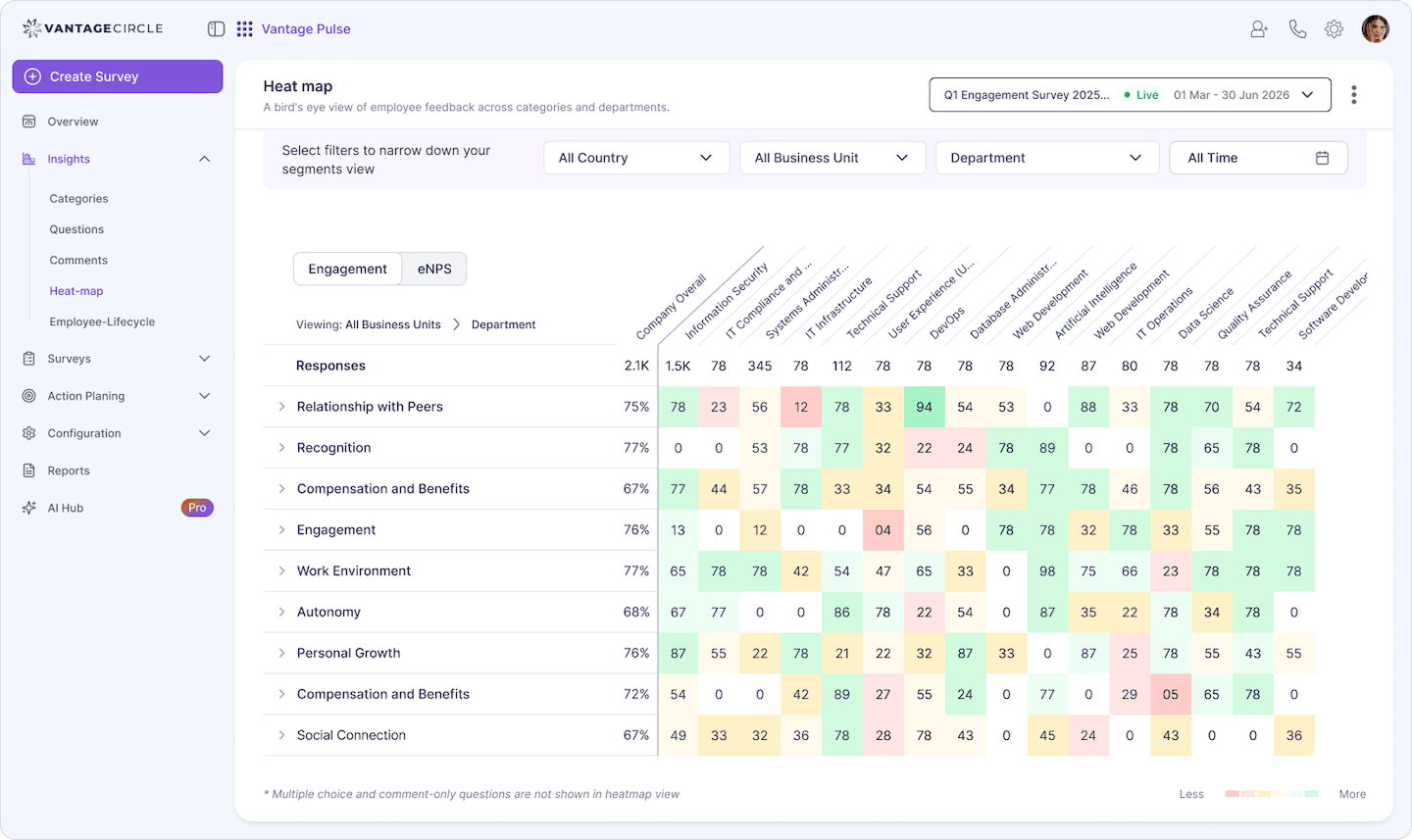 Vantage Pulse feedback heatmap shows sentiment intensity across themes, helping HR quickly identify areas that need attention.
These days survey platforms offer customizable survey templates; employee Net Promoter Score; exhaustive reporting to make your life easier. Some pulse surveys, such as Vantage Pulse, go a step further by calculating real-time department-level engagement scores. This feature assists you in determining why certain teams are highly engaged while others are not.
Implementing these tips will not only enhance the effectiveness of your pulse surveys but also contribute to a more engaged, informed, and responsive workplace culture.
Recommended Read: 10 Best 360 Degree Feedback Software 2024
Frequently Asked Questions About Pulse Surveys
Q: What questions are asked in a pulse survey?
A: Pulse surveys typically include questions across five categories: employee experience, work-life balance, leadership effectiveness, diversity and inclusion, and personal growth. The best pulse survey questions use a mix of Likert scale (1-5), eNPS scale (0-10), and open-ended formats to capture both quantitative scores and qualitative feedback.
Q: How do you write a good pulse survey question?
A: A good pulse survey question is specific, actionable, and tied to an HR outcome. Avoid double-barreled questions (asking two things at once). Use a consistent scale so responses are comparable over time. Each question should map to something HR can act on — if you cannot imagine what action a low score would trigger, the question is not worth asking.
Q: How many questions should a pulse survey have?
A: The ideal pulse survey has 5-15 questions. Weekly pulse checks work best with 3-5 questions. Monthly surveys can include 8-12 questions. Going beyond 15 increases survey fatigue and reduces response rates.
Q: Are pulse surveys anonymous?
A: Best practice is fully anonymous. When employees trust their responses cannot be traced back to them, feedback quality improves significantly. Survey platforms like Vantage Pulse enforce anonymity at the platform level with minimum response thresholds before results are displayed.
Q: How often should you run a pulse survey?
A: Most organizations run pulse surveys monthly or quarterly. Weekly surveys work for short 3-5 question checks. The key is consistency — running surveys at a regular cadence lets HR track trends over time and identify engagement shifts early.
Conclusion
As 2026 unfolds, the need for organizations to have a pulse on employee engagement and sentiment is more pressing than ever before. Implementing an effective employee pulse survey program allows HRs to gather frequent, candid feedback from their workforce. This real-time data empowers HR teams to quickly course-correct any issues impacting motivation or job satisfaction.
The 35 pulse survey questions in this guide provide a foundation for building surveys that generate actionable insights. Start with the templates provided, customize them for your organization's context, and commit to acting on what you learn. Because pulse surveys without follow-up action are worse than no surveys at all—they erode trust.
For HR leaders ready to implement a modern pulse survey program, platforms like Vantage Pulse offer ready-to-use templates, real-time analytics, and department-level insights that turn feedback into action.
Written by