
A morning meeting once changed the way I looked at motivation.
Our team was going through a difficult phase. Deadlines were slipping, energy was low, and morale had clearly taken a hit. In the middle of that discussion, our CEO turned to me and asked, "What would keep you moving forward: a bonus for hitting your target, or a thank-you for going above and beyond?"
That question stayed with me.
It made me think about motivation from both sides: as an employee who wanted to feel valued, and as a team lead trying to inspire others. Over time, I realized that incentives and rewards both matter, but they do not work in the same way. Incentives push people toward a future goal. Rewards recognize what they have already done.
And this is where many HR teams get stuck.
In this blog, we will break down the difference between incentives and rewards, when to use each, and how using both together can help drive performance while making employees feel genuinely appreciated.
Incentive vs Reward: Key Differences at a Glance
| Dimension | Incentive | Reward |
|---|---|---|
| Timing | Offered before the desired action | Given after the action is completed |
| Purpose | Motivates a specific future behavior | Recognizes a past achievement |
| Trigger | A pre-announced goal or condition | A completed behavior or outcome |
| Example | Sales commission for hitting a quarterly target | Employee of the Month award |
| Emotion | Anticipation, ambition | Appreciation, pride |
| Risk | Can create entitlement if poorly designed | Loses impact if delayed or generic |
| Best for | Driving specific results within a timeframe | Reinforcing values and building lasting loyalty |
What is an Incentive?
Incentives are tools designed to inspire and encourage employees to take action, exert effort, and drive them toward achieving specific goals. They are pre-determined offerings promised beforehand that create anticipation among employees and drive them to take specific actions to meet certain behaviors and outcomes.
Incentives are not strictly limited to rewarding past performance but are more oriented toward motivating employees to strive for something in the future.
Here are 5 core characteristics of incentives:
- Proactive: Incentives ignite a sense of proactiveness among employees, setting the stage for them to act promptly and achieve the desired outcome.
- Conditional (If-Then): They are linked directly to performance. For example, "If you hit this target, then you'll receive a bonus."
- Time-bound: They are often time-bound, requiring employees to meet specific criteria within a set timeframe.
- Goal-oriented: Incentives are tied to clear and tangible objectives that both the company and employees value.
- Designed to stimulate effort: The central goal of incentives is to drive effort, pushing employees to go above and beyond.
Types of Incentives (with examples)
Workplace incentives fall into 4 main categories:

- Monetary incentives: These include sales commissions, cash bonuses, and profit-sharing programs that directly reward employees for their achievements.
- Non-monetary incentives: These cover flexible work hours, extra time off, or additional training opportunities. They are particularly appealing to employees seeking work-life balance or career growth.
Recommended Resource: 18 Non-monetary Incentives to Motivate your Employees
- Individual incentives: These are designed to recognize individual performance. The bonuses are tied to personal key performance indicators (KPIs), and personalized rewards are tailored to employee preferences.
- Team-based incentives: These are designed to encourage collaboration and team achievement, including group bonuses for achieving shared targets or completing projects successfully as a team.
Recommended Resource: 7 Impactful Ways to Design a Team-Based Rewards Program
| Incentive | Use case |
|---|---|
| Sales commission | Motivates reps to close deals above a set monthly target |
| Performance bonus | Rewards a team that delivers a product launch ahead of schedule |
| Extra paid time off | Drives participation in a company wellness challenge |
| Stock options | Retains senior employees by tying compensation to long-term company growth |
| Training sponsorship | Encourages skill development aligned to a new role or team expansion |
| Profit-sharing | Connects individual effort to the company's financial outcome each quarter |
Recommended Resource: 25 Employee Incentive Examples for HR Leaders That Actually Works
What is a Reward?
Rewards are reactive tools that are offered in response to achieving desired behaviors or outcomes. They serve as a recognition of the employees' service, efforts, performance, achievements, and behaviors.
Rewards play a pivotal role in reinforcing behaviors that suitably align with organizational values and objectives.
Here are 3 core characteristics of rewards:
- Post-performance: They are conferred in response to completed tasks or achievements.
- Recognition-focused: Rewards are prioritized to recognize and value employees' contributions by highlighting their accomplishments.
- Tangible or intangible: Rewards can take multiple forms, either tangible or intangible, such as monetary bonuses or emotional recognition. It depends on what resonates most with employees.
Research from Loyola University Chicago found that intangible rewards like purpose, growth, and recognition often have a stronger impact on engagement than tangible perks.
Types of Rewards (with examples)
Here are some examples of impactful rewards you can use by aligning them with individual preferences and organizational goals.
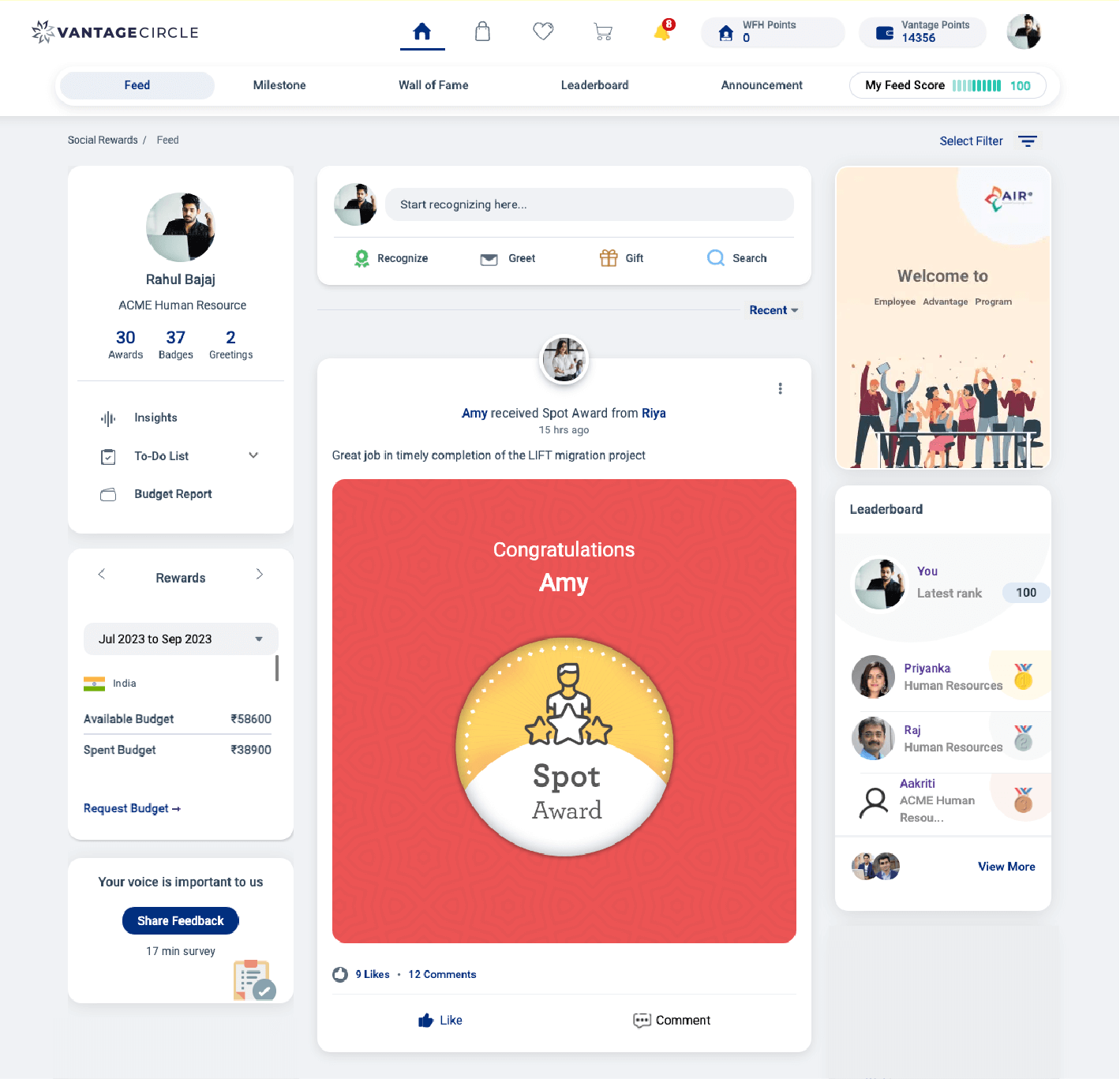
- Public recognition: This is intended to acknowledge an employee's achievements in front of their team or across the company, during town hall meetings or company-wide communications. Public recognition boosts pride among employees, and it particularly reinforces the behavior that earned them recognition in the first place.
Source: Vantage Recognition
- Personal appreciation: A personal "thank you" or a note of appreciation can go a long way in boosting employee motivation. Personal acknowledgment helps build trust and strengthen individual relationships.
- Spot awards: These awards are given on the spot to employees for demonstrating exceptional performance or going above and beyond. They are immediately and spontaneously conferred without delay, making them more impactful.

Source: Vantage Recognition
- Career development opportunities: Growth-oriented options such as workshops, mentorship, and additional training serve as a reward for employees seeking to advance their careers.
- Unique experiences: Rewards need not always be tangible or materialistic. Unique experiences, such as a vacation, a company retreat, or tickets to an event, add another layer of joy, making employees feel valued and giving them something to reflect on.
- Personalized gifts: Customizing gifts to an employee's personal preferences is yet another thoughtful approach to rewards. Whether it is a gift card, a hobby-related item, or something tailored to their interests, it demonstrates genuine recognition of individual tastes.
Recommended Resource: Types of Rewards for Employees: What Enterprise Data Reveals
When to Use an Incentive vs a Reward
Understanding which tool fits best depends on whether the behavior you want has already happened or still needs to happen.
Use an incentive when:
- You want to achieve a clear, time-bound goal: a sales target, a project milestone, a wellness program completion rate
- The desired behavior has not yet occurred, and you need to motivate it before a deadline
- You must direct your focused effort across a team toward a single measurable outcome
- Speed and urgency matter here because the time-bound structure of an incentive creates momentum that an open-ended reward cannot
Use a reward when:
- An employee has already demonstrated exceptional behavior or exceeded expectations
- You want to reinforce a specific action or behavior so that you see repeated instances of it
- You want to build long-term loyalty and signal that quality work is noticed and valued
- The contribution was spontaneous and not tied to a pre-set goal
A comprehensive study reported that incentive programs running for a year or more led to an average 44% increase in performance.
Decision Framework
| Situation | Use |
|---|---|
| New sales cycle starts and you need to hit a quarterly target | Incentive |
| An employee went above expectations on a project already delivered | Reward |
| Team wellness initiative needs 80% participation by month end | Incentive |
| A peer nominates a colleague for outstanding cross-team collaboration | Reward |
| A new hire needs to complete onboarding training within 30 days | Incentive |
| An employee reaches a 5-year long-service milestone | Reward |
Using Incentives and Rewards Together
Programs considered to be the strongest often pair a pre-action incentive with post-action recognition. While one motivates, the other reinforces. Using only one gives you half the impact.
By adopting a balanced approach that integrates the two, you can create a comprehensive motivation strategy that ensures employees remain engaged, focused, and motivated across different stages of performance.
The key is to understand that incentives motivate employees to achieve specific goals, while rewards are recognition for accomplishing those goals. When you blend the two, employees benefit from both.
Example scenario:
Consider a sales team. A company sets up an incentive where the team gets a bonus if they hit a sales target for a particular quarter. This incentive ignites the team to work harder, collaborate, and achieve results.
Once the target is met, the company also rewards the top performer with recognition, such as "Employee of the Quarter," or offers an exceptional experience, a team lunch, or a personalized gift.
The incentive spurred the effort and action to meet the target, while the reward recognized and celebrated the top performer's exceptional strategy and execution. This combination not only drives results but simultaneously reinforces the value of teamwork, strategy, and individual contribution.
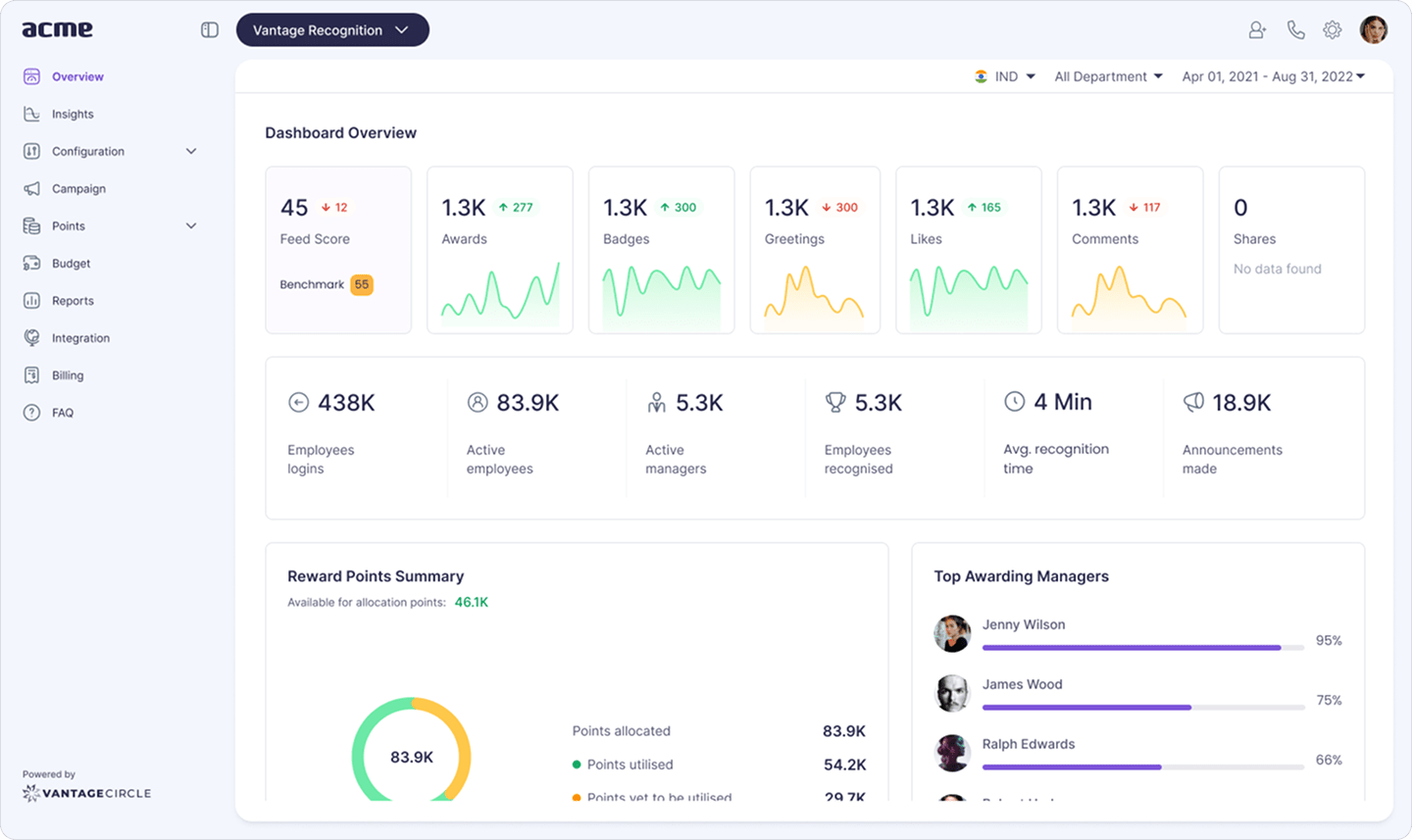
The strongest programs intentionally separate incentivization from recognition. The AIRe framework (Appreciation, Incentivization, Recognition, and emotional connect) is Vantage Circle's model for designing where each element belongs in your program. Assess your program with AIRe
Source: Vantage Recognition
The Psychology of Why Incentives and Rewards Change Behavior
Incentives and rewards work because they engage specific psychological mechanisms that shape how people make decisions and sustain effort over time. Understanding the underlying theory helps you design programs that hold up beyond the first cycle.
Extrinsic vs Intrinsic Motivation
At the core of incentives and rewards lies the concept of motivation, which falls into 2 types: extrinsic and intrinsic.
- Extrinsic motivation: This type of motivation is driven by external factors such as incentives or rewards. An employee can be motivated to meet a sales target because of the monetary bonus or a prize attached to it. This is the primary focus of most incentive and reward programs.
- Intrinsic motivation: In contrast, intrinsic motivation emanates from within. It is driven by personal satisfaction, enjoyment, or fulfillment of a task.
For example, an employee may take pride in delivering excellent performance for it values and seek joy from doing it well rather than seeking external validation.
Organizations are more prone to tapping into extrinsic motivation, but they must not undermine intrinsic motivation. If employees focus solely on external rewards, they may end up losing sight of the internal satisfaction that comes from contributing to meaningful work. In the long run, a balance between both motivations is the key to sustainable engagement.
Recommended Resource: Extrinsic Rewards: Definition, Types, Examples, and Benefits
Operant Conditioning (B.F. Skinner)
One of the foundational theories of behavioral psychology is B.F. Skinner's operant conditioning. The theory states that behaviors can be shaped by positive reinforcement.
- Positive reinforcement: Rewarding a desired behavior increases its repetition. In the context of employee motivation, rewards serve as positive reinforcement, strengthening the behaviors that contribute to organizational success.
- The promise of reward (incentives): Incentives tap into the anticipation of a reward. The promise of a future payoff motivates employees to perform tasks in a way that aligns with company goals, proactively shaping behavior before the outcome occurs.
Expectancy Theory (Victor Vroom)
Developed by Victor Vroom, expectancy theory is built on the belief that motivation is driven by the expectation that effort will lead to performance, which in turn leads to a reward. This theory is captured in the formula:
Effort → Performance → Reward
Employees are motivated to put in more effort when they believe their effort will contribute to a successful outcome and, ultimately, earn them a reward. In this model, incentives are the key motivators that create the belief that effort is recognized and met with a tangible result.
Self-Determination Theory (Deci and Ryan)
Self-determination theory (SDT), developed by Deci and Ryan, emphasizes the importance of 3 psychological needs in fostering intrinsic motivation: autonomy (control over one's actions), competence (being skilled at what you do), and relatedness (feeling connected to others).
When employees feel they have control over their actions, are skilled enough at what they do, and feel connected to others, they are more inclined to be intrinsically motivated.
Recommended Resource: Incentive Theory: Meaning, Psychology, Types and Implementation
Common Pitfalls (and How to Avoid Them)
Even well-intentioned incentive and reward programs can backfire. Here are 4 pitfalls you need to be vigilant of that consistently derail otherwise sound strategies:
Over-Reliance on Cash
Cash is the default, but it is also the most forgettable. A cash bonus lands in a bank account and disappears into the noise of daily expenses within days. Experiential and personalized rewards, such as a trip, a course in a field the employee cares about, or a recognition moment tied to a core value, are more memorable and more likely to be attributed to the employer long after the event.
Using cash as an incentive is beneficial when the financial calculation is the motivation. Use something more personal for rewards when you want the emotion of appreciation to sustain.
Recommended Resource: Cash vs Non-Cash Incentives: Types, Pros, Cons and Best Practices
Gaming the Metric
When you tie an incentive to a single measurable output, such as calls made, tickets closed, or units sold, employees can hit the number without delivering the outcome you wanted. If a call-center incentive rewards calls handled per hour, expect shorter calls than better ones. Design incentives around outcomes (customer satisfaction score, deal value, retention rate), not just activities, and include a quality gate alongside the quantity metric. Make sure that the incentive drives the result you need, not the number you measured.
Entitlement
Once a reward becomes predictable, it stops being a reward and starts being an expectation. If the same team receives a quarterly bonus every quarter without variation, you'll witness the motivational lift disappear by the second cycle.
This is what the psychology literature calls the over-justification effect: when external rewards become routine, employees stop associating the reward with exceptional performance and start treating it as a baseline entitlement.
Hence, it's necessary to introduce variations in form, timing, and the criteria to keep recognition meaningful and reserve the largest rewards only for genuine exceptional contributions.
One-Size-Fits-All Programs
A gift card that genuinely excites one employee might mean little to another. Monetary incentives motivate high performers in sales roles. Development opportunities motivate employees seeking career growth. Flexible time matters most to employees managing caregiving responsibilities.
As you can see, different reward programs cater to different preferences. Hence, effective programs segment by role, tenure, and individual preference rather than applying a single reward structure across an entire workforce. Using pulse data can give you a clear picture of what truly motivates each group, helping you design the program architecture.
Incentive vs Reward in HRM and Compensation
In Human Resource Management (HRM), incentives and rewards are both used to motivate employees, but they are not the same.
Incentives are part of an employee's variable pay. They are usually planned and communicated in advance. For example, an employee may receive a sales commission, annual bonus, or profit-sharing amount if they meet certain goals or KPIs. Since the employee already knows what they need to achieve to earn the payment, incentives are more formal and are often included in compensation plans, offer letters, or performance reviews.
However, incentives need to be designed carefully. If an incentive becomes regular or guaranteed, employees may start seeing it as part of their salary instead of something that motivates better performance.
Rewards, on the other hand, are usually part of employee recognition. They are not promised in advance. A reward is given after an employee does something valuable or meaningful. This could be public appreciation, a personalized gift, a long-service award, or peer recognition.
The main difference is that incentives are used to encourage employees to achieve a future goal, while rewards are used to appreciate employees for something they have already done.
In HRM, it is important not to mix the two. Incentives should have a separate budget under compensation or variable pay. And rewards should have a separate budget under recognition. They also need different success measures.
For example, a retention bonus is an incentive because it is offered in advance to encourage an employee to stay. But a long-service award is a reward because it appreciates an employee after they have completed a certain number of years with the company.
Conclusion
Incentives and rewards are both essential to a high-performing motivation strategy, but they are not the same tool. An incentive drives behavior before it happens; a reward reinforces it after.
Used together with intention, the incentive creates the goal, and the reward locks in the lesson. They build teams that are both focused and engaged. The most common mistake is using one word for both things and designing neither well. So, start by auditing whether your current programs are doing one job or both, and design the architecture accordingly.
FAQs
Is an Incentive a Reward?
Not exactly. An incentive is an offer made before an action to motivate it; a reward is recognition given after an action to acknowledge it. They overlap when the same thing — a bonus or a gift card — is used in both roles, but the timing and intent differ. An incentive creates the anticipation that drives behavior; a reward confirms that the behavior was valued. Using the terms interchangeably leads to programs that are neither motivating before the fact nor meaningful after it.
Are Incentives the Same as Rewards?
They serve the same general purpose of motivating people, but through opposite timing. Incentives work before the action by creating a goal to move toward. Rewards work after the action by reinforcing what already happened. Using the terms interchangeably leads to poorly designed programs: a reward called an "incentive" only after the fact loses the motivational pull of being pre-announced, and an incentive described as a "reward" retrospectively undermines the message that contributions are genuinely appreciated without conditions attached.
What are the 4 Types of Incentives?
The 4 main types of workplace incentives are:
- Monetary incentives — cash bonuses, commissions, profit-sharing schemes
- Non-monetary incentives — extra paid time off, flexible work arrangements, training opportunities
- Individual incentives — tied to personal performance targets and KPIs
- Team-based incentives — tied to collective outcomes such as project delivery or a shared sales target
What are the 4 Types of Rewards?
The 4 main types of workplace rewards are:
- Monetary rewards — spot bonuses, gift cards, cash recognition
- Non-monetary rewards — public praise, certificates, experiences, personal appreciation
- Social rewards — peer-to-peer recognition, team celebrations, company-wide acknowledgment
- Developmental rewards — training sponsorships, mentorships, career advancement opportunities

Riha Jaishi is a Content Marketing Specialist at Vantage Circle and host of the HR Vantage Influencers podcast, sharing insights that help organizations build recognition-rich, people-first cultures!!
Connect with Riha on LinkedIn.


