
The average US worker now commutes 27.2 minutes each way to work, according to the U.S. Census Bureau's 2024 American Community Survey. That works out to roughly 226 hours a year per person sitting in traffic, packed into a train, or waiting at a bus stop. Most of it gets written off as dead time. It does not have to be. The 10 tactics below cover what to do on the way in, organised by mode of transport, plus a section on how employers can fund the parts that scale beyond one person's habits.
What's the most productive way to use your commute to work?
The most productive commute uses the time intentionally for one of three things: preparing for the workday, learning, or recovering. Jachimowicz et al. (2017) in Harvard Business Review show that workers who use the commute to mentally transition into the work role report higher job satisfaction. Your mode of transport decides which intent is realistic on a given day.
Why a productive commute matters
The commute is back. The U.S. Census Bureau (2024) reports that 9.3% of American workers now have a one-way commute of 60 minutes or more, up from 8.9% the year before. Return-to-office mandates have pushed average commute times back near their pre-pandemic peak. What happens during that time matters. The Jachimowicz et al. HBR paper finds that commuters who plan their day on the way in report less commute-related strain and walk into work more focused. That is a workplace stress lever every employee can pull, and every HR team can support.
Here are ten ways you can make your daily commute to work a productive one -
1. Map out your day
If you do not drive yourself in, use the commute to plan the day. Build a short to-do list. Break the big tasks into smaller, named pieces. Decide which two or three items are non-negotiable before lunch.
The list does not have to be elaborate. A notes app or a paper notebook is enough. The point is to walk into the office with a plan, not to walk in and let the inbox decide your morning. The HBR research above identifies this kind of role-transition planning as one of the more effective ways to reduce commute strain.
2. Read a book or listen to an audiobook
Reading lowers stress and adds something new to the mental shelf at the same time. A motivational autobiography, a business title, or a science-fiction novel all count. Reading sharpens writing and expands vocabulary as a side effect.
If you take public transit, carry the book. If you drive, switch to an audiobook. Most public libraries now offer free audiobook borrowing through apps like Libby or Hoopla. The cost is zero and the habit compounds over a year.
3. Listen to a podcast
Podcasts work for almost every commuter, because they need only audio. Play one on your phone, your wireless earphones, or your car stereo. Pick one show on a craft you want to improve and one show on a topic that lifts your mood. Alternate.
The right show makes the commute feel shorter and sets a useful tone for the workday. For HR and people leaders, the top podcasts for managers list is a starting point. The Vantage Influencers Podcast library is another, with HR-specific conversations under 30 minutes each.
4. Take an online class
A 27-minute commute, twice a day, five days a week, is roughly 226 hours of learnable time in a year. That is enough to finish a full online course, with breaks. Platforms like Coursera, LinkedIn Learning, and Khan Academy ship recorded sessions that play offline. Many also let you adjust playback speed, which helps a commute-sized window.
Use the time to build the skill that gets you to the next role. Or to close a gap that has been bugging you for months. The pattern that works is one course at a time, finished, then the next. Treat the commute as the dedicated study slot. This is one practical form of continuous learning that fits into an existing schedule.
5. Catch up on the news
Social feeds are noisy and often inaccurate. The commute is a chance to switch to a slower, edited source. A newspaper app, a single trusted newsletter, or a public radio show all work. Limit it to one source, not five.
The goal is real situational awareness, not a flood. Twenty minutes of edited news beats two hours of feed scrolling. And it leaves you with something to actually talk about with colleagues.
6. Reflect on yourself
Use part of the commute to look back and look forward. What went well yesterday? What is one thing to change this week? Jennifer Porter's HBR piece on self-reflection argues that people who reflect regularly learn faster, decide better, and lead with more confidence than peers who skip the habit.
The commute is a rare unscheduled slot in most calendars. Treat 10 minutes of it as journalling time, even mentally. The questions do not have to be heavy. Asking "what did I learn yesterday" is enough.
7. Get a head start on work
Use the commute to triage email, scan an agenda, or sketch the first paragraph of a piece you need to write. The goal is not to add work hours. It is to land at your desk already inside the day, not warming up to it.
A writer can research the next post. An HR executive can review last week's pulse responses. A salesperson can re-read the brief on the morning's call. The result is the same. You walk in with one task already moved forward, which protects the rest of the day.
8. Meditate
Long commutes raise stress levels and crowd the mental space you need for the first hour of work. A short guided meditation during the commute pulls that back. The aim is not enlightenment. It is a reset before the first meeting.
Apps like Calm, Headspace, and Insight Timer have 10 to 25-minute sessions designed for transit. Save a few offline so the practice survives a subway tunnel. Reducing commute stress is closely linked to mental health at work, and a daily meditation slot is one of the cheapest interventions an employee can run on their own.
9. Get some sleep (public transit only)
If the commute is on a train, bus, or carpool, a 15 to 20-minute nap can recover real cognitive sharpness. CDC NIOSH guidance states that a brief nap can increase alertness for a couple of hours, with less grogginess than a longer one. Set a phone alarm so you do not miss the stop. Use noise-cancelling earphones if the carriage is loud.
This tip is for transit commuters only. If you drive or cycle to work, skip this one entirely. Drowsy driving is dangerous and is not a productivity hack.
10. Relax intentionally
Not every commute needs to be productive in the output sense. Sometimes the most useful thing the brain can do is decompress. Play music you actually like. Watch the scenery. Take slower, deeper breaths.
The trick is to make the relaxation deliberate, not accidental. Put the work notifications on do not disturb. Close the email tab. Treat the commute as a recovery slot for the bookends of a long day. Walking into the office tense is not a sign of commitment. It just costs the first hour of work.
Mode by mode: which tips fit which commute?
Not every tactic suits every commute. The table below maps the 10 tips to the three most common modes.
| Tip | Public transit | Driving solo | Walking or cycling |
|---|---|---|---|
| Map out your day | Yes | Voice notes only | Yes, voice notes |
| Read or audiobook | Read or listen | Audiobook only | Audiobook only |
| Listen to a podcast | Yes | Yes | Yes |
| Take an online class | Yes | Audio-only courses | Audio-only courses |
| Catch up on the news | Yes | Audio only | Audio only |
| Reflect on yourself | Yes | Yes, mental only | Yes, mental only |
| Head start on work | Yes | Voice notes only | Voice notes only |
| Meditate | Yes, guided audio | Audio-led only | Skip during cycle |
| Get some sleep | Yes | Never | Never |
| Relax intentionally | Yes | Yes | Yes |
The pattern is simple. Transit commuters get the widest menu because their hands and eyes are free. Drivers and cyclists work mostly through audio. Plan the week's commute habits around what the mode actually allows.
How employers can help: turning the commute into an engagement lever
The commute is the longest unstructured slot in most workers' days. Most HR programs ignore it. They should not. The older perks tied to physical office attendance have lost appeal in a hybrid world. The newer lever is wellbeing benefits that travel with the employee.
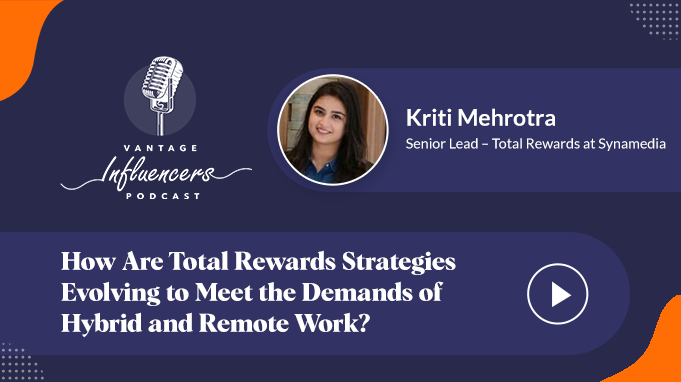
VANTAGE INFLUENCERS PODCAST
"Companies used to boast about gyms, cafe areas, and commute benefits. Today, those benefits have lost their appeal because everyone is not coming to office. Holistic wellbeing has become the must-have."
— Kriti Mehrotra, Senior Lead, Total Rewards at Synamedia
Listen to the EpisodeA few concrete plays work. Active-commute challenges through Vantage Fit reward employees for walking or cycling part of the way in. Step targets framed around the commute (park further, get off one stop early) outperform a generic "move more" nudge. Recognition for healthy commute habits in the Vantage Rewards social feed turns a one-time effort into a repeated one, because peers notice.
The third play is listening. Commute friction is a quiet drag on day-to-day engagement, and it rarely surfaces in a structured survey. Vantage Pulse catches it in sentiment analysis, so HR sees the pattern before it shows up in an exit interview.
Final word
The commute is a slot, not a sentence. Twenty-seven minutes each way, five days a week, is a meaningful amount of life. Spent with a little intent, it stops being a chore and starts being one of the most useful blocks in the week. And when the employer pulls in the same direction, with active-commute challenges, commuter perks, and a way to listen for fatigue, the habit sticks past the first month. That is when the commute starts working for both sides.
FAQs
How can I make my daily commute more productive?
Pick one of three intents for the ride: prepare, learn, or recover. Then match the activity to your mode. Transit riders can plan the day, read, or meditate. Drivers and cyclists can listen to audiobooks, podcasts, or audio courses. Treating the commute as a deliberate slot is the single biggest lever, per Jachimowicz et al. (2017) in HBR.
What are the best things to do during a commute to work?
The highest-return options are planning the day, listening to an audiobook or podcast, taking a short online class, meditating, and (on public transit only) napping. The choice depends on whether the goal is energy management or skill building.
Is a 1-hour commute to work too long?
A one-hour one-way commute is on the long end. The U.S. Census Bureau (2024) reports that 9.3% of American workers fall in this 60-minute-plus group. Whether it is too long depends on the trade-offs: salary, flexibility, mode, and what you do with the time.
How do you stay productive when commuting by public transport?
Transit frees your hands and eyes, which opens up reading, planning, online courses, and meditation. Save content offline so it works in tunnels. Keep a notes app open for the planning block. Use noise-cancelling earphones for focus. Batching tasks by day keeps the habit going.
How does commuting affect productivity and wellbeing?
Longer or unpredictable commutes are associated with higher stress and lower job satisfaction. The Jachimowicz et al. (2017) HBR research finds that the strain comes mostly from "role ambiguity" during the journey, not the duration alone. Commuters who plan their workday on the way in report less of that strain.

This article is written by Nilotpal M Saharia. He is a Senior Content Marketing Specialist & R&R Strategist at Vantage Circle, with 8 years of expertise in Marketing, HR, and Content Strategy.
Connect with Nilotpal on LinkedIn.


