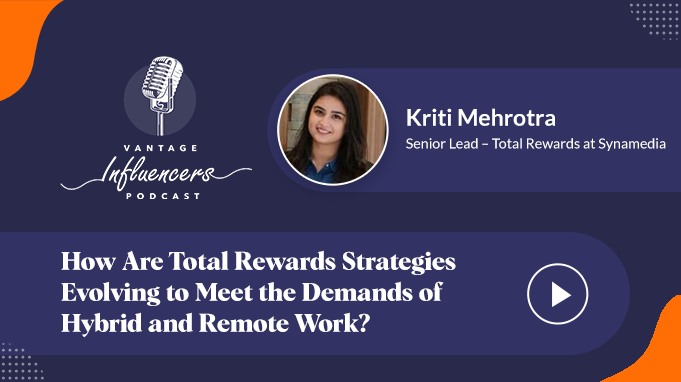
How Are Total Rewards Strategies Evolving to Meet the Demands of Hybrid and Remote Work?
Episode Overview
Kriti Mehrotra argues that the biggest shift in Total Rewards since the pandemic isn't a new perk or a bigger benefits list, it's the move from a pay-centric mindset to an experience-centric one. In this episode, she walks through how organizations are rethinking compensation now that location has stopped being the default anchor for pay, and why role-based and skill-based pay are gaining ground over pay tied to where someone happens to log in from.
The conversation moves through what has quietly become non-negotiable (holistic well-being, caregiving leave, and benefits that are equally accessible whether someone is in the office or working from home) and what has lost its relevance (on-campus perks like free lunches and gyms that only reach part of a hybrid workforce). Kriti also unpacks proximity bias in recognition, the metrics Total Rewards leaders should track to test whether their programs are actually working, and why she believes personalization, not a longer benefits list, is what will define Total Rewards strategy going forward.
Episode Highlights
- Total Rewards has moved from pay-centric to experience-centric since the pandemic, with flexibility, holistic well-being, and caregiving leave becoming near non-negotiable expectations.
- The emerging pay trend favors role-based and skill-based compensation over location-based pay, though companies in high cost-of-living hubs still factor location into some offers.
- On-campus perks like free lunches, gyms, and office celebrations have lost their appeal in a hybrid workforce; benefits now have to be equally accessible everywhere to stay relevant.
- Proximity bias is a real risk in remote recognition, and the fix is easy-to-use recognition systems, an outcome-based framework, regular data analysis, and clear communication to managers.
- Pay equity analysis, benefits utilization data, recognition penetration, learning uptake, and exit interviews are the metrics Total Rewards leaders should track to judge whether a program is working for hybrid teams.
- A two-tier "office versus remote" culture only forms when offerings and communication are unequal; keeping benefits, learning, and recognition equally accessible closes that gap.
About the Guest
Kriti Mehrotra, Senior Lead – Total Rewards at Synamedia
Kriti Mehrotra has spent over six years as a Total Rewards professional across two organizations and currently leads Total Rewards at Synamedia. Her work spans compensation, benefits, and recognition program design, with a focus on building reward structures that are fair, transparent, and aligned with business goals. She is particularly drawn to using data-driven insights to shape employee experiences that support both performance and long-term engagement.
Connect with Kriti on LinkedIn
Host
Riha Jaishi, Vantage Influencers Podcast Host
What You Will Learn
- Why Total Rewards has shifted from a pay-centric to an experience-centric model since the pandemic
- How organizations are choosing between location-based, role-based, and skill-based pay in a distributed workforce
- Which benefits have become must-haves in a hybrid environment, and which on-site perks have lost their relevance
- How to reduce proximity bias in recognition through strong systems, timely recognition, and a data-driven approach
- What metrics reveal whether a Total Rewards program is actually working for hybrid and remote teams
- How personalization and AI are shaping the next generation of Total Rewards strategy
Key Topics & Timestamps
| Time | Topic |
|---|---|
| 03:07 | How employee expectations around rewards have shifted since before the pandemic |
| 09:01 | Location-based pay versus role-based and skill-based pay in a distributed workforce |
| 14:04 | Benefits that have become non-negotiable, and on-site perks that have lost relevance |
| 21:14 | Avoiding proximity bias and keeping recognition visible in hybrid and remote teams |
| 30:38 | Metrics that show whether a Total Rewards program is working for hybrid teams |
| 38:11 | Bridging the "in-office versus remote" cultural divide through equal access |
| 44:07 | Kriti's advice for redesigning Total Rewards strategy going forward |
Full Transcript
Click to read the full episode transcript
Welcome to the Vantage Influencers podcast. This podcast is sponsored by Vantage Circle, the simple and effective recognition platform for employee engagement.
Riha Jaishi: Welcome back to another episode of the Vantage HR Influencers podcast. I'm your host, Riha, and today we're exploring a shift every organization is grappling with: how Total Rewards must evolve to stay relevant in a hybrid and remote world. Work has changed, and so have expectations. Employees want flexibility, well-being support, and rewards that reflect how they actually work today. Traditional compensation models aren't quite enough anymore, and organizations need reward strategies that are equitable, experience-driven, and built for a distributed workforce. And to help us break this down, I'm joined by Kriti Mehrotra, Senior Lead, Total Rewards at Synamedia. Welcome to the show, Kriti. It's a pleasure to have you with us today.
Kriti Mehrotra: Hey, hi, Riha. Thanks for having me. It's my pleasure also to be a part of this and share some insights, whatever I can gather from my experience on Total Rewards. So thanks, and looking forward to this conversation.
Riha Jaishi: Great, we are also looking forward to it. Okay, so just to kick things off, can you briefly take us through your professional journey so far? We are eager to learn about your journey.
Kriti Mehrotra: Yeah, surely. So I wouldn't say I have a lot of experience. I just started working after my MBA in 2019, and it's been a good six and a half years. Fortunately, I've been a Total Rewards professional throughout, I joined as a Total Rewards professional and I'm still continuing in the role. Maybe the role is challenging enough to keep you going, and there's a lot happening in this space. I feel myself very fortunate to have seen a pre-pandemic era too, because before and after the pandemic, Total Rewards, even a lot of industries, have gone through a drastic shift in the environment. So I'm happy that I got that opportunity to understand how needs have shifted, and as a Total Rewards professional, how the entire design of the strategy has shifted, and how we have evolved with it. So yeah, that's a brief experience. Synamedia is my second company, so across two companies is how my experience has built up. I hope I'm able to throw some light on whatever small experience I have.
Riha Jaishi: That's an inspiring journey, Kriti. Thank you so much for sharing your experience. Okay, so now with your permission, I would like to delve into our topic further, shall we?
Kriti Mehrotra: Yeah, let's get started.
Riha Jaishi: Okay, great. So when you talk to employees today, what's the very first thing you notice about how expectations for rewards have changed compared to pre-pandemic times?
Kriti Mehrotra: Yeah, so the expectation change and the discussion change has been drastic, not even something we could have imagined pre-pandemic, right? Pre-pandemic, if you talked to employees, or even prospective employees you were considering for a job posting, from a compensation or rewards perspective, people were more pay-centric. Now people have become more aware, and they are more experience-centric. So the conversations around Total Rewards were majorly focused on what my pay increase will be, and some around benefits, which people also used to compare more in terms of monetary benefits or health benefits. Post-pandemic, the importance of a lot of factors within Total Rewards has increased. So when I say experience-centric, what I exactly mean is that the aspects of flexibility, holistic well-being, and inclusive benefits have become major, major important points. Employees are asking about it, it's almost become non-negotiable. For example, today, whenever somebody is joining a new company, or we're talking to the recruitment team, they're also very keen to know what our strategy is for hybrid working and work-from-home policy, because those are the kinds of questions candidates are asking. We have to design policies to attract good talent, because that's what employees are asking for today. So one thing that's become almost non-negotiable is flexibility, that employees are looking forward to the flexibility or independence they'll get when they join an organization. If their family members need support, the company is willing to accommodate that with some work-from-home arrangement. Then, continuing with benefits, pre-pandemic, hardly anyone had heard about caregiving leaves. Post-pandemic, a lot has happened, and the importance of caregiving leave and helping programs has increased so much that these are discussion points nobody could have imagined pre-pandemic. So leaves are being discussed: what is your strategy on caregiving leaves? And there's been a buzz around things like menstrual leave gaining a lot of importance. So all of this is part of the well-being aspect being discussed, which is quite mature in itself, right? And it has to be inclusive. When I say inclusive, I'm not only talking about location, I'm also talking about multi-generation, because we're working with three or four generations in our workforce. It has to appeal to everyone. For example, Gen Z employees who may have just started working post-pandemic treat this as the norm, getting flexibility is normal for them. Millennials or employees who've been in the workforce longer see it more as an advantage. So largely, it has shifted from being pay-centric to experience-centric. As a Total Rewards professional, this has actually eased our work in some ways, because pre-pandemic, I was also managing well-being programs for my previous company, and the uptake was not good. When I say uptake, I'm talking about well-being sessions, well-being talks, and we also used to offer therapy sessions. Employees weren't talking about it or taking it up, it was a taboo. When we used to publish our dashboards pre-pandemic, the numbers weren't good, the percentage was in single digits, and hitting double digits was a victory for us. Post-pandemic, that has changed and shifted for good. And when you see that kind of uptake as a Total Rewards professional, you also want to invest in good vendors and good tools for employees, because the ROI is good. So that's how the shift has happened, from the employee perspective and from a Total Rewards professional's perspective, which I've noticed recently.
Riha Jaishi: That's such an amazing perspective, Kriti. First of all, I really like the way you highlighted that shift from pay-centric to experience-centric that's been going on in the workplace, and that point on flexibility and well-being programs, that's the main emphasis right now, along with inclusivity. So these are some important pointers that everyone needs to keep in mind, right?
Kriti Mehrotra: Yeah, that's how things have changed, and I'm really enjoying this change.
Riha Jaishi: Yes, it's for the better.
Kriti Mehrotra: It's for the better, yeah.
Riha Jaishi: Yes. Okay, so now moving ahead, how are organizations rethinking pay structures when location is no longer the primary anchor? Should remote work mean location-based pay or role-based pay? What do you have to say about this?
Kriti Mehrotra: So the trend is very much moving away from being location-centric. The emerging trend, if you ask me, is more toward role-based and skill-based pay today. A lot of focus is on skill-based pay, and you want to reward employees for being ready to upskill themselves rather than for their location. Having said that, there are companies that also compensate employees for relocating to a particular location, if there's a high cost of living involved, that's also fair. So largely, I'd say the trend is more toward skill-based pay, or anything that's agnostic of location, because it also widens the talent pool and talent availability for the organization. But at the end of the day, everything has to tie back to the business strategy you're trying to promote. So for companies that want employees back in a particular location, maybe because that location has a high cost of living, high premiums, high rents, that also makes a lot of sense. I'm not saying companies are moving completely to skill-based pay, but for some, it's a combination. The emerging trend leans more toward skill-based pay, and at the end, it has to tie back to your business strategy. Take Airbnb as an example, I was reading about the kind of business they're in. They promote working from anywhere, without any penalties or pay cuts, because that's what they want to promote to their customers too, and employees, at the end of the day, are your internal stakeholders. So the trend is emerging toward skill-based pay, skill-based premiums, role-based premiums, but companies design this as per their own business strategies. And I think one more important aspect is fairness and transparency. If you're tying pay to a location or to working from the office, it takes away that factor of fairness and transparency. If your levers are role or skill instead, it keeps fairness and transparency intact, and that appeals to employees more too, if they understand what factors their pay is actually linked to. So that's the emerging trend currently, companies are moving a lot toward skill-based pay.
Riha Jaishi: Kriti, you've mentioned this important aspect about fairness and transparency being more intact within skill-based pay. I really liked how you linked fairness and transparency being tied to skill-based pay, and how that ties back to business strategy, right?
Kriti Mehrotra: Yeah, because as an employee, if I'm working hybrid, maybe I'm coming to the office 15 days a month and not the other 15, that shouldn't affect the pay I'm getting if my outcomes are similar. If my role is similar to a colleague's, and we've both been upskilling ourselves to the same level, there shouldn't be a difference in the benefits and pay, the Total Rewards package, we're getting. That makes it a little fairer. If my colleague is based in a certain location and getting a better pay package purely for that reason, it takes away flexibility from me. So if you want to analyze your pay structures, these levers have to be very clear, and skill-based pay also encourages employees to upskill and keep upgrading themselves, rather than linking pay to a location that isn't really in the employee's control. It also helps the organization, because you don't have to keep hiring for new skills every time there's a shift in demand, if your employees are ready to upskill, it saves a lot on hiring and training costs.
Riha Jaishi: That's a valid point. Okay, so moving ahead, which benefits have really become non-negotiable in a hybrid workforce, and which traditional benefits are becoming irrelevant, Kriti?
Kriti Mehrotra: Yeah, so any benefit that can be equally accessed by a hybrid workforce is becoming relevant, and any benefit that can't be accessed by a certain population of employees who aren't present at a location is becoming obsolete. In essence, that's the answer, let me elaborate. Earlier, companies used to boast about their campuses having gyms, swimming pools, sports areas, cafe areas, and commute benefits. These were very good benefits, but today they've lost their appeal, because not everyone is coming to the office, and even those who do aren't coming daily, most companies are working on a hybrid model. So offering a free gym or a free lunch to everyone is a benefit that no longer appeals to employees. What has become a must-have, as I mentioned, is well-being services, your holistic well-being, and I use the word holistic because it touches mental health, financial health, physical health, everything. Then the aspect of flexibility, whatever benefits help ensure flexibility and the ability to balance it all, is gaining a lot of importance. Here's an example: a company doesn't have to re-strategize itself, it just has to change its offerings. If I'm a company that promotes employee well-being, and that's why I had a gym on campus, I don't have to change my strategy, I can still promote well-being, only the offering changes. It can be well-being vouchers, or I can empanel a vendor who offers virtual well-being services so that everyone is included, virtual therapy sessions if an employee wants them. So you're not re-strategizing, only the mode of delivering those benefits is changing. Any benefit that was strictly an on-ground benefit has completely lost its relevance, on-floor yoga breaks, on-floor celebrations, all of that. Some companies are redirecting those on-floor or off-site budgets into well-being vouchers, or offering a lump-sum well-being kitty that can be reimbursed against different lifestyle and well-being services employees subscribe to. The other thing that's gained a lot of importance is reimbursement to set up a home office, which was a buzz during COVID, having an office-like environment at home also allows a lot of flexibility. The other benefits becoming non-negotiable are new kinds of leave. Earlier we only talked about sick leave, casual leave, annual leave. Now leaves like caregiving leave, travel leave, breaks from work, and social service leave are gaining a lot of importance, these are also becoming non-negotiable. Apart from this, benefits also have to be inclusive. Every company is dealing with a multi-generational workforce, people in different phases of life, and employees aren't interested in comparing their benefits to others, they're interested in what's personally relevant to them. For example, if I've just started my career and my manager tells me about great retirement benefits, I'm not interested in that right now, I might be more interested in a travel leave or well-being vouchers. Some of my colleagues might be new parents, a mother or a father, and they'd appreciate leaves that support their family, or sessions that guide them through new parenthood. These are becoming must-haves today, and obsolete benefits like office lunches, gyms, and other on-campus perks are losing relevance because they don't appeal to everyone in a hybrid workforce. The more accessible your benefits are to everyone, the more important they become.
Riha Jaishi: Kriti, your perspective has really shed light on how this entire benefit structure is changing holistically. Earlier the focus was on free lunches or gyms, but now those have become obsolete, and things like holistic well-being, flexibility, and different kinds of leave have become dominant, these are the desired benefits employees are looking for now. And this will keep evolving, right?
Kriti Mehrotra: Yeah, it will keep evolving. We can always think creatively in this space, and it's good that uptake is improving and everyone is adapting. The well-being boom over the last five years has grown tremendously, you'll see so many companies in this space now, because the demand has grown so much. So that's how it's shifted, and everyone is offering more virtual, more integrated well-being into their systems, so it's very easy to access.
Riha Jaishi: Yes, okay, moving ahead. In remote and hybrid setups, visibility generally tends to drop. How can Total Rewards help ensure recognition isn't limited to the loudest or most visible people?
Kriti Mehrotra: That's a nice question, and I'd also like to mention that we've mostly been talking about benefits so far, but recognition is also a big part of Total Rewards. For me, Total Rewards consists of pay, benefits, incentives, recognition, and career progression, and because of how our way of working has changed, every bucket of Total Rewards has been impacted, recognition included. This is a very valid point, remote employees can feel aloof if they're not present, and there can be proximity bias, which is the term we use, we have to avoid it, because if you're closer to where the manager or leadership sits, your chances of being seen and getting recognized are higher. To deal with this, the best solution is strong systems and a data-driven approach. First, recognition should be easy to give and timely, recognition that doesn't come on time loses its relevance. If you implemented something last quarter but only get the award for it two quarters later, you might not even be in the same role to receive it anymore. So to keep momentum, it has to be timely. Use systems that make recognition easy to give, and that's only possible if the system is well integrated with the daily applications employees already use. If you're using Teams, your recognition tool should be integrated with it, so if I feel good about a colleague who helped me, I can give them a shout-out right there, and maybe their manager gets a notification too. These are small things that increase visibility without needing physical visibility. Second, your strategy should be tied to outcomes, you list the levers or values the company recognizes, and your framework should be strong enough to avoid bias, if a colleague displays one of those values, they get recognized, even if it's as small as a clap or a shout-out. So recognition should be more outcome-based than based on how much someone is seen or how well they connect socially. Third, when you have a good system and a good strategy in place, your approach still has to be data-driven, you need to read and analyze the data, because even good systems and strategies can lose relevance if you're not leveraging the data. If I analyze my reports and see that five out of ten people on a team haven't received recognition, the system can nudge me toward some kind of intervention. So you're sitting on a lot of data once you have a good system and strategy, and you can use that data to keep improving your programs. Following this approach reduces any kind of bias, proximity or otherwise. So those are my three points: strong, easy, timely systems; a strong recognition framework; and reading the data. And I forgot a fourth: communication, how you position the program. You can have everything in place, but if you're not equipping employees or managers to use it, it goes to waste. Traditionally, managers would send an email saying an employee did a great job, or forward customer feedback to the team, but that's a very subjective approach, some managers do it, others don't. When you have a standard system in place, quarterly recognition cycles, a framework, it becomes much easier for managers to use consistently. So as a rewards team, if you build all of this but don't equip your managers and leadership to actually use it, everything goes to waste. That fourth piece, communication and positioning, is just as important. If you have all of this in place and keep reading the data and improving, these biases reduce over time and the system becomes very functional.
Riha Jaishi: You've highlighted some amazing and significant points here, Kriti, about having strong systems, being data-driven, and tying strategies to outcomes. These are important aspects every Total Rewards leader and HR professional should look into, so that the hybrid workforce stays in sync with everyone else, particularly around recognition, which is where they often feel invisible.
Kriti Mehrotra: Yeah, I'll share a recent example. We were evaluating vendors, looking at a lot of options, and one feature that stood out to me, apart from analytics, was nudging. As a Total Rewards professional, I'm fine spending time on these strategies, but a manager whose goals aren't tied to recognition, who has other priorities, is reluctant to spend even an hour a week deciding who deserves recognition, on top of annual cycles and performance reviews. So there was a feature that nudges the manager: this employee hasn't been recognized in a while, do you think they should be? It's that simple, the manager doesn't have to sit and evaluate everything themselves. If systems can enable that kind of ease and intuitiveness, the business doesn't spend much time on these activities and uptake increases. And it doesn't matter whether you're visible or not, because the system doesn't know if you're hybrid or in-office, it doesn't carry that bias. That nudge feature really stood out to me, beyond all the analytics, and it ties directly to our own strategy, since we very much support remote working. For an organization like ours, it nailed it.
Riha Jaishi: Yeah, that nudging feature really is one of the biggest takeaways here, for other HR leaders too, implementing something like that can bring about real change.
Kriti Mehrotra: Correct, and recognition ties in very well with engagement too. The more you're recognized in an organization, the more sense of purpose you feel, and you'll see how much engagement scores rise just from being recognized. So all of this is very much connected.
Riha Jaishi: Yes, absolutely. Okay, moving ahead, Kriti, what metrics should leaders track today to understand whether their Total Rewards program is working for hybrid teams? You touched on data analysis earlier, so let's get into the metrics.
Kriti Mehrotra: Yeah, absolutely. Since we're talking about how times have shifted to hybrid working, the most reliable thing for any Total Rewards professional is data. You're sitting on a lot of system data you can read and use as metrics. Starting with pay, you can run a pay equity analysis to see where the gaps are, whether there's any bias, whether your hybrid system is working, or whether increases differ between employees working remotely versus from the office. At our organization, we run this every six months, once alongside the annual cycle and once off-cycle, just to see if the data has shifted or if there's some bias, and we cut it not just by gender but also by work mode, hybrid, remote, or permanently in office. That's a good pay metric. In benefits, utilization is a very strong metric, which segment is using which benefit more, and whether some benefits aren't being used at all, because everything boils down to cost, and that same cost could be redirected toward something actually in demand. Benefits utilization is important data, not just which benefits are used, but the employee experience around them too. Medical and insurance is a big chunk of benefits cost, and it's very important, sometimes you've onboarded a good vendor, but the employee experience isn't great, and that's where you see employees dropping off the plan and premiums rising. That data helps you decide whether to renew with the same vendor or go back to the market and evaluate other options. It's a strong metric because it's a big chunk of the cost hitting payroll, and sometimes a vendor is good on paper but their service isn't, you'll only find that out by reading the data rather than relying on feedback forms that are hard to get responses to. Third is recognition, as we discussed at length, you can look at penetration, how much of your team has been recognized in the past twelve or six months, and what percentage. If one individual is receiving recognition far more frequently than others, is something wrong there, or does the recognition framework need adjusting? Maybe you've listed five values and one of them isn't being appreciated at all, maybe it's time to revisit it. Then there's career progression, if employees can see themselves progressing into different roles within the organization, their stickiness and engagement improve. You can track uptake of learning programs and the percentage of employees upskilling, that's a very important data point for building your talent pipeline and deciding which talent pools to invest in. One more I'd mention is exit interviews, I haven't seen many organizations really leveraging them, because departing employees don't always give you honest feedback, but whatever feedback you do get is worth analyzing, if you can extract insights or find patterns, your attrition can drop drastically. I was reading that LinkedIn found employees who take more learning programs on the platform have a lower chance of attrition, that's the kind of insight this data can surface. These are some of the metrics that can be used to judge how effective your programs really are.
Riha Jaishi: These metrics you've highlighted really show the power of data, and how data can reveal whether rewards are actually working for distributed teams. Everything is right there in front of you to dissect and look into in depth.
Kriti Mehrotra: Yeah, absolutely, and thanks to AI too, for helping with analysis and building insights. Data is key, and companies already leveraging it are ahead of the game, that's where the innovative strategies come from. When my team is designing something, knowing whether it's actually working on the ground is extremely difficult when you're dealing with thousands of employees, that's the real challenge, and the only way through it is reading your data. Connecting with managers helps too, but your initial insight always comes from data. Your data speaks louder than anything, and when you're working with a large organization with a lot of employees, you really get good insight out of it. So data is key.
Riha Jaishi: Yes, well said. Okay, so hybrid work risks creating a two-tier culture, those in office and those remote. Can Total Rewards bridge that cultural divide?
Kriti Mehrotra: Yeah, it can bridge it, but only if offerings are equally accessible regardless of location. If your Total Rewards offerings aren't segmented, your workforce will never feel segmented. If you create equal opportunities and equal access, every employee experiences the same thing, and that two-tier divide never forms. But if your offerings differ, say someone in the office is getting extra perks, that creates a divide, because it makes remote employees feel like they're losing out simply for not being in the office, and that drops engagement. So if benefits, learning opportunities, recognition, and incentives are equally accessible across all segments of your workforce, it won't create a divide. If there's a gap, the divide becomes very apparent. The second piece is communication. When people work from the office, informal coffee chats and water-cooler conversations happen naturally, and employees there may end up more exposed to certain information than people working from home who don't get that same social access. But important communication from leadership has to go through channels that are equally accessible to everyone, it shouldn't be that someone in the office learns about something before a remote colleague does. That feeling of unequal treatment is what creates the divide. So two things: your systems and reward structures need to be equally accessible and inclusive, and your communication has to be transparent and go through formal channels so nobody misses out. That said, informal sessions, on whatever medium most companies use, Teams or similar, should still happen regularly, so team meetings should be held on that shared medium consistently so everyone feels included and can pick up from wherever the conversation left off. Everything that happens on the floor should also happen virtually. If you build that kind of environment and culture, a divide can never form. Otherwise, if offerings are partial, the divide becomes very evident.
Riha Jaishi: You've made a really big point here, that if the culture itself encourages that kind of division by offering unequal opportunities or accessibility, nobody can stop the cultural divide. So equal offerings and communication transparency between office and remote workers is the key.
Kriti Mehrotra: Yeah, and mainly, from whatever small reading I've done, employees who aren't in the office are often quite insecure about their growth in the organization, thinking a colleague in the office will get promoted before them. If your metrics are outcome-based, you can tackle this, because outcomes aren't affected by location, they show your actual work. That kind of insecurity can only be addressed if your culture, systems, and strategies are completely location-agnostic. Learning programs and training should be virtual, not tied to an in-office certification session, because people who aren't present at that moment will lose out even if they wanted to participate. So the goal is to run that training virtually so everyone has an equal opportunity to benefit from it. This kind of divide and insecurity around career growth is very common, and it can be tackled if the offerings themselves are equal opportunity.
Riha Jaishi: Yes, absolutely, well said. Okay, so before we wrap the session, Kriti, if you could give one piece of advice to organizations redesigning their Total Rewards strategy for 2025 and beyond, what would it be?
Kriti Mehrotra: Yeah, I think this is a good closing question, because I can summarize most of what we've spoken about. I'd break it into two or three parts. First, there's no one-size-fits-all anymore, you can't hand out one flyer listing all your benefits and call it a day. It has to be personalized. Employees aren't impressed that a company offers twenty benefits, they care that even five of those, or seven out of twenty, are actually relevant to them. There's no one-size-fits-all, there has to be personalization, there's a term for this I read and liked: persona-based benefits, offering what actually appeals to each person. The second important thing is data and AI. You can design good strategies, but you can't improve them without analyzing your data regularly and using AI on top of it. There are genuinely good use cases for AI in Total Rewards. Here's one that ties back to persona-based benefits: AI can analyze an employee's data, understand their family situation, whether they have a spouse or children, and recommend benefits relevant to that stage of life, suggesting they top up insurance, or if someone is a returning mother, surfacing sessions designed for that transition. AI can read data and make sense of it quickly, and organizations actually using these use cases are already ahead. So the best things a Total Rewards professional can do are: build persona-based, customizable benefits covering well-being, flexibility, and leave preferences, and leverage data and AI. There's a stereotype that Total Rewards teams just work on spreadsheets all day, and that's partly true, we do spend a lot of time in Excel, but strategizing smartly matters just as much. I'm proud that last year, my organization implemented flexible leave choice, out of our annual leave kitty, employees can now choose three or four leaves themselves. I'm not forced to take leave for a festival I don't celebrate, I can pick from a kitty of fifteen leaves instead of being forced into ones I don't need, and then not having leave available when I actually do need it. It's not even a cost hit, it's just planning, the total number of leaves stays the same, but flexibility increases. Being able to choose and club leave days is genuinely empowering, and that idea came directly from data showing certain times of year when specific employee segments took more leave. So there has to be some flexibility left in employees' hands. If you have good data and you're using it well, strategizing becomes easier. Use your data, use AI, and make Total Rewards as personalized and customizable as possible, it will make a real difference. That's my final word on it.
Riha Jaishi: Kriti, you've given some very practical and helpful advice to reward professionals and HR leaders out there. There's a lot to take in, and this is exactly what organizations need right now to take their rewards game to the next level.
Kriti Mehrotra: Yeah, this is a very interesting space, and I think after COVID, the way we've traditionally thought about this has changed and been challenged. That's its own kind of change management, not just for employees but for rewards teams too. It's interesting how some things used to be just a tick in the box, like well-being, because employees weren't asking for it and we just offered it anyway. Now it's become a genuinely important part of the job. It's a challenging space, and that's what keeps me exploring it further.
Riha Jaishi: So I suppose evolution and adaptability really need to go hand in hand as you move ahead?
Kriti Mehrotra: Absolutely, absolutely. If you're not able to adapt, you become obsolete, or irrelevant.
Riha Jaishi: Okay, Kriti, we've come to the end of our podcast session. Thank you so much for joining us today and sharing your incredible insights. It's been more than a pleasure hearing your perspective on how Total Rewards must evolve to meet the demands of a hybrid and remote workforce. We really appreciate your time and expertise, and I'm sure everyone tuning in is walking away with a lot to think about.
Kriti Mehrotra: Thank you so much. I hope it's helpful for anyone who tunes in, and thanks for making it so interactive, I really enjoyed it. This is actually my first time on a podcast, so it's been a pleasure and a learning experience for me too. Thank you for being such an amazing host.
Riha Jaishi: Thank you so much, Kriti. And to our listeners, thank you for tuning in, we hope you found today's conversation as enlightening as we did. Until next time, take care, and we'll see you soon.
Thanks for listening to the Vantage Influencers podcast. Be sure to subscribe on Apple Podcasts, Spotify, and our Vantage Circle YouTube channel for the latest episodes.
FAQ
How is Total Rewards shifting from pay-centric to experience-centric?
Post-pandemic, employees are less focused on pay increases alone and more focused on flexibility, holistic well-being, and inclusive benefits like caregiving leave, topics that barely came up in Total Rewards conversations before the pandemic.
Should remote work pay be location-based or role-based?
The emerging trend favors role-based and skill-based pay because it's agnostic to location, widens the available talent pool, and keeps compensation fair and transparent. Some companies still factor in location for high cost-of-living hubs, but it's increasingly the exception rather than the rule.
How can hybrid teams avoid proximity bias in recognition?
By building recognition systems that are easy to use and timely, tied to a clear outcome-based framework, backed by regular data analysis, and reinforced through consistent communication to managers, since a well-designed system doesn't register whether someone works in-office or remotely.
What metrics should HR track to measure Total Rewards effectiveness for hybrid teams?
Pay equity analysis cut by work mode, benefits utilization data, recognition penetration and frequency, uptake of learning and upskilling programs, and insights from exit interviews.
Related Reading
Also listen on