What if one of the most effective mental-health interventions at work isn't a benefit at all?
While organizations continue investing in therapy support, wellness platforms, and Employee Assistance Programs, a growing body of evidence points to something far simpler: recognition.
The implication is significant. Recognition is not merely a way to celebrate performance. It is one of the clearest signals an organization can send that people matter — and one of the most practical tools available for protecting mental health at scale.
This guide examines why.
Note: This article covers workplace employee recognition, a people-management practice focused on acknowledging employee contributions. If you are looking for information on recognizing symptoms of mental illness, please consult clinical resources from your healthcare provider or the World Health Organization.
The Workplace Recognition and Mental Health Connection
Employee recognition improves mental health by activating the brain's reward and belonging systems. When recognition is absent, the resulting disengagement correlates directly with burnout, anxiety, and turnover intent.
The data is clear. The World Health Organization (WHO) estimates that approximately 15% of working-age adults live with a mental health condition at work. Employees who gave recognition in the past 30 days report 24% lower odds of a probable anxiety diagnosis (O.C. Tanner Global Culture Report 2025, hereafter GCR 2025). When employees strongly agree their organization genuinely cares about their overall wellbeing, they are 73% less likely to feel burned out (Gallup 2024) — and recognition is one of the most consistent, scalable ways to deliver that signal.
The mechanism is not complicated: human beings are wired for social affirmation. When work goes unacknowledged, the brain reads the absence as a social threat. Over time, that threat response surfaces as chronic stress, disengagement, and mental-health decline. Recognition short-circuits that cycle by delivering the signal of value and belonging that the brain is seeking.
What separates high-performing organizations from the rest is not whether they have recognition programs, but whether those programs are consistent, specific, and tied to meaning. A once-a-year award does almost nothing for mental health. Daily and weekly recognition that connects an employee's contribution to company values builds the psychological safety at work that holds teams together under pressure.
Do Give a Read: For a deeper look at how recognition connects to engagement and wellbeing, check out our blog- employee engagement.
5 Ways Employee Recognition Supports Mental Health
Recognition supports mental health through five interconnected mechanisms: reinforcing belonging, reducing workplace stress, preventing burnout, building manager-employee trust, and surfacing early mental-health risk signals through sentiment data. Each mechanism addresses a different layer of the mental-health equation, which is why a well-designed recognition program consistently outperforms single-point interventions.
1. Reinforces Belonging (the Strongest Mental-Health Protective Factor)
Belonging is the most powerful psychological-safety signal an organization can provide, and recognition is the most reliable way to communicate it at scale.
When an employee's contribution is publicly acknowledged, particularly when tied to a company value, two things happen simultaneously. The individual receives confirmation that they are seen. The team observes that this kind of contribution is valued, which reinforces group identity and cohesion. Both effects are mental-health protective.
The O.C. Tanner GCR 2025 confirms that employees who participate in recognition report significantly lower rates of anxiety, depression, and burnout. Public recognition on a shared platform, combined with values tagging, makes belonging visible rather than assumed — a critical distinction for distributed and hybrid teams where the passive belonging signals of shared office life are absent.
Vantage Rewards' social recognition feed allows employees and managers to recognize contributions publicly, while values tagging connects each recognition moment to something larger than the task itself. For remote and hybrid teams, this visible layer of belonging is the difference between employees who feel part of a community and employees who feel isolated.
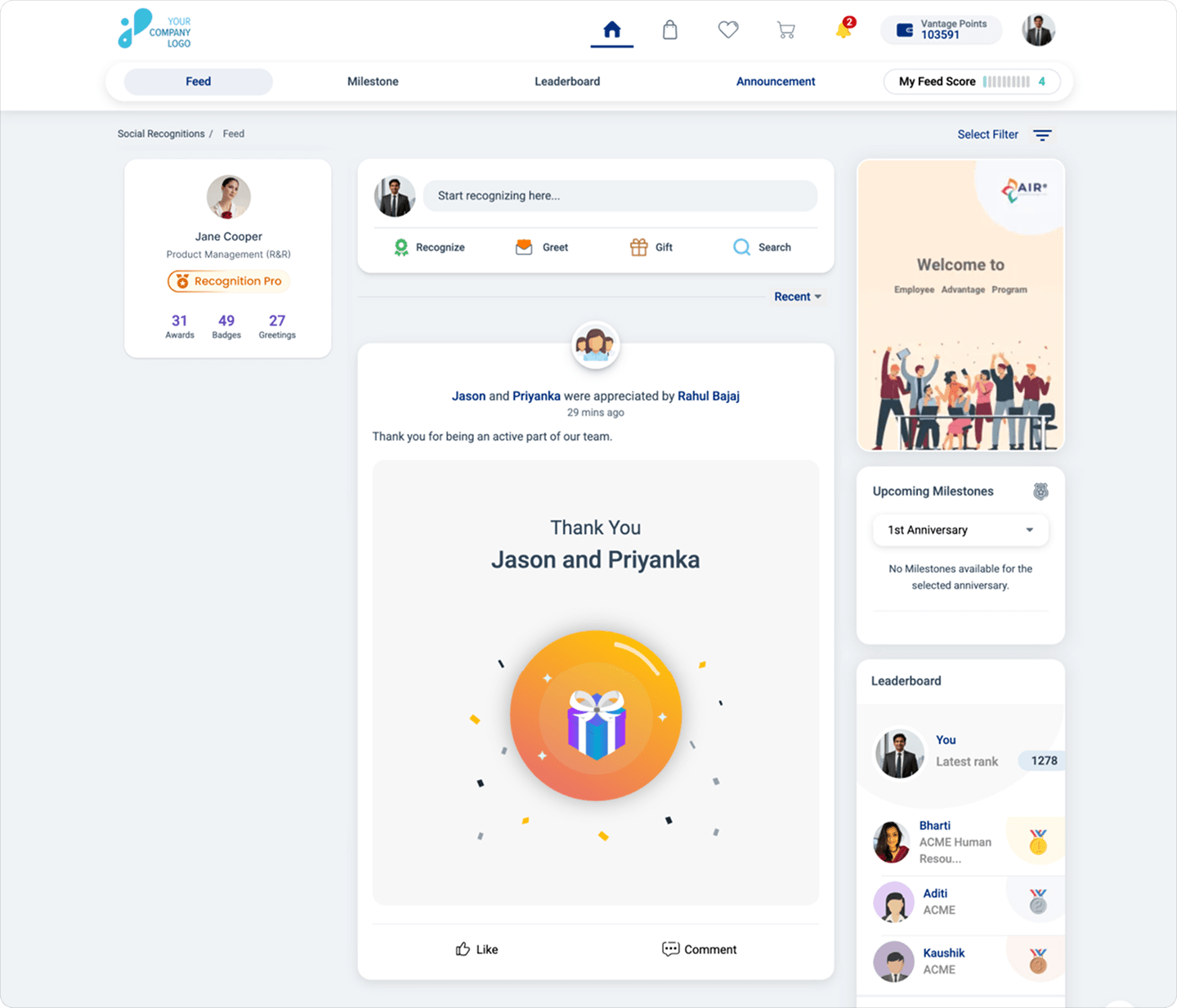
See Vantage Rewards recognition feed
2. Reduces Felt Stress Through Predictable Affirmation
Predictable recognition reduces ambient cortisol; unpredictable feedback environments amplify workplace stress.
The cortisol connection is one of the most underappreciated aspects of recognition design. When employees cannot predict whether their work will be acknowledged, the brain remains in a low-level threat-detection state. That state is cognitively expensive. Over time, chronic unpredictability manifests as stress, irritability, and reduced concentration.
Weekly recognition, even simple written acknowledgment of specific contributions, interrupts that pattern. It is not the magnitude of the recognition that matters most; it is the regularity. A manager who recognizes their team once per week, specifically and sincerely, does more for team mental health than a manager who delivers one significant award per quarter.
The practical implication for HR program design is to set a recognition cadence floor, not just a ceiling. Rather than measuring only how much is recognized at peak moments (end-of-year awards, work anniversaries), measure the floor: how frequently is recognition happening across teams week over week? That frequency data, available through recognition analytics, is the most predictive leading indicator of team wellbeing.
3. Counters Burnout Through Purpose Connection
Values-tagged recognition connects daily work to meaning, which is the most powerful burnout-protective factor available to HR teams.
Burnout is most commonly framed as a workload problem, but the research points to a different root cause: a disconnection from meaning. Employees who cannot see how their daily work connects to something larger, a team goal, a company value, a customer outcome, lose the sense of purpose that makes effort feel worthwhile. That loss of meaning is what accelerates burnout, not the hours themselves. When a manager acknowledges a contribution and explicitly links it to a company value (innovation, customer impact, team support), they complete the loop between effort and meaning. That loop is what prevents the hollowness that precedes burnout.
Programs that use values-tagged recognition outperform programs that use generic praise because they amplify the purpose signal, not just the approval signal. Employees who gave recognition in the past 30 days report 57% lower odds of burnout (O.C. Tanner GCR 2025) — the strongest burnout-protection signal in current workplace research.
Do Give a Read: For a full look at identifying and addressing burnout at work, see employee burnout.
See values-tagged recognition in Vantage Rewards
4. Builds Manager-Employee Trust That Enables Help-Seeking
Consistent recognition by managers builds psychological safety, the precondition for employees to disclose mental-health concerns at work.
Managers do not need to be trained therapists. They need to be consistent recognizers. The consistent act of recognition builds trust over time, and trust is what makes an employee willing to say "I am struggling" rather than masking it until the situation escalates.
Without that trust layer, mental-health resources (EAPs, therapy reimbursement, mental-health days) go underused. Employees who do not trust their manager to see them as a whole person will not risk disclosing vulnerability, even when benefits are actively promoted.
Manager recognition also reduces the perceived power asymmetry that makes mental-health conversations feel risky. When a manager has repeatedly demonstrated through recognition that they notice and value an employee's contributions, the employee has evidence that they are not expendable. That evidence is what makes the conversation possible.
The training implication is direct: before investing in manager mental-health training programs, invest in making managers consistent recognizers. Recognition is the trust foundation on which every other form of support is built.
5. Surfaces Early Mental-Health Risk Signals Through Sentiment Analysis
Sentiment shifts in free-text pulse responses and recognition patterns are early indicators of disengagement that often precede mental-health declines by four to eight weeks.
Annual engagement surveys are too infrequent to catch mental-health risk before it becomes a retention or performance problem. By the time results are analyzed and acted on, the intervention window has typically closed.
Continuous sentiment analysis through pulse surveys changes this timeline. When employees respond to pulse questions in free text, the language they use carries emotional signal. Words associated with exhaustion, isolation, or frustration cluster before formal engagement scores drop. Catching that signal early allows HR and managers to intervene with recognition, check-ins, or benefits referral before the situation escalates.
Vantage Pulse runs sentiment analysis on free-text pulse responses continuously, giving HR teams a four to eight week earlier signal than annual surveys. Combined with recognition cadence data from Vantage Rewards, the platform identifies which teams have both low recognition frequency and declining sentiment — the highest-risk combination for mental-health deterioration.
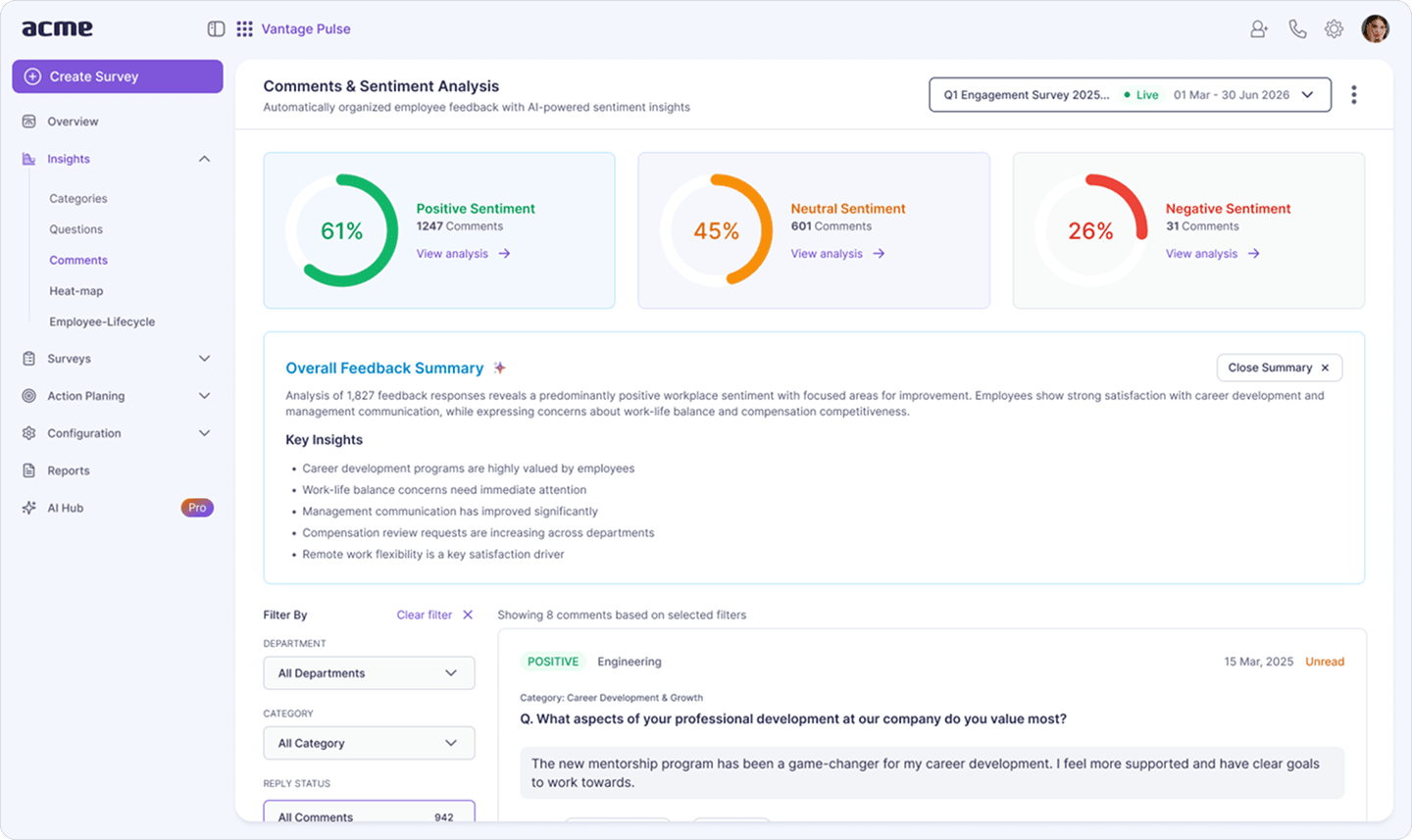
See Vantage Pulse sentiment analysis
Recognition vs. Other Mental Health Interventions: How to Position It
Recognition is a continuous protective factor that complements, rather than replaces, clinical-support interventions. The table below, informed by the Deloitte 2024 Mental Health and Employers Report, positions each intervention by primary use case, cost range, and evidence base.
| Intervention | Best For | Typical Cost (per employee/year) | Engagement Lift Evidence |
|---|---|---|---|
| Employee Assistance Program (EAP) | Crisis support and short-term counseling | $30–$60 | Point-in-time utilization; limited sustained engagement lift when used alone |
| Therapy reimbursement / mental-health benefit | Ongoing individual care | $500–$2,500 | Strong individual mental-health outcomes; low direct engagement signal |
| Mental-health days / time-off policies | Acute recovery and symptom relief | Time cost | Short-term symptom relief; no sustained engagement effect |
| Workplace recognition program | Continuous belonging, purpose, and stress reduction | $200–$2,000 | 57% lower burnout odds; 24% lower anxiety odds for active participants (O.C. Tanner GCR 2025) |
Recognition belongs in every mental-health strategy not because it replaces EAPs or therapy benefits, but because it makes them less urgently needed. A workforce that receives consistent recognition has lower baseline stress, stronger psychological safety, and higher trust in management — conditions that reduce the probability of mental-health crises requiring EAP or clinical intervention.
The Deloitte 2024 report found that the majority of mental-health spend by employers goes toward reactive programs. Recognition is the proactive layer that shifts investment from treatment toward prevention, at a fraction of the cost of clinical benefit spend.
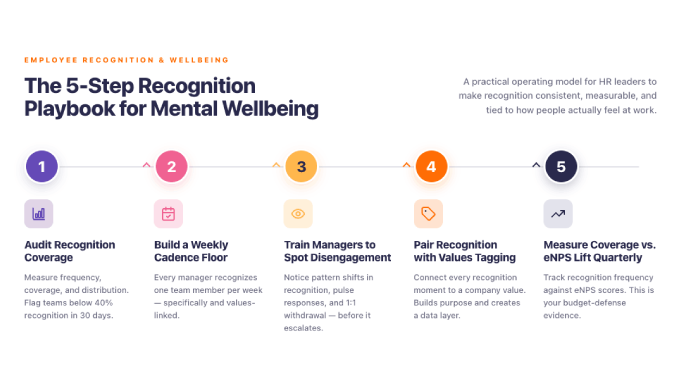
The 5-Step Playbook: Designing a Recognition Program as a Mental-Health Intervention
A recognition program designed as a mental-health intervention requires deliberate architecture. The five steps below build the program systematically, from diagnosis to measurement.
Step 1 — Audit Current Recognition Coverage
Start by measuring what you have. Pull recognition data from your platform to assess frequency, coverage (what percentage of employees received recognition in the past 30 days), and distribution (which teams are recognition deserts). Use employee Net Promoter Score (eNPS) surveys from Vantage Pulse to establish a baseline for how recognition coverage correlates with engagement scores across teams.
Coverage gaps are the first mental-health risk indicator. A team where fewer than 40% of employees received recognition in the past month is a belonging-deficit environment by definition.
Step 2 — Build a Weekly Cadence Floor
Set a minimum expectation: every manager must recognize at least one team member per week, specifically and values-linked. This is not about mandatory positivity; it is about creating the rhythm of affirmation that reduces ambient stress and builds trust over time.
Track cadence through recognition analytics. Frequency data is more predictive of team mental health than total recognition volume, because frequency drives the predictability effect that psychological safety depends on.
Step 3 — Train Managers to Spot Disengagement Signals
Managers are the first line of mental-health detection. Train them to notice changes in recognition patterns (an employee who used to recognize peers and has stopped), sentiment shifts in pulse responses, reduced participation in team channels, and withdrawal in one-on-one (1:1) meetings.
This is not mental-health diagnosis. It is pattern recognition. A manager who notices a behavioral shift and responds with specific, genuine recognition plus a check-in question is performing the earliest possible mental-health intervention available to any organization.
Step 4 — Pair Recognition with Values Tagging
Every recognition moment should connect to a company value. This takes fewer than 10 seconds in a well-designed recognition platform and delivers the purpose signal that Gallup 2024 identifies as a core driver of burnout prevention.
Values tagging also creates a data layer: over time, recognition analytics reveal which values are most frequently cited by which teams, and where purpose-connection gaps exist. That data informs both manager coaching and program design.
Step 5 — Measure Recognition Coverage vs. eNPS Lift Quarterly
Close the loop by measuring recognition coverage against eNPS scores every quarter. The correlation between recognition frequency and engagement scores is the evidence base HR needs to defend the program in budget conversations.
Vantage Rewards and Vantage Pulse together produce this correlation automatically: recognition events feed the analytics layer, and pulse data shows which teams need recognition urgency. The result is a defensible, data-backed mental-health investment.
For a comprehensive look at designing an employee recognition program from the ground up, see employee recognition programs.
How Managers Can Use 1:1s and Recognition to Support Employee Mental Health
Managers support employee mental health most effectively not by becoming therapists, but by becoming consistent recognizers and pattern-spotters.
The five manager moves below require no clinical training. They require consistency, attention, and the willingness to use recognition as a relational practice rather than a performance tool.
1. Recognize specific contributions weekly. Name what the employee did, name the value it connected to, and name the impact it had. Specificity is what makes recognition feel genuine rather than procedural.
2. Ask one wellbeing question in every 1:1. A simple question such as "What has been the hardest part of your work this week?" signals that the manager sees the whole person, not just the output. It opens the door to conversations that might not happen otherwise.
3. Notice sentiment shifts in pulse responses. If an employee's pulse responses shift in tone, frequency, or emotional content, treat that shift as early-warning data worth acting on — not noise.
4. Refer to EAP or mental-health benefits when appropriate. Managers should know what mental-health benefits are available and how to surface them without diagnosing. "We have an EAP that offers confidential counseling. I want to make sure you know it is there" is sufficient and appropriate.
5. Model boundaries. Recognize work-life-balance behaviors explicitly. When a manager acknowledges an employee for protecting focused work hours, taking proper breaks, or logging off on time, they signal that the organization values sustainable performance over burnout performance.
Frequently Asked Questions
How does employee recognition affect mental health?
Employee recognition affects mental health by reinforcing belonging, reducing stress signals, and protecting against burnout. The mechanism is psychological: recognition activates the brain's reward and belonging systems, reducing the chronic threat-detection state that underlies workplace stress and anxiety. Research consistently links regular, specific recognition to lower rates of anxiety, burnout, and disengagement across team types and industries.
Why is recognition important for mental wellbeing at work?
Recognition is important for mental wellbeing because it delivers the social affirmation signal the human brain is wired to seek. When work goes unacknowledged, the brain registers this as a social threat, which triggers chronic stress over time. Regular, specific recognition interrupts that cycle and builds the psychological safety that protects against disengagement, anxiety, and burnout.
What are the mental health benefits of being appreciated at work?
The mental health benefits of being appreciated at work include reduced anxiety, lower burnout risk, a stronger sense of belonging, and higher psychological safety. Employees who feel appreciated are more likely to ask for help when struggling, more likely to engage with available mental-health resources such as EAPs and therapy benefits, and more likely to stay with their organization long term.
How can managers support employee mental health through recognition?
Managers support employee mental health through recognition by making it consistent, specific, and values-linked. Weekly recognition builds the predictability that reduces ambient stress. Specific recognition builds the trust that makes employees comfortable disclosing mental-health challenges. Values-linked recognition builds the sense of purpose that Gallup 2024 identifies as the strongest driver of burnout prevention. Managers who recognize consistently also become better pattern-spotters for early mental-health risk signals in pulse data and 1:1 behavior.
What role does recognition play in burnout prevention?
Recognition plays a direct role in burnout prevention by connecting daily work to meaning and reducing the invisible-effort feeling that accelerates burnout. When employees see their contributions acknowledged and linked to company values, they experience their work as meaningful rather than transactional — and that sense of purpose is the strongest protective factor against burnout in current research.
How does workplace recognition reduce stress?
Workplace recognition reduces stress by delivering predictable affirmation that interrupts the brain's ambient threat-detection mode. In workplaces where recognition is infrequent or unpredictable, employees maintain a low-level cortisol response tied to uncertainty and invisibility. Regular recognition signals safety and value, reducing that baseline stress load. Peer-to-peer recognition amplifies this effect by distributing the safety signal across the team, not just from manager to employee.
The Bottom Line
Burnout is expensive. Disengagement is expensive. Turnover is expensive.
Making people feel seen is not.
Recognition will never replace professional mental-health support, nor should it. But it remains one of the simplest ways to reduce isolation, strengthen belonging, and create a workplace where employees are more likely to thrive than struggle in silence.
The practical path forward is to pair Vantage Rewards for the recognition layer with Vantage Pulse for the sentiment signal layer. Recognition events build the culture; sentiment data tells you where recognition urgency exists. Together, they form the proactive mental-health infrastructure that reactive benefit spend alone cannot deliver.

This article is written by Shaoni Gupta. Shaoni Gupta is a content marketing specialist at Vantage Circle, with expertise in scriptwriting and copywriting in the field of employee rewards and recognition.
Connect with Shaoni on LinkedIn.