
Most "employee benefits guides" on the open web were not written for HR. They were written for the employees of one specific company, then uploaded as a PDF. That leaves HR professionals without a working reference. They are the people who actually design, administer, and communicate benefits programs. This guide fills that gap. It covers the 7 standard categories of benefits you will be asked about, the strategy framework for choosing the right mix, the administration checklist that keeps the program compliant, the communication channels that lift utilization, and the metrics that prove the program is working. A downloadable template is available at the end.
An employee benefits guide is the HR-owned reference that defines what benefits a company offers, who is eligible, how the program is administered, and how it is communicated to employees. For HR professionals, a working guide covers 7 standard benefit categories, a strategy framework, an administration workflow, a communication plan, and the metrics that prove the program is working.
Employee benefits now sit at the center of every total rewards conversation. According to MetLife's 2025 Employee Benefit Trends Study (EBTS), employees who have a positive benefits experience are 2.4x more likely to feel holistically healthy and 1.8x more likely to trust their employer's leadership — making benefits central to workforce retention. The HR professional's job is not to list what a company happens to offer. It is to build a program that is competitive, compliant, clearly communicated, and measurable.
What Counts as an Employee Benefit (and What Doesn't)
Benefits, for the purposes of HR program design, are the non-wage compensation components a company provides to employees in addition to their base salary or hourly pay. They include health insurance, retirement savings contributions, paid leave, and legally mandated programs such as Social Security (FICA) contributions and workers' compensation insurance.
Benefits vs. perks vs. compensation. HR teams that conflate these three categories end up with budgets that are hard to benchmark and packages that are hard to communicate. The distinction that matters operationally:
Benefits vs. perks in one line: Benefits are the foundational compensation components your workforce depends on (health, retirement, time off). Employee perks are the discretionary enhancements that make your company a place people choose to stay.
Compensation is the direct cash exchange for work: salary, hourly wages, bonuses, and commissions. Benefits are the indirect, non-cash, or deferred-value components. Perks are the discretionary extras that enhance day-to-day experience but do not sit inside a regulated benefits structure.
Statutory vs. voluntary benefits. The second line HR must hold is between statutory benefits (mandated by federal or state law) and voluntary benefits (offered at employer discretion). Statutory benefits in the US include Social Security, Medicare, federal and state unemployment insurance (FUTA/SUTA), and workers' compensation. Under the Affordable Care Act (ACA), employers with 50 or more full-time equivalent employees must offer qualifying health coverage. Everything else in your benefits stack is voluntary. Understanding this distinction matters because statutory benefits are compliance obligations. Voluntary benefits are the strategic levers that differentiate your employer brand and drive retention.
The next section maps all 7 standard benefit categories against this statutory/voluntary framework, with 2025 cost benchmarks from the Bureau of Labor Statistics (BLS) Employer Costs for Employee Compensation (ECEC) series.
The 7 Standard Benefit Categories (with 2025 Cost Benchmarks)
The standard taxonomy HR uses to build, benchmark, and administer a benefits program covers 7 benefit categories. The table below maps each category against its coverage scope, statutory or voluntary status, and 2025 cost benchmarks from the BLS ECEC series for private-industry workers.
| Benefit Category | What It Covers | Statutory or Voluntary | 2025 US Cost Benchmark (BLS ECEC) |
|---|---|---|---|
| Health and medical | Medical, dental, vision insurance; FSA and HSA enrollment | Voluntary (ACA mandates apply at 50+ FTEs) | ~$3.52/hour worked per employee |
| Retirement and financial | 401(k)/403(b) employer match, pension plans, profit-sharing | Voluntary | ~$1.72/hour worked per employee |
| Paid time off and leave | PTO, sick leave, FMLA, parental leave, bereavement | Partially statutory (FMLA, state paid-leave laws) | ~$2.93/hour worked per employee |
| Insurance | Group life, short-term and long-term disability | Voluntary | ~$0.46/hour worked per employee |
| Wellness and wellbeing | EAP, mental health programs, gym access, telehealth | Voluntary | ~$200–$600/employee/year (SHRM 2025) |
| Learning and development | Tuition reimbursement, learning stipends, training platforms | Voluntary | ~$1,200–$1,500/employee/year (SHRM 2025) |
| Lifestyle and perks | Commuter benefits, employee discounts, meal programs | Voluntary | Varies; often $0–$300/employee/year employer cost |
Source: BLS ECEC, Q1 2025 (private-industry workers); SHRM 2025 Employee Benefits Survey. FTE = Full-Time Equivalent. EAP = Employee Assistance Program. FSA = Flexible Spending Account. HSA = Health Savings Account. FMLA = Family and Medical Leave Act. PTO = Paid Time Off.
1. Health and Medical Benefits
Health insurance is the anchor of most US benefits packages. Employer contributions to medical premiums averaged approximately $3.52 per hour worked in Q1 2025, according to the BLS ECEC series. For a full-time employee working 2,080 hours per year, that translates to roughly $7,300 per year in employer costs for health coverage alone.
HR's administration load here includes annual carrier negotiations, plan-design decisions (high-deductible health plans vs. PPO vs. HMO), FSA and HSA enrollment windows, and ACA reporting obligations. Applicable large employers must file Forms 1094-C and 1095-C annually.
2. Retirement and Financial Benefits
Retirement benefits center on 401(k) or 403(b) employer matching and, in some organizations, legacy defined-benefit pension plans. The employer match is the primary lever for differentiation: the median employer match in 2025 sits at 3% of salary (SHRM 2025 Benefits Survey). HR also manages enrollment windows, vesting schedules, and Employee Retirement Income Security Act (ERISA) compliance obligations, including plan document maintenance and Form 5500 filings.
3. Paid Time Off and Leave
Paid time off (PTO) policy design is one of the highest-leverage decisions in the benefits mix. It costs a relatively modest $2.93 per hour worked per BLS ECEC Q1 2025, yet ranks consistently among the top three benefits employees value most. HR owns PTO policy design, accrual rules, FMLA administration, and compliance with any state-mandated paid sick or parental leave laws.
4. Insurance Benefits (Life, Disability, Voluntary)
Group life, short-term disability (STD), and long-term disability (LTD) insurance round out the core protection stack. Voluntary benefits within this category include supplemental life, critical illness, accident insurance, and hospital indemnity, typically offered at group rates where employees pay the premium. The voluntary benefits category is where HR can expand the benefits menu at near-zero employer cost, which is why it deserves a dedicated strategy rather than a bolt-on at open enrollment.
5. Wellness and Wellbeing Benefits
Wellness benefits have expanded well beyond gym memberships. The 2025 category includes mental health support, therapy apps, Employee Assistance Program (EAP) services, telehealth access, financial wellness tools, and stress-management resources. According to MetLife's 2025 EBTS, 77% of employees cite rising medical costs as their primary source of financial stress, contributing to a 5% decline in workforce productivity recorded in the study.
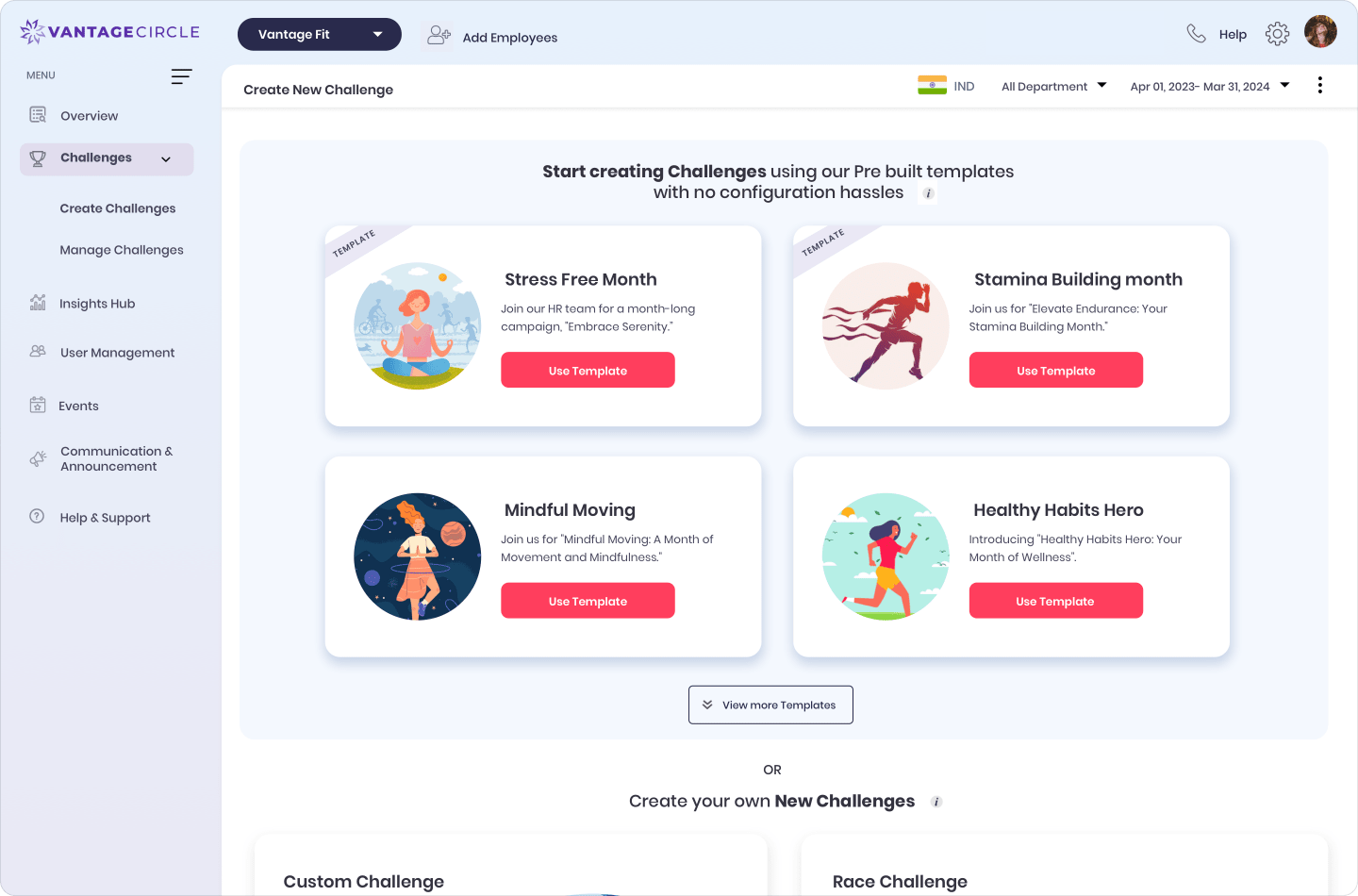
Wellness benefits stall when they sit on a portal nobody opens. Pairing a wellness benefit with a gamified challenge program turns it into something employees actually use weekly, which is what HR needs to see before renewing the line item. Vantage Fit's wellness challenge module combines step tracking, activity goals, and team competitions to drive sustained engagement with a benefit employees already have. See Vantage Fit
6. Learning and Career Development Benefits
Learning is moving from a discretionary perk into the core benefits stack in 2026. According to the SHRM 2025 Benefits Survey, 45% of organizations now offer tuition assistance, with a maximum annual benefit averaging $5,372 per employee. A stipend-based learning marketplace gives employees real choice without HR having to negotiate a separate vendor for every course. Vantage Perks includes a learning benefits module that puts a curated marketplace directly in the employee's hands. Explore learning benefits
7. Lifestyle and Perks Benefits (Commuter, Discounts, Employee Assistance)
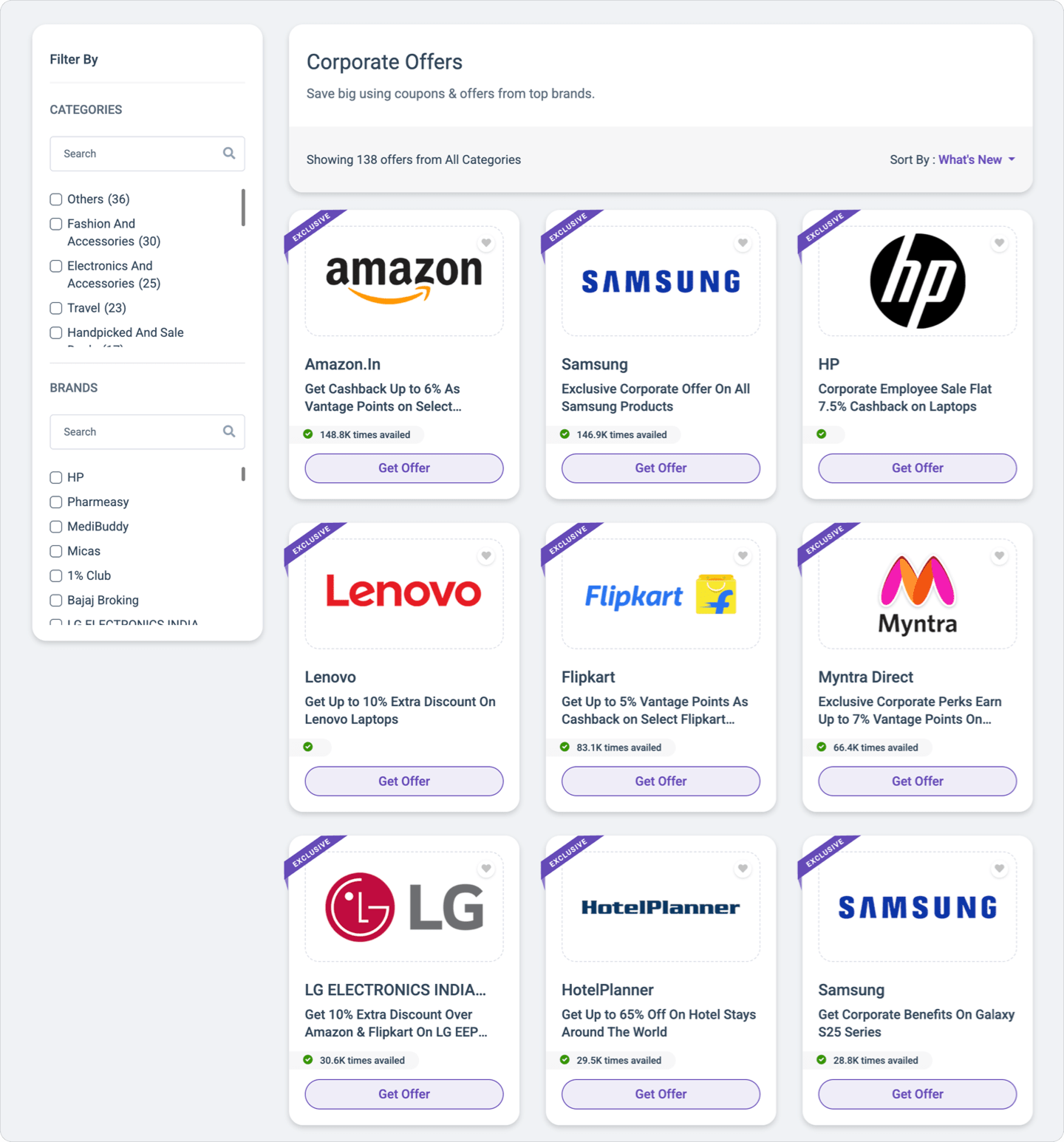
The lifestyle and perks tier of a benefits program is where utilization is usually highest and employer cost is usually lowest. This category includes commuter benefits (pre-tax transit and parking accounts), fringe benefits like wellness allowances and home-office stipends, and employee discount programs. A discounts platform extends spending power across thousands of brands without raising payroll, which is why it shows up in most modern benefits stacks as a default. Vantage Perks delivers employee discounts across 1,000-plus brand partners covering retail, travel, dining, and wellness, with no incremental employer cost per transaction. Explore Vantage Perks
The 7 standard benefit categories are your architecture. The next section covers how to decide which combination of those categories to offer, at what funding level, and for which workforce segments.
How to Build an Employee Benefits Strategy
A benefits strategy is the documented decision framework that tells HR which benefits to offer, at what cost envelope, to which workforce segments, and how success will be measured. Without a strategy, benefits spend grows by accumulation rather than design.
Here is the 5-step framework HR teams can use to build or reset a benefits strategy:
Step 1: Audit current spend and utilization. Pull actual enrollment and utilization data for every active benefit. Identify programs with under-20% utilization. These are candidates for consolidation, redesign, or replacement. Cost-per-utilized-benefit is the metric that surfaces dead weight in the portfolio.
Step 2: Segment your workforce. A 22-year-old engineer has different benefit priorities than a 45-year-old manager with a family. Workforce segmentation by demographics (age bands, family status, job level, location) tells HR where to allocate budget for maximum perceived value. Research consistently shows that tailoring benefits to distinct workforce segments — by age band, family status, or job level — drives measurably higher satisfaction and utilization. Mercer's 2025 National Survey of Employer-Sponsored Health Plans confirms that benefits design aligned to workforce needs is a leading differentiator in competitive packages.
Step 3: Set the total budget envelope. Benefits spending represents approximately 30% of total compensation for private industry workers, rising to around 32% when public sector employees are included (BLS ECEC, Q1 2025). Set the envelope as a percentage of total compensation rather than a flat-dollar figure so it scales with headcount.
Step 4: Choose the mix. Within the budget envelope, prioritize statutory compliance obligations first: health coverage for applicable large employers, FMLA administration, and ERISA requirements. Then layer in the voluntary benefits with the highest utilization potential for your workforce segments. Reserve 5% to 8% of the benefits budget for voluntary add-ons such as discount platforms, learning stipends, and financial wellness tools. These cost little per employee but score high in satisfaction surveys.
Step 5: Set the measurement plan before you launch. Define participation targets, utilization baselines, and eNPS (employee Net Promoter Score) benchmarks for benefits-specific sentiment before the program goes live. Without pre-defined metrics, the annual benefits review becomes a cost-reduction exercise rather than a strategic one. See the employee benefits strategy section for additional framework depth.
The administration workflow is where strategy becomes daily operations.
Employee Benefits Administration: A Working Checklist
Benefits administration is the operational engine HR runs year-round to keep the program compliant, enrolled, and functioning. The 8 core administration areas below define what HR owns and at what cadence.
| Administration Area | What HR Owns | Frequency / Cadence |
|---|---|---|
| Eligibility management | Define and maintain eligibility rules; update on qualifying life events (hire, termination, marriage, birth, COBRA trigger) | Ongoing; life-event updates within 30 days |
| Open enrollment | Plan design decisions, carrier negotiations, employee communications, enrollment window management | Annual; typically 30–60 days before plan-year start |
| Vendor management | Carrier relationships, SLA monitoring, invoice reconciliation, renewal negotiations | Quarterly reviews; annual RFP cycle |
| ERISA and ACA compliance | Plan document maintenance, Form 5500, ACA reporting (1094-C/1095-C), Summary Plan Description (SPD) distribution | Annual filings; ongoing plan-doc updates |
| COBRA administration | Qualifying-event notices, election packets, premium collection per Consolidated Omnibus Budget Reconciliation Act (COBRA) | Within 14- and 44-day statutory windows per qualifying event |
| Payroll integration | Premium deductions, employer contributions, FSA and HSA funding, W-2 reporting | Per pay period; annual W-2 reconciliation |
| Audit trail and recordkeeping | Maintain enrollment records, life-event documentation, and appeals files for minimum 6 years per ERISA | Ongoing |
| Annual program review | Utilization analysis, cost benchmarking, carrier re-bids, workforce satisfaction data collection | Annually; Q3 prep for Q4 renewal |
The administration checklist above is the backbone of the downloadable HR template at the end of this guide.
How to Communicate Benefits So Employees Actually Use Them
The most common reason benefits utilization stays low is not program quality. It is that employees do not know what they have. According to MetLife's 2025 EBTS, employees who understand and actively use their benefits are 2.6x more likely to feel cared for by their employer — yet low benefits utilization remains a persistent challenge for most HR teams. HR teams that run a structured communication program see measurably higher utilization rates, which directly improves the return on benefits spend.
The 4 communication channels HR should run:
1. Pre-enrollment campaign (6 weeks out). Send email and Slack or Teams messages alongside a brief manager enablement kit, delivered 6 weeks before open enrollment opens. The goal is awareness rather than enrollment mechanics. Cover what is new, what is changing, and why it matters.
2. Manager enablement. Managers are the most trusted source of benefits information for employees (SHRM 2025). Give managers a one-page FAQ and a talk track for common benefits questions. They are not expected to be benefits experts. They are expected to know where to send people.
3. On-demand resources. A searchable benefits hub — whether an intranet page, an HRIS module, or a simple PDF library — that employees can access year-round. Include the Summary Plan Description, enrollment guides, and a contact directory for each benefit vendor.
4. Year-round utilization nudges. Benefits communications should not stop on the last day of enrollment. Monthly or quarterly nudges tied to relevant moments (financial wellness reminders in Q1 tax season, mental health resources during high-stress periods) measurably improve utilization throughout the year. The hardest part of benefits communication is knowing which channels worked. Engagement analytics shows which employee segments are reading, opening, and acting, giving HR the input needed to plan next cycle's communications more effectively. See engagement analytics
The metrics section converts communication effort into leadership-ready reporting.
Metrics That Prove Your Benefits Program Is Working
Benefits ROI is invisible without a measurement framework. The 5 core metrics HR should track are:
1. Participation rate by benefit. The percentage of eligible employees enrolled in each benefit. A participation rate below 60% for a core benefit signals either a design problem or a communication problem. Benchmark: according to the BLS 2025 Employee Benefits in the United States report, 87% of full-time private industry workers have access to employer-sponsored medical plans, with a 65% take-up rate among those workers.
2. Utilization rate. For benefits where access and use are distinct (EAPs, wellness programs, learning stipends), participation alone is misleading. Track utilization: the percentage of enrolled employees who actively use the benefit at least once per quarter. EAP utilization nationally runs 3% to 6%; internal rates above that threshold signal effective communication.
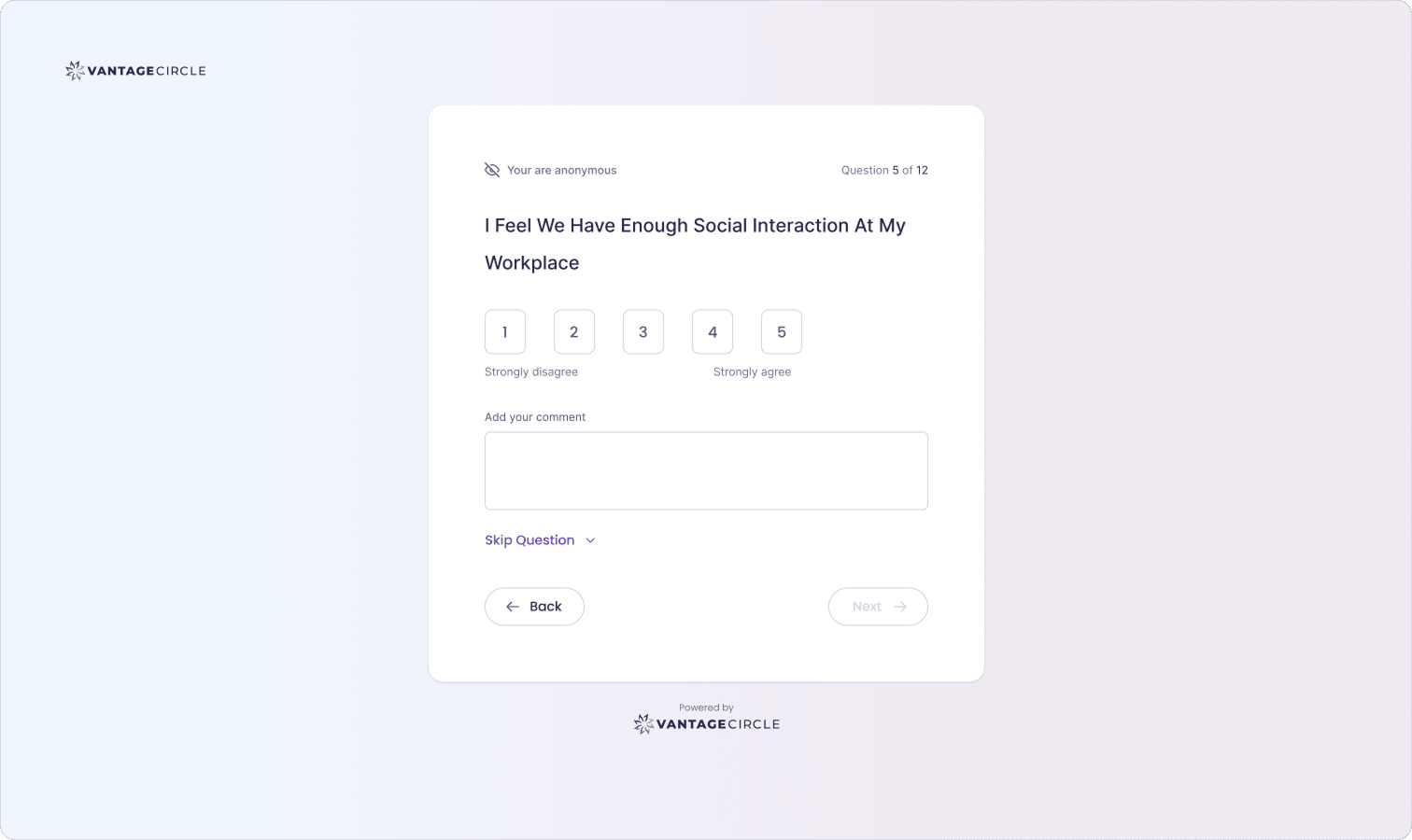
3. Benefits eNPS. A single-question pulse survey asking employees to rate their benefits package on a 0 to 10 scale, then segmented into promoters, passives, and detractors. Running a benefits-specific eNPS 30 days after open enrollment converts soft anecdotes into a number HR can take to leadership. Vantage Pulse makes it straightforward to deploy a targeted pulse survey to a specific employee segment, connecting sentiment data to engagement trends without manual spreadsheet work. Measure benefits sentiment with Vantage Pulse
4. Cost per utilized benefit. Total annual employer spend on a benefit divided by the number of employees who actively used it. This metric surfaces benefits that look affordable on a per-head basis but are effectively subsidizing non-users.
5. Retention correlation. Compare 12-month retention rates for employees who are high benefits utilizers versus those who are not. A positive correlation is the data point finance needs to approve next year's benefits investment. According to Gallagher's 2025 Benefits Benchmarking Report, employee retention ranks as the top operational priority for U.S. employers — second only to growing revenue — with 31% of employers actively enhancing medical benefits specifically to support retention.
See employee engagement KPIs for the broader framework these metrics slot into.
2026 Employee Benefits Trends HR Should Plan For
Five named 2026 trends are reshaping how HR designs and administers benefits programs. Each reflects a shift in workforce priorities backed by 2025 survey data.
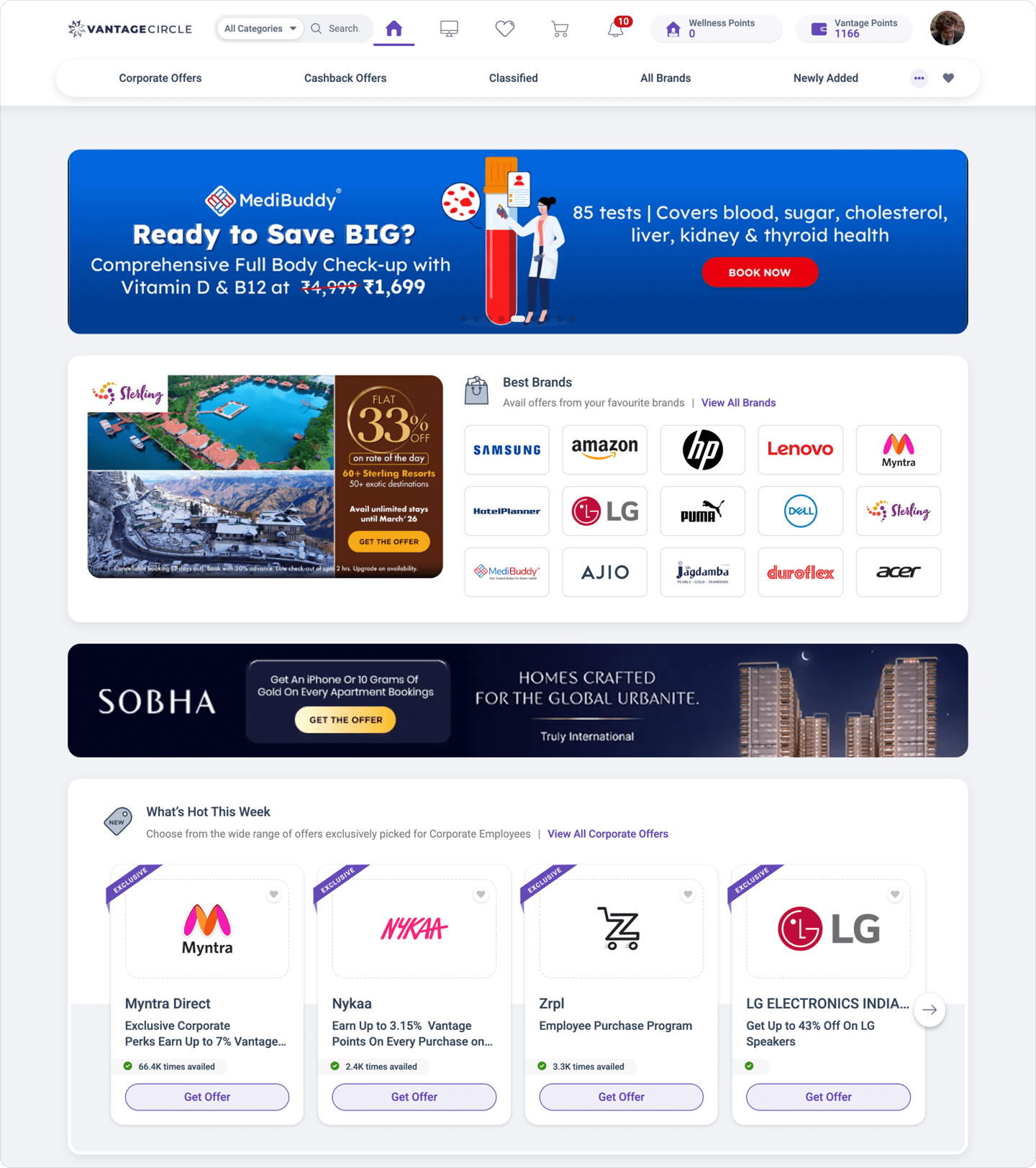
Trend 1: Financial wellness as a core benefit. Financial stress has overtaken physical health as the top driver of productivity loss — MetLife's 2025 EBTS found that 77% of employees cite rising medical costs as their primary stress source, contributing to a measurable 5% drop in workforce productivity. Salary-advance, savings tools, and financial-literacy programs are moving from perks to core voluntary benefits. Vantage Perks includes a financial wellness module covering salary advance and financial-literacy access, addressing the voluntary-benefit employees engage with most. See Financial Wellness
Trend 2: Mental health parity and expanded EAP coverage. The industry standard of 3 to 6 EAP sessions per year is widely seen as insufficient. In 2026, employers are expanding EAP session limits and adding digital mental health platforms. According to Gallagher's 2025 Benefits Benchmarking Report, nearly 60% of organizations report that emotional wellbeing became more important in 2025, with 93% of employers planning to maintain or expand their wellbeing offerings.
Trend 3: Caregiving leave. Parental leave has been table stakes since 2022. The 2026 frontier is elder care and caregiving leave for employees supporting aging parents or family members with disabilities. SHRM 2025 data shows 31% of employers now offer paid leave to care for immediate family members, down from 33% in 2024 — a sign that cost pressures are beginning to affect even established leave programs.
Trend 4: Learning stipends as standard benefits. The line between L&D budget and benefits budget is disappearing. The SHRM 2025 Benefits Survey finds that 65% of employers now rank professional and career development as a very or extremely important benefit category — and dedicated learning stipends are emerging as a flexible complement to traditional tuition assistance. HR should plan for this line item in the benefits budget, not only in the L&D budget.
Trend 5: AI-enabled benefits navigation. The complexity of the modern benefits stack is one of the main reasons employees do not engage with what they have. AI-powered benefits guides and chatbots that answer employee questions in plain language are being deployed by leading employers to reduce HR helpdesk volume and improve enrollment completion rates. According to Mercer's research on AI in benefits management, 85% of employers say they are currently using AI or plan to do so within the next 12 months — with benefits navigation and enrollment personalization identified as top use cases.
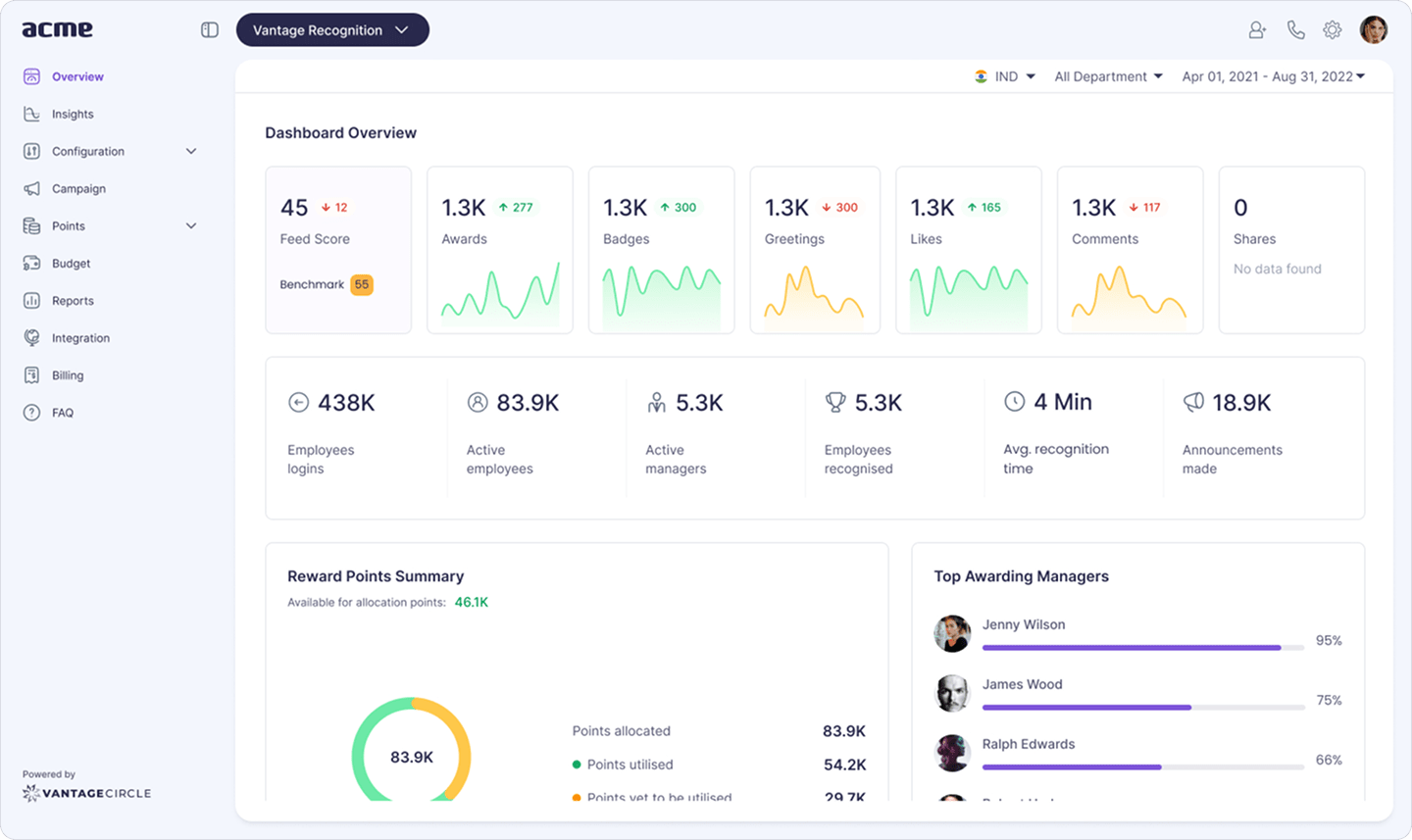
Recognition belongs inside the total-rewards conversation, not adjacent to it. A modern benefits guide names recognition as a category because employees increasingly read peer recognition, manager recognition, and milestone awards as benefits, not niceties. Explore Vantage Rewards
Frequently Asked Questions
What are the 4 types of employee benefits?
The 4 core types are: (1) health and medical (insurance, FSA, HSA); (2) retirement and financial (401(k) with employer match); (3) paid time off and leave (PTO, sick leave, FMLA); and (4) insurance (life, disability, voluntary supplemental). Most HR programs expand this into a 7-category taxonomy that adds wellness, learning, and lifestyle benefits.
What is an employee benefit guide?
An employee benefits guide is the HR-owned reference that defines what a company offers, who is eligible, how to enroll, and how the program is administered. It is not an employee-facing enrollment PDF. It covers the full HR lifecycle: benefit taxonomy, strategy, administration, communication, and measurement.
What are the top 5 employee benefits?
According to SHRM's 2025 Employee Benefits Survey, the top 5 are: (1) health insurance, (2) flexible and remote work, (3) paid leave, (4) retirement savings with employer matching, and (5) mental health and wellbeing programs.
What are the three types of benefits?
The 3 types by employer obligation are: (1) statutory benefits, required by law (Social Security, Medicare, workers' compensation, FMLA); (2) traditional voluntary benefits, standard in competitive packages (health, 401(k) match, PTO, life insurance); and (3) supplemental voluntary benefits, typically employee-paid at group rates (critical illness, accident, discount programs).
Build a Benefits Program Employees Actually Value
The HR professional's job is not to list what a company happens to offer. It is to build a benefits program that is competitive on cost, compliant with ERISA and ACA requirements, clearly communicated to employees, and measurable enough to justify renewal at the next leadership review.
The 7 standard benefit categories, the 5-step strategy framework, the 8-area administration checklist, and the 4-channel communication model in this guide provide the architecture. The downloadable template below puts the checklist and communication calendar in a format your team can use from day one.
Vantage Perks brings together employee discounts, wellness benefits, learning stipends, and financial wellness tools in a single platform, making it straightforward to expand the voluntary benefits layer without adding vendor complexity. Vantage Rewards extends that program into recognition, closing the loop between the benefits employees use and the acknowledgment that signals they are valued.
Ready to rethink your benefits strategy? Download the Employee Benefits Guide Template for HR Teams below and explore how Vantage Circle can help you build, communicate, and measure a program your workforce actually engages with.
Free Download: Employee Benefits Guide Template for HR Teams (PDF) — strategy framework + administration checklist + annual communication calendar
Sources: BLS Employer Costs for Employee Compensation (ECEC), Q1 2025; BLS Employee Benefits in the United States, 2025; SHRM 2025 Employee Benefits Survey; MetLife Employee Benefit Trends Study (EBTS) 2025; Mercer 2025 National Survey of Employer-Sponsored Health Plans; Gallagher 2025 Benefits Benchmarking Report.

This article is written by Lupamudra Deori. Lupamudra is a content marketing specialist at Vantage Circle, focused on creating clear, research-driven content on employee engagement and workplace culture.
Connect with Lupamudra on LinkedIn.


