
Here's the brutal truth: Most employee nominations fail before they even reach the committee.
It's not because the employee is undeserving, but the nomination fails to demonstrate the impact. A manager writes, "Arya is always willing to help and brings positive energy to the team." It sounds nice. But when a recognition committee reads forty versions of the same sentence, even genuinely deserving employees can get lost in the pile.
That is the real problem. Most nominations describe the person but do not show what they actually did, why it mattered, or what changed as a result.
And this matters more than most organizations realize. A Gallup research found that well-recognized employees are 45% less likely to change organizations after two years.
A strong nomination helps close that gap. It turns appreciation into evidence and gives committees a clear reason to say yes. And most importantly, it makes sure meaningful contributions do not go unnoticed.
What Makes an Employee Nomination Strong: The 6 Criteria
A strong nomination provides a decision-maker with enough evidence to say "yes," without having to fill in the gaps.
The 6 criteria below are the filters most recognition programs use, whether they are structured award cycles or informal peer recognition programs. Make sure your nominee meets at least three criteria before you proceed.
1. Reflects Core Company Values
Go beyond performance evaluations and look for behaviors that your organization wants to reinforce. Name the specific value your nominee demonstrated and show how their actions expressed it, not just how it was adjacent to it.
- ❌ "She demonstrated integrity."
- ✅ "She flagged a billing discrepancy that was not her responsibility to find and built a process to prevent it."

Source: Vantage Recognition
2. Exceptional, Evidenced Performance
"Exceptional" is not about someone consistently doing their job well, it's about a performance or specific action that went beyond expectations. If a neutral person analyzed the facts and agreed it was exceptional, it's a strong case. If the reason is "they always work hard," look for a more specific example.

Source: Vantage Recognition
3. Loyalty and Consistency
Some recognition programs value tenure, reliability, and consistency, contributions that often go unnoticed until they are missing. Loyalty is demonstrated when someone maintains quality under pressure, steps in to fill a gap, or supports the team during a difficult period.
4. Leadership and Initiative
Leadership in a nomination context is not defined by seniority or title, but by the capability to take ownership. It shows when someone spots a problem early, suggests or creates a solution, and helps others move forward.
"She noticed the gap, created a better process, and had three colleagues using it before anyone asked her to."
5. Customer Service Excellence
Applicable to customer-facing roles, this assesses whether the nominee exceeded the expected resolution to create a measurably better experience. Document the specific interaction, the customer's need, and how the employee approached it differently. A client satisfaction score or direct feedback quote is the strongest evidence.
6. Innovation and Creativity
This criterion rewards originality that created a real, observable improvement, a new process that cuts handling time, a creative approach to a recurring problem, or an idea nobody had tried before. Name the idea, describe what it replaced, and show what changed.

Source: Vantage Recognition
Criteria to Evidence: What to Attach to Each
| Criterion | What to Look For | Evidence to Attach |
|---|---|---|
| Core company values | A specific action that expressed a named company value | Describe the behavior and map it to the value by name |
| Exceptional performance | A result measurably above standard output | Numbers: output volume, error rate, delivery time, quality score |
| Loyalty and consistency | Sustained reliability over a defined period, especially under pressure | Track record: months or years of strong performance; instances of covering gaps |
| Leadership and initiative | Self-directed action that created a positive outcome for the team | Describe the problem identified, the action taken, and the people it affected |
| Customer service excellence | An interaction where the employee created a better outcome than required | Customer feedback, ticket notes, or a direct manager observation |
| Innovation and creativity | A change the employee introduced that improved a process or outcome | Before-and-after metrics; adoption by other team members |
How to Write and Submit an Employee Nomination in 5 Steps
Good nominations are built, not written in one go. Here's a 5-step process to assist managers in their nomination submissions.
Step 1. Identify a Genuinely Deserving Performer
Start with a specific moment or time period, not someone you generally admire. Ask yourself: What did this person do in the last review cycle that clearly went beyond expectations? If you can't answer in one sentence, the nomination isn't ready yet.
Common mistake: Choosing the person first and then looking for evidence to justify. Instead, start with the specific action or moment, and let that lead you to the right nominee.
Step 2. Gather Concrete, Specific Evidence
This step separates strong nominations from the ones that get stuck during review. "She always goes the extra mile" is not evidence. Strong evidence includes:
- The date
- The situation
- What the person did
- What changed as a result
Use project notes, email threads, client feedback, performance data, or recognition data to support the nomination.
Step 3. Quantify the Impact
Not every contribution has a clean metric, but most can be backed with some numbers, time saved, errors reduced, satisfaction scores, revenue impact, or number of people involved.
Use only numbers that are real and easy to verify. If there is no exact metric, use a clear comparison:
"This work reduced a 3-day manual process to 4 hours."
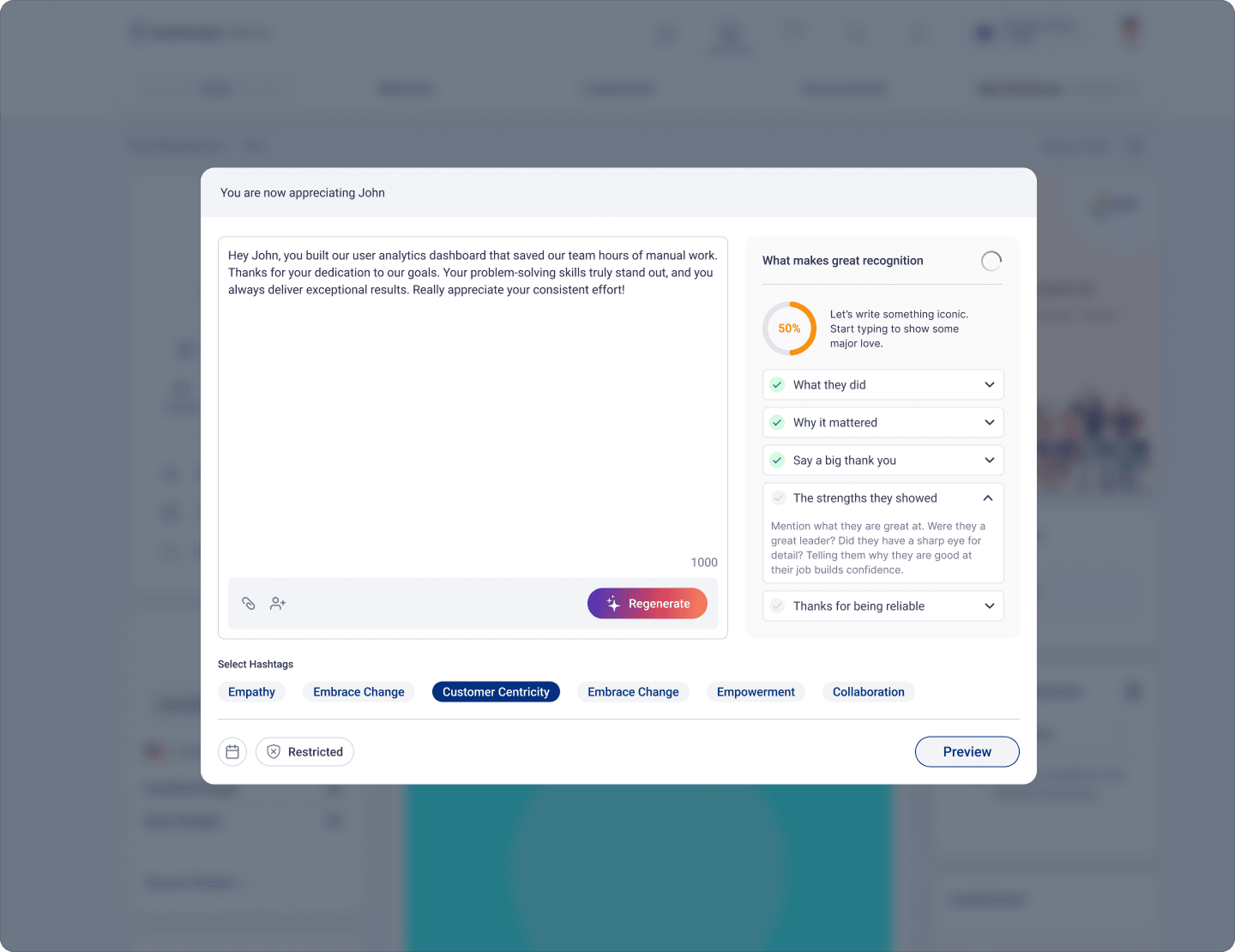
Step 4. Connect It to a Company Value
Choose the company value that best matches the nominee's work. Don't force the connection, review committees can easily spot nominations where the value alignment feels constructed. The connection should feel natural.
Source: Vantage Recognition
Step 5. Polish, Proofread, and Submit
Read your nomination draft aloud. If it sounds like a performance review, revise it. A strong nomination should read like a story: what happened, what the person did, what changed, and why it mattered.
- ✅ Aim for 100–200 words
- ✅ Remove sentences that describe character rather than specific actions
- ✅ Check for spelling errors
- ✅ Submit before the deadline, late nominations rarely get exceptions
Employee Recognition Nomination Examples You Can Copy and Adapt
Each example follows a common structure: situation → action → result → value connection.
Note: The numbers in these examples are illustrative. Replace with real figures from your organization before using.
Example 1: Exceptional Performance
"During the Q3 product launch, [Name] coordinated campaign deliverables across 3 regional teams within a 2-week compressed timeline. She built and maintained a shared tracker that reduced briefing time by 40% and ensured zero gaps across 12 collateral pieces. Her precision under pressure was directly responsible for our on-time launch. This reflects our core value of Ownership."
Example 2: Teamwork
"When our content team lost 2 members simultaneously, [Name] stepped in to cover 2 additional workstreams for 6 weeks without a reduction in quality or timeline. He proactively reallocated his own tasks, communicated transparently with stakeholders, and prevented 3 deadlines from slipping. That kind of quiet reliability is what our Collaboration value looks like in practice."
Example 3: Innovation
"[Name] identified that our onboarding documentation was creating a recurring delay in new hire ramp time. Without being asked, she rebuilt the entire module structure, piloted it with the next 3 hires, and reduced average time-to-productivity by an estimated 30%. The revised format has since been adopted by 2 other teams. This reflects our Innovation value directly."
Example 4: Customer Service Excellence
"A key client raised a last-minute concern that would have required a 3-day redesign. [Name] proposed an alternative that resolved the concern in 4 hours without reopening the original scope. The client cited this in their project feedback as the reason for a 9/10 responsiveness rating. This is exactly what Customer First looks like under pressure."
Example 5: Peer Nomination (Cross-Functional)
"[Name] consistently supported our creative team's requests over an 8-month period, providing detailed briefs, fast turnarounds on feedback, and specific guidance on every deliverable. The quality of our output improved visibly on every project where he was involved. Recognition should go in both directions, and he made cross-functional collaboration feel straightforward in a year when that was genuinely hard to achieve."
What Gets a Nomination Approved vs. Rejected
The difference between an approved nomination and one that gets passed over is almost always about the quality of the evidence, not the employee.
| Element | Weak Nomination | Strong Nomination |
|---|---|---|
| Opening line | "Sarah is a fantastic team member who always brings positivity." | "In October, Sarah led an audit that identified and recovered $12,000 in billing errors over 3 weeks." |
| Evidence | "She always goes above and beyond." | "She identified the error pattern independently, built a 4-step verification process, and trained 6 team members on it." |
| Impact | "Her work really made a difference this year." | "The new process reduced billing disputes by 35% in the following quarter." |
| Values connection | "She truly embodies our company culture." | "This reflects our core value of Integrity: she flagged and fixed a problem that was not hers to own." |
| Tone | Emotional, personality-focused, vague | Factual, behavior-focused, evidence-driven |
| Length | Padded with filler to reach a word count | 120–180 words with every sentence earning its place |
How Peer Recognition Works Differently, And Why It Doesn't Need a Nomination
Not every act of recognition needs a formal nomination process.
Structured nominations make sense for award cycles, Employee of the Month, annual excellence awards, leadership recognition, where a committee reviews submissions and picks a winner. However, peer recognition operates on a different logic entirely.
When a colleague helps you meet a deadline, resolves a blocker at the last minute, or quietly carries extra load while someone else is out, waiting for the next nomination window to acknowledge it is a mistake. The moment loses its essence, the behavior goes unrecognized, and the person who deserves to feel seen does not.
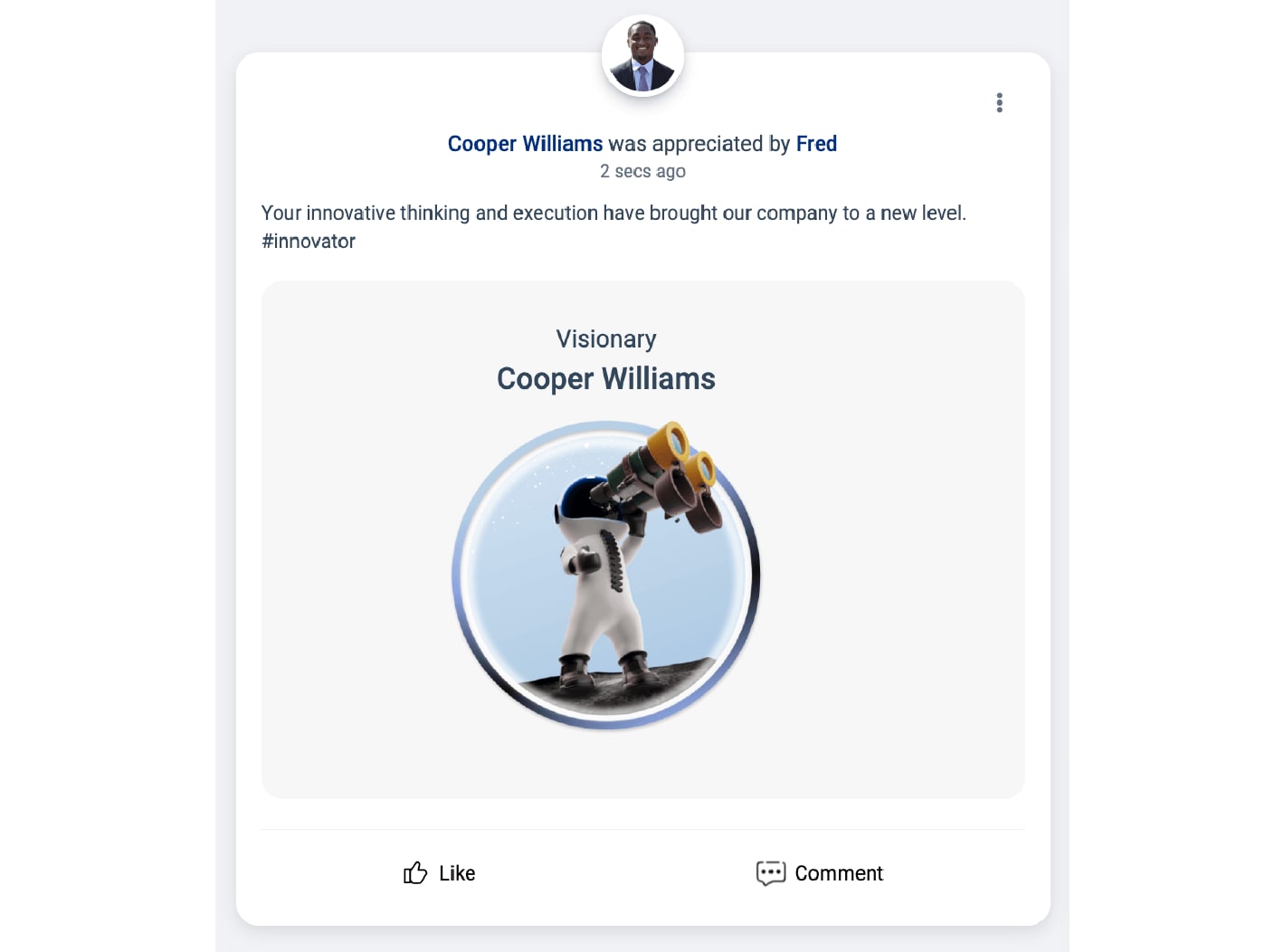
Platforms like Vantage Recognition allow any employee to recognize a peer directly, in real time, without filing a nomination or waiting for a manager's approval. Employees can tag a company value, write what the colleague did and why it mattered, and post it to a social recognition feed. The recognition lands immediately, and the whole team sees it.
Source: Vantage Recognition
This visibility serves two purposes:
- It closes the gap between the behavior and the acknowledgment, which is when recognition has the most impact.
- It shows everyone else what good work looks like in practice, in your team's own words, not through a committee.
Final Thoughts
A well-written nomination does more than recognize an employee. It shows everyone what the organization truly values in action. When recognition is specific, evidence-based, and consistently shared, it creates a clearer standard for what great work looks like.
Over time, these nominations help build a stronger recognition culture, one where meaningful contributions are noticed, named, and celebrated.
FAQs
What do you say when nominating an employee for an award?
State what the employee did, when they did it, what the measurable outcome was, and which company value their action expressed. Avoid character assessments. A nomination committee cannot evaluate "she is a great person." They can evaluate "she identified a process gap, built a fix, and reduced onboarding time by 30% in one quarter." Name the behavior. Show the result.
What should you write when nominating someone for an award?
Write in 3 parts: the situation (what challenge or opportunity existed), the action (exactly what the person did), and the result (what changed because of it). Keep it between 100 and 200 words for most programs. Cut any sentence that describes the person's personality rather than their specific behavior during a specific event.
What is an example of a good nomination?
"During the product migration in March, [Name] coordinated across engineering, QA, and customer success, none of which report to her. She built a shared issue log, ran daily standups for 3 weeks, and the migration completed 2 days ahead of schedule. This reflects our core value of Initiative."
Situation, action, result, values connection, in under 60 words.
What is an example of an employee recognition message?
A peer recognition message can be simpler than a formal nomination:
"I want to recognize [Name] for how she handled the client escalation last week. She stayed calm, took ownership of the communication, and resolved it within 24 hours. I have been on this team for 2 years and that was genuinely impressive to watch."
Specific, behavioral, and human.

Riha Jaishi is a Content Marketing Specialist at Vantage Circle and host of the HR Vantage Influencers podcast, sharing insights that help organizations build recognition-rich, people-first cultures!!
Connect with Riha on LinkedIn.