
You are about to sign a three-year contract for a workforce you cannot describe past next quarter.
That is the quiet problem sitting underneath most rewards and recognition deals right now. The platform demo is impressive. The references check out. The per-employee price looks reasonable on the spreadsheet. And then you sign a multi-year commitment priced against a headcount number that everyone in the room privately suspects will not survive the next reorg.
Nobody says this out loud in the procurement meeting. The CFO is thinking it. The CHRO is thinking it. And then everyone moves on to the implementation timeline.
The contract assumes a workforce that will not exist in 18 months
Headcount is no longer a stable planning input. Recognition contracts have not caught up.
A 2026 Gartner survey found 80% of organizations piloting AI had already made workforce reductions. Those cuts mostly failed to deliver expected returns. Gartner expects roughly half of the companies that trimmed customer-service roles for AI to rehire by 2027. Cut, then rehire, inside the same contract term.
McKinsey's work on automation puts the number higher still. Up to 375 million workers globally may need to shift occupational categories by 2030, touching close to a third of the US workforce.
The workforce is not just shrinking. It is churning in both directions, on a timeline shorter than the contract you are being asked to sign.
I would push back on the doom framing that usually rides alongside these numbers. AI is not quietly deleting your org chart overnight; its real effect on recognition and rewards is subtler than the headlines suggest. But the planning point holds regardless: the headcount you have on signing day is the one input you can be most confident will be wrong by renewal. Most recognition contracts are priced as if that input were fixed.
Per-seat pricing was built for a decade that already ended
Almost every recognition platform still bills the same way. A price per employee, per month, locked to the headcount you contracted on day one.
Look at any "best recognition software" roundup and the pattern is identical. Two to seven dollars per user per month, billed annually, on the seat count you committed to upfront. That model made sense when headcount moved a few percentage points a year. It does not hold when a restructuring shifts it 20% in a quarter.
Here is what should bother a finance leader. When headcount drops, the per-seat invoice usually does not. You contracted for 8,000 seats. You are now running 6,400. You are still paying for 8,000, because the contract has no mechanism to follow your actual workforce down. The "flexibility" on offer is a renegotiation call. Which is to say, no contractual flexibility at all.
This is why two questions matter more than any feature comparison before you sign:
Q1: Do you price on contracted headcount, or on monthly active users?
Q2: What happens to our invoice if headcount drops 15% or more due to restructuring?
Ask both directly on your next vendor call. A good answer to the first is "monthly active users." A good answer to the second is "pricing recalibrates automatically within 30 days, no renegotiation required." Anything else, any version of "we would handle that case by case," is the vendor telling you whose risk the contract was designed to protect. It is not yours.
The part of the contract nobody stress-tests: adoption
Recognition only returns anything if people actually use it.
That is the line item no pricing page mentions. And it is the one that quietly sinks more programs than bad software ever does.
The business case for recognition is genuinely strong. Gallup and Workhuman's 2024 research found well-recognized employees 45% less likely to have left after two years. Aon's 2025 Employee Sentiment Study found 60% of employees open to or actively pursuing a new role. Recognition is not a nice-to-have. It is a retention lever.
But here is the catch buried in the same Gallup data. Only 22% of employees say they receive the right amount of recognition. Our own numbers point the same way. The Recognition Effect, a joint study by Great Place to Work® India and Vantage Circle drawing on 5.7 million employees across 2,000 organizations, found only 55% of employees feel truly recognized, while high-recognition cultures show a 21-point lift in intent to stay. Most programs fail not because the software is bad. Adoption never happened. A recognition tool nobody opens is an expensive screensaver.
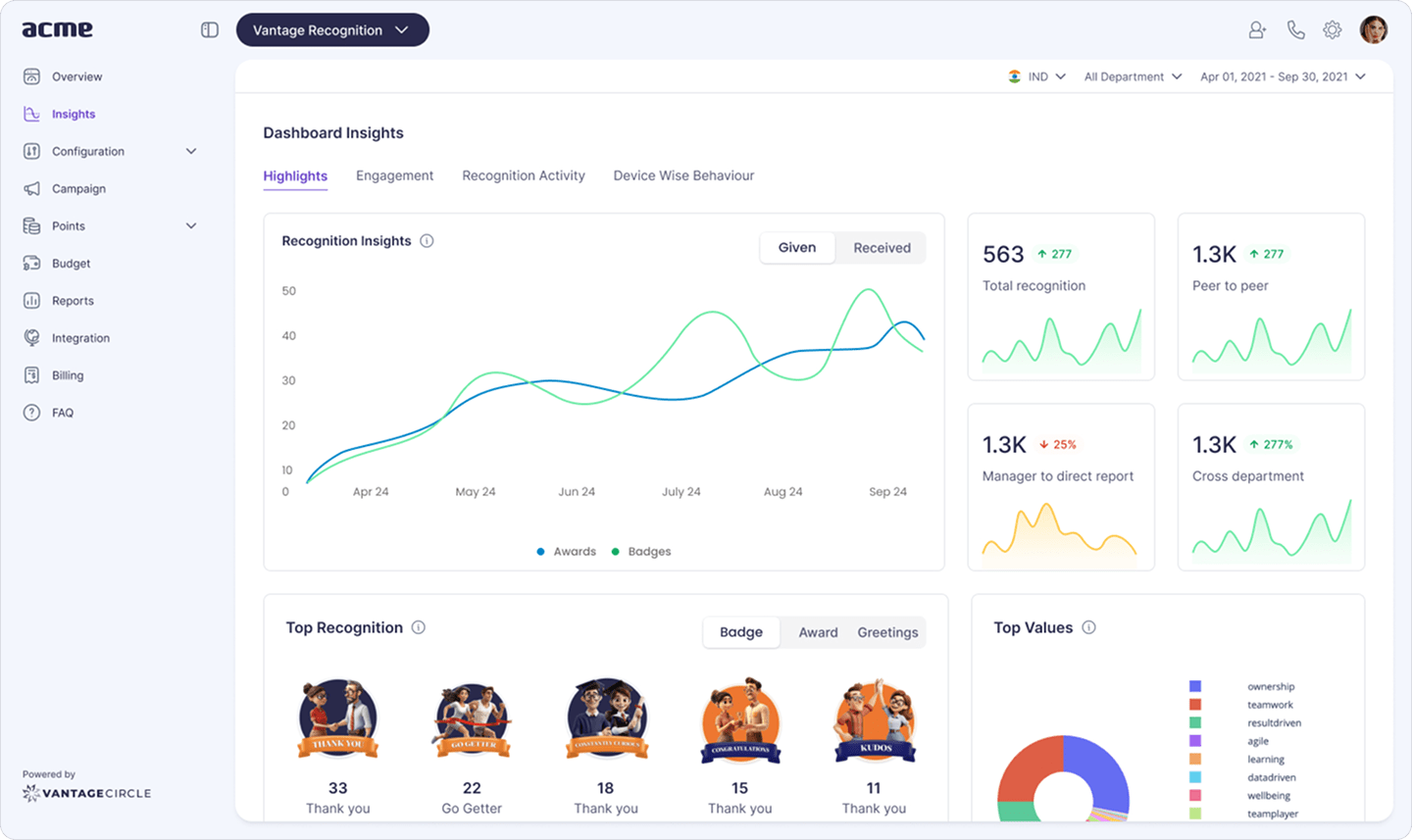
The only way to know whether adoption actually happened is to watch it. A recognition insights view, peer-to-peer activity, manager-to-report coverage, cross-department reach, monthly active users, turns "we hope people are using it" into a number you can hold a vendor to at renewal.
So who carries the adoption risk in the contract?
In almost every deal I have seen, the answer is the HR leader who championed the purchase. The vendor promises adoption in the pitch, hands the rollout back to HR after kickoff, and shows up again at renewal regardless of whether anyone logged in. The change-management risk, which is the actual risk, sits entirely on the buyer.
A small number of vendors have started building contracts that work differently. Not different pricing mechanics. A different distribution of risk altogether. Vantage Circle is among the first to formalize this as a named commercial model. Vantage Base prices on monthly active users rather than contracted headcount, so the invoice follows your workforce down automatically if it shrinks. Vantage Proof places 40% of the annual fee at risk against KPIs you and the vendor define together before signing; miss the outcomes, and that portion is simply not invoiced. Vantage Assurance commits to 70% monthly active adoption by month six, with a free contract extension if that threshold is not reached. Taken together, they call it Vantage Adaptive Pricing. The structure is the point: every commercial risk that currently sits with HR gets redistributed back to the vendor.
Before you sign, ask your vendor this:
Q4: What percentage of your fee is at risk if the outcomes we agreed on are not delivered?
If the answer is zero, you have learned something important. McKinsey research is unambiguous: 70% of change programmes fail, largely due to employee resistance and lack of management support. Most vendors carry none of that risk. A serious vendor puts a number in the contract, not a reassurance in the pitch.
And then:
Q3: What adoption rate do you guarantee, and what happens contractually if you miss it?
A serious answer names a threshold, a timeline, and a consequence. As a reference point, Vantage Circle's Vantage Assurance clause commits to 70% monthly active adoption by month six and extends the contract at no cost if it misses that mark. The real question to put to any vendor is simpler: is your adoption commitment in the contract, or only in the deck?
The money that never reaches your employees
There is a budget version of this problem that sits even further below the surface.
Industry analyses estimate that only about 60 cents of every reward dollar actually reaches the employee. The rest disappears into reward markups of 20 to 30%, plus 10 to 15% in breakage on points people never redeem. You budgeted recognition spend. A meaningful slice of it never reached a single human being.
On a 2%-of-payroll recognition budget, that is not a rounding error. It is the difference between a program that lands and one that quietly erodes trust. The budget is simply not arriving in full.
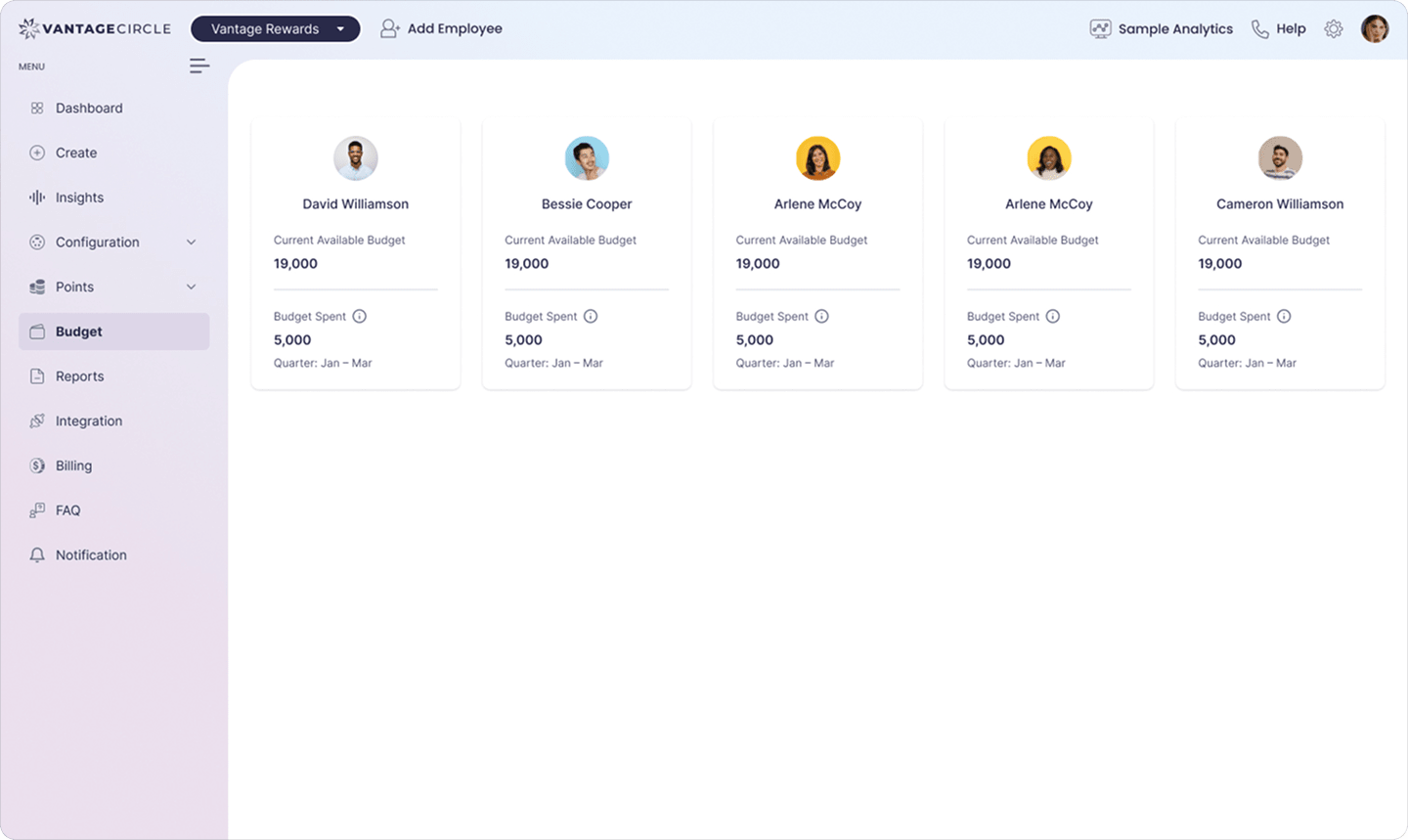
The fix is not complicated, but most vendors avoid it: show every manager exactly what budget they hold, what has been spent, and what reaches the employee, with no markup skimmed in between. When the budget is visible down to the dollar, the question of where it went stops being a mystery.
So a fifth question belongs on your list:
Q5: What transaction fees or markups do you charge on rewards redeemed?
Zero markup means every budget dollar reaches your team. Most platforms charge 14 to 25% on every reward without stating it in the summary pricing. That money was never going to show up in your engagement numbers.
There is a related question that determines whether any of this is measurable at all. Most HR software proposals die in Finance for one reason: there is no measurable financial justification attached to them. Not because recognition does not work. Because nobody agreed on what working looked like before the money was spent.
Q6: How do you define and measure success, and is it agreed before we sign?
Vendors who define success at renewal are protecting themselves, not you. The KPIs that matter (voluntary turnover reduction, manager participation rate, recognition coverage, monthly active users) should be documented and agreed at signing, not described in the pitch as something you will figure out together over the first quarter.
And the seventh question, the one that reveals the most about the first six:
Q7: What happens at renewal if our engagement goals were not met?
If the answer is a conversation, that is not accountability. A vendor with genuine skin in the outcome has already written the answer into the contract.
These seven questions work on any vendor. A contractual commitment is green, a case-by-case assurance is amber, silence is red. Run it before you sign, not after.
Before your next vendor call
See how an adaptive pricing model answers all seven.
We expanded this checklist into a full buyer's guide, the exact questions to ask a recognition vendor, and how adaptive pricing in recognition programs shifts headcount, adoption, and budget risk off your plate and onto the vendor's.
The contract is the strategy
The recognition conversation starts with features and ends with a price per seat. It should start somewhere else entirely: not "which platform has the best feed," but "which contract still makes sense if my headcount, my budget, and my org chart all look different a year from now."
None of this makes the recognition program itself good. Strategy, manager behavior, and culture still do the heavy lifting. What a different commercial model does is remove the structural deadweight: a contract that ignores headcount reality, a vendor with no skin in the outcome, an adoption risk that lands on the one person who can least afford it.
That is a smaller claim than "this fixes recognition." It is also a more honest one.
Run the seven questions on your vendor before renewal. Whatever you choose, choose a contract built for the workforce you will actually have. Not the one you had the day you signed.

He has worked in the human resources environment and has elevated recognition and rewards through his insightful and detailed writing. He aims to enhance the practice of Recognition in the workplace with new ideas and innovation that will help shape the work culture. For any related queries, contact editor@vantagecircle.com