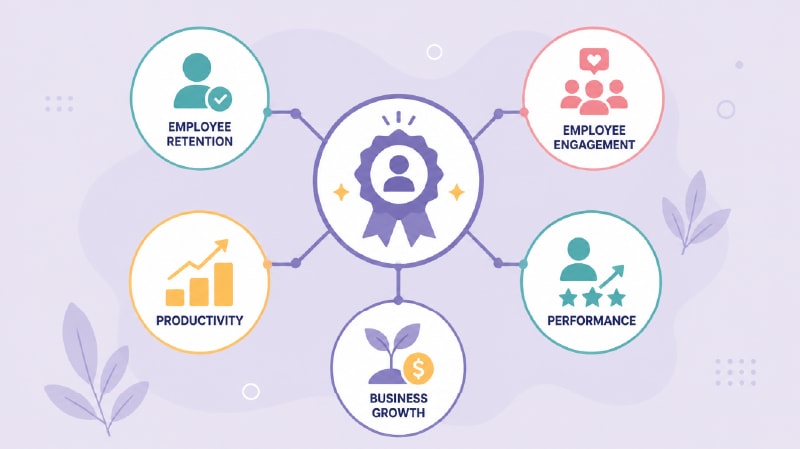
Every HR leader has heard the question from finance: "What do we actually get back from recognition?" The honest answer is a number, and it is bigger than most budgets assume. Employee recognition ROI (return on investment) is the return your recognition spend produces across specific business outcomes, from lower turnover to higher productivity. This guide breaks that return down by outcome, with the formula, named data, and a calculator so you can build a business case your CFO will sign.
Key Takeaways
- What Is Employee Recognition ROI?
- Recognition ROI by Business Outcome
- How to Calculate Recognition ROI: A 5-Step Method
- The Cost Side: What a Recognition Program Actually Costs
- How to Present Recognition ROI to Your CFO
- Frequently Asked Questions
What Is Employee Recognition ROI?
Employee recognition ROI is the financial return a company earns from its recognition program spend, measured as the combined value of improved business outcomes minus program cost, divided by program cost. The return shows up across specific outcomes: lower voluntary turnover, higher productivity, stronger engagement, reduced absenteeism, and better customer satisfaction.
The distinction that matters most in any ROI conversation is the difference between a general claim ("recognition improves culture") and a specific one ("recognition reduced our voluntary attrition rate by 31%, saving $3.6 million in backfill costs against a $50,000 program investment"). Finance responds to the second kind. The rest of this guide is built on the second kind.
The Master ROI Formula
Master Formula
Recognition ROI = (Value of Outcomes Achieved − Program Cost) / Program Cost
Express as a ratio or multiply by 100 for a percentage. Ratio format is more legible than percentages in executive conversations.
The inputs to this formula are not a single number but a stack of outcome-specific returns. Each business outcome has its own valuation method. The next section builds that stack, row by row.
Why Measure ROI by Specific Outcome
Most recognition ROI content quotes a single aggregate figure and leaves HR to justify it. The problem with single-figure ROI is that it gives finance nowhere to apply it against the business problems they actually own. A CFO who is worried about rising attrition in engineering will not act on a generic "23% improvement in business outcomes." She will act on "recognition reduced voluntary attrition in this function by 31%, avoiding $1.2 million in backfill costs."
Outcome-specific ROI translates recognition into the language of whatever problem the C-suite is currently solving for: employee retention, productivity, quality, customer satisfaction, or safety. It also forces a measurement baseline. You cannot calculate recognition ROI for a specific outcome unless you measured that outcome before the program launched.
Recognition ROI by Business Outcome
Recognition programs produce measurable returns across 7 specific business outcomes. The table below shows each outcome, the data behind it, and how the return is calculated.
Throughout this article, you will see findings from The Recognition Effect, a study by Great Place To Work® India and Vantage Circle covering 5.7 million employees across 2,000 organizations. It is cited as supporting evidence alongside primary US research from SHRM, Gallup, Deloitte, and NSC.
| Business Outcome | What the Data Shows | How to Calculate the Return |
|---|---|---|
| Retention / Turnover Cost | 31% lower voluntary turnover (SHRM, 2023) | Retained employees x replacement cost (50–200% of salary) |
| Productivity | 23% higher business outcomes in highly engaged vs. disengaged teams (Gallup, 2023) | Productivity lift % x revenue per employee x headcount |
| Employee Engagement | 40% more engaged workforce when managers excel at recognition (Gallup, 2022) | Engagement lift % x Gallup's 21% profitability premium |
| Absenteeism | 81% less absenteeism in highly engaged vs. actively disengaged teams (Gallup, 2023) | Absence days recovered x daily labor cost per employee |
| Customer Satisfaction | 94% vs. 82% excellent customer service in high vs. emerging recognition cultures (VC / Great Place to Work, 2025) | CSAT or NPS lift x customer revenue retention rate |
| Safety and Quality | 93% vs. 78% organizational agility in high vs. emerging recognition cultures (VC / Great Place to Work, 2025) | Incident reduction x average incident cost (downtime, rework, workers comp) |
| Discretionary Effort (Leading Indicator) | 95% organizational pride in high-recognition cultures vs. 82% in emerging recognition cultures (VC / Great Place to Work, 2025) | Stretch project completion rate x estimated project value |
Each example below uses a different industry scenario to illustrate where that outcome is most commonly measured and most easily defended to finance. The same methodology applies across all US industries. Start with the outcomes your business already tracks rather than attempting to measure every possible benefit.
| Industry | Most Defensible Recognition ROI Outcomes |
|---|---|
| Technology / SaaS | Retention, Productivity |
| Financial Services | Retention, Customer Satisfaction |
| Healthcare | Retention, Safety, Absenteeism |
| Manufacturing | Safety, Quality, Retention |
| Professional Services | Retention, Customer Satisfaction |
1. Retention and Turnover Cost
Retention is the largest and most defensible input in a recognition ROI calculation, and it is where most CFOs will close the conversation.
Formula: Retained employees x replacement cost per employee = Turnover cost avoided
lower voluntary turnover in companies with effective recognition programs
SHRM, 2023
Worked Example
A 1,000-person organization at 18% voluntary attrition and a $65,000 average salary spends $50,000 per year on recognition. Applying SHRM's (2023) 31% voluntary turnover reduction benchmark:
- Turnover falls from 180 departures per year to 124: 56 fewer exits
- Turnover cost saved: 56 x $65,000 = $3.64 million
- Recognition ROI on turnover savings alone: ($3.64M minus $50K) / $50K = 72.8x (using a conservative replacement cost equal to one times annual salary, the lower end of SHRM's 50–200% range; actual return is higher at mid-range replacement costs)
Recognition programs that achieve broad workforce coverage (peer-to-peer, manager-led, and milestone-based) are the ones that produce results at this scale. At LTTS, 93% of 23,000+ employees participated in the recognition program. At Wipro, 57% of 230,000 employees received recognition in one fiscal year. That coverage is what moves the retention needle SHRM's benchmark is measuring.
For the complete retention ROI model with leading indicators, enterprise program benchmarks, and a fully worked CFO-ready calculation, see The ROI of Employee Recognition: How to Build the Business Case.
2. Productivity and Performance
Productivity ROI is real, but treat it as additive upside in your business case rather than the primary argument. Attribution is harder to defend than retention math, and you do not need it to close the case.
Formula: Productivity lift % x revenue per employee x headcount = Productivity return
Gallup's 2023 State of the Global Workplace found organizations with highly engaged workforces outperform bottom-quartile peers by 23% on business outcomes. Recognition is the most consistent driver of the engagement levels that produce that performance gap. When employees receive recognition at least weekly, 61% are engaged, compared to 38% who receive manager feedback without recognition.
The Vantage Circle × Mercer Future of Total Rewards whitepaper cites Harvard Business Review research showing continuous recognition drives 12% higher productivity compared to annual feedback cycles. Reinforcement that happens year-round builds behavioral habits that annual reviews cannot.
Worked Example
A 500-person SaaS company generating $200,000 in annual recurring revenue per employee. Conservative assumption: recognition drives a 5% improvement in individual output (well below the 23% ceiling).
- Productivity value: 500 x $200,000 x 5% = $5 million
- Program cost at $50 per employee: $25,000
- Net productivity return: $4.975 million
Lead with retention. Bring productivity as the second line of evidence if finance pushes back on the retention assumption.
3. Employee Engagement
Higher engagement is the mechanism through which recognition produces most of the other returns in this guide, so tracking it is tracking the engine, not just one of its outputs.
Formula: Engagement lift % x profitability premium (21%) x revenue = Engagement-driven profitability gain
Gallup's 2024 State of the Global Workplace found that only 23% of employees globally are engaged at work. Organizations in the top quartile of engagement outperform those in the bottom quartile by 21% in profitability (Gallup, 2023). Recognition is the primary behavioral driver of that gap: when employees receive recognition at least weekly, engagement runs at 61% versus 38% for those who receive only feedback without recognition (Gallup, 2023).
Supporting this, the Vantage Circle and Great Place to Work Recognition Effect study (2025), covering 5.7 million employees across 2,000 organizations, found that motivation runs at 91% in high-recognition cultures versus 73% in emerging recognition cultures. Motivation is the leading indicator that the 21% profitability premium above is measuring.
Worked Example
A 500-person professional services firm generating $100,000 in revenue per employee ($50 million total). Currently 25% engaged, near the Gallup global average.
Recognition drives weekly recognition frequency across the workforce over 12 months. Conservative target: move from 25% to 38% engaged, roughly halfway toward Gallup's 61% benchmark for weekly-recognized employees. Conservative assumption: this partial engagement improvement drives a 2% business outcome improvement, well below Gallup's 21% top-quartile ceiling.
- Value: $50M × 2% = $1 million
- Program cost at $50 per employee: $25,000
- Net engagement return: $975,000 = 39x
illustrative engagement ROI for a 500-person firm moving from 25% to 38% engaged on $50M revenue
Conservative model — 2% business outcome improvement against $25K program cost
Present this alongside, not ahead of, retention math. Engagement improvement also drives the retention and absenteeism returns in sections 1 and 4, so some of this return is captured in those calculations. Tracking engagement through eNPS is the mechanism; the other outcome metrics are the confirmation.
Motivation is the leading indicator of engagement: when motivation scores shift in your employee net promoter score (eNPS) data, engagement improvements follow within one to two quarters. Vantage Pulse connects recognition activity directly to eNPS trends so you can show finance a causal signal rather than a correlation.
4. Absenteeism
Absenteeism is one of the most trackable, least disputed ROI inputs in a recognition program, and it shows up in operational data within one to two quarters of program launch.
Formula: Absence days recovered x daily labor cost per employee = Absenteeism savings
Gallup's 2023 research found that highly engaged teams have 81% less absenteeism than actively disengaged teams. Recognition is the most direct organizational lever for converting disengagement into the belonging and sense of value that drives consistent attendance.
Worked Example
A 500-person company at 4 unplanned absence days per employee per year ($65,000 average salary = approximately $250 per day):
- Recognition-driven engagement improvement reduces unplanned absences by 1.5 days per employee per year
- Days recovered: 500 x 1.5 = 750 days
- Absenteeism savings: 750 x $250 = $187,500
- Program cost at $50 per employee: $25,000
- Net absenteeism return: $162,500 = 6.5x
5. Customer Satisfaction and Revenue
Customer satisfaction ROI is strongest for customer-facing organizations and is backed by one of the most direct data sets in the recognition literature.
Formula: Customer satisfaction lift % x annual revenue base x customer retention improvement = Customer impact return
Gallup research shows that in customer-facing roles, business units with top-quartile engagement consistently outperform bottom-quartile peers on customer satisfaction metrics. The link is strongest in organizations where recognition reinforces specific service behaviors, not just tenure. The Vantage Circle × Mercer Future of Total Rewards whitepaper cites Deloitte's 2023 Human Capital Trends research: employees who feel genuinely appreciated and connected to company values deliver 18% higher customer satisfaction scores. Supporting this at program scale, the Vantage Circle and Great Place to Work Recognition Effect study (2025), covering 5.7 million employees, found that 94% of employees in high-recognition cultures report their organization delivers excellent customer service, compared to 82% in emerging recognition cultures. Both findings point to the same conclusion: the service quality gap between recognized and unrecognized workforces has a direct line to revenue retention, churn, and NPS in any customer-facing business.
Worked Example
A regional financial services organization managing $100 million in annual client revenue. A 5% improvement in client retention driven by the service quality improvement from recognition:
- Revenue retained: $100 million x 5% = $5 million
- Program cost at $50 per employee for 1,000 employees: $50,000
- Customer impact ROI: approximately 100x on this input alone
The assumption linking service quality to retention is most defensible in financial services, IT services, healthcare, and professional services, where client relationships are primary assets.
6. Safety and Quality
Safety ROI is the most compelling argument for manufacturing, construction, healthcare, and IT services, where a single incident can cost more than an entire year of recognition investment.
Formula: Incident reduction x average incident cost = Safety and quality return
The National Safety Council estimates that workplace injuries and incidents cost US employers approximately $167 billion annually in lost wages, medical expenses, and productivity losses (NSC, 2023). Recognition programs that reinforce quality behaviors (catching errors before they ship, flagging deviations proactively, completing verification steps under deadline pressure) directly reduce this cost. Gallup's meta-analysis research consistently finds that highly engaged teams report significantly fewer quality incidents, which is the same engagement-safety link that makes recognition one of the highest-ROI tools available in safety-sensitive industries. When employees feel valued for proactive quality behaviors, they perform them more consistently.
Worked Example
A healthcare system with 3,000 employees. Average preventable incident cost: $450,000. Current rate: 12 incidents per year ($5.4 million total). A recognition program designed around safety and quality behaviors targets a 25% reduction (3 fewer incidents per year):
- Cost avoided: 3 x $450,000 = $1.35 million
- Program cost at $50 per employee: $150,000
- Net quality return: $1.2 million = 8x
7. Discretionary Effort (Leading Indicator)
Discretionary effort is the hardest outcome to quantify, but it is the one that compounds most over time and is most visible to leadership.
Discretionary effort is what employees do when no one is mandating it: the extra hour on a proposal, the proactive client update, the knowledge shared without being asked. SHRM research consistently identifies recognition as one of the top drivers of the intrinsic motivation that produces above-and-beyond performance. Employees who feel genuinely valued bring more of themselves to their work; employees who do not consistently withhold it.
The practical measurement: track the percentage of employees who take on stretch assignments, volunteer for cross-functional initiatives, or contribute to knowledge-sharing programs via a quarterly pulse. An increase in this behavior set is evidence of growing discretionary effort, and each strategic initiative that benefits from it carries a project value you can quantify.
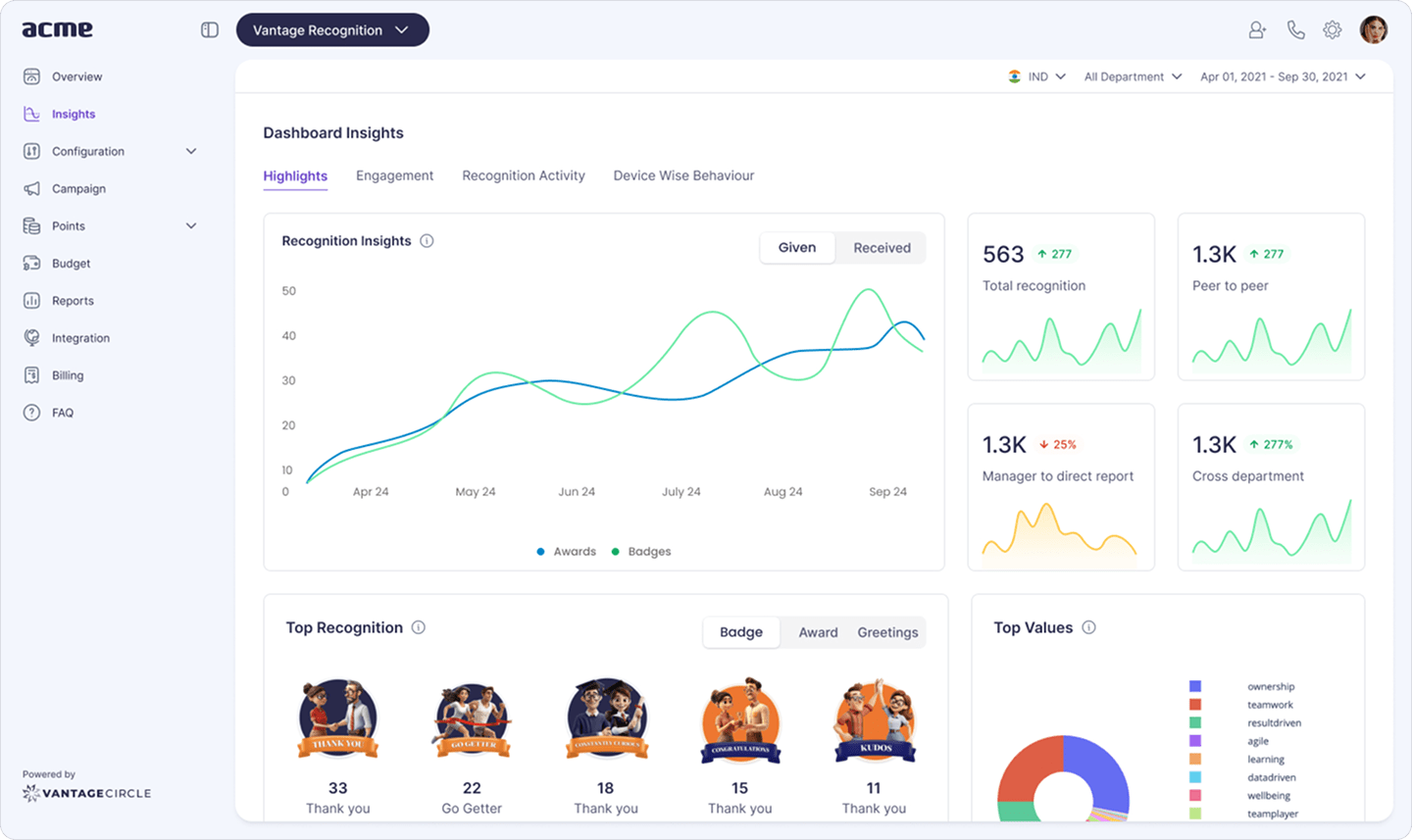
Recognition analytics within Vantage Rewards track the frequency, reach, and spend data that are the raw inputs for every outcome model above. Receiver coverage and giver coverage, the two leading indicators that predict whether a program is on track to deliver its targeted return, are visible from week one.
How to Calculate Recognition ROI: A 5-Step Method
Calculating recognition ROI does not require a consultant. It requires five steps, a baseline measurement, and the discipline to track leading indicators from week one.
Step 1: Set your baseline. Before the program launches, measure the current state of the outcome you are targeting. Voluntary attrition rate (trailing 12 months), unplanned absence days per employee, incident frequency, eNPS, or customer satisfaction score. Record the measurement date. This is your before number.
Step 2: Project the outcome lift. Apply the relevant benchmark from the table above as your forward projection: 31% for retention (SHRM, 2023), 64% for safety incidents (Gallup meta-analysis), or the engagement-outcome benchmarks for productivity and absenteeism. Use a conservative first-year assumption: model 50 to 60% of the benchmark for year one, since a new program will build to full coverage over time.
Step 3: Assign a dollar value to the projected lift. Every outcome has a cost line or a revenue line. Retention is backfill cost. Absenteeism is daily labor cost. Safety is average incident cost. Customer satisfaction is revenue retention. Map your projected lift to that dollar value using the formulas above.
Step 4: Calculate the full program cost. Platform fee plus reward budget plus admin time. See the next section for typical ranges. The denominator in your ROI formula must include all three components, not just the platform fee. An understated cost denominator inflates the apparent return and loses credibility with finance.
Step 5: Apply the formula.
Recognition ROI = (Value of Outcomes Achieved minus Program Cost) / Program Cost
Present the result as a ratio (8x, 22x, 72x). Ratios are more legible than percentages in executive conversations. Lead with the highest-confidence outcome, which is usually retention, then bring the other outcomes as additive upside.
Track the HR metrics for your target outcome from the day the program launches. Leading indicators (receiver coverage, giver coverage, recognition frequency) shift within 60 to 90 days. Outcome metrics confirm in two to four quarters.
The Cost Side: What a Recognition Program Actually Costs
A credible recognition ROI model requires an honest cost denominator. Most vendor ROI claims omit admin time and reward spend, understating true cost and inflating the apparent return. Use the full three-part cost model below.
| Cost Component | Typical Range | Notes |
|---|---|---|
| Platform fee | $2–$6 per employee per month | Enterprise platform with analytics, integrations, and a global rewards catalog |
| Reward budget | $30–$100 per employee per year | SHRM median: $50 per employee per year for US points-based programs |
| Admin and program management | 5–10% of total program cost | Program design, manager training, communications, and reporting |
| Total typical cost | $75–$175 per employee per year | Compare to $32,500–$130,000 to backfill one $65K employee (50–200% of salary per Gallup) |
The Vantage Rewards global rewards catalog keeps the reward spend line predictable by capping points budgets per employee and providing transparent redemption tracking across global locations. That stability matters for the denominator in your ROI model: a cost that fluctuates by 40% quarter to quarter undermines the reliability of the calculation you present to finance.
A transparent cost model also protects credibility. If your business case uses $50 per employee and finance later discovers the real cost is $150 per employee, the entire case loses trust. Model the full cost from the start. The math still works.
How to Present Recognition ROI to Your CFO
The business case that gets recognition funded leads with the cost of not having a program, not with the benefits of having one.
Three principles for a finance-grade recognition ROI presentation:
Lead with the cost of inaction. Start with the current annual voluntary attrition cost: departures per year multiplied by average replacement cost. That number is already in finance's model, labeled as recruiting and onboarding expense. Recognition is the investment that reduces it. Starting there reframes the conversation from "HR wants a program" to "we have a $3 million problem and this is a $50,000 solution."
Anchor on the most defensible assumption. The SHRM (2023) 31% voluntary turnover reduction benchmark is the most cited, most validated figure in the recognition research base. Build your primary case on it. Present productivity, engagement, and absenteeism returns as additive upside, not load-bearing assumptions. If finance challenges any number in your model, that one holds.
Show the measurement model, not just the forecast. Name exactly how you will track the return: receiver coverage percentage month-over-month as a leading indicator, voluntary attrition rate quarterly as the lagging confirmation. Giving finance a measurement methodology converts a forecast into an accountability commitment. That changes the tone of the conversation from "this might work" to "here is how we will confirm it."
Frequently Asked Questions
What is the ROI of employee recognition?
The return depends on the outcomes targeted and the assumptions applied. As an illustrative model: 1,000 employees, 18% voluntary attrition, $65,000 average salary, and a conservative replacement cost of one times annual salary (the lower end of SHRM's 50–200% range) produces a 72.8x return on turnover savings alone ($3.64 million saved against a $50,000 program cost). At mid-range replacement cost assumptions the same model exceeds 145x. Productivity, engagement, and absenteeism returns are additive to either figure. Run your own numbers with the ROI Calculator.
How do you build a business case for employee recognition?
Calculate your current annual voluntary attrition cost, apply the SHRM 31% reduction benchmark, compare the savings to full program cost, and present the ratio to finance. Retention math is the primary case; productivity, absenteeism, and customer satisfaction returns are additive evidence. Name the quarterly metrics you will track so the forecast carries a measurement commitment. See the full model in The ROI of Employee Recognition: How to Build the Business Case.
Does employee recognition reduce turnover?
Yes. Companies with effective recognition programs experience 31% lower voluntary turnover (SHRM, 2023), and employees who receive high-quality recognition are 45% less likely to leave within two years (Gallup, 2022). For a full breakdown by industry and program type, see Employee Retention Strategies.
Recognition delivers a financial return. The evidence across all 7 outcomes in this guide is named, dated, and conservative. What determines whether that return shows up in your organization is not the research, but whether you defined the specific outcome you were investing in before you designed the program.
Choose the outcome your C-suite is losing sleep over right now. Build the recognition program to move it. Measure from the start. For the complete enterprise program benchmarks and a fully worked CFO-ready model, see The ROI of Employee Recognition: How to Build the Business Case.
Calculate Your Recognition ROI
Enter your headcount, average salary, and attrition rate. The Vantage Circle ROI Calculator applies named benchmarks and outputs a finance-ready business case with your specific inputs.
Built for HR and Total Rewards leaders who need numbers, not narrative.
Calculate Your ROI
Supriya is a Content Marketing Lead at Vantage Circle, where she writes on employee engagement, recognition, workplace communication, and culture. She spent the earlier part of her career in corporate communications at Burson, ESPN Star Sports, and CBRE, advising organizations on the messages employees actually hear.
Connect with Supriya on LinkedIn.