
Only 22% of employees say they get the right amount of recognition (Gallup, 2024). That number looks like a morale problem. It's actually an innovation problem.
The people who feel under-recognized are the ones most likely to keep their best ideas to themselves. Not out of spite - out of the quiet calculation that sharing is not worth the risk if the last contribution went unacknowledged. A 2025 study published in PubMed Central confirmed what that gap costs: recognition directly shapes the employee outcomes that feed innovation (Jo, 2025). Great Place To Work's research puts it concretely - employees who feel recognized are 2.2 times more likely to drive innovation and bring new ideas forward.
The mechanism behind that number breaks into 3 things you can measure: how many ideas surface, how good they are, and how fast they ship.
Key finding: A 2025 peer-reviewed study (Jo, 2025, PubMed Central) found that recognition, fairness, and leadership significantly influence key employee outcomes - the same outcomes that determine whether innovation happens or stalls.
Why Recognition and Innovation Are Connected
The mechanism is what most organizations skip when they talk about recognition. "Recognition boosts engagement" is a familiar claim. But engagement isn't the same as innovation. Innovation requires something more specific: the willingness to share a half-formed idea, to try something that might not work, and to keep going after it does not.
That willingness is called psychological safety. It's the belief that you won't be punished for speaking up, taking a risk, or making a mistake. Without it, employees protect themselves by staying quiet, playing it safe, and defaulting to what worked last time.
Recognition is one of the clearest signals an organization can send about whether experimentation is welcome. When someone tries a new approach and gets recognized for it - even if the result was imperfect - the message to that person and to everyone watching is: experimentation is valued here.
A 2023 study by Kwarteng and colleagues documented a significant scholarly link between recognition, engagement, and organizational performance. Recognized employees are more engaged across contexts, and engaged employees contribute more to innovation outcomes than their under-recognized counterparts.
The connection runs both ways. When recognition is absent, employees read that absence as a signal too. A team that consistently sees careful, conventional work get recognized - and unconventional experiments ignored - will stop producing experiments. Recognition shapes what the organization gets, not just how people feel.
An employee recognition program designed around innovation behaviors changes that environment for the entire organization.
The 3 Dimensions Recognition Improves
The recognition-innovation link is not a single effect. It operates across 3 measurable dimensions, each with its own mechanism and its own metric. Here's how each one works.
1. Idea Rate - Recognition Widens the Top of the Funnel
Most ideas never surface. Not because people don't have them, but because sharing feels risky. What if it gets ignored? What if it's dismissed? What if someone else takes credit?
Recognition changes that calculus. When an organization consistently acknowledges the act of contributing an idea - separate from whether the idea eventually gets implemented - people contribute more. The top of the innovation funnel widens, because the social cost of sharing drops.
Peer-to-peer recognition makes this especially powerful, because it doesn't depend on a manager being in the right place at the right time. Most contributions that feed innovation - the observation from a customer call, the process shortcut a frontline employee figured out, the cross-team connection nobody else made - never reach a manager's desk. When any colleague can recognize a contribution, the organization sees the ideas that would otherwise stay invisible.
The idea rate metric to track: ideas submitted per quarter, per team. If recognition is working, this number rises over time in teams with active programs, and stays flat in teams without them.
2. Idea Quality - Recognition Signals Which Behaviors to Repeat
Recognition is a signal about what gets rewarded. When an organization recognizes only the safe wins - the project that delivered on spec, on time, with no surprises - it teaches employees that safety is what is valued. Employees who internalize that lesson stop experimenting.
The reverse is equally true. When recognition is tagged to behaviors like cross-functional collaboration, creative problem-solving, or challenging a longstanding assumption, those behaviors get repeated. Not because employees are calculating, but because social signals shape what feels worth doing.
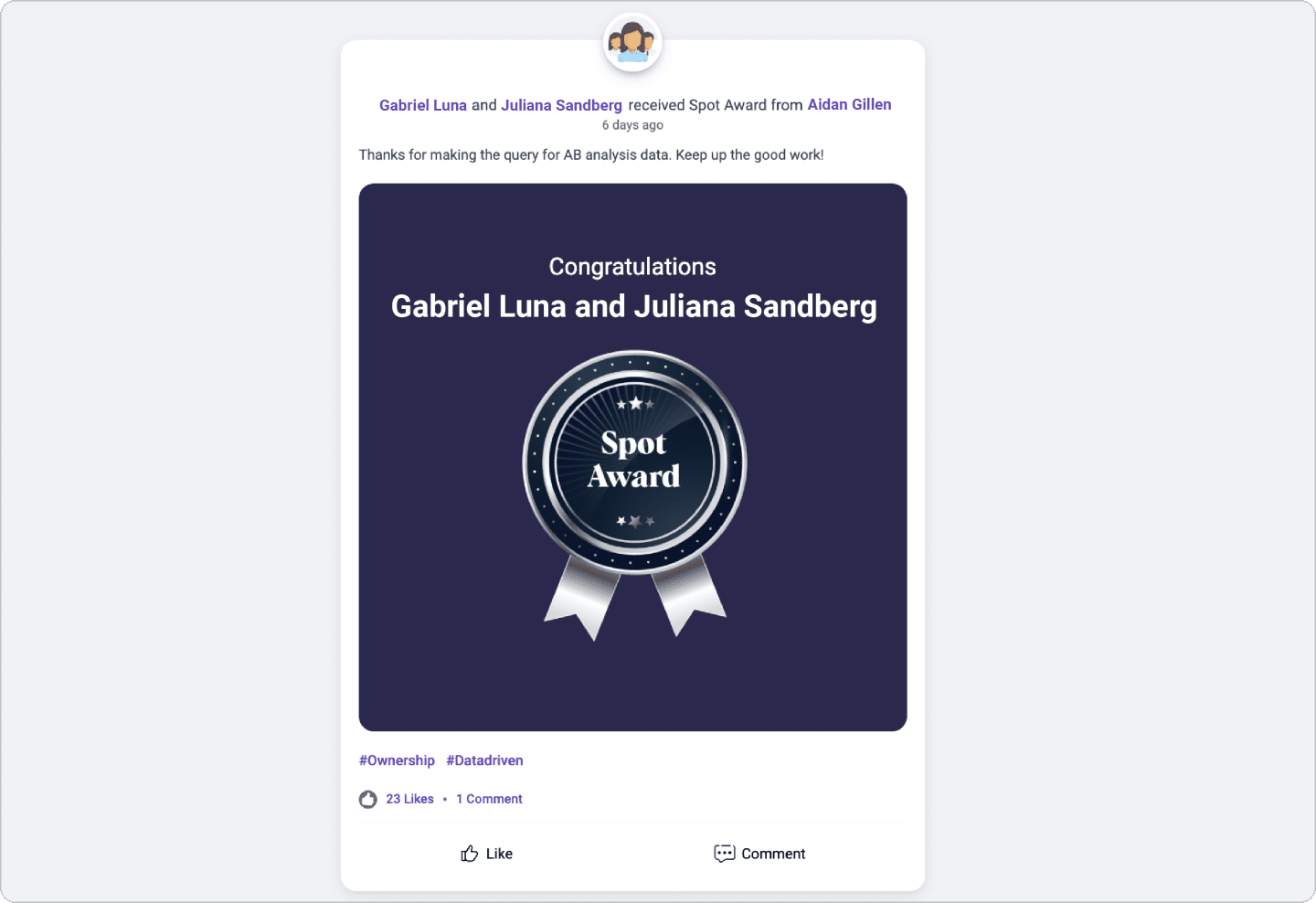
Social recognition amplifies this effect. When a recognition message is visible on a company-wide feed, it shows every employee what good work actually looks like in this organization. One well-crafted recognition post for an employee who proposed an unconventional solution and was proven right teaches more than any innovation training session.
Core values alignment in a recognition platform makes this deliberate. Tagging recognition to an "innovation" value tells the whole organization which behaviors earn applause, so people do more of the work that actually moves things forward.
The idea quality metric to track: the percentage of submitted ideas that advance to pilot, prototype, or implementation. Peer recognition that surfaces ideas from a broader range of contributors tends to improve the diversity and quality of what comes in.
3. Execution Speed - Recognition Shortens the Effort-to-Acknowledgment Loop
The gap between putting in effort and receiving acknowledgment is one of the most underestimated friction points in organizational innovation. When that gap is 12 months long - an annual performance review - the feedback cycle is too slow to shape behavior in real time. Experimental energy dies in the interval.
Real-time recognition closes that loop. When a manager or peer recognizes someone's experimental work within hours or days of it happening, the person knows their effort was noticed. They are more likely to pick up the next experiment quickly, because the signal they received is fresh.
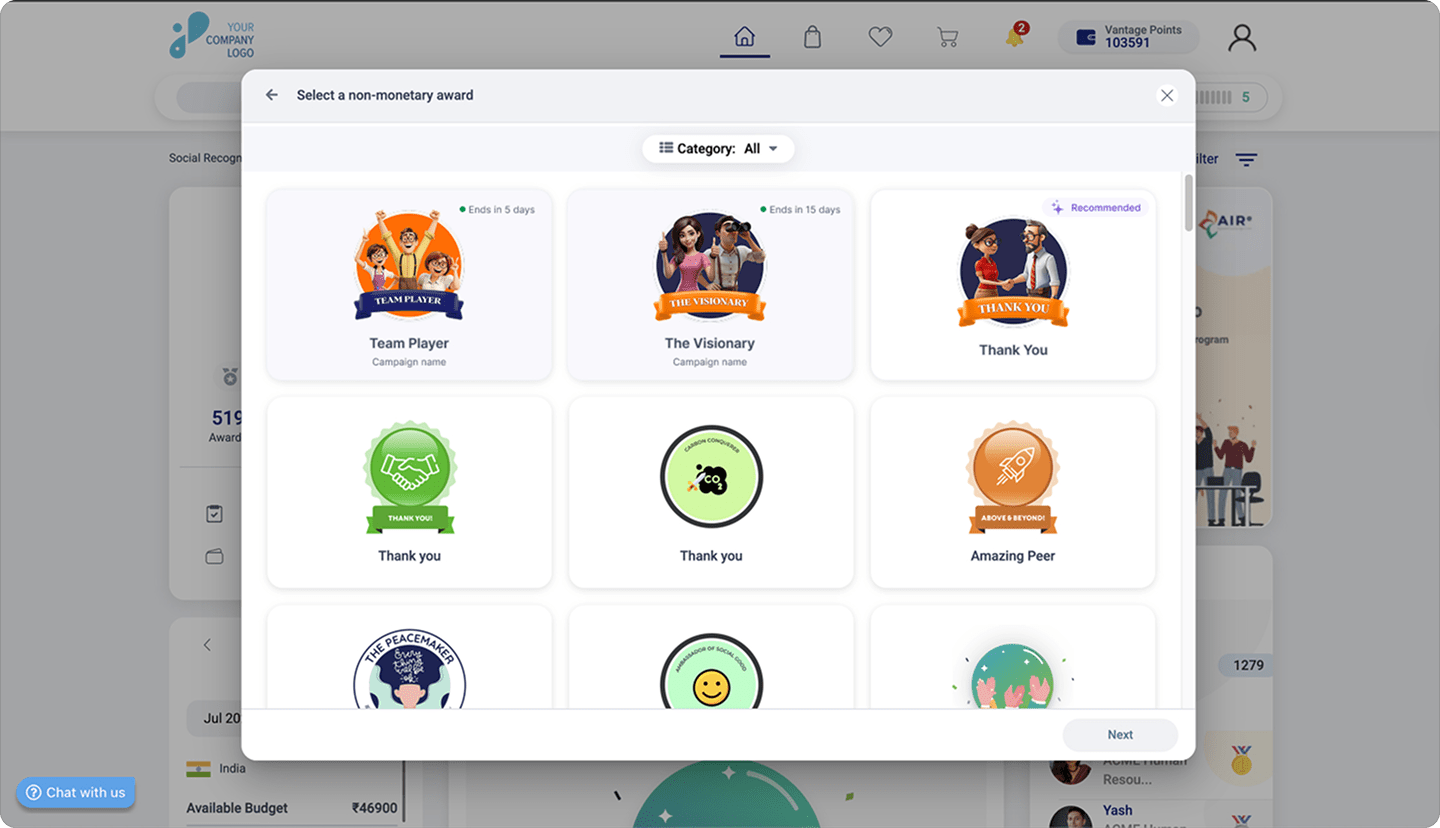
Spot awards make this practical at scale. A spot award given the week someone tests a new process or pilots an unconventional idea keeps the momentum going. Waiting to acknowledge it at the next quarterly review does not.
The execution speed metric to track: average time from idea submission to first implementation milestone. Real-time recognition should correlate with shorter cycles, especially in teams where spot awards are being used actively.
How recognition moves each innovation dimension:
| Innovation Dimension | How Recognition Moves It | Metric to Track |
|---|---|---|
| Idea rate | Removes the social cost of sharing; peer recognition surfaces contributions managers never see | Ideas submitted per quarter; % of team who contributed at least one idea |
| Idea quality | Tags recognition to innovation behaviors, signaling what to repeat; social feed makes high-quality thinking visible company-wide | % of ideas advancing to pilot or implementation |
| Execution speed | Shortens the acknowledgment loop; real-time spot recognition keeps experimental energy alive between review cycles | Average time from idea to first implementation milestone |
What the Research Says
The research on the recognition-innovation link comes from multiple angles, and each source adds something the others don't.
NIH/PubMed Central (Jo, 2025). A 2025 peer-reviewed study found that recognition, fairness, and leadership significantly influence key employee outcomes - the outcomes that determine whether people engage creatively with their work or hold back.
Kwarteng et al. (2023). A widely cited scholarly study documented the link between recognition, employee engagement, and organizational performance. The finding held across contexts: recognized employees are more engaged, and engaged employees contribute more to innovation outcomes than their under-recognized counterparts.
Great Place To Work (2025). Their research found that employees who feel recognized are 2.2 times more likely to drive innovation and bring new ideas forward. Organizations with strong recognition cultures consistently show higher rates of employee-reported idea contribution and creative engagement at work.
The number that explains the gap: Only 22% of employees say they receive the right amount of recognition (Gallup, 2024). The other 78% are managing a quiet calculation: is it worth sharing this idea if the last one went unacknowledged? For most of them, the answer is no.
WorldatWork (2024) adds the program context: recognition that is structured, visible, and tied to organizational values motivates employees and signals what the company stands for. A recognition program that is absent or inconsistent sends the opposite signal.
The evidence is not that recognition is the only driver of innovation. It is that the psychological conditions recognition creates - safety, belonging, and a clear signal about what is valued - are preconditions for the creative risk-taking that innovation requires.
5 Ways to Recognize Innovation
The recognition-innovation link doesn't work through vague praise. It requires specific program structures designed around the behaviors that actually feed innovation.
1. Idea challenges with built-in recognition
Run a structured idea challenge - a campaign where employees submit process improvements, product ideas, or customer experience fixes. Build recognition into the program architecture from the start: every idea submitted gets a peer vote, every shortlisted idea gets public acknowledgment on the social recognition feed, and the implemented ideas get a spotlight moment with named attribution.
The critical design choice: recognition doesn't wait for the result. It starts at the contribution. Employees who submit ideas and hear nothing are less likely to submit the next one. A campaign management tool keeps this consistent across quarters, rather than fading after launch week.
2. Spot awards for experiments, not just wins
The most powerful shift available to any innovation-focused organization is recognizing intelligent experiments that did not work - not just the projects that delivered. When a team tries a new approach, instruments it properly, and learns something concrete, that is exactly the behavior an innovative organization needs more of.
A spot award given for a well-run experiment (regardless of outcome) sends a clear signal: the quality of thinking is rewarded, not just the outcome. This is the single fastest way to change an organization's relationship with failure, and it costs the same as any other spot award.
3. Peer kudos for cross-team collaboration
Innovation rarely happens in silos. It happens when someone on the product team spots an insight from the customer success team, or when an engineer and a designer solve a problem together that neither could solve alone.
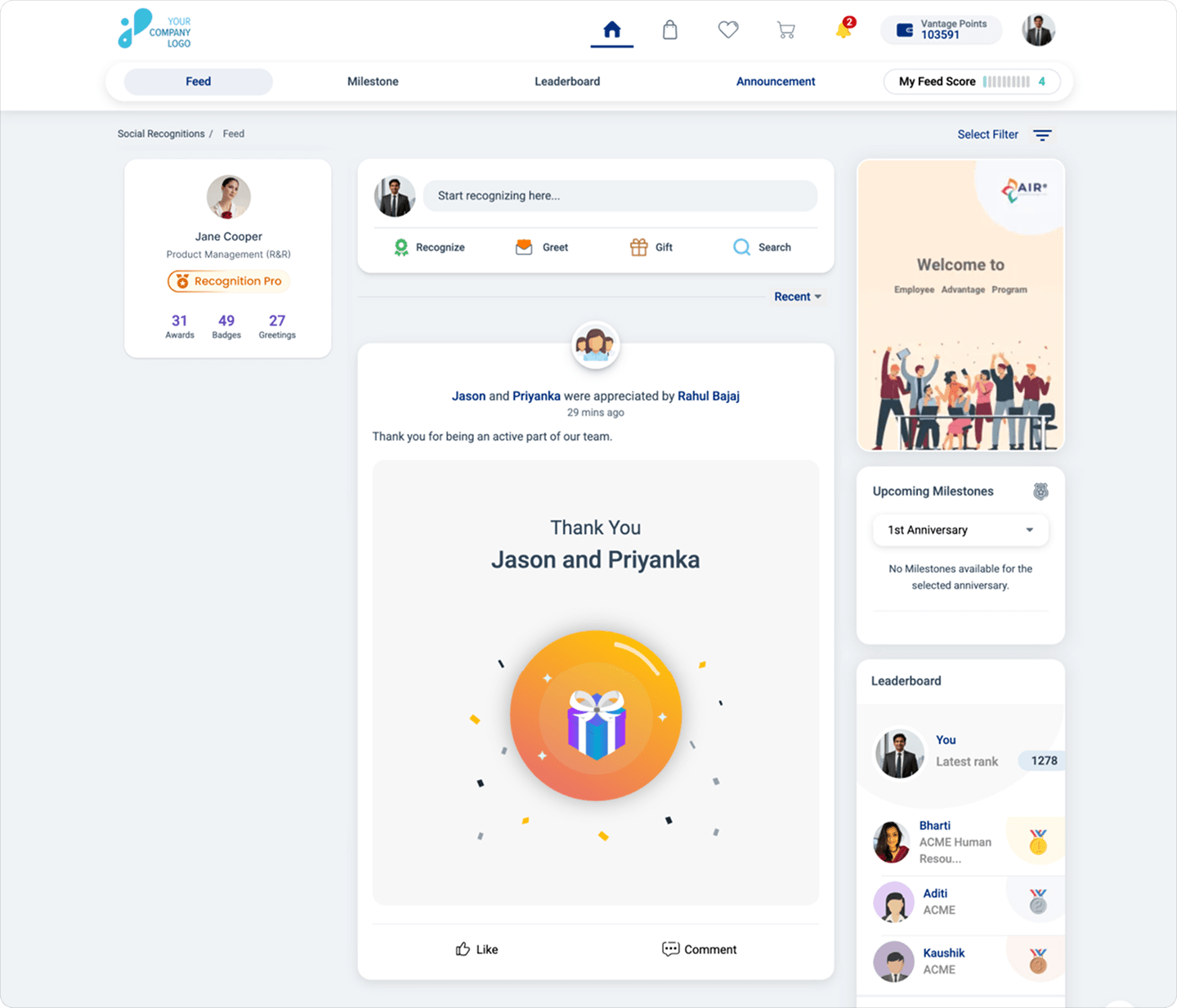
Peer-to-peer recognition surfaces these cross-functional contributions that managers often cannot see. When an employee can recognize a colleague for an insight that sparked a new direction, the organization starts to understand where its innovation actually comes from - and can design more of those moments intentionally.
4. Value-tagged recognition for "innovation"
General praise ("great job!") doesn't signal what to repeat. Recognition tagged to a specific core value - "innovation," "creative problem-solving," or "intelligent risk" - tells the whole organization which behavior was worth noticing.
When that recognition is public, visible on a feed where the whole company can see it, the effect compounds. Every employee who reads it learns what kind of work gets recognized here. Over time, the pattern of recognized behaviors becomes a practical definition of the company's innovation culture, more legible than any values statement on a wall.
5. Recognizing intelligent failure
This is the contrarian example that most organizations skip, and the most powerful one available for building an innovation culture. When someone takes a thoughtful risk that does not pay off, recognizing the quality of their thinking rather than penalizing the outcome sends the clearest possible psychological safety signal.
A public recognition of intelligent failure - "this team piloted a new approach, it didn't scale, and here's what they learned" - does more for innovation culture than any all-hands innovation speech. It shows every employee that the organization means it when it says experimentation is valued.
How to Measure Recognition's Impact on Innovation
Connecting recognition programs to innovation outcomes requires 5 metrics, tracked over time.
Idea submission rate. The number of ideas formally submitted per quarter, per team. If recognition is widening the top of the funnel, this number rises over time in teams with active recognition programs. A flat or declining rate is a signal that the program is not changing the contribution calculus.
Idea advancement rate. The percentage of submitted ideas that advance to pilot, prototype, or implementation. This is the quality signal. As recognition reaches a broader and more diverse range of contributors, the quality and variety of ideas in the pipeline should improve.
Time from idea to first milestone. How long does it take from an idea submission to the first concrete action? Real-time recognition that keeps experimental energy alive should correlate with shorter cycles. This is the execution speed metric, and it is the one most directly linked to spot award activity.
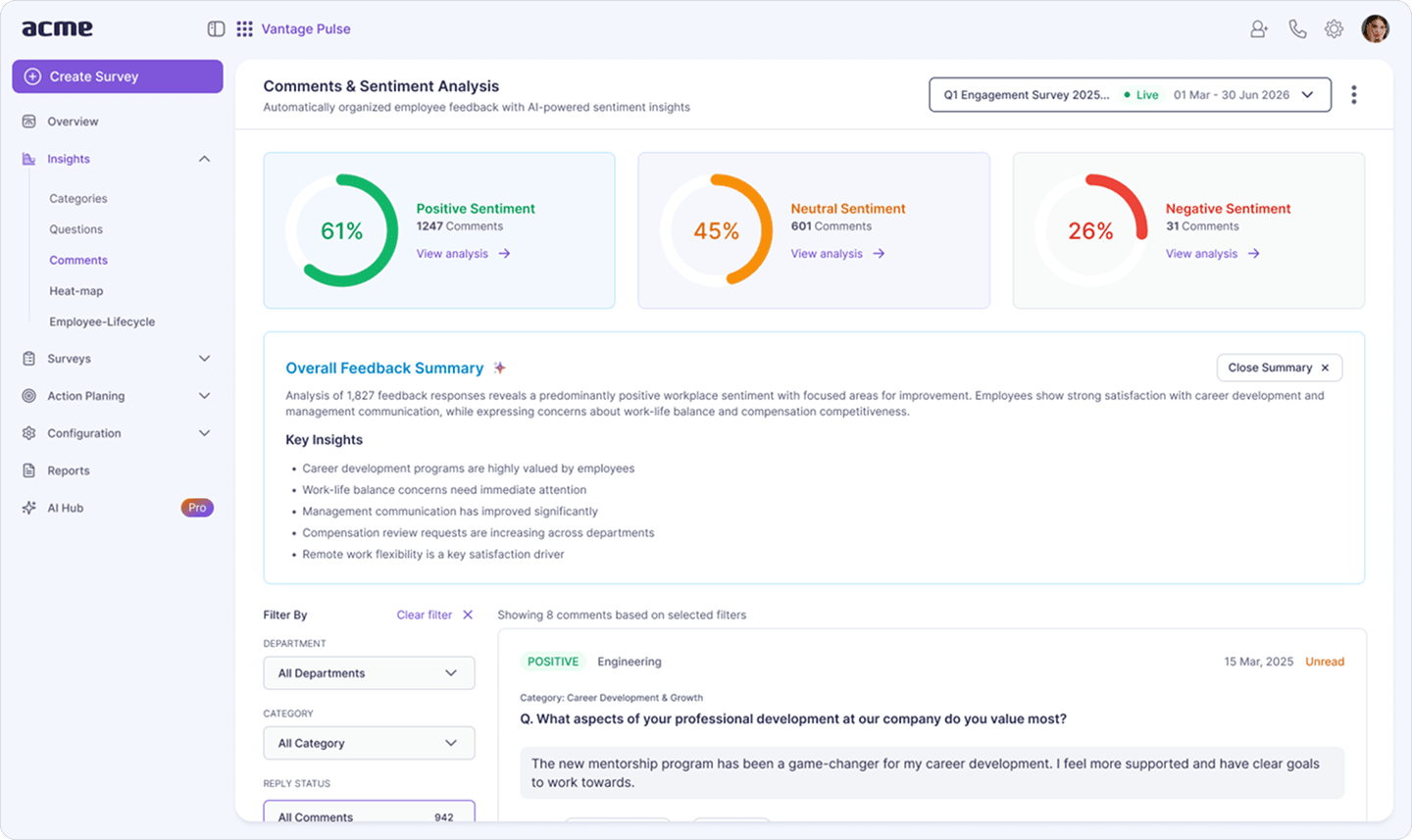
eNPS and sentiment scores. Pulse survey data shows whether employees feel safe enough to share half-formed ideas. A recognition-rich culture should move psychological safety scores upward over time. A flat or declining eNPS in innovation-adjacent questions is a signal that recognition is not reaching the people who need it most.
Recognition coverage. The percentage of employees who have given or received recognition in the past 30 days. Low coverage means the signal is not reaching the full organization. Innovation culture requires the signal to be ambient - not concentrated among the same 10 high-profile contributors.
Explore the levels of recognition to understand how recognition coverage changes across organizational tiers, and where the gaps typically are.
Recognition analytics make this visible in practice. If appreciation is reaching only the usual high-profile winners, the program is reinforcing an existing hierarchy rather than widening innovation capacity. The data tells you which teams are covered and which are not.
For larger organizations looking for practical starting points, the recognition ideas for large companies guide covers how to build coverage at scale without losing the personal quality that makes recognition meaningful.
Frequently Asked Questions
Does employee recognition really drive innovation?
Yes, based on peer-reviewed research. A 2025 NIH/PubMed Central study (Jo, 2025) found that recognition significantly shapes the employee outcomes that feed innovation. The mechanism is psychological safety: when people feel seen for their effort and intelligent risks, they share more ideas and experiment more freely.
What are examples of employee recognition and innovation?
5 concrete examples: idea challenges with built-in recognition at submission (not just at implementation), spot awards for well-run experiments whether or not they succeed, peer kudos for cross-team collaboration that sparked a new direction, value-tagged recognition for "innovation" on a visible social feed, and recognizing intelligent failure publicly.
How does recognition affect creativity and idea quality?
Recognition signals which behaviors the organization values. When recognition is tagged to creative problem-solving, cross-functional collaboration, or challenging a longstanding assumption, those behaviors get repeated. A social recognition feed makes high-quality ideas visible company-wide, so innovation behavior spreads by example.
What does the research say about recognition and innovation?
3 bodies of research converge on the link. Jo (2025) in PubMed Central found recognition shapes key innovation-feeding employee outcomes. Kwarteng et al. (2023) documented the recognition-engagement-performance connection. Great Place To Work (2025) ties a culture of recognition to higher rates of employee-reported innovation.
Is employee recognition a low-cost, high-impact way to boost innovation?
It can be. Vantage Circle's State of Recognition & Rewards 2025 found that 84% of high-effectiveness recognition programs spend under $100 per employee per year. The design matters more than the budget. Peer recognition, value-tagging, and real-time spot recognition are all low-cost mechanisms with measurably high innovation impact. The investment is mostly in program design and consistency, not per-employee spend.
To Wrap It Up
The framing of recognition as a morale tool has always undersold what it actually does. What recognition changes, at the level of organizational behavior, is the signal environment: what feels safe, what feels worth trying, and what feels worth sharing.
Start with one dimension. Run spot awards for experiments this quarter - not just wins - and track whether idea submissions increase over the next 30 days. Run a pulse survey before and after to see whether the psychological safety signal is moving. The numbers will tell you whether recognition is changing behavior or just being processed.
Idea rate, idea quality, and execution speed are measurable, and they respond to deliberate program design. If you're building or redesigning a recognition program with innovation outcomes in mind, Vantage Recognition handles the infrastructure - peer-to-peer idea surfacing, real-time spot recognition, and analytics that show whether appreciation is reaching the people taking creative risks.

Lupamudra is a content marketing specialist at Vantage Circle, where she has written 50+ articles on employee recognition, rewards, and workplace culture, alongside employee engagement, diversity and inclusion, and HR compliance topics, including how India's tax rules apply to recognition and rewards programs.
Connect with Lupamudra on LinkedIn.