
New hire? HR. Benefits question? HR. Office conflict? Definitely HR.
For a long time, HR was seen as the department that onboarded people and processed paperwork. That perception is outdated.
The BLS projects faster-than-average growth for HR managers through 2033. SHRM's 2025 Talent Trends report shows surging demand for data fluency, workforce strategy, and employee experience design. And the WEF's Future of Jobs 2025 confirms that AI is absorbing the transactional side of HR.
The question isn't whether HR is a good career. It's which direction you want to take it — and whether you're building the skills that will matter in the next five years. If you're exploring where HR analytics fits in, you're already asking the right questions.
If you're thinking about where to take your HR career next, here's a look at the roles worth considering.
The best HR professionals I know see themselves not as HR people but as business people who happen to work in HR.
– Dave Ulrich, Professor, Author & Father of Modern HR
Is HR a Good Career in 2026?
HR is a strong career in 2026 if you orient toward the strategic and analytical end of the function. Generalist administrative roles face the most AI displacement, while HRBP, People Analytics, Total Rewards, and Employee Experience roles are in active hiring growth.
However, the right approach is: it depends on where in HR you're headed.
If you're still doing the work that software can now do in seconds:
- Scheduling interviews
- Generating offer letters
- Running standard compliance reports
Those part of the role is shrinking. AI tools are handling it faster and with fewer errors.
The parts of HR that are growing are strategic workforce planning, interpreting people data and connecting it to business outcomes. Other than that designing compensation structures that actually retain talent, building cultures where people want to stay, these aren't things you can automate. They require judgment, context, and a deep understanding of how organisations work.
So yes, HR is a good career in 2026.
But the professionals who will thrive are the ones who treat it as a business discipline, not an administrative function. The roles below reflect exactly that shift.
Do Give a Read: Importance of HR: Why Human Resources Matter More Than Ever
Is HR Replaced by AI? The Honest 2026 Answer

HR is not being replaced by AI. But the routine administrative layer of HR is.
Let's be specific about what that actually means, because "AI will take HR jobs" and "HR is safe from AI" are both wrong in different ways.
What AI is already handling:
- Resume screening and candidate shortlisting
- Leave and absence administration
- Basic policy Q&A via chatbots and HR portals
- Interview scheduling and calendar coordination
- Onboarding document generation and compliance checklists
These tasks aren't disappearing. They're being absorbed by tools that do them faster, cheaper, and with fewer errors. If your HR role is built primarily around any of the above, the role is shrinking, not the profession.
What AI cannot replicate:
- Employee relations: navigating conflict, disciplinary conversations, grievances — these require trust, context, and judgment that no model can replicate
- Leadership coaching and executive development
- Culture design and the day-to-day work of making a workplace feel human
- Complex compensation negotiation, especially around equity and retention packages
- Change leadership, guiding organisations through restructures, mergers, or cultural shifts
These are judgment-heavy, relationship-dependent, and deeply contextual. They will remain human work for the foreseeable future.
How to position yourself — three skill bets worth making:
- Data fluency : Not becoming a data scientist, but being able to read a people dashboard, ask the right questions, and translate workforce data into a business case
- Change management : Organisations are restructuring faster than ever; HR professionals who can lead people through uncertainty are in high demand
- Executive coaching : The ability to develop leaders and influence at a senior level is one of the hardest skills to automate and one of the most valued
The 7 HR Career Paths You Can Take
HR offers seven main career paths: HR Generalist, HR Business Partner (HRBP), Talent Acquisition, Total Rewards, Learning and Development, People Analytics, and Employee Experience.
Not every HR career looks the same and that's actually one of the best things about the field.
Depending on where your strengths and interests lie, you can move in very different directions. Here's a quick breakdown of each path.
1. HR Generalist
The starting point for most HR careers.
Generalists handle a bit of everything. Onboarding, employee relations, policy administration, compliance. It's a great way to learn the full scope of the function before you specialise.
2. HR Business Partner (HRBP)
The strategic arm of HR. HRBPs work directly with business leaders to align people strategy with company goals. This path suits those who are comfortable in the boardroom as much as in the HR function.
It's one of the most in-demand roles right now.
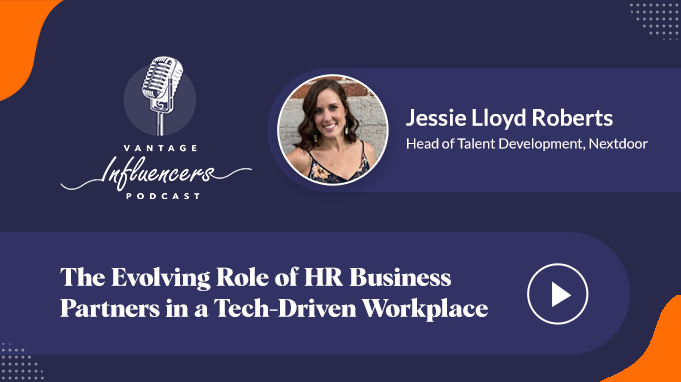
VANTAGE INFLUENCERS PODCAST
"Tech isn't just something HR uses anymore. It's basically shaping decisions, workflows, and even culture in real time."
— Jessie Lloyd Roberts, Head of Talent Development at Nextdoor
Listen to the Episode3. Talent Acquisition
Talent acquisition professionals today are part marketer, part analyst, part relationship builder. They work on building talent pipelines before roles even open, partnering with hiring managers to define what "great" actually looks like for a given position, and ensuring candidates walk away with a positive impression of the company. Irrespective of wheteher they get the job or not.
With AI screening tools now handling the top-of-funnel work, the real value a TA professional brings is judgment: knowing when a résumé doesn't tell the whole story, building relationships with passive candidates, and designing interview processes that are both rigorous and human. It's a high-visibility path.
4. Total Rewards
Compensation, benefits, equity, and recognition.
Now, this path is perfect for the analytically minded. Total Rewards professionals design the packages that attract and retain talent, and they work closely with finance to keep structures competitive and sustainable.
Do Give a Read: Total Rewards Strategies: How to Build a Winning Employee Value Proposition
5. Learning and Development (L&D)
L&D professionals design and deliver the programmes that help people grow in their roles. In 2026, this path increasingly involves building internal capability for AI fluency, leadership development, and skills-based progression frameworks.
6. People Analytics
One of the fastest-growing paths in HR.
People analytics professionals turn workforce data into insights, on attrition risk, productivity, hiring effectiveness, DEI progress, and more. Strong demand, and a path that rewards both HR knowledge and comfort with data tools.
7. Employee Experience
A newer but rapidly maturing specialisation. Employee Experience professionals design the end-to-end journey an employee has with an organisation. From offer letter to exit interview. Think of it as the HR equivalent of customer experience, applied internally.
Most HR careers start in one area and evolve across several. The key is to know which direction you're heading and build the skills that path actually requires.
| Path | What You Do | Best Fit For |
|---|---|---|
| HR Generalist | Handle hiring, onboarding, compliance, and employee relations across the full HR lifecycle | People early in their HR career who want broad exposure before specialising |
| HR Business Partner (HRBP) | Partner with business leaders to align people strategy with company goals | Those who are comfortable with data, ambiguity, and C-suite conversations |
| Talent Acquisition | Attract, assess, and hire talent; build pipelines and employer brand | Relationship builders with a commercial mindset and strong instincts for people |
| Total Rewards | Design compensation, benefits, equity, and recognition frameworks | Analytical thinkers who enjoy working at the intersection of HR and finance |
| Learning & Development | Build and deliver programmes for skills growth, leadership, and onboarding | Natural teachers and curriculum designers who want lasting organisational impact |
| People Analytics | Turn workforce data into insights on retention, performance, and hiring effectiveness | Data-fluent professionals who want HR to drive decisions, not just report them |
| Employee Experience & DEI | Design the end-to-end employee journey and embed inclusion into culture and systems | Empathetic, systems-level thinkers who care about how work actually feels |
HR Career Roadmap: Entry to C-Suite
A typical HR career follows four stages over 10–20 years: entry-level coordinator (0–2 years), specialist or generalist (2–5 years), manager or HRBP (5–10 years), and director-or-VP-to-CPO (10+ years).
Most HR professionals don't plan their career in a straight line — but knowing the general shape of the journey helps you make smarter decisions at each stage. Here's how the progression typically looks, what titles you'll hold, and what skills actually move you forward.
| Stage | Years In | Typical Titles | Skills to Build |
|---|---|---|---|
| Entry Level | 0–2 years | HR Coordinator, HR Assistant, Recruiting Coordinator | Process knowledge, communication, HRIS tools, attention to detail |
| Specialist / Generalist | 2–5 years | HR Generalist, Recruiter, L&D Specialist, Compensation Analyst | Functional depth, stakeholder management, data literacy, employment law basics |
| Manager / HRBP | 5–10 years | HR Manager, HR Business Partner, TA Manager, Total Rewards Manager | Strategic thinking, business acumen, influencing without authority, people analytics |
| Director / VP / CPO | 10+ years | HR Director, VP of People, Chief HR Officer, Chief People Officer | Executive presence, org design, workforce strategy, board-level communication |
Worth Knowing: The median time to reach HR Director is 9–12 years from your first HR role. — SHRM 2025 Benchmarking Data
The biggest jumps in this career, from specialist to HRBP, and from manager to director, rarely happen on tenure alone. They happen when you start demonstrating business impact, not just HR competence.
The professionals who move fastest are the ones who learn to speak the language of the leaders they support.
How to Start a Career in HR (No Experience)
A lot of people assume HR is a closed door without the right degree or a few years of experience on your CV. It's really not. What actually holds most people back isn't a lack of qualifications. It's not knowing where to start. So here's where to start.
Step 1: Pick a sub-function to target Don't try to enter "HR" broadly. Choose one path, Talent Acquisition, L&D, Employee Recognition, or People Operations. You must build everything around that. Specificity makes you easier to hire.
Step 2: Get one relevant certification SHRM-CP, PHR, or a Google Project Management certificate all signal credibility to hiring managers. You don't need all of them, one is enough to show intent.
SHRM offers free student memberships and discounted exam prep. If you're early in your career, it's one of the highest-ROI investments you can make.
Step 3: Start with a coordinator or contract role HR Coordinator, Recruiting Coordinator, or People Ops Assistant roles are the most accessible entry points. Contract roles at staffing agencies count, the experience is real even if the contract isn't permanent.
Step 4: Build a practical portfolio Run a mock employee engagement survey for a student club or volunteer org. Help a small business set up an onboarding checklist. Tangible outputs beat a blank CV every time.
Step 5: Show up where HR professionals gather SHRM local chapters, LinkedIn HR communities, and HR-focused Slack groups are where hiring managers and mentors actually spend time. One warm introduction is worth ten cold applications.
Follow HR practitioners on LinkedIn who share their day-to-day work, not just thought leaders. You'll learn faster from people in the weeds than from keynote speakers.
Frequently Asked Questions (FAQs)
Is being in HR a good career?
Yes, HR is a strong career, particularly if you move toward the strategic end of the function. Roles in HR Business Partnering, People Analytics, Total Rewards, and Employee Experience are in active hiring growth. The BLS projects faster-than-average growth for HR managers through 2033. Administrative HR roles face more AI displacement, but judgment-heavy, people-facing work remains very much in demand.
What are the careers in HR?
HR offers seven main career paths: (1) HR Generalist, (2) HR Business Partner (HRBP), (3) Talent Acquisition, (4) Total Rewards, (5) Learning and Development, (6) People Analytics, and (7) Employee Experience and DEI. Most professionals start in a generalist or coordinator role, then specialise over time. Each path has its own entry titles, senior titles, and skill requirements.
1. Is HR replaced by AI?
No, but the administrative layer of HR is. WEF 2025 and McKinsey 2024 data show 35–45% of HR tasks are automatable, mainly scheduling, compliance tracking, and basic Q&A. What AI cannot replace is employee relations, culture design, leadership coaching, and complex compensation decisions. HR professionals who build data fluency, change management, and coaching skills are well-positioned regardless of how AI evolves.
What is the highest salary for HR?
At the top of the function, Chief People Officers (CPOs) and Chief HR Officers (CHROs) at large enterprises typically earn $250,000–$500,000+ annually in the US, including equity. The US median annual salary for HR managers sits around $136,000 (BLS 2024). VP of People and HR Director roles generally range from $150,000–$220,000 depending on company size, industry, and geography.
Is HR highly paid?
Honestly, not at entry level, but strongly so at senior levels. HR Coordinator and Generalist roles typically start at $45,000–$65,000. Mid-level HRBP and specialist roles land in the $80,000–$120,000 range. Total Rewards and People Analytics roles tend to command a premium due to their technical depth. The pay ceiling rises significantly once you reach Director level and above.
How do you start an HR career with no experience?
Pick one sub-function to target, get a single certification (SHRM-CP or PHR), and apply for coordinator or contract roles. These are the most accessible entry points. Build a practical portfolio by running a mock engagement survey or setting up an onboarding process for a volunteer org. Then network: SHRM chapters and LinkedIn HR communities are where the introductions that actually lead to jobs happen.
Conclusion
A Career in HR is one of the most sought after in the current day and age, and rightfully so. You can take the responsibility to train yourself, leadership opportunities to hone yourself, and the authority to steer a company towards success. In short, it has all the necessities of a fulfilling career.
Plus, after looking at the above-mentioned superb career opportunities, the tag of an HR seems sweeter than ever! For reasons as such, the number of HR professionals is growing fast over the years. Also, as long as the world has businesses, the need for HR will never diminish.
In this regard, a career in human resources is also very secure. For this reason, you should work hard and carefully plan your next move to excel in this career path. To do so, we hope this blog helped you gain an idea of how you can progress ahead in your HR career.

This article is written by Sanjeevani Saikia. Sanjeevani Saikia is a Senior Content Strategist at Vantage Circle, where she leads end-to-end content strategy across SEO, thought leadership, brand storytelling, podcasts, and video. She is also the host of the Vantage Influencers Podcast, where she brings conversations with HR and business leaders from top global organisations, including Fortune 500 companies.
Connect with Sanjeevani on LinkedIn.


