94% of business leaders agree that AI is crucial for success. A whopping number of leaders having such faith in Artificial Intelligence (AI) is no joke.
What’s equally reassuring is that 74% of business leaders consider HR a key player in driving business outcomes.
Now, if AI is key to success and HR drives business outcomes, what happens when they come together?
The answer lies in AI empowering HRs to rethink how they connect with employees. AI can effortlessly streamline routine processes and assist HRs in designing better employee engagement strategies. It also has the potential to make employee engagement smarter, more personalized and impactful.
So, in this blog, we’ll understand in-depth the role of AI in employee engagement. And how it can transform workplace dynamics.
What Is AI in Employee Engagement?
AI in employee engagement is the application of artificial intelligence to continuously listen to, analyze, and act on the signals that show how connected, motivated, and satisfied employees are at work.
At its core, it combines machine learning, natural language processing, and predictive analytics to turn raw employee data into insights that HR teams and leaders can actually use to make better decisions, faster.
Related Resource: AI in Employee Recognition: How Artificial Intelligence Is Changing Workplace Appreciation
Why AI in Employee Engagement?
I am sure, you may now've a question, "Why does AI even need to be a part of the conversation?"
To that my answer is, the old ways of measuring engagement simply are not keeping up.
Annual surveys give you a snapshot of how people felt, say, six months ago. Exit interviews tell you what went wrong after someone has already decided to leave. And with teams spread across locations, time zones, and work styles, it is nearly impossible for managers to have a pulse on everyone all at once.
That is where AI changes the game.
It works in the background, continuously picking up on signals that humans would miss or not have the bandwidth to process, and turning them into something actionable. Instead of reacting to problems after they have already affected the team, organizations can spot the early signs and step in at the right moment.
AI enables HR teams to make data-driven decisions, predict workforce trends, and personalize the employee experience, transforming how organizations manage their most valuable asset, their people.
Hear more on this in our podcast, AI: Its Role and Implications for HR, where Avadhesh Dixit, CHRO at Acuity Knowledge Partners, unpacks how AI is reshaping HR practices and the future of employee engagement.
Types of AI Used in Employee Engagement
Not all AI is built the same. When HR teams talk about using AI for engagement, they are usually pulling from a small set of capabilities, each suited to a different job. Knowing which type does what helps you pick the right tool for the problem you are actually trying to solve, instead of buying into a generic "AI" pitch.
Here are the five types that show up most often in modern employee engagement platforms.
| AI Type | What It Does | Engagement Use |
|---|---|---|
| NLP and Sentiment Analysis | Reads open-text responses, chat messages, and survey comments to detect tone, themes, and emotion. | Surfaces what employees actually feel from pulse comments, exit surveys, and Slack channels, beyond what closed-ended scores reveal. |
| Predictive Analytics | Uses historical engagement and HR data to forecast outcomes such as attrition risk or burnout signals. | Flags teams or individuals at risk of disengaging early, so managers can intervene before resignation. |
| Generative AI | Produces drafts of communications, recognition messages, learning content, and survey questions on demand. | Helps managers write timely, personalized recognition notes and helps HR draft engagement comms at scale. |
| Conversational AI (Chatbots) | Holds natural language conversations to answer queries, collect feedback, and guide employees through processes. | Acts as a 24/7 HR concierge for policy questions, benefits queries, and quick pulse check-ins. |
| Recommendation Engines | Matches employees to content, peers, mentors, and growth opportunities based on behavior and profile data. | Personalizes learning paths, recognition suggestions, and internal mobility options for every employee. |
Most engagement platforms combine two or three of these under the hood. The value comes not from any single technique, but from how well they work together to give HR a clearer, faster, and more human read on the workforce.
How AI is Revolutionizing Employee Engagement?
We think of AI to be a single tool. But, AI shows up across the entire employee experience in ways that are practical, measurable, and increasingly hard to ignore.
Here is a look at where it is making the biggest difference.
1. Personalization of Employee Experience
Forbes, in one of its articles, highlighted that Talent Acquisition experts across the world see the most significant opportunity with Gen AI in,
- Automating repetitive tasks – 74%
- Sourcing candidates faster- 67%
- Engaging better with candidates- 59%
And why do Talent Acquisition experts believe so?
Because the moment a new employee steps into the organization, AI-powered tools take on the responsibility to elevate their experience. It can streamline the onboarding process and help you identify career growth opportunities.
At the same time, it gathers feedback to refine hiring practices. All of this aims to continually improve the experience for future hires.
2. Continuous Listening and Sentiment Analysis
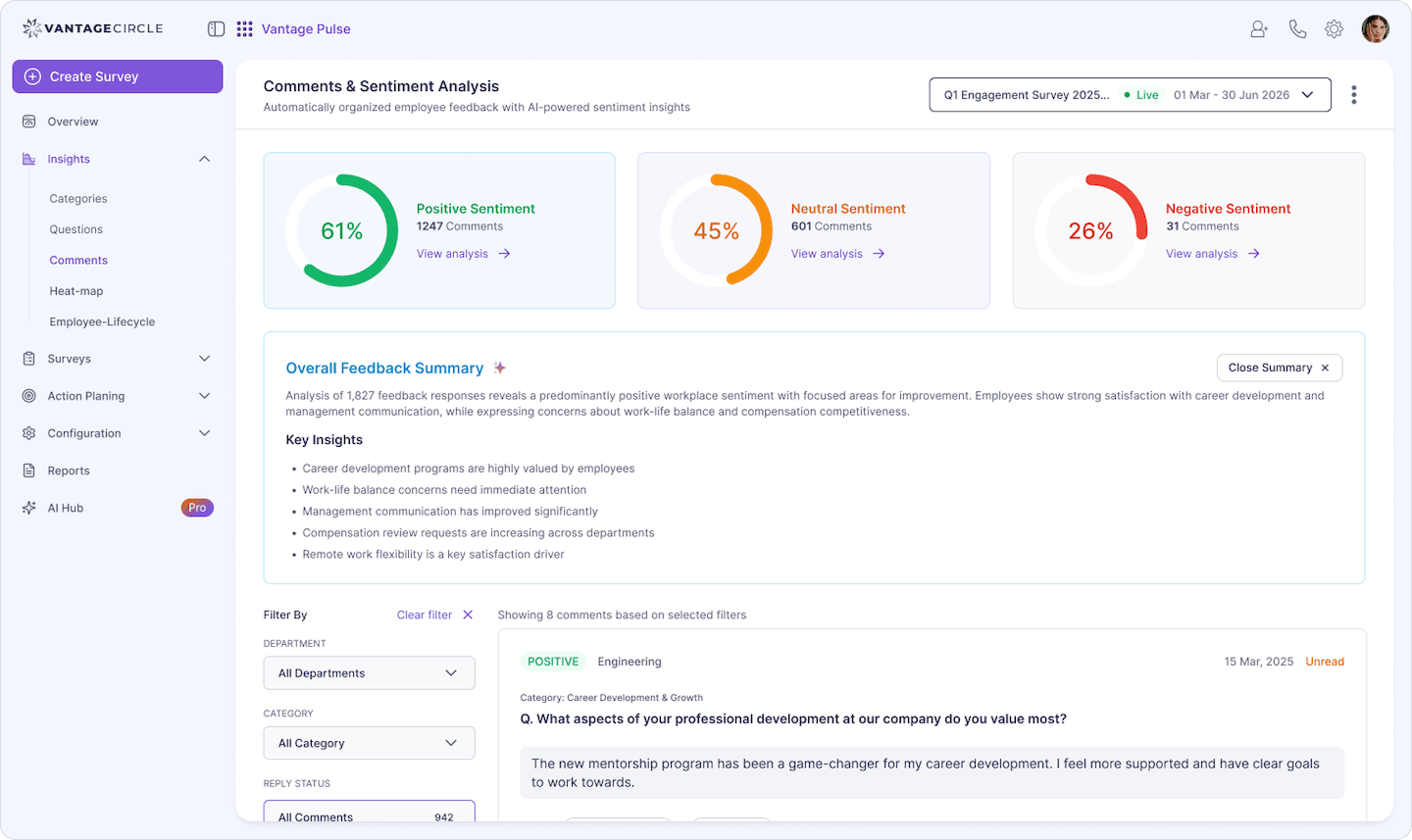
Traditional surveys ask employees how they feel once or twice a year. AI-powered continuous listening does it around the clock, without the survey fatigue. Sentiment analysis tools pull from employee pulse surveys, open-ended feedback, and workplace communication patterns to detect shifts in morale, stress, or disengagement as they happen.
Platforms that support continuous listening, Vantage Pulse being one example, give HR teams a live read on the emotional health of the organization at every level, not a delayed snapshot.
3. Predictive Retention and Attrition Risk
Someone deciding to leave rarely makes that decision overnight. The signs are usually there weeks or months before the resignation letter, and AI is particularly good at picking up on them. Predictive models work across performance data, engagement scores, tenure, and behavioral signals to flag employees who may be pulling away.
4. AI Chatbots and Virtual HR Assistants
Employees have questions every day about benefits, policies, time off, and payroll. AI-powered chatbots handle the routine ones instantly, around the clock, without adding to the HR team's workload.
HR professionals get more time for higher-value work, and employees get faster, more consistent answers.
5. Personalized Learning and Development
Most employees want to grow.
The challenge is that generic training programs rarely match where someone actually is in their career or where they want to go. AI closes that gap by reading into skills, goals, and learning patterns to surface courses, mentors, and opportunities that are actually relevant to that person.
6. Real-time Feedback and Recognition
Gone are the days of waiting for annual reviews. Feedback and recognition can now happen in real-time with AI in the picture.
AI tools can analyze performance and provide instant, constructive feedback. Additionally, these tools can automate recognition systems. Basically, ensuring that achievements, big or small, don’t go unnoticed.
Benefits of Using AI
AI has several benefits. no wonder it's the hit of the hour. Even in the space of employee engagement. Let's know how:
1. Enhanced Personalization
Imagine walking into work and finding a system that truly gets you. That’s what AI brings to the table. For you, it can tailor onboarding processes to customize career development plans. It can transform generic workplace interactions into deeply personalized experiences.
2. Improved Productivity and Efficiency
No one enjoys being bogged down by repetitive tasks. Fortunately, AI steps in to automate routine workflows, freeing up time for employees to focus on meaningful, creative work.
It simply streamlines workflows and reduces human error.
3. Boosted Employee Satisfaction and Well-being
Ever wished for immediate feedback or recognition? With AI, it’s no longer a dream. AI tools analyze performance in real-time, offering constructive feedback and even automating recognition for achievements.
But it doesn’t stop there! AI-powered sentiment analysis can identify signs of stress or disengagement. It ensures employees feel supported before issues escalate. When employees know their well-being is a priority, job satisfaction naturally soars.
You May Also Like to Read:10 Great Ways to Make Employees Feel Valued at Work
4. Data-Driven Decision-Making
Making informed decisions is easier when you have data to back it up. AI’s predictive analytics offer insights into employee engagement trends. It helps HR teams identify potential challenges before they arise.
Take this for an example,
AI can detect patterns in absenteeism or performance dips. With that data, you can take proactive measures to improve the performance of low-performing employees.
Now that we’re aware of the benefits, we also have to know the downsides of AI. Here are some of them.
Best Practices for Implementing AI in Employee Engagement
Implementing AI in employee engagement can feel like a big leap, but with the right approach, it can lead to incredible results. To make the transition smoother and more effective, it’s important to focus on thoughtful, strategic steps.
Here are some best practices to guide your journey:
1. Start Small and Scale Up
I am sure you must’ve heard this- “Don't dive in headfirst. Test the waters.”
Start by introducing AI in specific areas like onboarding or performance reviews. It allows you to evaluate its impact and fine-tune processes before rolling it out across the organization.
2. Prioritize Transparency and Employee Trust
AI can feel intimidating. For many people it does.
So, to ease these concerns, openly communicate AI’s role, what data it uses, and how it benefits your employees. Trust us, when people know the why behind the what, they’re more likely to buy into the change.
3. Balance AI and Human Insights
AI can do a lot. But you’ll be happy to know that it cannot replace your intuitions. Your “human intuitions.”
Having said that, the best results come from blending AI’s data-driven recommendations with your empathy and judgment. After all, a bot can analyze patterns, but only a person can truly understand context.
4. Continuous Improvement through Employee Feedback
Just like any tool, AI isn’t perfect.
So, it’s your duty and moral responsibility to gather regular feedback from employees. You must know how new systems are working on them. Use their feedback to make adjustments and ensure the technology evolves alongside your team’s needs.
Frequently Asked Questions (FAQs)
What is AI in employee engagement?
AI in employee engagement is the use of artificial intelligence to continuously listen to, analyze, and act on the signals that show how connected, motivated, and satisfied employees are at work. It combines machine learning, natural language processing, and predictive analytics to turn raw employee data into insights HR teams can use to make faster, better decisions.
How does AI improve employee engagement?
AI improves engagement by replacing slow, point-in-time tactics with continuous, personalized ones. It analyzes pulse surveys and feedback in real time, flags early signs of disengagement, automates timely recognition, personalizes learning and communications to each employee, and frees HR from repetitive tasks so they can focus on higher-value, human work.
What are some examples of AI tools used for employee engagement?
Common examples include sentiment analysis on pulse surveys (such as Vantage Pulse), predictive analytics platforms that forecast attrition risk, AI-powered recognition tools that surface moments to celebrate, conversational chatbots that answer HR questions around the clock, and recommendation engines that personalize learning paths and internal mobility opportunities.
Is it safe to use AI for handling sensitive employee data?
It can be, but only with the right guardrails. HR teams should choose vendors with clear data governance, strong encryption, role-based access, and compliance with regulations like GDPR. Equally important is transparency with employees about what data is collected, how it is used, and how decisions are made. AI should support human judgment, not replace it on sensitive calls.
Will AI replace HR professionals?
No. AI replaces routine, repetitive HR tasks like answering policy queries, sorting feedback, and surfacing patterns in data. It does not replace the judgment, empathy, and relationship building that sit at the heart of HR work. The most effective teams use AI to handle the heavy lifting on data and admin, so HR professionals can spend more time on coaching, culture, and strategy.
Conclusion
AI is changing how we engage with employees, making work more personalized, efficient, and enjoyable. While there are challenges, like privacy concerns and ethical issues, we can overcome them by starting small, being clear about how AI works, and combining AI with human judgment.
The future looks bright with AI helping to create workplaces that are not just smarter but also more supportive and human. It's an exciting time, as AI makes it easier to make employees feel valued every day.

Sanjeevani Saikia is a Senior Content Strategist at Vantage Circle, where she leads end-to-end content strategy across SEO, thought leadership, brand storytelling, podcasts, and video. She is also the host of the Vantage Influencers Podcast, where she brings conversations with HR and business leaders from top global organisations, including Fortune 500 companies.
Connect with Sanjeevani on LinkedIn.