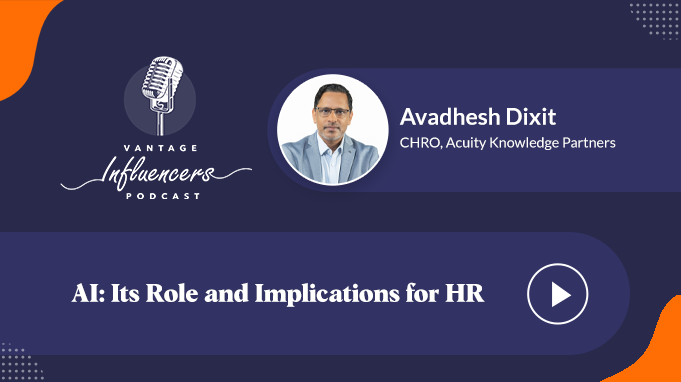
AI: Its Role and Implications for HR
Episode Overview
Avadhesh Dixit, CHRO at Acuity Knowledge Partners with close to 25 years in HR, argues that AI has not yet transformed HR, and won't for a couple of years or more, but it is already influencing the function fast. He draws a clear line: repetitive, standardized work like recruitment operations, HR analytics, background verification, onboarding, and level-one helpdesk queries will fall to AI quickly, while anything requiring human emotion, judgment, or empathy, like performance counseling, career conversations, or disciplinary action, will stay out of AI's reach for years, maybe longer.
His sharpest, most concrete point comes on the question of bias. Rather than treating AI ethics as an HR-specific problem, he places it squarely on how a model gets trained: skewed training data produces skewed output, in sales or finance just as much as in HR. On recruitment specifically, he says he isn't worried about bias creeping into hiring decisions, because his own company already uses ChatGPT to draft job descriptions, generate interview questions, and match CVs against a role, but the final call still runs through multiple rounds of human interviews. That distinction, AI as an assistant that drafts and suggests versus AI as a decision-maker, runs through everything else he says about data protection, workforce dynamics, and where HR professionals should focus their energy next.
Episode Highlights
- AI has not yet transformed HR, according to Avadhesh Dixit, but it is already influencing the function, and he expects real transformation within a couple of years or more.
- Repetitive, standardized work such as recruitment operations, HR analytics, background verification, onboarding, and level-one helpdesk queries are the functions he expects AI to automate first.
- Complex, emotion-driven work like performance conversations, career counseling, disciplinary action, and employee assistance for stress will stay out of AI's reach for at least four to five years, since it needs human empathy, legal judgment, and psychology.
- Ethical concerns about AI bias apply to every business function, not just HR, and trace back to how a model is trained; on hiring specifically, he isn't worried, because human interviewers, not AI output, still make the final call.
- AI will not eliminate whole HR jobs but will typically absorb 10 to 70 percent of the routine activities inside a role, freeing HR staff for culture building, performance conversations, and employee engagement.
- His advice to HR professionals is to build strength in the science of HR (data, analytics, and pattern-reading) alongside the traditional soft skills, and to start with a small AI pilot, like a chatbot, before scaling up.
About the Guest
Avadhesh Dixit, CHRO, Acuity Knowledge Partners
Avadhesh Dixit has close to 25 years of experience in human resource management across companies in the UK, Ireland, the US, and Europe. He began his career with a 13-year run at the Tata Group, including five years leading overseas HR out of London, then served as CHRO of CMC Limited, a Tata Group company, before moving to GE Capital India and later to Moody's Corporation as its regional HR head for India. He joined Acuity Knowledge Partners in 2016 and, based out of the Gurgaon office, has spent the last eight years as CHRO, where he also leads the company's compliance, corporate services, and CSR activities. Avadhesh holds an MBA in Human Resources from the Delhi School of Economics at the University of Delhi and a graduate degree in Economics. He is certified as a Global Professional in Human Resources (GPHR) by SHRM USA and is a regular speaker at Indian national HR and CSR conferences.
Connect with Avadhesh on LinkedIn
Host
Sanjeevani Saikia, Vantage Influencers Podcast Host
What You Will Learn
- Why Avadhesh Dixit believes AI has not yet transformed HR, only influenced it so far, and what he expects to change in the next couple of years
- Which HR functions (recruitment operations, analytics, background verification, helpdesk queries, routine training) are most exposed to near-term AI adoption
- Why complex, emotion-driven HR work such as performance counseling and disciplinary conversations will resist AI for years to come
- How ethical and bias concerns around AI trace back to model training, and why Avadhesh isn't worried about AI bias in hiring decisions specifically
- How much of a typical HR role AI can realistically take over, and what that frees HR professionals to focus on instead
- Why Avadhesh urges HR professionals to build data and analytics skills, what he calls the "science of HR," before scaling any AI pilot
Key Topics & Timestamps
| Timestamp | Topic |
|---|---|
| 01:48 | Avadhesh's corporate journey across Tata Group, CMC Limited, GE Capital, Moody's, and Acuity |
| 03:40 | How AI is already influencing, but hasn't yet transformed, HR functions |
| 11:43 | Ethical implications of AI and bias in recruitment algorithms |
| 18:21 | Balancing AI's benefits with protecting sensitive employee data |
| 21:23 | How AI integration is reshaping workforce dynamics and employee morale |
| 27:10 | Emerging trends in AI for HR over the next 5 to 10 years |
| 33:47 | Best practices and key strategies for HR professionals adopting AI |
| 37:18 | Closing thoughts and how to connect with Avadhesh |
Full Transcript
Click to read the full episode transcript
Welcome to the Vantage HR Influencers podcast. This podcast is sponsored by Vantage Circle, the simple and AI-powered rewards and recognition platform for employee engagement. According to SHRM, the Society for Human Resource Management, approximately 25% of organizations utilize automation or artificial intelligence to assist with HR-related tasks. This figure is certainly no joke, and in the coming years, this number will grow even further. After all, AI enables HR teams to make data-driven decisions, predict workforce trends, and personalize the employee experience. When HR harnesses the power of AI, it transforms how organizations manage their most valuable asset: their people. Whether you are an AI enthusiast or still trying to wrap your head around chatbots, this episode will help you understand the role and implications of AI in HR.
So hello everyone, welcome to another episode of Vantage Influencers Podcast. I'm your host, Sanjeevani Saikia, and today, we are diving into a topic that's reshaping the very fabric of HR: artificial intelligence. To help us unpack this fascinating topic, we are thrilled to have Avadhesh Dixit, the CHRO at Acuity Knowledge Partners with us. Avadhesh will bring a wealth of experience and insight to our discussion.
Sanjeevani Saikia: Hi Avadhesh, thank you so much for joining in today's conversation.
Avadhesh Dixit: Yeah, thank you so much, thank you for inviting me to your podcast. I really appreciate it.
Sanjeevani Saikia: Before we get into today's topic, AI, its role and implications for HR, could you please kindly walk us through your corporate journey so far?
Avadhesh Dixit: Thanks for asking that question. As far as I'm concerned, I have been a career HR professional for the last 25 years now. I started my journey with the Tata Group. I spent around 13 years with the Tata Group, and of those 13 years, I was also looking after overseas HR based out of London for five years. When I came back from London, I became the head of HR and CHRO for CMC Limited. CMC Limited was a Tata Group company. I had a good five-year stint there as CHRO, and once I was done with that role, I moved to GE Capital. GE Capital in India had two joint ventures: the back-end operations, and the front-end operations, which was a joint venture with SBI, now called SBI Card. I was CHRO for that. After my stint with GE Capital, I moved to Moody's Corporation as their regional HR head, heading what they called the India region. So I was head of HR for Moody's Corporation in India, and for the last eight years I've been with Acuity Knowledge Partners as their CHRO. That's the journey, all in all more than 24-25 years in HR.
Sanjeevani Saikia: Wonderful. Thank you so much for sharing your journey with us. I really appreciate it. So, with your permission, I'd like to now begin today's conversation on the topic. As AI is becoming a cornerstone in almost all industries, including human resources, the impact of AI on HR practices is profound: changing how companies recruit, manage, and retain talent, from automating routine tasks to providing deep insights through data analytics. AI is, I'm sure, enhancing efficiency in decision-making. But here I would like to know your take on how AI has transformed HR practices, and what specific functions it influences the most.
Avadhesh Dixit: Sanjeevani, I would not say that AI has already transformed the HR function. I think we are on our way toward that kind of transformation, in a couple of years or maybe more. But one thing is very clear: AI is already influencing the function of HR. Some transformational stories with respect to AI in HR are yet to be written, yet to be experienced. But having said that, there is no doubt in my mind that as various functions within organizations pick up AI, HR is not going to be far behind. In fact, CHROs and HR organizations have already started looking at AI applications: what AI can do for productivity enhancement of employees, what AI-enabled technology can do to aid and assist HR teams, and what it means for productivity enhancement not just for the larger organization and its employees, but for the HR team itself. All of that is happening, and it's happening at a very fast pace. The adoption and penetration of AI technologies is gaining momentum by the day, and it's surprising to see how quickly some of these AI-driven technologies are taking shape.
Now, to answer your question on which functions of HR are going to be influenced by AI: I believe almost every function, in some form or shape, is going to be influenced, shaped, or in future transformed by AI. But there's no doubt in my mind that certain functions are going to be more amenable, more suited to AI adoption: functions or jobs that are easy to replicate, that are technology-enabled, that are easy to duplicate. If I can give you an example, anything that is very repetitive in nature, done over a period of time with a fair amount of standardization, those are the jobs where AI will start penetrating very fast. In fact, it has already started. Look at recruitment operations, for example: all recruitment, all kinds of analytics, HR analytics, data crunching, drawing conclusions from the large amounts of data HR collects. That entire field of data analytics and HR analytics is getting disrupted or transformed for sure, that's one.
Take recruitment and screening, which is a low-end process: identifying candidates, matching the skills of candidates against a job, what I call JD (job description) and skill mapping, or JD and CV matching. Look at HR operations: background verification, onboarding, and some aspects like helpdesk queries, resolving what we call level-one queries of employees.
So, in summary, what I'd say is that there isn't a single function of HR, whether it's recruitment, performance management, or training and development, that won't see some disruption. Training and development, in fact, can get disrupted quite a bit when it comes to routine training, mandatory training, for example training on information security, or creating content for faculty members. So there will be some disruption that AI does, or I'd say assistance that AI provides, to trainers and the entire training function. Almost every function of HR is going to be transformed in some way or form.
The only good news is that there are certain elements of the HR role which are very complex, which require a multidisciplinary approach. For example, if you're trying to separate an employee, or you're doing career counseling or performance counseling, that requires human intellect, emotional intelligence, and knowledge of multiple disciplines like legal and psychology, bringing about that human element and human understanding. I think current AI is far away from that kind of situation right now. So there's no doubt in my mind that level-one queries, operational jobs, some helpdesk queries, are going to be taken over by AI in a year or two, but there's a lot in HR that is very difficult and very complicated for AI to undertake.
Sanjeevani Saikia: Could you share some particular areas of the human resources domain that will be nearly impossible for AI to take over?
Avadhesh Dixit: As I said, look at employee relations. When I talk about employee relations, I'm talking about performance conversations, very complex career conversations where an employee believes it's time for them to move up the career ladder and you, as a manager, don't believe that. That's a very difficult conversation where there's a mismatch of expectations, maybe from both sides. There could be situations where you're taking disciplinary action against an employee, and the employee believes the action isn't in line with the indiscipline they're accused of. Any area, Sanjeevani, where there's an interplay of complex human emotions, where a resolution has to be found through conversation, negotiation, listening, and being empathetic, I think those are the areas that are far away from AI for the time being. In time to come, whether AI will reach that kind of capability, I doubt it, at least in the near term, another four or five years. And even if AI does reach that capability, I don't think the HR function is going to rely on AI to conduct separation conversations, for example. Look at employee assistance programs too, where employees call because they're stressed. AI can give you tips on how to feel less stressed, but it can't engage in a powerful conversation about how to actually reduce your stress, for example, if you've been fired and you're not able to cope with that. I doubt AI currently has that kind of capability.
Sanjeevani Saikia: Interesting. Again, with AI's increasing role in recruitment, there are growing concerns about its potential biases. We've seen how algorithms can unintentionally perpetuate existing biases, affecting hiring decisions and workplace diversity. Ensuring that AI in HR is fair and transparent is a significant challenge that companies must address. So, what are the ethical implications of using AI in HR, particularly regarding bias in recruitment algorithms, and how can organizations ensure fairness and transparency when leveraging AI technologies?
Avadhesh Dixit: Sanjeevani, this question of the ethical implications of AI is larger than being discussed only in the context of HR. I think the ethical implications and considerations for AI cut across not just HR, but almost every function or business line where AI is adopted, whether it's sales, finance, HR, or business more broadly. The reason is this: some AI technologies, take ChatGPT or any other LLM-based system, the way you train the system, the kind of data you use to train it, if that's not done in a very ethical manner, you can expect the output, whether for sales, HR, or any other function, to be skewed and prejudiced.
So the question you're asking is larger than its impact on HR, and I'll come to how HR gets influenced too. The advancement in technology is also ensuring that the language models being built by data scientists have the ability to take bias out of the system. There would be some kind of self-correcting mechanism in some of these new models, where even prejudice and bias gets corrected automatically. Now, I have no idea exactly how that's going to happen; some people are attempting it, and since these are self-learning models, I'm sure the LLM technologies will also identify mechanisms to keep themselves prejudice-free and bias-free. A lot of governments across the world are grappling with the ethical considerations around AI. Some are talking about regulation, transparency in how these models are trained, and I'm hopeful that with self-regulation by the technology and some intervention from governments and other participants in the AI ecosystem, we'll see largely prejudice-free and bias-free AI technology evolve in the future. That's my larger comment on ethical considerations.
Now, coming to HR and recruitment: not just recruitment, you can have bias entering performance management, bias in how you let people go, bias in how you engage with staff, are you engaging with certain sections more than others, how you handle gender diversity, whether you're doing gender pay analysis and gender diversity analysis in an unbiased manner. And diversity and inclusion isn't restricted to gender alone: is there an inclusive culture in the company that takes into account other kinds of diversity, people with disabilities, transgender communities, are they being treated differently even after they've joined the company, forget about the recruitment process. To the extent that LLMs can be unethical if trained a certain way, we're going to be subject to that if we're using ChatGPT to generate, say, a questionnaire for an interview. I'm talking about recruitment now. If you go to a platform and ask for interview questions for a certain role, and some of those questions are biased because that's how the training data shaped the model, you'll have to live with that output.
But then, I don't really think that companies like ours, or any other company out there in the world, are going to rely only on the output produced by AI to make recruitment or hiring decisions. You can take assistance from ChatGPT: give me the JD for this role, I don't have one; can you match this JD against the skills in this CV; can you tell me where to find this kind of profile in the market. Those kinds of queries are already happening, we use them in our company too. We're using ChatGPT to generate interview questions, to help write JDs, and so on. But the crux of it is that even after you get that output, you're not taking hiring decisions based on it alone. The hiring decision is still based on the human interface, and the human interface can also be prejudiced, so I'm not going to get into that. But with multiple rounds of interviews for a candidate, especially for critical positions, I'm hoping we're able to reduce or remove bias from the recruitment process. So, in summary, AI and ethical considerations cut across all functions. I think the one thing that could set AI's advancement back is a lack of ethical consideration across the entire ecosystem where AI is progressing. And on recruitment specifically, we don't have to worry too much, because I don't think companies are making decisions based only on what AI tells them.
Sanjeevani Saikia: Again, AI's power lies in its ability to analyze large datasets, providing valuable insights for HR. However, this also means handling vast amounts of sensitive employee information. The balance between harnessing AI's benefits and protecting this data is delicate and crucial for maintaining trust and compliance. So how can HR departments balance the benefits of AI with the need to protect sensitive employee data?
Avadhesh Dixit: We are always going to protect employees' personal and sensitive information, which means that unless we're convinced about a particular technology, and how do we get convinced? We have our own mechanisms to run compliance checks, to run information security and data-breach assessments whenever we're onboarding any kind of system. We also have our own internal guidelines for how we deal with, treat, and process personal data on any technology platform. This was an issue even without AI. Even with a third-party technology system, you have a risk of losing employee personal information if the IT infrastructure, information security infrastructure, or compliance ecosystem of the company you're working with isn't robust enough. So our ability to run compliance and information security review end-to-end, for third-party providers or any AI platform we're using, comes into play there. The only way we can ensure protection is by working with the best, and by trusting that our own internal assessment of how we currently protect personal information is intact.
Having said that, there are chances that some AI platforms run amok and get access to employee personal data, not because you wanted them to, but somehow they do, and by the way, that's unethical practice to begin with. I'm sure regulation is going to take care of that. You're aware that a lot of countries and companies are already raising concerns about AI platforms using their data without permission, a lot of litigation is happening, and governments around the world are trying to figure out how to limit AI from getting into somebody else's territory without permission. We may voluntarily participate in building a large language model where some of our data is required, which means we'd follow permission and consent from employees, and our own guidelines, in case we're participating in any study that requires us to share data to benefit from some AI technology. So currently, I don't see any issue as long as our own mechanisms for evaluating the protection of personal data are in place.
Sanjeevani Saikia: Now, how is the integration of AI in HR processes affecting workforce dynamics and employee morale? Are there any significant shifts in job roles or employee expectations that you've particularly observed?
Avadhesh Dixit: There's no doubt in my mind that over a period of time, certain jobs, and when I say jobs, I don't mean a complete job, let's talk about components of a job. For example, an HR manager might do 50 activities in a day. I'm not saying AI is going to replace that entire job completely. There's a good chance that, depending on the role, 10%, 15%, 20%, maybe 30% of the activities could be done by AI. There would hardly be any jobs with a complete takeover by AI. As I said, the penetration of AI into a job could be anywhere between 0% and 60-70%.
We've done a study in our own organization, and we feel AI may have a positive impact in how it assists employees with productivity. That also means certain jobs are going to get reorganized. AI is also going to enable staff to be more productive, because they know their entire job isn't going to disappear. For example, if an HR manager has only 10-15% of their activities impacted by AI, they may use AI tools to hand off those activities, and become more effective in the remaining 80-85% of the job, because they have more time for complex work that can't be handled by AI. So as AI gets deployed in HR functions, it will start assisting, and it may make certain activities within a job redundant. As those activities become redundant and AI takes over, that leaves HR people with a lot more time for higher-value activities: building culture, having more meaningful performance conversations, career counseling, psychological counseling, dealing with stress, employee engagement, areas where I don't see AI making inroads anytime soon.
In terms of morale, any new technology can create some anxiety, and the workplace is no different. Due to a lack of information about what's coming, it can be distressing and full of anxiety about what will happen to your role. I can assure people that there have been waves of technology before where people felt insecure and anxious, and history tells us that none of those waves of technology have really taken away jobs. What's happened instead is that jobs have transformed, become different. Some jobs may have been lost, but the number of jobs lost versus the number of new jobs created, the gap is huge; more jobs get created, more get reorganized, and ultimately technology has the ability to create more jobs too.
Now, am I saying employees shouldn't think about the reorganization of their jobs? Obviously they should, and that's where I'd say everyone working in a business domain must look at whether they're adopting AI, whether they're comfortable with technology, whether they're evaluating how their own jobs might get reorganized, what percentage of AI impact will hit their job, and whether they're preparing for that. I don't think any employee in the world can relax and say nothing is happening to their job. Everyone has to look at what kind of technology they want to adopt, stay aware of AI's impact on the activities they perform, and reinvent and reorganize themselves, getting more skilled at using HR technology. In our own company, almost everyone is using ChatGPT to assist them, whether it's generating questions, minutes of meetings, or asking for guidance on how to have difficult conversations. We're also in the process of deploying an AI-enabled chatbot in the company, and 70-80% of the HR team is involved in deploying it. We're doing this because the more they get exposed to AI, the more secure they feel; they realize it's exciting, that it's going to help them and make their job more productive. So my message to employees would be: embrace the technology, don't run away from it, and don't feel insecure about it.
Sanjeevani Saikia: True. As AI continues to evolve, it brings new trends and innovations that will shape the future of HR, from predictive analytics to personalized employee experiences. The next decade promises exciting developments, so keeping an eye on these trends is crucial for HR professionals to stay ahead. Avadhesh, could you help us identify some emerging trends in AI for HR that we should watch out for in the next five to ten years?
Avadhesh Dixit: That's a very interesting question. As I said, AI's penetration into every walk of life, every domain of business, is quite exciting, and the pace is quite exciting too. Almost every day there's a new technology, new apps coming out that are based on AI. I don't think HR is going to remain isolated; HR is going to get influenced, get transformed, maybe in the years to come. And it's good news, because remember, HR is a very people-facing function. Many times, HR people get bogged down dealing with things that have nothing to do with people, non-people-centric work: preparing reports, data crunching, analyzing reports, telling the company where things stand, following up for background verification, collecting verification files, a lot of very routine, mundane work goes into HR. That takes away a lot of good HR time from doing something much more meaningful for employees.
My guess is that as AI starts penetrating the HR function, some of this mundane and routine work is going to be taken over by AI, and some more complex work may get taken over as we progress with AI too. It's not mere automation, it's much more intuitive and widespread than that, it goes beyond automation of HR systems and beyond mere technology adoption.
Having said that, some functions where I believe there's a lot of exciting stuff waiting to happen: recruitment, for sure. We spoke about skill mapping, identifying the right candidates, detecting fraud in CVs, detecting fraud where employees claim something that isn't true, finding passive candidates, and using data analytics to predict which candidates are going to be successful in the job. I think those dimensions of recruitment and hiring are going to be much more powerfully enabled by AI.
Look at performance management: trying to predict who the star employees are, who's likely to do better, who's at risk of attrition, who we're more likely to lose. You could do that with predictive analytics even without AI, but AI is going to make it far more powerful. Given the amount of data it consumes and the level of analytics processing it can do, some AI-enabled predictive analytics tools, where text, pictures, and even mood are being analyzed, may give much stronger predictive ability around who the good performers are and who might leave the organization.
If you go to HR operations, as I said, all the mundane MIS reporting work is going to change. In training and development, I think there's a fair amount of support AI is going to provide trainers: content creation, preparing training plans and calendars. That leaves trainers and faculty free to focus on complex case studies and complex delivery of training programs, like time management or managing sales. Even if 20-30% of their time is saved, imagine how much more time they can devote to something more complex that can't be replaced by AI, delivering world-class, one-to-one, face-to-face training.
I could go on, but the trend is very clear. Almost every function of HR, take chatbots: I don't expect employees to write an email to HR asking what their leave balance is. If you look at customer service functions, they're already being impacted by chatbots, and chatbots aren't only going to work off pre-trained data, they're going to crawl multiple policies and give complex answers, looking at travel policy, leave policy, and other policies, and using natural language processing, they can give answers that are much more complex than a simple, pre-trained chatbot limited to a preset list of questions and answers. I'm not saying that's not important, but an AI-enabled chatbot will have a much more complex capability to answer questions that aren't limited to level-one or level-two queries. So Sanjeevani, the space is very exciting, and I think the HR function will get much more productive, with more time to do the things it really ought to be doing. Almost every function of HR will see some kind of positive influence because of AI.
Again, my message to the HR fraternity, everyone listening to me, is to please embrace technology, embrace AI, read about it, go to your CHRO or head of HR and ask what's being done with AI and HR. Start some small projects, some pilot projects, get involved, and join the journey of AI and HR.
Sanjeevani Saikia: True. For HR professionals looking to integrate AI into their practices, what advice would you give? Are there any best practices or key strategies they should consider to ensure a smooth and effective implementation?
Avadhesh Dixit: Very simple. For a long time, HR people have been seen as the soft guys, soft people, and it is, don't get me wrong, HR is about being empathetic, managing people, training people, creating leadership, driving culture, that's the soft side of HR. I think with AI and technology now coming into the picture, I'd ask HR professionals to be equally good at the science of HR. When I say the science of HR, I mean a love for data, for the ability to analyze data, for drawing patterns from analyzed data and deriving insights. Because unless you have an equally strong footing in the science of HR, AI is going to scare you, and you won't be in a position to adopt it. At the core of AI is science, and that science is all about how you collect data and how you analyze it.
So my recommendation to people in HR who want to take on the AI journey is to get into the science of HR, start reading and preparing yourself more on that side, which is really just a good use of data and statistical analysis to understand how the HR function is being driven by data. Having said that, when it comes to HR functions, you need to start training your teams on the science of HR, start exposing them to AI, basic AI, you don't want your people to become coders, but every HR professional and every CHRO must ensure their teams are getting exposed to it on the functional user side.
If you want to be successful deploying AI in HR, first you need to be very tech-savvy and embrace technology, that's one. Second, your company needs very good internal systems to collect good, large, quality data. If you can't collect good, large data, and you don't have the ability to analyze large amounts of data, the output could be misleading. Only a large amount of data, analyzed over a long period, can give you insights you can act on. Otherwise, you may be using a half-baked output, which can be very dangerous, especially in people situations. It's not a business decision like whether to buy a chair or not; you might be dealing with people, and if you're not 100% sure about the output, you can't use it for action. So it's all about data, embracing technology, doing pilots, and once you've done pilots, scaling up. I'd ask everyone in HR and HR functions to start the journey as quickly as possible, even if it's a small journey with one or two tools, it could be as simple as deploying an AI-enabled chatbot in your company, which might take five to six months to deploy, but go for it and enjoy the ride.
Sanjeevani Saikia: Avadhesh, thank you so much for sharing your insights. I'm sure our listeners will greatly benefit from all the responses you've given to each of our questions. So thank you so much. We've reached the end of today's podcast. Do you have any message for our listeners? Also, our audience might want to stay in touch with you after this podcast, so it would be great if you could tell them how they can reach out to you.
Avadhesh Dixit: My message, in the end, is that these are very exciting times for HR, and for the business function more broadly, in the era of AI. The message is: please don't be insecure, don't be afraid of what AI can do. I can assure you, once you start adopting it, you'll love it. There's a lot of productivity gain, a lot of learning, a lot of exciting things happening with AI's intervention in HR, and you could play a pivotal role, not just in transforming your HR function and how productive it can be, but also for the hundreds and thousands of employees depending on your company, in making a very positive impact on their lives. Take out some time for them, give them productivity tools that can make their life easier, that can drive more work-life balance and flexibility at the workplace.
To the larger employee or workforce, my message is that history tells us that any technology that has transformed jobs, taken away certain jobs, or reorganized jobs, has also created many more jobs in return. So the only thing I can tell you is that this entire AI landscape is good news for the workforce, good news for the HR function, and very good news for HR professionals at the individual level. Just embrace it and make it part of your professional journey, that's the only message I have. In case anyone wants to contact me, they can connect with me on LinkedIn, follow me, track what I'm up to on a daily basis, that's the best way to reach out to me.
Sanjeevani Saikia: Avadhesh, thank you so much for sharing your journey with us and for joining us in today's episode. I'm really grateful to you, so thank you, thanks a lot.
Avadhesh Dixit: No problem, and thanks for inviting me. My best wishes to you and to all your audience, anywhere in the world. Thank you so much, thanks for inviting me once again.
Thanks for listening to the Vantage HR Influencers Podcast. Please do subscribe to the Vantage HR Influencers Podcast on Apple Podcasts, Spotify, and our YouTube channel for new episodes.
FAQ
Has AI already transformed HR, or is it still just influencing the function?
Avadhesh Dixit is clear that AI has not yet transformed HR functions; he says real transformation is still a couple of years or more away. What has already happened, in his view, is that AI is influencing HR, with CHROs and HR teams actively piloting AI tools to boost productivity for both the organization and the HR team itself.
Which HR functions are most likely to be automated by AI first?
Avadhesh points to work that is repetitive and easy to standardize: recruitment operations, HR and people analytics, screening and CV-to-job-description matching, background verification, onboarding, and level-one helpdesk queries. He says these are already seeing the fastest AI penetration.
Is AI in HR biased, and how does Avadhesh think companies should handle it?
Avadhesh frames ethical and bias concerns as a challenge that applies to every business function using AI, not HR alone, and traces the root cause to how a model was trained. On recruitment specifically, he says he isn't worried, because his company uses AI to draft job descriptions and interview questions, but final hiring decisions still run through multiple rounds of human interviews.
Will AI take away HR jobs?
No. Avadhesh says AI will typically absorb somewhere between 10 and 70 percent of the activities inside a given HR role, not the entire job. He points to history as evidence: every past wave of workplace technology eventually created more jobs than it eliminated, and he expects the same pattern with AI.
Related Reading
Also listen on