This is not the future. This is happening now. -- Partha Neog, CEO, Vantage Circle
That is how the keynote opened at a recent SHRM Tech, and it captures the moment accurately.
The real question for HR leaders is not whether AI will show up in recognition. It already has. The question is how to scale recognition without making it feel automated, how to use AI to surface more genuine appreciation rather than replace it with algorithmic substitutes.
That tension, between reach and authenticity, is what this guide is actually about. It covers the AIRe Framework for thinking about AI's role in recognition, how AI is being used in practice, 8 ready-to-use prompts for when AI-assisted writing makes sense, and the risks worth understanding before you implement.
What Is AI in Employee Recognition?
AI in employee recognition is the practice of using artificial intelligence to identify, recommend, personalize, and reinforce meaningful appreciation across the employee lifecycle. Rather than relying on memory or manual processes, AI analyzes patterns of work, collaboration, and behavior to surface recognition opportunities before they go unnoticed.
AI-powered recognition shifts appreciation from reactive to proactive: from thanking people after they ask for feedback to systematically identifying contributions before they disappear. Understanding trends in employee recognition helps set the right expectations for what AI can and cannot change.
Assistive vs. Automated AI: Why the Distinction Matters
Not all AI-powered recognition works the same way.
Assistive AI supports managers and employees by suggesting who to recognize, why it matters, and how to say it, while leaving the final message and intent to humans.
Automated AI generates recognition messages or triggers rewards with minimal human input.
Effective systems prefer assistive AI. The goal is not to replace human appreciation but to ensure it does not fall behind.
How AI Fits into Modern Recognition Programs
Manager-led recognition uses AI to surface insights managers would otherwise miss. In distributed teams with asynchronous work patterns, managers cannot observe every contribution. AI solves this by aggregating visibility, analyzing project data, communication patterns, and peer feedback to surface contributions worth acknowledging.
**Peer-to-peer recognition** uses AI to reduce friction for employees who want to appreciate colleagues but face barriers: unfamiliarity with platforms, uncertainty about appropriate language, or simply time pressure. AI-guided workflows and message assistance lower that barrier without removing the human intent behind it.
 Source: Vantage Recognition
The Vantage Circle Approach: The AIRe Framework
The AIRe Framework is Vantage Circle's structured model for building recognition programs that stay human, strategic, and sustainable. It defines four pillars that AI should support rather than replace, and it is one of the only named strategic frameworks for AI-powered recognition built specifically for HR practitioners rather than for AI vendors.
A -- Appreciation
Go beyond surface-level acknowledgment. Recognize specific actions and behaviors that align with your organization's values and goals. AI assists by surfacing the right moment. The human provides the meaning behind it.
I -- Incentivization
Motivate the right behaviors through meaningful rewards, monetary or non-monetary. Use data to ensure incentives reinforce the behaviors that actually drive results, not just the outputs that are easiest to measure. AI identifies which behaviors are worth incentivizing. The reward structure determines whether that signal gets amplified or ignored.
R -- Reinforcement
Consistency builds culture. Systems that reinforce appreciation over time strengthen habits, drive performance, and build team trust. A single recognition moment matters. A pattern of recognition moments changes behavior.
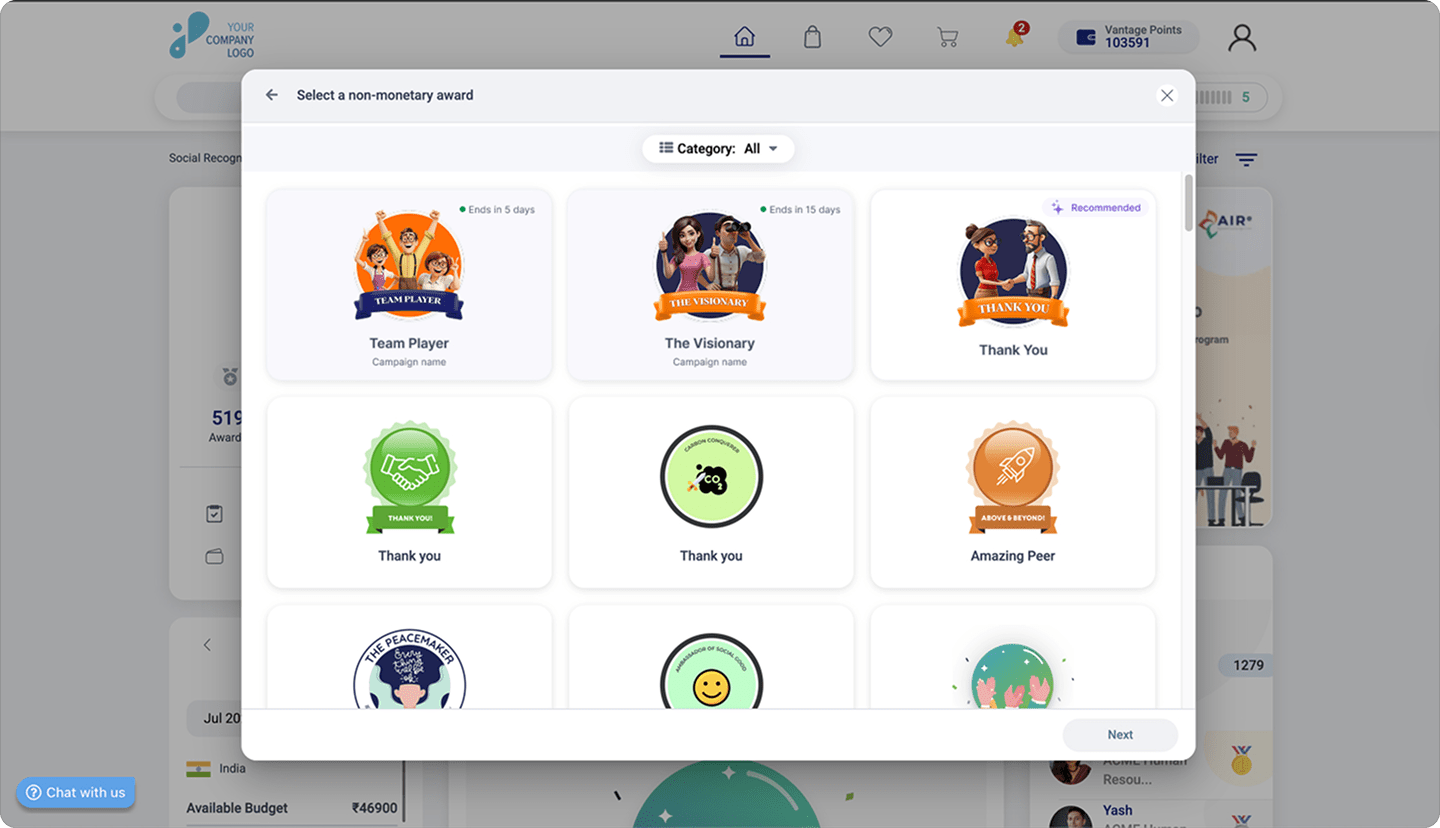
AI-powered badge systems make this reinforcement visible and repeatable. Badges like "Team Player," "Encouragement Expert," or "Agility Ace" are awarded based on real-time recognition data and behavioral patterns rather than simple counting. When an employee earns a badge after consistent peer recognition, that visible achievement validates their effort while signaling that the recognized behavior is valued by the organization.
 Source: Vantage Recognition
e -- Emotional Connect
Recognition must feel real. This is the pillar AI cannot handle alone. It can surface the moment and draft the message. The emotional resonance has to come from the person sending it.
When organizations implement the AIRe Framework, they build recognition rooted in purpose rather than performance metrics, balancing data, motivation, and human connection in a way no fully automated system can replicate.
Research from Quantum Workplace (2024) shows that organizations prioritizing recognition are 12 times more likely to achieve strong business outcomes, while highly engaged teams achieve 23% higher profitability, per Gallup 2024.
The AIRe Framework in Practice
Lisa, a marketing manager, faces a familiar challenge. Recognition matters, but between meetings and deadlines, it consistently falls through the cracks.
Her Microsoft Teams sends a nudge: "You have not recognized a teammate recently. Would you like to see who might benefit from appreciation?"
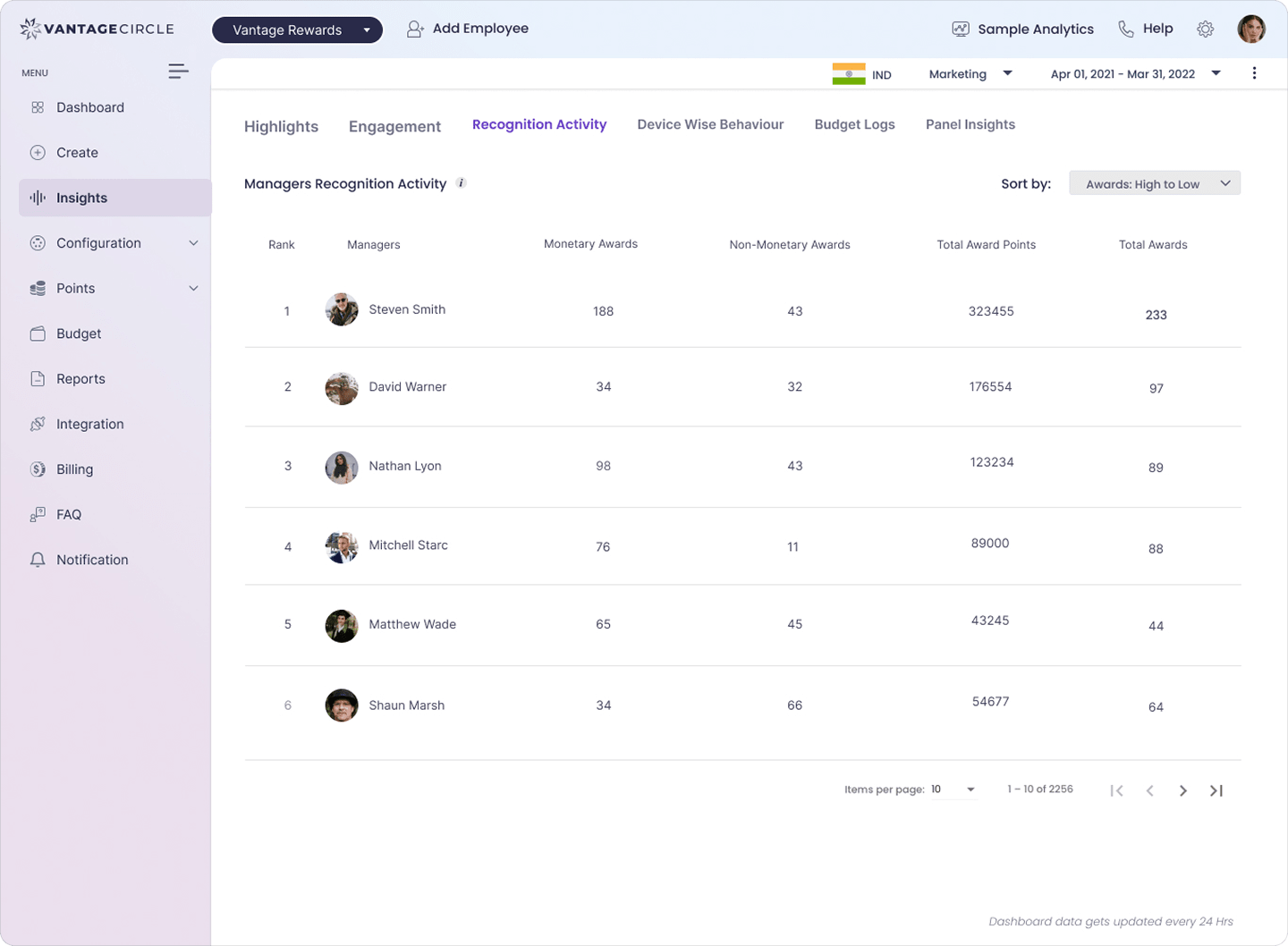
Instead of relying on memory, the system surfaces recognition data from within the platform: who has contributed to which projects, who has not been acknowledged recently, and what those contributions looked like. It identifies that Mary and Alicia have not been recognized in 30 days despite significant involvement in Campaign X. It drafts a suggested message based on their documented project contributions, not by reading private messages or emails.
Lisa reviews the suggestion, adjusts the tone to match her voice, and sends it in two minutes instead of not at all.
 Source: Vantage Recognition
This is not automation replacing human connection. It is AI amplifying it by surfacing genuine contributions that would otherwise go unnoticed. The appreciation comes from Lisa. The AIRe Framework is what made it consistent.
Recommended Resource: The Complete Guide to Employee Recognition in 2026: Using the AIRe Framework
Why AI Matters for Recognition Right Now
The case for rethinking recognition is not about AI specifically. It is about the fact that most recognition programs are not working, and the gap is measurable.
Only 21% of employees are actively engaged globally, per Gallup's 2024 State of the Global Workplace report. That number has barely moved in a decade despite widespread investment in recognition and rewards programs. The AIRe x Mercer Future of Total Rewards whitepaper (2025) offers one explanation: 94% of traditional total rewards components show critical gaps in behavioral reinforcement or emotional connection. The programs exist. The design is the problem.
The same pattern shows up in program effectiveness data. 91% of organizations have rewards programs and 94% have recognition programs, yet only 31% rate them as effective, per a 2024 HRMarketer study. The programs exist. They are just not landing.
Vantage Circle's Recognition Effect study (conducted with Great Place To Work India, covering 5.7 million employees across 2,000 organizations, 2025) points to where the gap actually lives: only 55% of employees feel truly recognized. When employees experience all four recognition outcomes (Appreciated, Accepted, Validated, Accomplished), 97% intend to stay and 98% report strong workplace sentiment. When even one signal is missing, that number drops to 83%. Recognition quality, not recognition frequency, is what drives retention.
This is where AI becomes relevant. Not because it is inevitable, but because consistency and visibility are exactly what AI is well-suited to support, and exactly what manual employee recognition programs consistently fail to deliver.
How AI Is Actually Used in Employee Recognition Today
AI helps recognition programs do three things that manual effort consistently fails at: seeing contributions that happen offscreen, reducing bias toward visible contributors, and personalizing appreciation without adding administrative burden.
3 Ways AI "Sees" Achievement
AI systems recognize employees by interpreting work-system signals, sometimes called "digital body language."
A note on what this does and does not mean. In a recognition context, these signals come from within work platforms: recognition activity, project participation records, document collaboration, and meeting attendance. They do not mean reading private messages, emails, or personal conversations. Enterprise HR buyers should expect any AI recognition platform to be explicit about which data sources it uses and which it does not. If a vendor is not clear on this, that is itself a signal worth paying attention to.
Collaboration data: participation in shared projects, meetings, and collaborative documents
Recognition activity: who has been recognized, by whom, and how recently
Outcome patterns: milestones achieved and consistency of contribution over time
Together, these inputs reveal recognition-worthy moments that go beyond visible wins and capture everyday impact.
The "Quiet Contributor": Using AI to Reduce Proximity Bias
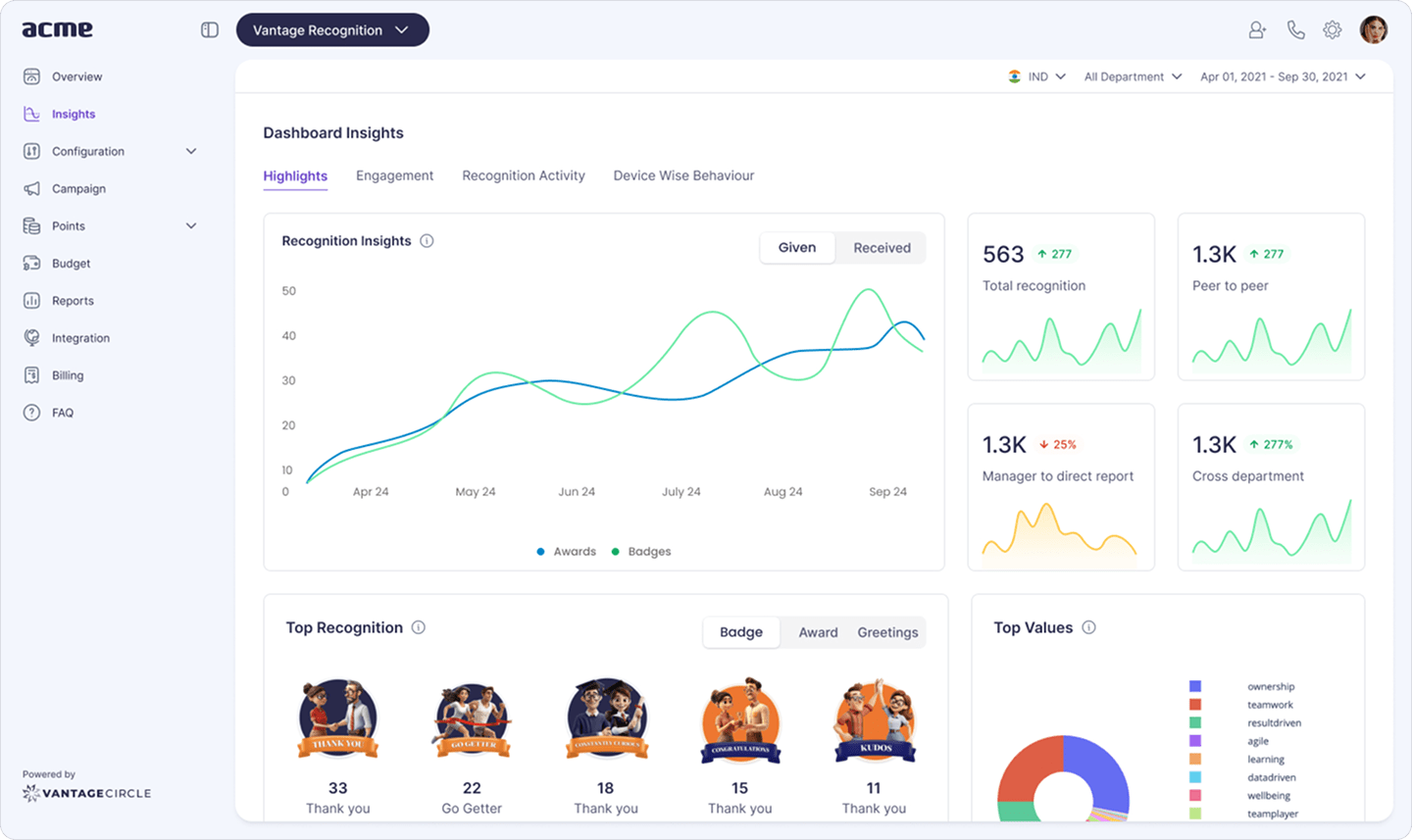
Traditional recognition favors the loudest voices or those closest to leadership. AI corrects this by identifying contributors who work behind the scenes, operate remotely or asynchronously, and consistently support team success without self-promotion.
 Source: Vantage Recognition
Recognition Analytics gives this data a structured home. AI can only surface meaningful patterns if the underlying recognition data is being captured consistently, which is what a purpose-built recognition platform is designed to do.
Personalizing Recognition at Scale
AI enables personalization without adding administrative burden: recognition tied to specific actions rather than vague praise, messaging aligned with individual preferences, and timing optimized for emotional impact. This is how organizations move from generic appreciation to recognition that actually resonates.
Should AI Write Employee Recognition Messages?
AI should assist, not author, recognition. The distinction is not semantic.
| Dimension | AI-Assisted Recognition | AI-Generated Recognition |
|---|---|---|
| Role of AI | Suggests context and insights while managers craft the message. | Writes recognition messages end-to-end automatically. |
| Human Involvement | Keeps humans in control of tone, intent, and personalization. | Minimizes human input in message creation. |
| Authenticity | Preserves authenticity and personal voice. | Risks sounding generic or templated. |
| Perception | Feels supportive, enabling, and collaborative. | Can feel automated or transactional. |
Role of AI
AI-Assisted Recognition
Suggests context and insights while the manager crafts the message.
AI-Generated Recognition
Writes recognition messages end-to-end automatically.
Human Involvement
AI-Assisted Recognition
Keeps humans in control of tone and intent.
AI-Generated Recognition
Minimizes human input in message creation.
Authenticity
AI-Assisted Recognition
Preserves authenticity and personal voice.
AI-Generated Recognition
Risks sounding generic or templated.
Perception
AI-Assisted Recognition
Feels supportive and enabling.
AI-Generated Recognition
Can feel automated or transactional.
Employees can sense when appreciation is real and when it is automated. When recognition feels manufactured, it can damage trust rather than build it.
This is the principle behind Recognition Guide, Vantage Circle's AI-assisted writing companion. Powered by the AIRe Framework, Recognition Guide is designed so that the thought stays with the human and AI helps with expression. The manager decides who deserves recognition and why. Recognition Guide helps them say it well. That division of responsibility is intentional and it is where the assistive model works best in practice.
8 Ready-to-Use AI Prompts for Authentic Recognition
Used correctly, AI prompts help managers overcome writer's block without losing sincerity. These 8 prompts cover the most common recognition scenarios HR teams encounter. For more message ideas, see employee recognition letter examples.
Prompt 1: The Project Milestone
"Highlight the specific contribution [Name] made to [Project], why it mattered, and how it helped the team succeed."
Prompt 2: The Soft Skill Shoutout
"Recognize [Name] for demonstrating [soft skill] during [situation], and explain the positive impact on others."
Prompt 3: The Consistency Recognition
"Acknowledge [Name] for consistently [behavior] over [time period], with 2 to 3 specific examples that show this pattern."
Prompt 4: The Behind-the-Scenes Contributor
"Recognize [Name] for their behind-the-scenes work on [project/task] that was essential to [outcome], and validate that this invisible contribution is valued."
Prompt 5: The Growth Recognition
"Recognize [Name] for growth in [skill area], contrasting their earlier work with recent achievements, and acknowledge the effort this improvement required."
Prompt 6: The Cross-Team Collaboration
"Recognize [Name] for bridging [Team A] and [Team B] on [initiative], explain what would have been harder without their involvement, and name the specific outcome it made possible."
Prompt 7: The Values-Based Recognition
"Recognize [Name] for an action that demonstrated [company value], describe exactly what they did and when, and explain why it is a concrete example of that value rather than just a statement of it."
Prompt 8: The New Employee Welcome
"Recognize [Name] for how they have shown up in their first [time period] at [Company], name one specific moment or contribution that stood out, and explain what it signals about how they will grow here."
The Risks of Using AI for Employee Recognition
AI-powered recognition has genuine risks that most vendor content underplays. Understanding them upfront is what separates a thoughtful implementation from one that backfires. The same principles that govern employee engagement broadly apply here: trust is easy to damage and slow to rebuild.
When AI Makes Recognition Feel Inauthentic
Over-automation strips recognition of emotion. Warning signs include repetitive language, poor timing, a lack of specific context, and messages that feel written for anyone rather than for this person in this moment.
The visibility problem emerges when employees realize recognition is algorithmically triggered rather than human-initiated. Receiving a badge for "excellent collaboration" feels different when you know a manager deliberately chose to recognize you versus knowing an algorithm detected patterns in your communication data. The solution is not avoiding AI. It is transparency about when recognition is human-initiated, AI-assisted, or fully automated.
The personalization paradox occurs when AI generates technically personalized but emotionally generic messages. Algorithms can insert a name, reference a recent project, and acknowledge specific achievements while still producing content that feels templated.
Algorithmic Bias: How to Audit Your Data
Bias enters through skewed data. AI systems can reflect and reinforce the biases present in their training data. In recognition contexts, this creates a risk: if the underlying recognition data over-indexes on certain teams, roles, or working styles, an AI system may surface fewer recognition opportunities for employees who are already less visible, compounding an existing gap rather than correcting it.
Mitigation requires regular audits of recognition patterns across teams and roles, human oversight of AI outputs, and inclusive data sources that do not over-index on the most visible contributors. Any AI recognition platform worth evaluating will have a clear answer for how it handles this.
What to Look For in AI-Powered Recognition Software
Evaluating AI recognition platforms requires looking beyond feature lists to examine implementation quality, built-in safeguards, and whether systems are designed for human-AI collaboration or human replacement.
Ethical AI and Data Privacy (SOC 2 / GDPR)
Any AI recognition platform should meet enterprise standards for data security, privacy compliance, and ethical AI governance. Ask vendors specifically: what data does the system collect, how are recognition recommendations generated, and where does human judgment remain essential. Employees deserve answers to those questions before they appear in an AI-generated recognition note.
Operational transparency means employees understand when they are receiving AI-assisted versus human-written recognition, when AI makes automated decisions versus surfacing recommendations for human review, and what data the system collects about their work.
Integrations (Microsoft Teams / Slack)
Adoption depends on workflow fit. The most effective recognition happens immediately, within the tools and workflows where the contribution took place. Seamless integrations with Microsoft Teams and Slack ensure recognition happens in context, not as a separate destination that requires an extra login.
Integration architecture reveals whether a platform is designed to meet employees where they work or to pull them away from it. For most distributed teams in 2026, that distinction determines whether a recognition program gets used at all.
FAQs
What is the best employee recognition platform for AI-powered programs?
The best platform for AI-powered recognition is one built on assistive AI rather than automated AI. It should surface recognition opportunities from real work data (collaboration patterns, project contributions, peer interactions), integrate with tools your team already uses like Microsoft Teams or Slack, and keep humans in control of the final message and intent. Vantage Circle's recognition platform applies the AIRe Framework to ensure AI-powered recognition stays human, strategic, and sustainable, with Recognition Analytics, manager-facing nudges, and a global rewards catalog built into a single system.
What are the key trends in employee recognition for 2026?
The defining trend in 2026 is the shift from sporadic recognition to systematic recognition, driven by AI. Platforms are moving from passive tools where recognition only happens if someone remembers to log in, to active systems that surface recognition moments from real work data. Secondary trends include values-aligned recognition tied to company principles rather than generic praise, cross-cultural recognition design for global and distributed teams, and greater emphasis on transparency about when recognition is AI-assisted versus human-initiated.
Final Thought
The future of employee recognition is not about choosing between technology and humanity. It is about using AI to protect what makes appreciation meaningful: the specificity, the timing, and the human decision that something was actually worth recognizing.
The organizations getting this right are not waiting. They are building it now.

Supriya is a Content Marketing Lead at Vantage Circle, where she writes on employee engagement, recognition, workplace communication, and culture. She spent the earlier part of her career in corporate communications at Burson, ESPN Star Sports, and CBRE, advising organizations on the messages employees actually hear.
Connect with Supriya on LinkedIn.