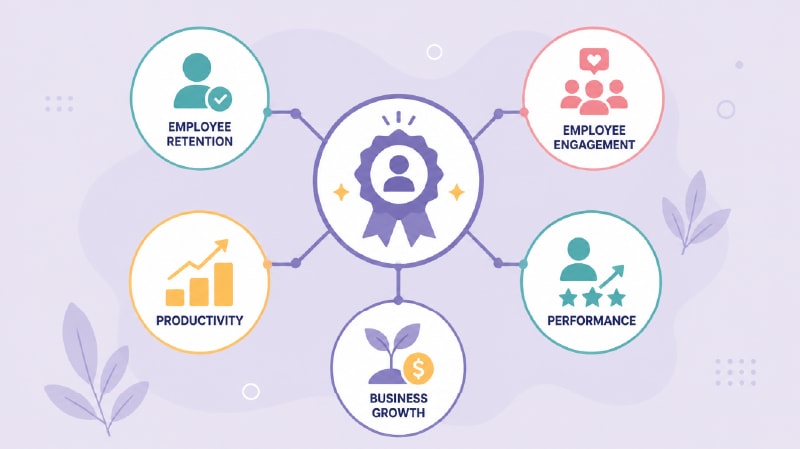
Recognition, as most companies practice it, suffers from a sequencing problem. The praise comes first. The proof comes later, if it comes at all. A manager posts a shoutout, HR orders a batch of certificates, and eighteen months on, someone in the C-suite asks a question nobody thought to answer at the outset: what is this actually buying us?
For a company building recognition from scratch, that failure is optional. There is no legacy program to retrofit, no years of goodwill spending to justify after the fact. The metric can come before the moment, not after it. Most playbooks on this subject don't offer that choice. They're written for repair, not design, aimed at HR teams untangling a program that already exists. This one is written for the blank page.
Done right, alignment is simple to state and hard to practice. Every act of recognition ties to one measurable goal, engagement, retention, or productivity, and the organization tracks whether that number moves. It does not start with a wall of ideas. It starts with choosing one outcome and refusing to dilute it.
This guide gives you a 5-step starter framework, a metrics set you can use from week one, and a 90-day plan built for Indian SMBs and first-time HR teams. If you're still building the case for a formal rewards and recognition program, this is where to start.
What does it mean to align recognition with business outcomes?
Aligning recognition with business outcomes means every award is tied to a behavior that drives a named business metric, not just a thank-you.
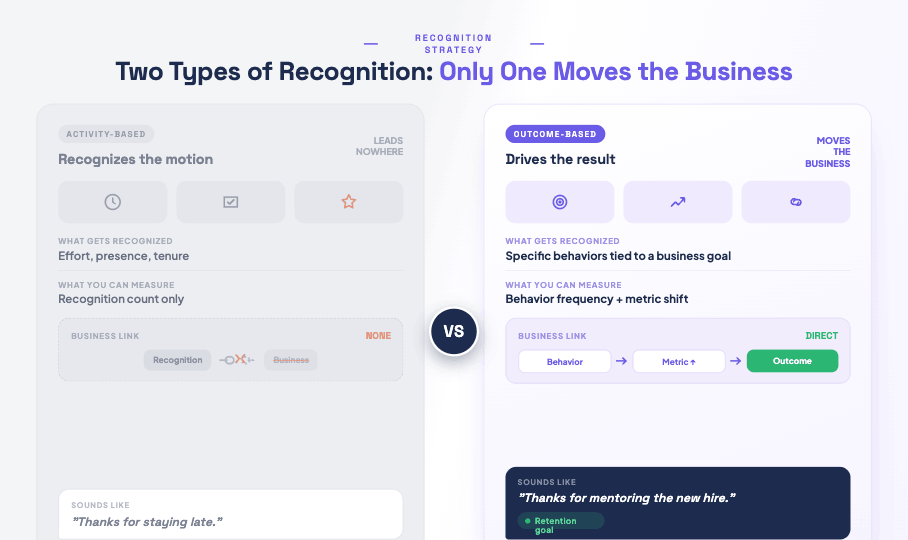
Most recognition falls into one of two categories. Activity-based recognition rewards presence or effort. Outcome-based recognition rewards the specific behaviors that move a metric you've already chosen. The second kind has a chain you can trace: behavior, then metric, then outcome. The first doesn't.
For a team just starting out, the distinction matters more than it seems. When recognition is tied to an outcome, every recognition moment reinforces the same direction. When it isn't, recognition creates noise instead of signal, and you can never prove it worked.
Why recognition drives business outcomes (the evidence)
Recognition moves business outcomes because it raises engagement, and engaged teams retain and perform measurably better.
Gallup Workplace Analytics (2024) found that organizations with well-designed recognition programs see 21% higher profitability, 20% higher productivity, and 40% lower voluntary attrition. These are not marginal gains. They are the difference between a recognition program that justifies its budget and one that gets cut in the next planning cycle.
A Gallup (2025) study found that among employees who receive both feedback and recognition from their manager at least once a week, 61% are engaged, compared with 38% of employees who receive weekly feedback but less frequent recognition. Recognition is not just a culture initiative, it is a measurable performance driver.
The problem is that most programs are not well-designed. The AIRe Benchmarking Study (2024), which covered 352 organizations across North America, India, and the UAE, found that fewer than 10% of recognition programs meet high-impact standards, and 63% require reengineering. The average program scores just 60% on recognition design quality.
 [Source:Vantage Recognition]
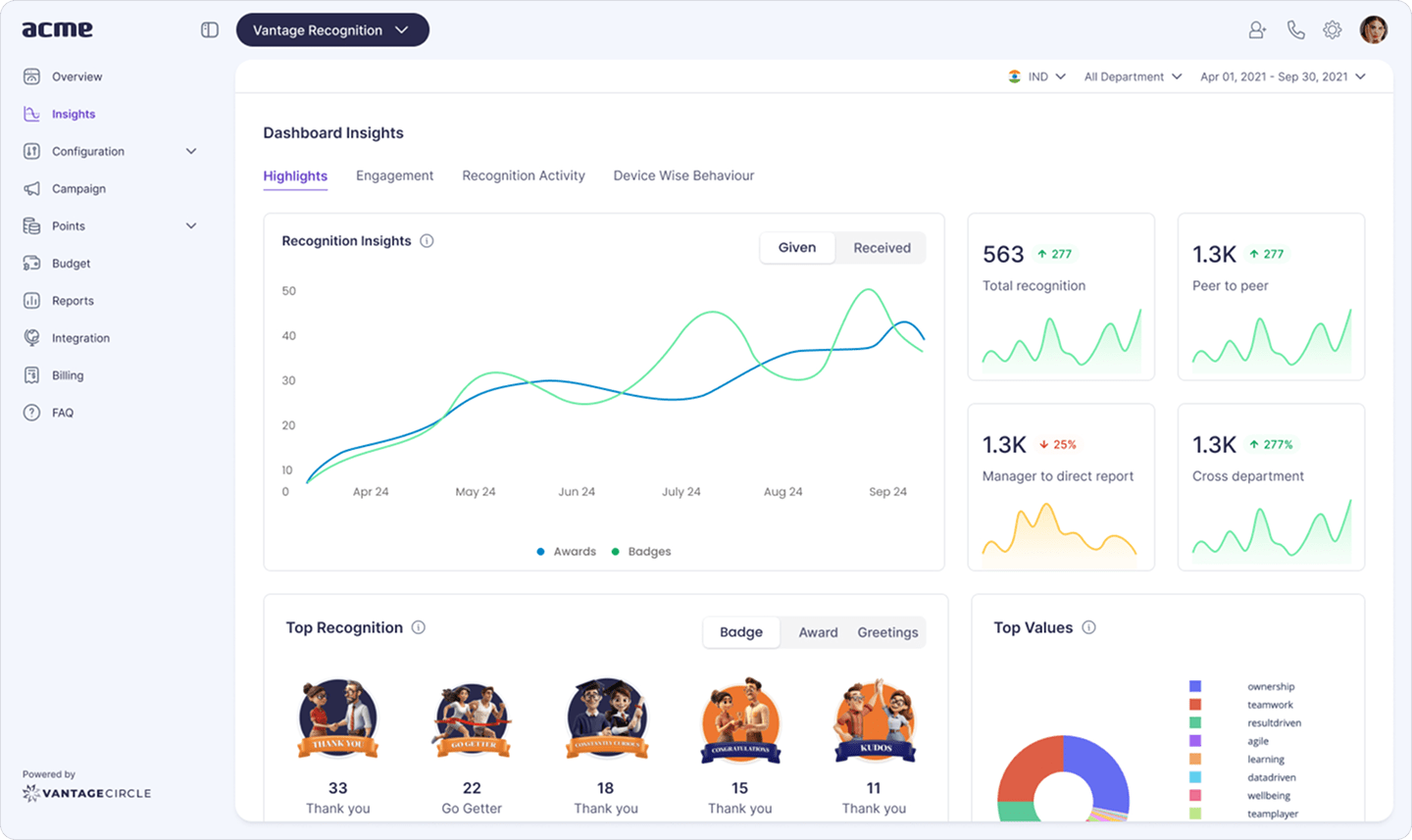
When recognition is tied to a specific outcome, analytics show not just how many people are being recognized, but which behaviors are being recognized and whether participation is growing. Those are the signals that connect recognition activity to the metric you chose.
The 5-step starter framework to align recognition with outcomes
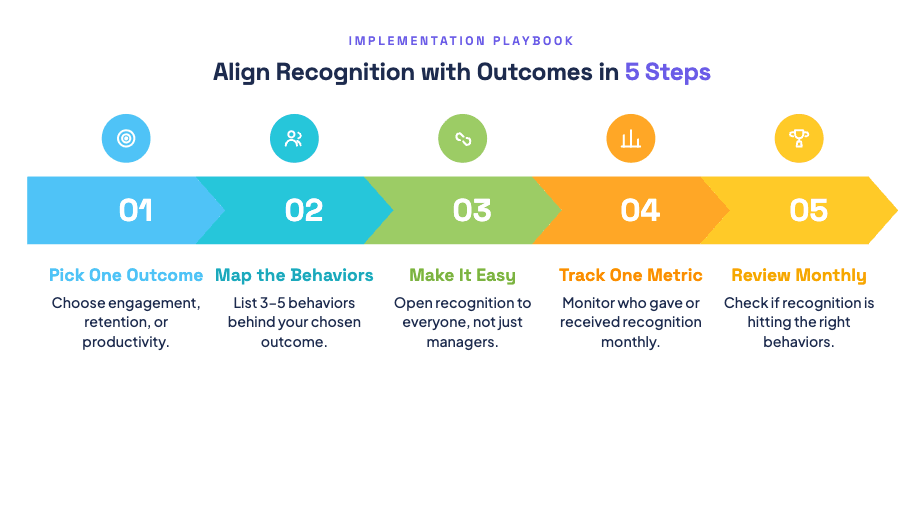
To align recognition with business outcomes when starting out, follow five steps: pick one outcome, map the behaviors behind it, make recognizing those behaviors easy, track one leading metric, and review monthly.
Step 1: Pick one business outcome
The most common mistake new programs make is trying to drive everything at once. Pick one. Engagement, retention, and productivity are the three most common choices. For most Indian SMBs starting out, retention is the highest-value outcome to begin with. Recognition is one of the most direct levers you have, and a focused program can start moving the needle within 90 days.
If you're unsure which outcome to start with, ask: what is the one metric leadership mentions most often? Start there.
Step 2: Map the behaviors that drive it
Once you've picked an outcome, list three to five specific behaviors that contribute to it. If your outcome is retention, the behaviors might include mentoring a newer colleague, going above scope on a cross-functional project, or handling a difficult client situation well. These are the behaviors you'll recognize.
This is where core values tagging pays off. When each award is tagged to a specific behavior, recognition stops being random praise and starts reinforcing the exact actions behind your chosen outcome. That tagging is what later lets you prove the link between recognition and results.
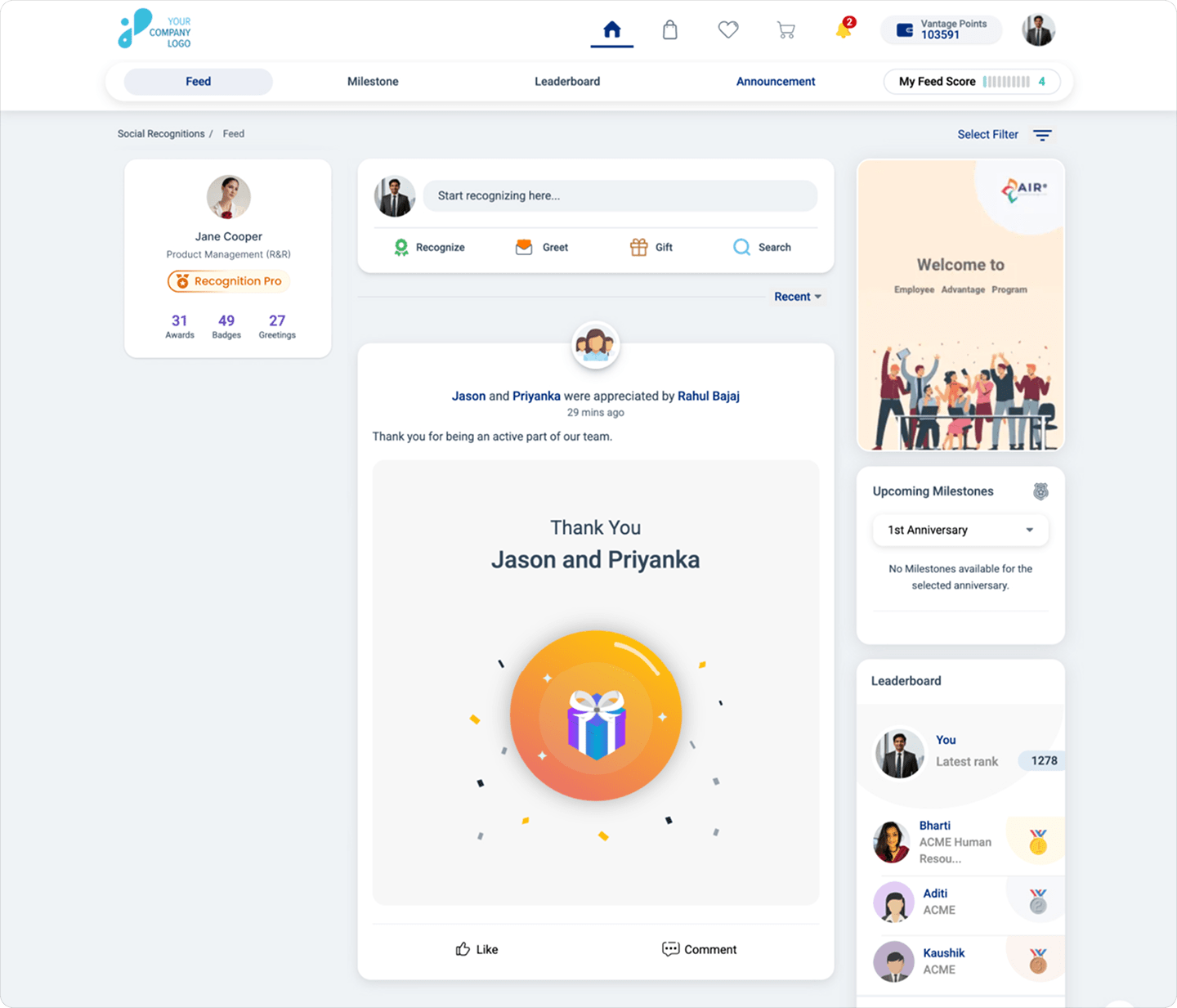
Step 3: Make recognizing those behaviors easy
 [Source:Vantage Rewards]
The fastest way to raise recognition frequency in a new program is to let anyone recognize anyone, not just managers. Peer-to-peer recognition widens participation from week one, which is the leading signal you will track in Step 4. Manager-only recognition is a bottleneck. Most managers already have full plates, and when recognition depends only on them, it becomes infrequent and inconsistent.
The rule is simple: the fewer the steps to give recognition, the more recognition gets given.
Step 4: Track one leading metric
A leading metric moves before your outcome does. It tells you whether your program is on track weeks before retention numbers shift. For a new recognition program, the leading metric to track is participation rate: what percentage of your team either gave or received recognition in the past 30 days? A participation rate above 60% in the first 90 days is a strong signal your program is taking hold.
Step 5: Review and adjust monthly
Set a 30-minute monthly review. Check your leading metric, look at which behaviors are being recognized most frequently, and ask whether those are the behaviors you mapped in Step 2. If recognition is clustering around the wrong behaviors, that is your signal to course-correct, not the participation rate alone.
Start-Small Recognition-to-Outcome Map
| Business Outcome | Behavior to Recognize | Leading Metric | Review Cadence |
|---|---|---|---|
| Retention | Mentoring, cross-functional contribution, tenure milestones | Participation rate (% giving or receiving recognition) | Monthly |
| Engagement | Initiative, going beyond role, collaborative problem-solving | Recognition frequency (average per employee per month) | Monthly |
| Productivity | Process improvement, on-time delivery, quality output | Recognition-to-performance correlation | Bi-monthly |
| Customer Satisfaction | Client handling, escalation resolution, response quality | % of customer-facing employees recognized | Monthly |
| Learning and Development | Knowledge sharing, training completion, skill-building | Peer nominations in L&D behaviors | Quarterly |
Which metrics should a beginner team track?
A team just starting out should track four measurable signals: recognition participation rate, recognition frequency, eNPS (Employee Net Promoter Score), and the one outcome metric chosen in Step 1.
If participation rate is your leading indicator, eNPS is your mid-term check. It should start moving within 60 to 90 days of a consistent recognition program. A team that has both running from day one has exactly what it needs to make the case for recognition at the next leadership review.
A simple starter framework for Indian SMBs and first-time HR teams
Indian SMBs can start aligning recognition with outcomes on a modest budget by combining low-cost peer recognition with one tenure or festival milestone tied to a retention outcome.
India has recognition patterns that global programs often miss. Tenure matters more here than in many Western markets. Long service is a point of pride, and recognizing it publicly carries real weight. Festival seasons like Diwali, Dussehra, are natural recognition moments that employees already expect. Layering a business-outcome-tied recognition campaign around these periods is a low-friction way to start a program that feels culturally grounded rather than imported.
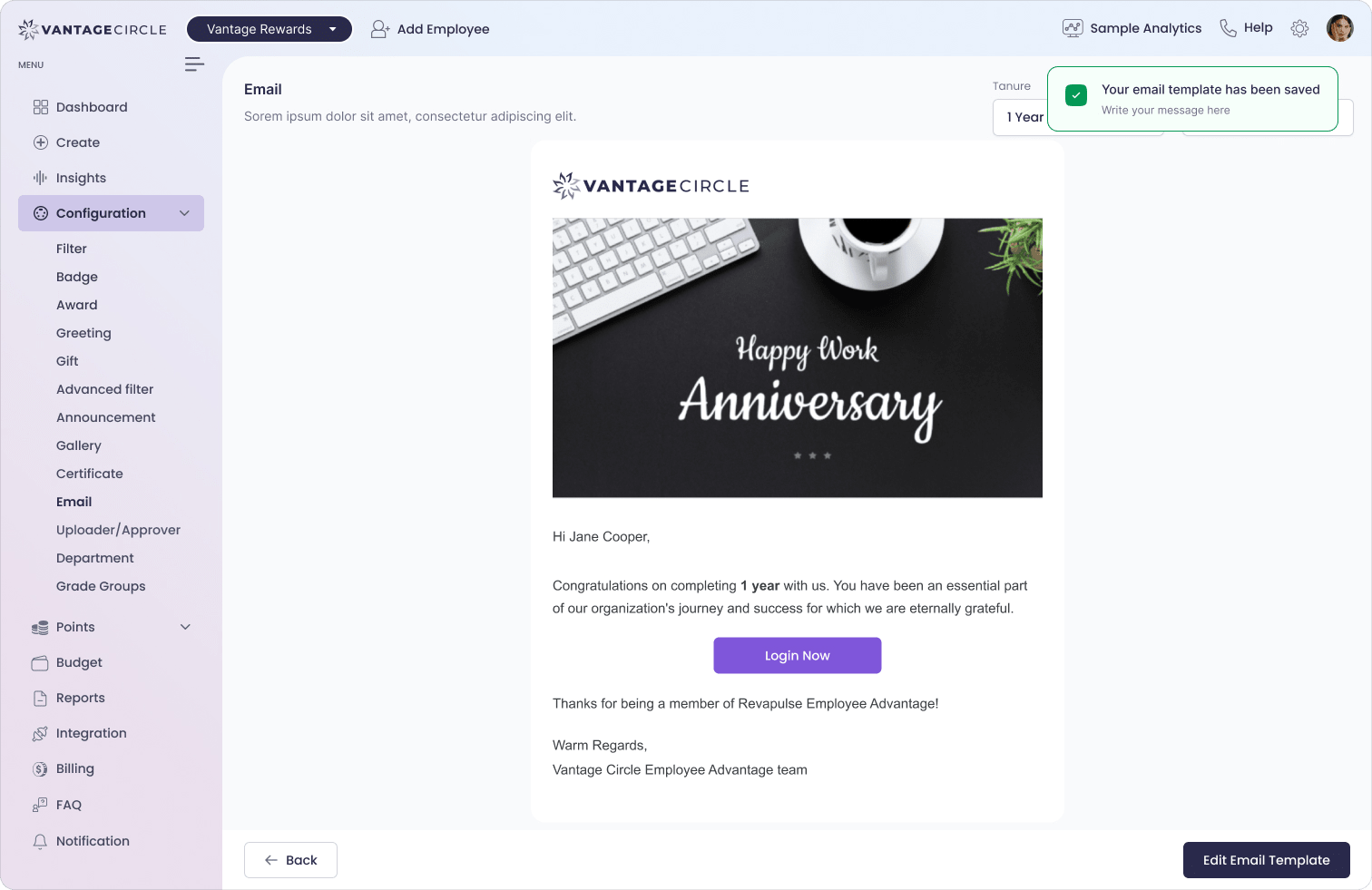
Automated long-service milestones are a low-effort first win that ties directly to a retention outcome. They require no manager discretion, run on a schedule, and signal to employees that staying matters to the organization.
The AIRe Benchmarking Study (2024) found that among the 148 Indian organizations studied, only 11% had very high recognition program effectiveness, with 43% falling in the low-to-moderate band. That is not a discouraging number. It means a focused, beginner-friendly program built around one outcome is already ahead of most programs running in India today. If you're also building your broader employee engagement strategies in parallel, recognition aligned to one outcome gives you the clearest early signal that the work is having an effect.
90-Day Plan for Indian SMBs
- Month 1: Choose your outcome (retention recommended), map three behaviors, and launch peer-to-peer recognition. Track participation rate weekly. Budget focus: non-monetary recognition only, near-zero cost.
- Month 2: Add one tenure milestone category (1-year, 3-year, or 5-year). Run your first eNPS pulse. Review which behaviors are being recognized and compare against your Step 2 list.
- Month 3: Tie one recognition campaign to a business goal or an upcoming festival period. Compare participation rate against the Month 1 baseline. Adjust your behavior list if recognition is clustering in the wrong areas.
Budget reality: peer-to-peer non-monetary recognition costs nearly nothing to run. Monetary recognition can start at a few hundred rupees per employee per month and scale as the program proves its return. Start non-monetary, prove participation, then add monetary layers once you have the data.
Common mistakes when aligning recognition with business outcomes
The most common mistake is recognizing everything, which dilutes the signal and breaks the link to any single outcome. Three mistakes that consistently sink new recognition programs:
1. No outcome chosen:
If you haven't named one business metric this program is meant to move, every recognition moment is just noise. You cannot measure what you didn't define.
2. Manager-only recognition:
When only managers can give recognition, frequency stays low and recognition becomes inconsistent. Peer behaviors that drive your chosen outcome go unseen. Peer-to-peer recognition is not optional for a program trying to prove ROI (Return on Investment).
3. No measurement from day one:
Measurement doesn't require a sophisticated HR analytics stack. Participation rate can be tracked with a basic recognition dashboard from week one. Teams that don't measure from the start have no baseline to compare against and no case to make when budget review comes around.
Recognizing everything also creates a different problem. Time-boxed recognition campaigns keep a young program focused on one behavior tied to one outcome at a time, rather than spreading recognition across every possible action and losing the signal entirely.
Conclusion
Recognition programs succeed or fail based on one decision made early: whether you name the outcome before you start giving out praise. A program built the other way, activity first and a business case invented later, spends its first year proving nothing and its second year fighting for budget. A program built outcome-first, with one metric, one set of behaviors, and one leading indicator, has a case to make within 90 days.
Start there. Pick retention, engagement, or productivity. Map the three to five behaviors that drive it. Make it easy for anyone to recognize anyone. Track participation rate from week one. Review monthly, not quarterly. None of this requires a large budget or a mature HR function. It requires deciding what the program is for before you launch it.
The teams that get this right are rarely the ones with the most sophisticated recognition platform. They are the ones who refused to recognize everything, and chose instead to recognize the few things that actually moved the number they cared about.
Frequently asked questions
How do you align recognition with business goals?
Start by choosing one business goal, then list the specific employee behaviors that contribute to it. Recognize those behaviors consistently, both peer-to-peer and manager-driven. Track whether recognition of those behaviors is increasing month over month as your leading indicator, then track whether the business metric shifts as your lagging indicator. The alignment comes from maintaining the chain: behavior, recognition, metric, outcome.
How can we improve recognition in a company?
The single highest-impact change is adding peer-to-peer recognition alongside manager recognition. Most programs stay low-frequency because recognition depends entirely on managers. Widening who can give recognition increases frequency immediately, which is the primary driver of recognition's effect on engagement and retention.
What are the 5 C's of employee retention?
The 5 C's of employee retention are Compensation, Career development, Culture, Colleagues, and Conditions. Recognition directly supports culture and colleagues. It shapes how employees feel about the environment they work in and how valued they feel by the people around them. A structured recognition program tied to retention behaviors addresses two of the five C's at once.
What are the 3 R's of employee retention?
The 3 R's of employee retention are Recognition, Reward, and Respect. Recognition is listed first because it is the most frequent and lowest-cost lever available to any team. Reward is the monetary component. Respect is the cultural outcome that consistent recognition builds over time. An outcome-aligned recognition program addresses all three.

This article is written by Shaoni Gupta. Shaoni Gupta is a content marketing specialist at Vantage Circle, with expertise in scriptwriting and copywriting in the field of employee rewards and recognition.
Connect with Shaoni on LinkedIn.