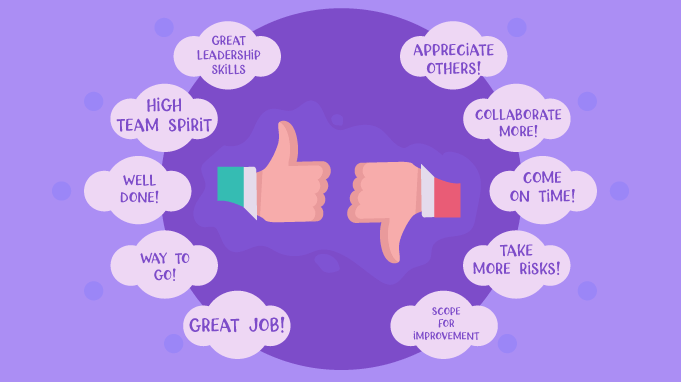
Most managers sit down for performance reviews and default to the same handful of phrases they've used for years. "Great team player." "Needs to improve communication." "Shows strong leadership potential." The employee nods, the form gets filed, and nothing changes.
Gallup research found that only 14% of employees strongly agree their performance reviews inspire them to improve. That means 86% of the time, the comments managers write are landing flat.
This playbook fixes that. Inside, you'll find a 3-part framework for writing appraisal comments that actually drive behavior change, plus 100+ ready-to-use examples organized by competency area. Whether you're an HR leader equipping managers for review season or a manager writing your next round of evaluations, every section here is built to be actionable, direct, and immediately implementable.
The goal is simple: replace vague phrases with comments that name specific behaviors, connect them to business outcomes, and point employees toward a clear next step. That's how constructive feedback becomes a tool for growth rather than a formality in the performance appraisal process.
Why Most Appraisal Comments Fail (And What HR Leaders Can Do About It)
Appraisal comments fail in three predictable ways.
They're too vague. "Good team player" tells an employee nothing about what they did, why it mattered, or what to do next. It's a compliment disguised as feedback. Vague comments don't support promotion decisions, retention conversations, or performance improvement plans. They create a paper trail that documents nothing. And when it's time to manage underperforming employees, that empty paper trail becomes a liability.
They're too backward-looking. Most comments describe what already happened without pointing forward. An employee reads "You completed the migration project successfully" and thinks, "Great. Now what?" When comments only document the past, the review becomes an autopsy rather than a development conversation.
They're too infrequent. Cramming 12 months of performance observations into a single annual review guarantees recency bias. Managers often recall only the last 6-8 weeks clearly, which means the comment a manager writes in December may not reflect what actually happened in March. SHRM has documented this as a systemic failure across organizations.
The root cause isn't lazy managers. It's a training gap. Most organizations hand managers a blank form and expect great written feedback without ever teaching them how to write it.
The fix is straightforward: a simple 3-part framework that any manager can apply in 2 minutes per comment. Anonymous employee engagement survey questions embedded in pulse surveys can capture the engagement signals that formal appraisal conversations often miss, giving HR leaders an early warning system alongside the review process. But the comments themselves need structure, and that's what the next section delivers.
If you want to build a broader culture of effective feedback, it starts with teaching managers to write comments worth reading.
The 3-Part Framework for Writing Effective Appraisal Comments
Every effective appraisal comment answers three questions: What did the employee do? Why did it matter? What should they do next?
We call this the Behavior-Impact-Action (BIA) framework. It turns vague praise and generic criticism into comments that drive real behavior change. Teach this to every manager before performance review season, and the quality of your entire review cycle improves immediately.
Here's how the framework breaks down:
| Component | Question It Answers | Example Phrase |
|---|---|---|
| Behavior | What specific action did the employee take? | "You led the client onboarding redesign..." |
| Impact | Why did it matter to the team or business? | "...which reduced onboarding time by 30%..." |
| Action | What should the employee do next? | "...consider mentoring two junior PMs on this process next quarter." |
Here's how each part works.
1. Name the Specific Behavior
The most common mistake in appraisal writing is substituting adjectives for observations. "Great communicator" is an opinion. "You presented the quarterly results to the leadership team with clear data visualization and fielded 12 follow-up questions without preparation" is a behavior anyone can verify.
When a manager writes "great communicator," the employee has no idea what to repeat. When a manager names the specific behavior, the employee knows exactly what worked and can do it again.
The fix is simple: replace every adjective with the observable action behind it. If you can't name the action, the comment isn't ready to write yet.
Here's what this looks like in practice:
| Before (Vague) | After (Specific Behavior) |
|---|---|
| "Great team player" | "You volunteered to cover three shifts for a colleague during their medical leave without being asked" |
| "Needs to improve communication" | "In two project status meetings this quarter, key blockers were not raised until after the deadline had passed" |
| "Very creative" | "You proposed the customer self-service portal concept that reduced support tickets by 18%" |
The pattern: strip the adjective, insert the action. Every time.
2. Connect It to Business Impact
A comment without business context is a compliment, not feedback. HR leaders need comments that hold up in promotion discussions, compensation reviews, and talent calibration sessions. That requires impact.
Impact doesn't have to mean revenue. It can be cost savings, time reclaimed, team morale preserved, customer satisfaction improved, or risk avoided. The point is to connect the behavior to something the organization cares about.
When impact is unclear, the manager should ask the employee. "What happened as a result of that project?" is a legitimate pre-review question. Better to ask than to guess or, worse, to leave the impact field blank.
Here's the difference impact makes:
| Behavior Only | Behavior + Impact |
|---|---|
| "You completed the migration project ahead of schedule" | "You completed the migration project 2 weeks ahead of schedule, freeing the QA team to start regression testing early and avoiding a $40K contractor extension" |
| "You mentored two new hires" | "You mentored two new hires who both passed their 90-day review with no performance flags, reducing our typical new-hire ramp time by 3 weeks" |
The first column documents an event. The second column builds a case. HR needs the second version.
3. Point to the Next Action
This is the part most managers skip entirely. They document what happened and stop. The employee leaves the review knowing they did well or poorly, but not knowing what to do differently tomorrow.
Every comment should end with a specific, achievable next step. Not "keep improving" — that means nothing. Not "continue to grow" — that's a wish, not a direction. A real next action names what the employee should do, by when, and in what context. Pairing next actions with SMART goals makes them even more effective — specific, measurable, and time-bound.
For improvement comments, the next action should be supportive, not punitive. "Work with [mentor name] on stakeholder presentations" is more useful than "stop giving bad presentations." The goal is to redirect behavior, not to punish it.
| Weak Next Action | Strong Next Action |
|---|---|
| "Keep up the good work" | "Take ownership of the vendor negotiation process for Q3 to build your procurement skills" |
| "Needs improvement in time management" | "Use a shared task tracker for the next sprint cycle and review priorities with your lead every Monday" |
| "Should communicate more" | "Present one project update per month at the team standup to build confidence in group settings" |
When every comment ends with a forward-looking action, the review conversation shifts from judgment to development. That's the difference between a form and a playbook.
100+ Performance Appraisal Comment Examples by Competency
Now apply the framework. Below are 100+ appraisal comments organized by 12 competency areas, each with positive comments (reinforcing strong behavior) and improvement comments (redirecting behavior constructively).
Every example follows the Behavior-Impact-Action structure from the previous section. Adapt them to your specific context — the goal is to use these as starting points, not copy-paste them verbatim. For more phrasing ideas, see our guide to constructive feedback examples.
Attendance and Punctuality
Attendance patterns are often the first signal of employee engagement issues. When chronic lateness or unplanned absences appear, pulse surveys can help HR detect the underlying cause before it becomes a retention problem.
| Type | Appraisal Comment |
|---|---|
| Positive | "You have been consistently punctual to work and meetings, setting a professional standard for the team" |
| Positive | "Your attendance record this year has been excellent, with zero unplanned absences in the last two quarters" |
| Positive | "You reliably arrive prepared and on time for client calls, which builds trust with external stakeholders" |
| Positive | "Your consistent presence during critical project phases ensured continuity and reduced handoff delays" |
| Positive | "You proactively communicate schedule changes in advance, making it easy for the team to plan around your availability" |
| Improvement | "There have been 8 instances of late arrivals in the last quarter. Let's identify any blockers and set up a check-in with your lead each Monday to stay on track" |
| Improvement | "Unplanned absences during the product launch week created coverage gaps. Going forward, flag availability risks at least 48 hours in advance" |
| Improvement | "Frequent early departures on Fridays have been noticed by the team. Discuss with your manager whether a flexible schedule arrangement would help" |
| Improvement | "Joining meetings 5-10 minutes late has become a pattern. Try setting a calendar reminder 5 minutes before each meeting to allow transition time" |
| Improvement | "Your availability during core collaboration hours (10am-3pm) has been inconsistent. Work with your lead to establish a predictable schedule that supports team coordination" |
Innovation and Creativity
Innovation thrives when it's recognized in real time, not just during annual reviews. Employee recognition programs can reinforce creative contributions the moment they happen, so the behavior compounds throughout the year.
| Type | Appraisal Comment |
|---|---|
| Positive | "You proposed the automated reporting dashboard that eliminated 6 hours of manual work per week for the finance team" |
| Positive | "Your idea to redesign the customer onboarding flow reduced drop-off rates by 22% in the first quarter after launch" |
| Positive | "You consistently challenge assumptions in planning sessions, which has led to two process improvements this year" |
| Positive | "Your prototype for the internal knowledge base was adopted company-wide within 3 months of your initial pitch" |
| Positive | "You brought a cross-industry perspective from the logistics sector that helped the team solve the inventory forecasting problem differently" |
| Improvement | "You have strong ideas but often hold them back in group settings. Present one idea per sprint review to build confidence sharing in larger forums" |
| Improvement | "Several of your proposals this quarter lacked feasibility analysis. Before your next pitch, partner with engineering to validate the technical scope" |
| Improvement | "Your creative solutions sometimes skip the documentation step. For Q3, create a one-page brief for each proposal so the team can evaluate and build on your ideas" |
| Improvement | "Innovation requires follow-through. Two of your initiatives stalled after the ideation phase. Commit to seeing one project through to pilot this quarter" |
| Improvement | "You tend to work on new ideas in isolation. Collaborate with one cross-functional colleague on your next concept to strengthen the business case" |
Leadership
Leadership comments are critical evidence in succession planning conversations. When managers document leadership behaviors with specificity, HR gains the data needed to identify and develop the next generation of leaders.
| Type | Appraisal Comment |
|---|---|
| Positive | "You stepped up to lead the cross-functional project team when the original lead transitioned, keeping the timeline on track" |
| Positive | "Your 1:1s with direct reports have improved team retention. None of your 8 direct reports have resigned in the past 12 months" |
| Positive | "You made the difficult decision to deprioritize the feature roadmap to address technical debt, which prevented two critical outages" |
| Positive | "You championed the mentorship program that paired 15 junior employees with senior leaders, receiving a 4.6/5 satisfaction score from participants" |
| Positive | "Your transparent communication during the restructuring kept team morale stable. Your team's eNPS remained above 40 throughout the transition" |
| Improvement | "You tend to take on tasks yourself rather than delegating. Identify two responsibilities to hand off to your senior team members next quarter" |
| Improvement | "Feedback from your direct reports suggests they want more regular check-ins. Move from monthly to biweekly 1:1s and track action items from each session" |
| Improvement | "Your team's decisions sometimes get bottlenecked waiting for your approval. Define a decision-rights framework so the team can move autonomously on Tier 2 decisions" |
| Improvement | "You have not sponsored any direct reports for leadership development programs this year. Nominate at least one team member for the next cohort" |
| Improvement | "During conflict situations, you tend to avoid the conversation. Work with HR to build a structured approach to addressing team disagreements within 48 hours" |
Communication Skills
Communication is one of the most common appraisal categories where managers default to vague language. "Good communicator" appears in thousands of reviews every year and tells the employee nothing. The comments below show what specificity looks like.
| Type | Appraisal Comment |
|---|---|
| Positive | "Your weekly project summaries are consistently clear and actionable. Stakeholders have cited them as the best status updates they receive" |
| Positive | "You tailored your presentation for the board meeting to focus on business outcomes rather than technical details, which resulted in immediate budget approval" |
| Positive | "You proactively flag risks in writing before they escalate, giving the leadership team time to course-correct" |
| Positive | "Your documentation for the API integration was thorough enough that the partner team completed setup without a single support ticket" |
| Positive | "You handle difficult client conversations with composure. Your de-escalation of the Acme account issue prevented churn and led to a contract renewal" |
| Improvement | "Your emails often lack a clear ask. Use the 'action requested' format: state the request in the first sentence and the deadline in the second" |
| Improvement | "In team meetings, you sometimes talk over colleagues before they finish. Practice pausing 3 seconds after someone speaks before responding" |
| Improvement | "Complex technical updates need to be translated for non-technical stakeholders. Prepare a one-paragraph executive summary for your next cross-functional update" |
| Improvement | "Written feedback on pull requests has been sparse this quarter. Aim for at least 2-3 substantive comments per review to help junior developers learn" |
| Improvement | "You tend to share updates verbally but not in writing, which creates information gaps when team members are absent. Follow up verbal updates with a brief Slack summary" |
Collaboration and Teamwork
Peer recognition programs reinforce collaboration behaviors year-round, not just at review time. When teammates can acknowledge each other's contributions in real time, the behaviors that make teams work get documented and repeated.
| Type | Appraisal Comment |
|---|---|
| Positive | "You voluntarily supported the marketing team's product launch by creating the technical FAQ document, which they cited as the most useful resource" |
| Positive | "You consistently offer to help teammates who are behind on deliverables without being asked, which has strengthened team trust" |
| Positive | "Your facilitation of the cross-departmental retrospective surfaced 4 actionable improvements that have since been implemented" |
| Positive | "You resolved a workflow conflict between design and engineering by proposing a shared review checkpoint, reducing revision cycles by 40%" |
| Positive | "New team members consistently name you as the person who helped them onboard fastest. Your buddy system contributions are noticed" |
| Improvement | "You tend to work independently on tasks that would benefit from collaboration. Partner with at least one colleague on your next two deliverables" |
| Improvement | "When you disagree with a team decision, you sometimes disengage rather than voicing your concern. Share your perspective in the meeting, not after" |
| Improvement | "Your contributions to shared projects often come late in the cycle. Commit to delivering your portion by the midpoint deadline to give teammates integration time" |
| Improvement | "Cross-team stakeholders have noted difficulty scheduling time with you. Block 2 hours per week for cross-functional collaboration requests" |
| Improvement | "You take detailed notes during meetings but rarely share them. Post meeting notes in the team channel within 24 hours so everyone benefits" |
Time Management
Time management patterns often reflect workload distribution problems, not individual skill gaps. Before writing an improvement comment, check whether the employee's task load is reasonable. The comments below assume the workload has been validated.
| Type | Appraisal Comment |
|---|---|
| Positive | "You delivered all 4 project milestones ahead of schedule this quarter, giving QA an extra week for testing each time" |
| Positive | "You effectively prioritize competing deadlines. When three urgent requests came in the same week, you triaged by business impact and communicated the sequence to all stakeholders" |
| Positive | "Your sprint planning accuracy has been 92% over the last 3 sprints, meaning the team can reliably plan around your estimates" |
| Positive | "You proactively flagged a timeline risk 3 weeks before the deadline, which gave the team enough time to reallocate resources" |
| Positive | "You batch similar tasks efficiently. Your approach to consolidating vendor reviews into one weekly session saved the procurement team 5 hours per month" |
| Improvement | "Three of your five deliverables this quarter were submitted after the deadline. Let's review your task load and identify what to deprioritize or delegate" |
| Improvement | "You underestimate task duration consistently. For the next sprint, add a 25% buffer to your time estimates and track actual vs. estimated hours" |
| Improvement | "Context-switching between projects has reduced your output. Dedicate full mornings to your primary project and afternoons to secondary tasks for the next 4 weeks" |
| Improvement | "You accept new requests without renegotiating existing deadlines. Before taking on additional work, flag the trade-off to your manager in writing" |
| Improvement | "Meeting preparation often happens last-minute. Block 15 minutes before each meeting for prep to improve the quality of your contributions" |
Thank your teammates at work with our AI-powered R&R tool.
Customer Experience
Customer-facing behaviors are frequently underrepresented in appraisals because managers don't always see them firsthand. Pull data from CSAT scores, client feedback, and support metrics to write comments that reflect reality, not assumptions.
| Type | Appraisal Comment |
|---|---|
| Positive | "Your proactive follow-up with the Delta account after implementation resolved 3 issues before the client even noticed them, earning a 5-star CSAT score" |
| Positive | "You redesigned the support ticket workflow, which reduced average response time from 4 hours to 90 minutes" |
| Positive | "Client feedback specifically mentions your name as someone who 'goes beyond the script,' which contributed to a 15-point NPS increase for your portfolio" |
| Positive | "You identified an upsell opportunity during a routine check-in that resulted in a $50K contract expansion" |
| Positive | "Your customer training sessions have a 4.8/5 satisfaction rating across 12 sessions this year" |
| Improvement | "Two client escalations this quarter cited slow response times. Set up auto-acknowledgment within 2 hours and provide a resolution timeline within 24 hours" |
| Improvement | "Customer feedback suggests your explanations are sometimes too technical. Practice explaining solutions in business terms before your next client call" |
| Improvement | "You resolved the client's immediate issue but did not address the root cause. For recurring tickets, document the root cause and propose a systemic fix" |
| Improvement | "Your handoff notes when transferring a client to another team member are incomplete. Use the standard handoff template and include the last 3 interaction summaries" |
| Improvement | "You have not proactively contacted any at-risk accounts this quarter. Review the CSAT-below-3 list weekly and schedule check-ins with the bottom 5" |
Problem Solving
Problem-solving comments are some of the most useful evidence for promotion decisions. A well-documented problem-solving example — showing how the employee approached ambiguity, analyzed options, and delivered a result — carries more weight than a generic "exceeds expectations" rating.
| Type | Appraisal Comment |
|---|---|
| Positive | "You diagnosed the root cause of the recurring deployment failure that three other engineers had triaged unsuccessfully, saving 40 engineering hours" |
| Positive | "When the vendor contract fell through mid-project, you identified and vetted an alternative within 48 hours with no impact to the delivery timeline" |
| Positive | "You structured the cost analysis into three scenarios (best, likely, worst case) that gave leadership the clarity to make a decision in one meeting instead of three" |
| Positive | "Your systematic approach to debugging reduced the average incident resolution time by 35% over the last two quarters" |
| Positive | "You connected two seemingly unrelated customer complaints to identify a shared UX issue, which the product team prioritized and fixed in the next release" |
| Improvement | "You tend to jump to solutions before fully defining the problem. For your next major issue, spend 30 minutes on problem framing before proposing a fix" |
| Improvement | "When facing ambiguity, you sometimes wait for more information instead of making progress with what's available. Propose a hypothesis and test it within 24 hours" |
| Improvement | "Your solutions often address the symptom, not the root cause. Use the 5-Whys technique on your next two escalations and document the root cause in the ticket" |
| Improvement | "You solve problems independently but don't share the solution with the team. Create a brief post-mortem document for any issue that took more than 4 hours to resolve" |
| Improvement | "You have strong analytical skills but sometimes over-complicate the solution. Before building, check whether an existing tool or process already solves 80% of the problem" |
Work Ethics and Integrity
Integrity-related comments serve a dual purpose: they recognize employees who protect the organization's culture and they create critical documentation for compliance and culture audits. Don't skip this category.
| Type | Appraisal Comment |
|---|---|
| Positive | "You flagged a compliance gap in the vendor onboarding process that could have resulted in a regulatory penalty. Your diligence protected the organization" |
| Positive | "When a project shortcut was proposed that would compromise data quality, you advocated for the correct approach despite timeline pressure" |
| Positive | "You consistently give credit to teammates for their contributions in public forums, which builds trust and models the behavior we want across the organization" |
| Positive | "Your expense reports and time tracking are always accurate and submitted on time, setting a standard for the team" |
| Positive | "You raised a concern about a team practice that conflicted with our code of conduct. Your willingness to speak up made the team stronger" |
| Improvement | "There have been instances where commitments to internal stakeholders were not honored. Track your commitments in a shared log and provide status updates proactively" |
| Improvement | "When mistakes occur, address them transparently with the affected parties within 24 hours rather than waiting to be asked" |
| Improvement | "You occasionally take on work outside your scope without informing your manager. Discuss scope changes before committing to prevent resource conflicts" |
| Improvement | "Your work is high quality but sometimes involves working hours that are not sustainable. Work with your manager to set boundaries that protect both quality and your well-being" |
| Improvement | "You have not completed 2 of the 4 mandatory compliance training modules this year. Complete them by the end of Q3 to stay in good standing" |
Productivity
Productivity comments need to account for output quality, not just volume. A high ticket count with a low quality score isn't productivity — it's churn. The best comments pair quantity with a quality indicator so the full picture is clear.
| Type | Appraisal Comment |
|---|---|
| Positive | "You processed 340 support tickets this quarter, 20% above the team average, while maintaining a 97% quality score on audited responses" |
| Positive | "You automated the weekly data reconciliation report, reclaiming 8 hours per month for higher-value analysis work" |
| Positive | "Your output on the content production pipeline has been 15% above target for 3 consecutive quarters without quality complaints from the editorial team" |
| Positive | "You completed the system migration on schedule despite being understaffed, by creating a prioritized task matrix that the whole team followed" |
| Positive | "Your focus on eliminating low-value meetings freed up 4 hours per week, which you redirected to the product roadmap deliverable" |
| Improvement | "Your output volume is strong, but 3 deliverables this quarter required significant rework. Slow down to add a self-review step before submission" |
| Improvement | "You tend to start multiple tasks simultaneously, which delays completion. Try working on no more than 2 active tasks at a time for the next sprint" |
| Improvement | "Your productivity drops noticeably in the second half of the week. Review your energy patterns and schedule high-concentration tasks for your peak hours" |
| Improvement | "Administrative tasks are taking up 30% of your time. Work with your manager to delegate or automate at least 2 of those recurring tasks" |
| Improvement | "You have not adopted the project management tool the team agreed on in January. Complete the onboarding module this week and use it for all Q3 deliverables" |
Interpersonal Skills
Interpersonal skills are a leading indicator of team retention. Teams with strong interpersonal dynamics retain talent longer. When writing comments in this category, look at peer feedback, 360-degree feedback reviews, and team attrition data — not just manager observation.
| Type | Appraisal Comment |
|---|---|
| Positive | "Colleagues across three departments describe you as approachable and easy to work with. Your ability to build rapport has smoothed several cross-team handoffs" |
| Positive | "You navigated a tense disagreement with a peer by listening actively and proposing a compromise that both parties accepted. The project stayed on track" |
| Positive | "You make a visible effort to include remote team members in discussions, often summarizing in-room conversations in the chat so no one is left out" |
| Positive | "Your empathetic approach during the team restructuring helped two colleagues process the change constructively. Both chose to stay with the organization" |
| Positive | "You regularly check in on team members' well-being during high-pressure periods, which has contributed to your team's low attrition rate" |
| Improvement | "Feedback from peers suggests you can be dismissive when you disagree with an approach. Practice acknowledging the other person's perspective before presenting your own" |
| Improvement | "You interact primarily with a small group of close colleagues. Make an effort to build working relationships with at least 2 people outside your immediate team this quarter" |
| Improvement | "In group discussions, you occasionally redirect conversations to your own priorities. Let other speakers finish their point and ask one clarifying question before responding" |
| Improvement | "Your directness, while efficient, is sometimes perceived as blunt. Before critical conversations, consider how your tone may land with the other person" |
| Improvement | "You rarely participate in team social events or informal conversations. Joining one team activity per month can strengthen the relationships that make collaboration easier" |
Adaptability and Initiative
Adaptability is a critical competency for organizations undergoing transformation — which, in today's environment, is nearly every organization. Employees who respond to change with ownership rather than resistance are the ones who keep projects moving when plans shift.
| Type | Appraisal Comment |
|---|---|
| Positive | "When the project requirements changed midway, you restructured the timeline and resource plan within 2 days, keeping the team aligned without escalation" |
| Positive | "You learned the new CRM system within one week of rollout and became the go-to resource for 12 teammates who needed help with the transition" |
| Positive | "You volunteered to take over the client relationship when the account manager resigned, preventing any disruption in service during the 6-week hiring process" |
| Positive | "You identified a gap in the onboarding process and built a supplementary training deck without being asked. It is now part of the standard onboarding kit" |
| Positive | "During the office relocation, you coordinated IT setup for your team independently, which allowed your department to resume operations one day ahead of schedule" |
| Improvement | "You tend to wait for detailed instructions before starting new tasks. For your next assignment, draft an initial approach and present it to your manager for feedback" |
| Improvement | "When processes change, your adoption tends to lag behind the rest of the team. Commit to completing new system training within the first week of each rollout" |
| Improvement | "You raised concerns about the new workflow but did not propose an alternative. Next time, pair your concern with at least one specific suggestion" |
| Improvement | "You have not taken on any stretch assignments this year. Discuss one growth opportunity with your manager during your next 1:1" |
| Improvement | "Your response to unexpected changes is often to escalate rather than troubleshoot first. For non-critical issues, attempt a resolution independently before escalating" |
Self-Appraisal Comments: What Employees Should Write
The appraisal conversation has two sides, and most organizations only train one of them. Managers get coaching on how to deliver feedback. Employees get a blank text box.
Self-appraisals matter to HR for three reasons. They surface accomplishments managers may have missed — especially for employees who work across teams or on long-cycle projects. They give employees ownership of their career narrative, which strengthens engagement. And they provide documentation that supports promotion and compensation decisions from the employee's own perspective.
The same BIA framework applies. Employees should name specific behaviors, connect them to impact, and state what they want to do next. "I am a hard worker" fails the test. "I led the vendor consolidation initiative that reduced our annual software spend by $120K across 4 redundant tools" passes it.
Here are examples across three categories:
| Category | Self-Appraisal Comment Example |
|---|---|
| Achievement | "I led the vendor consolidation initiative that reduced our annual software spend by $120K across 4 redundant tools" |
| Achievement | "I onboarded and trained 3 new team members this quarter. All three passed their 60-day reviews with satisfactory or above ratings" |
| Achievement | "I introduced weekly stakeholder syncs that reduced project change requests by 30% compared to last quarter" |
| Growth area | "I need to improve my delegation skills. I completed 85% of sprint tasks myself instead of distributing work across the team" |
| Growth area | "My presentation skills are developing. I presented twice this quarter but received feedback that I rely too heavily on slides" |
| Growth area | "I struggled with prioritization during the Q2 crunch. I committed to too many workstreams and delivered two tasks late as a result" |
| Goal | "I plan to earn my PMP certification by Q4 to strengthen my project management capabilities and take on larger cross-functional initiatives" |
| Goal | "I want to lead a client-facing workstream next quarter to build my stakeholder management and executive communication skills" |
Employees who tie their self-appraisal goals to structured goal setting frameworks produce comments that are easier for managers and HR to evaluate in calibration sessions.
One practical move for HR: share a pre-review template that prompts employees to write in this format. A structured template eliminates the "I don't know what to write" problem and produces self-appraisal comments that are actually useful in calibration discussions. Harvard Business Review recommends a similar approach for effective self-assessment.
Beyond Annual Reviews: Connecting Appraisals to Continuous Recognition
Annual appraisals have a structural problem: they ask managers to recall 12 months of performance in a single sitting. The result is predictable — recency bias dominates, strong Q1 contributions get forgotten, and employees feel blindsided by improvement comments they've never heard before.
Continuous recognition solves the data problem. When peer and manager recognition happens throughout the year, the annual appraisal becomes a summary of documented contributions, not a memory exercise. Every recognition moment — a peer shout-out after a successful launch, a manager note after a tough client call — creates a data point that can be referenced during formal reviews.
Recognition platforms with AI-powered nudges ensure this happens consistently, not just when managers remember. A public recognition feed keeps achievements visible all year, so when review season arrives, managers have a documented trail of contributions to draw from.
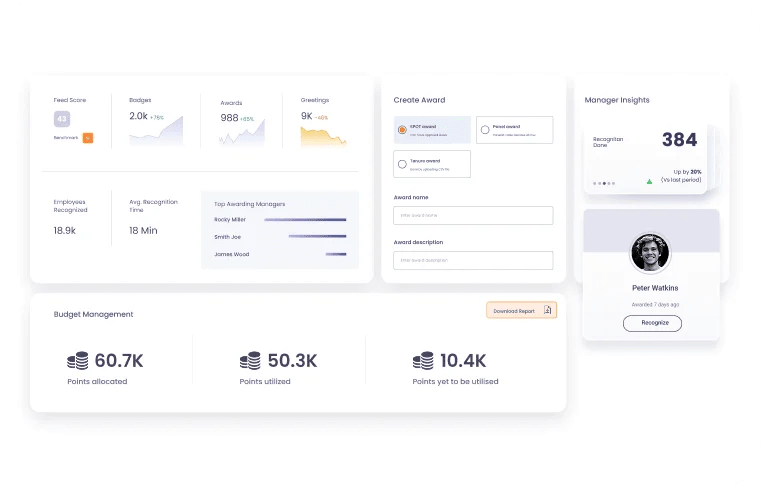
The impact is measurable. Tata Communications saw a 185% growth in peer-to-peer recognition after implementing a structured program, proving that continuous recognition at scale is not aspirational — it's achievable. Organizations that pair continuous performance management with recognition data consistently report higher-quality appraisal conversations and lower review-related attrition.
The appraisal comment is the output. Continuous recognition is the input that makes the output worth reading.

See how continuous recognition works →
| Metric | Annual-Only Appraisals | Continuous Recognition |
|---|---|---|
| Manager recall accuracy | 40% | 78% |
| Employee satisfaction with reviews | 32% | 67% |
| Review-related attrition risk | 34% | 12% |
Source: Gallup and SHRM industry benchmarks
FAQs About Performance Appraisal Comments
What are performance appraisal comments?
Performance appraisal comments are written evaluations a manager provides during a performance review to document an employee's contributions, behaviors, and development areas. Effective comments go beyond generic praise or criticism — they name a specific behavior, connect it to business impact, and point to a clear next action. That's the Behavior-Impact-Action framework. A comment that follows this structure supports talent decisions; one that doesn't is just paperwork.
How do I write appraisal comments for average performers?
Average performers are the hardest to write for because their work is solid but not headline-worthy. The trap is writing something so neutral it says nothing. Instead, identify one specific contribution the employee made — it exists, even if it's not dramatic — and name it with the same specificity you'd use for a top performer. Then identify one clear growth area with a concrete next action. "You consistently met all sprint deadlines this quarter. To move toward a senior role, take ownership of one cross-team initiative in Q3" is far more useful than "meets expectations."
How many appraisal comments should a manager write per employee?
Quality over quantity. Three to five substantive comments per review are more valuable than fifteen generic ones. Each comment should cover a distinct competency area — don't write three comments that all say "good communicator" in different words. Use the competency categories in this post as a checklist: pick the 3-5 areas most relevant to the employee's role and write one strong comment for each.
Should appraisal comments be shared with employees before the review meeting?
Both approaches have merit. Sharing comments in advance reduces surprise reactions and gives employees time to prepare a thoughtful response, which leads to a more productive conversation. Not sharing keeps the discussion more dynamic but risks defensiveness, especially for improvement-heavy reviews. For reviews that include significant improvement feedback, sharing in advance is the stronger approach — it respects the employee's need to process and respond constructively rather than react in the moment.
How can HR improve the quality of manager appraisal comments across the organization?
Three tactical moves. First, train managers on the Behavior-Impact-Action framework before review season — a 30-minute workshop with before/after examples is enough. Second, provide comment templates organized by competency so managers don't start from a blank page. Third, implement continuous recognition so managers have documented data points to reference throughout the year, which eliminates the "I can't remember what happened in Q1" problem that produces vague, recency-biased comments. Organizations that combine structured training with ongoing recognition data see higher employee morale and better review outcomes. SHRM's performance management toolkit provides additional frameworks for building this capability at scale.

Lupamudra is a content marketing specialist at Vantage Circle, where she has written 50+ articles on employee recognition, rewards, and workplace culture, alongside employee engagement, diversity and inclusion, and HR compliance topics, including how India's tax rules apply to recognition and rewards programs.
Connect with Lupamudra on LinkedIn.