
The calendar invite arrives with a familiar subject: Performance Review. Following the invite, the employee starts replaying the past year, trying to remember every win, missed deadline, and difficult conversation. The manager, on the other hand, is rummaging through emails and notes, hoping to compile twelve months of work before the meeting begins.
By the time they sit down, both sides are prepared for evaluation, but not necessarily for a useful and meaningful conversation.
That is where many performance reviews go wrong. A process meant to bring clarity and aid growth is reduced to a once-a-year exercise filled with vague feedback, recent memories, and unexpected concerns.
To give performance reviews their rightful place, this blog will delve deeper into them and explore how to make reviews fairer, more specific, and more constructive, right from preparation and writing to delivery and follow-up. It will also touch on common mistakes that weaken reviews and why organizations are moving towards more regular performance conversations.
What is a Performance Review?
A performance review is a structured conversation that covers a session between a manager and an employee, where they discuss how work went over a defined period, recognize what stood out, address what did not, and discuss goals for the road ahead.
It is both a snapshot and a compass. It looks back at results and forward towards growth. The best reviews spend as much energy on the second part as the first.
But here’s the paradox. Organizations invest a great deal of time and effort in performance reviews, yet most employees do not find them motivating. This is supported by Gallup’s research, which states that only 14% of employees strongly agree that their reviews inspire them to improve. It implies that nearly six out of seven employees leave a conversation feeling uninspired by a review designed to encourage better performance.
However, you cannot term a performance review ineffective because the idea itself is flawed. The reason behind its failure is its reliance on memory, the final judgment feeling it evokes, and its disconnection from an employee’s everyday work.
When reviews are based on clear evidence, ongoing feedback, and real progress, they can become one of the manager’s most valuable tools. Rather than perceiving it as an annual formality, it should be seen as an opportunity for employees to offer an honest, specific, and encouraging view of their growth.
Performance Review vs. Performance Management vs. Performance Appraisal
A performance review is a periodic evaluation; performance management is the ongoing process of supporting and improving employee performance; and a performance appraisal is the formal rating given as part of the review. The three are often used interchangeably, which can be confusing.
To give you a precise picture:
A performance review is a moment, a scheduled conversation that happens quarterly, twice a year, or annually.
Performance management is the ongoing process of setting expectations, providing coaching, and addressing performance throughout the year. A review is one single checkpoint within this larger process.
A performance appraisal is a formal evaluation within the review process, where an employee’s performance is evaluated against specific goals or standards.
Understanding these differences is crucial because one good review cannot make up for a year without feedback. When a review is the only form of feedback employees hear once a year about their performance, it is a clear case of a system failure.
Types of Performance Reviews
Performance reviews can be grouped in three ways: by who provides feedback, how often the review takes place, and what event triggers it.
Feedback may come from the employee, manager, peers, direct reports, or a combination of people through a 360-degree review. Reviews may happen annually, twice a year, quarterly, or continuously. They may also be linked to specific events, such as the end of probation, completion of a project, a promotion, or a formal performance improvement plan.
Most organizations use a combination of two or more review types.
Understanding these categories is crucial because the review format determines the kind of information you receive. A manager review reflects one person’s perspective. Peer feedback reveals how an employee collaborates with colleagues. Upward feedback reveals how employees experience their manager’s leadership.
Be mindful that choosing the wrong review type can result in a well-run process that might end up measuring the wrong aspects of performance.
Who Gives the Feedback?
Here’s a proper classification of the categories of performance review and how they impact.
| Review type | Who gives the feedback | Best used for | Watch out for |
|---|---|---|---|
| Self-review | The employee, assessing their own performance | Surfacing context, obstacles, and ambitions a manager cannot see | Maybe too modest or too positive; pair it with the manager's evidence |
| Manager review | The direct manager | Accountability, goal progress, pay and promotion decisions | A single line of sight, and the recency bias that comes with it |
| Peer review | Colleagues who work alongside the person | Collaboration, reliability, and everyday behavior | Drifts toward popularity unless it is anchored to specific behaviors |
| Upward review | Direct reports assessing their manager | Leadership development and catching problems early | Needs real anonymity and real safety, or you get polite silence |
| 360-degree review | Manager, peers, reports, sometimes clients | A rounded developmental picture of how someone works | Heavy to run, and honesty drops the moment it is tied to compensation |
A few review categories need special attention.
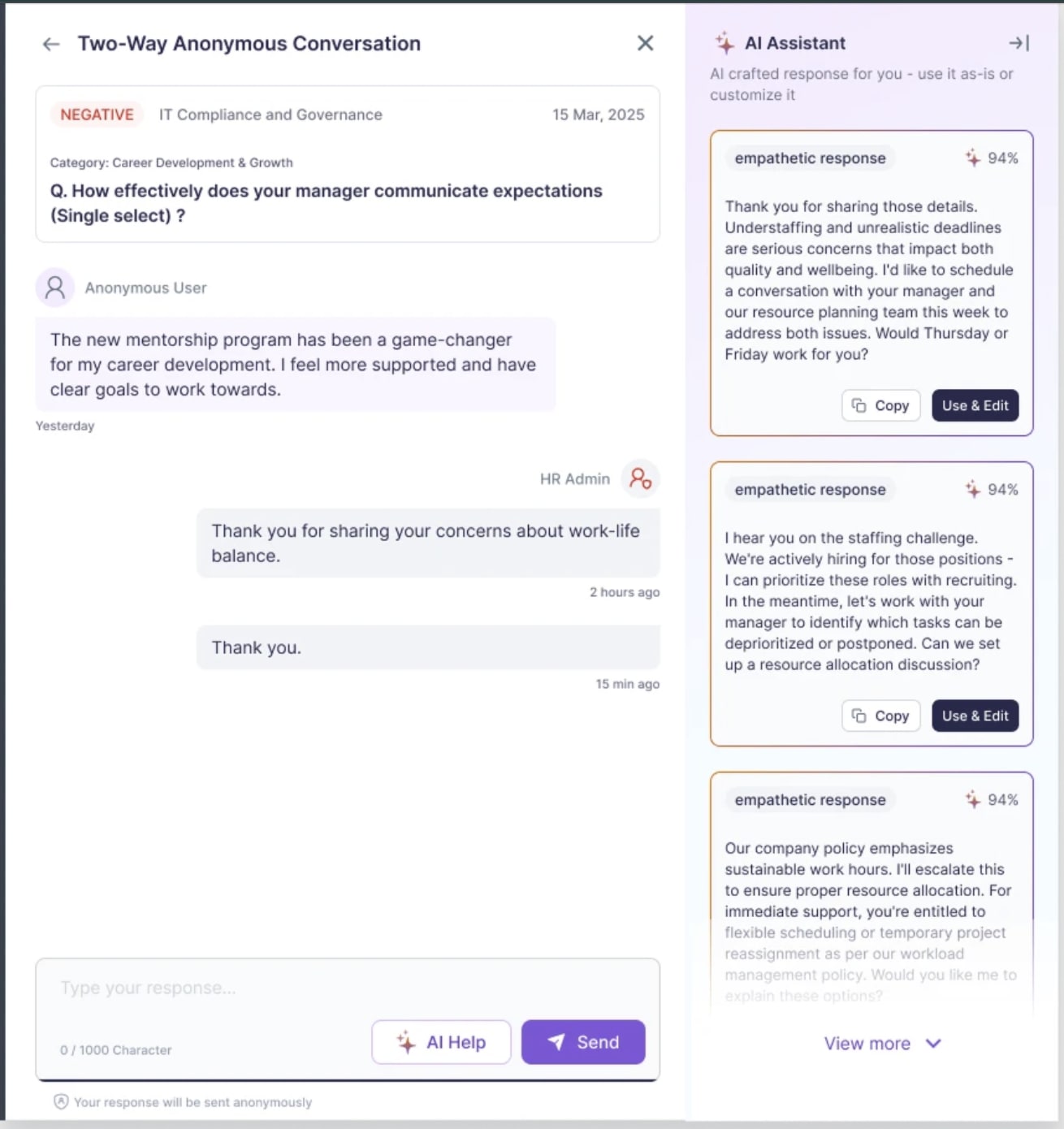
A self-review gives you the opportunity to shape your performance narrative in your own words before your manager does. Use clear evidence, own your gaps honestly, and connect your achievements to your future goals. When written well, a self-review is not about boasting. It is about presenting your contributions clearly and supporting them with evidence. For more guidance on structure, wording, and examples, read the blog on self-evaluation examples.
Peer reviews also provide useful insights into how someone works with others. The feedback should focus on actions and behavior, not personality. Peer feedback examples can help you choose the right wording.
A 360-degree review collects feedback from managers, peers, direct reports, and others. It can be powerful for employee development, but it should be used carefully when linked to pay decisions. If the person knows that feedback or ratings will affect someone’s compensation, they may be less honest. People may be less honest if they know their feedback could affect someone’s salary or bonus.
For this reason, 360-degree feedback is best suited to support growth, not to decide compensation.
Source: Vantage Pulse
How Often Do They Happen?
The second way to classify performance reviews is by how often they happen. This is also where many organizations are changing their approach.
Annual: One formal review each year. It is still common, but managers may rely too heavily on recent memory.
Semi-annual: One review in the middle of the year and another at year-end. The mid-year review helps address issues early and prevents delayed surprises.
Quarterly: These are short, goal-focused reviews held four times a year. They give employees sufficient time to improve before the next review.
Continuous: These include regular check-ins, held often monthly or every two weeks. The formal review then becomes a summary of conversations that have already taken place.
The shift from annual reviews to more continuous feedback is one of the biggest changes in performance management today. This guide explores it in more detail in the later section.
What Event Triggers Them?
The third way to classify performance reviews is by understanding what event triggers them. These reviews happen after a specific event rather than on a fixed schedule.
Probation or 90-day review: This is an early review for a new employee. It focuses on how well they are settling into the role, learning the work, and adjusting to the organization.
Project or milestone review: This review is held after completing a project or reaching a milestone. It is useful when employees work across several projects during the year.
Promotion or calibration review: This particular review helps decide whether someone is ready for a higher role. Calibration, in this context, means managers compare ratings across teams to ensure the same standards are applied.
Performance improvement plan (PIP): A structured plan with a clear timeline, highlighting specific performance concerns and extending support needed to improve. It should never be the first time an employee hears about the issue.
Which Type Should You Actually Run?
Most teams benefit from combining a self-review and manager review twice a year, coupled with short quarterly check-ins in between. Peer feedback can be added for collaborative roles, while 360-degree reviews are better suited for development and leadership growth. The best review schedule is one the organization can follow consistently. Review types explain who gives feedback and how often, while review methods explain how performance is measured.
The Performance Review Cycle: 5 Phases
A complete employee performance review is categorized into five stages: setting goals, gathering evidence, writing the review, having the conversation, and following up. Skipping any one of these stages can make the review feel unexpected, unsupported, or ineffective.
Many managers view the review process through a one-dimensional lens, limiting it to meetings. In reality, meetings come at the fourth stage of the process. The steps before and after the meeting truly determine the usefulness of a review.
Setting goals gives managers clear expectations to measure against. Gathering evidence throughout the review period makes feedback fair and specific. Writing the review brings clarity. The conversation makes the process personal. Follow-up turns feedback into action.
The process should be treated as a continuous cycle, not a one-time event. The follow-up from one review often becomes the starting point for the next.
| Phase | What happens | Who owns it |
|---|---|---|
| 1. Set goals | Agree on clear, measurable objectives and the standards work will be judged against | Manager and employee together |
| 2. Gather evidence | Collect examples, results, KPIs, and feedback across the whole period, not just recent weeks | Manager (with employee self-input) |
| 3. Write the review | Turn evidence into a specific, balanced written assessment tied to goals | Manager |
| 4. Deliver the conversation | Discuss the review as a two-way dialogue, not a one-way verdict | Manager leads, employee participates |
| 5. Follow up | Convert the review into a development plan and check in on it before the next cycle | Manager and employee together |
Here’s a quick note on KPIs. A KPI, or key performance indicator, is a specific measure used to track progress, such as tickets resolved, revenue generated, or projects completed on time. KPIs appear throughout the review process because effective reviews should be based on measurable results, not personal impressions.
How to Prepare for a Performance Review
The most significant part of preparing for a performance evaluation is to stick to this practice: write from records, not from memory. There’s no doubt that templates, ratings, and talking points are useful, but they matter far less than the clear, recorded evidence of what happened throughout the year.
Most managers are prone to remembering recent events more clearly than work completed months earlier. This is known as a recency bias. Here, a consistently strong performer having a slower final month is underrated, while the performer who performs well in the final month and is stagnant throughout receives a higher rating. Therefore, giving fair reviews requires moving beyond memory.
Managers should start gathering evidence even before they form an opinion. This may cover goals, KPIs, project results, peer feedback, and recognition received during the review period. Employees should simultaneously prepare their personal summary of achievements, challenges, and future goals. When both sides arrive with evidence, the review leads to a useful discussion rather than an unexpected judgment.
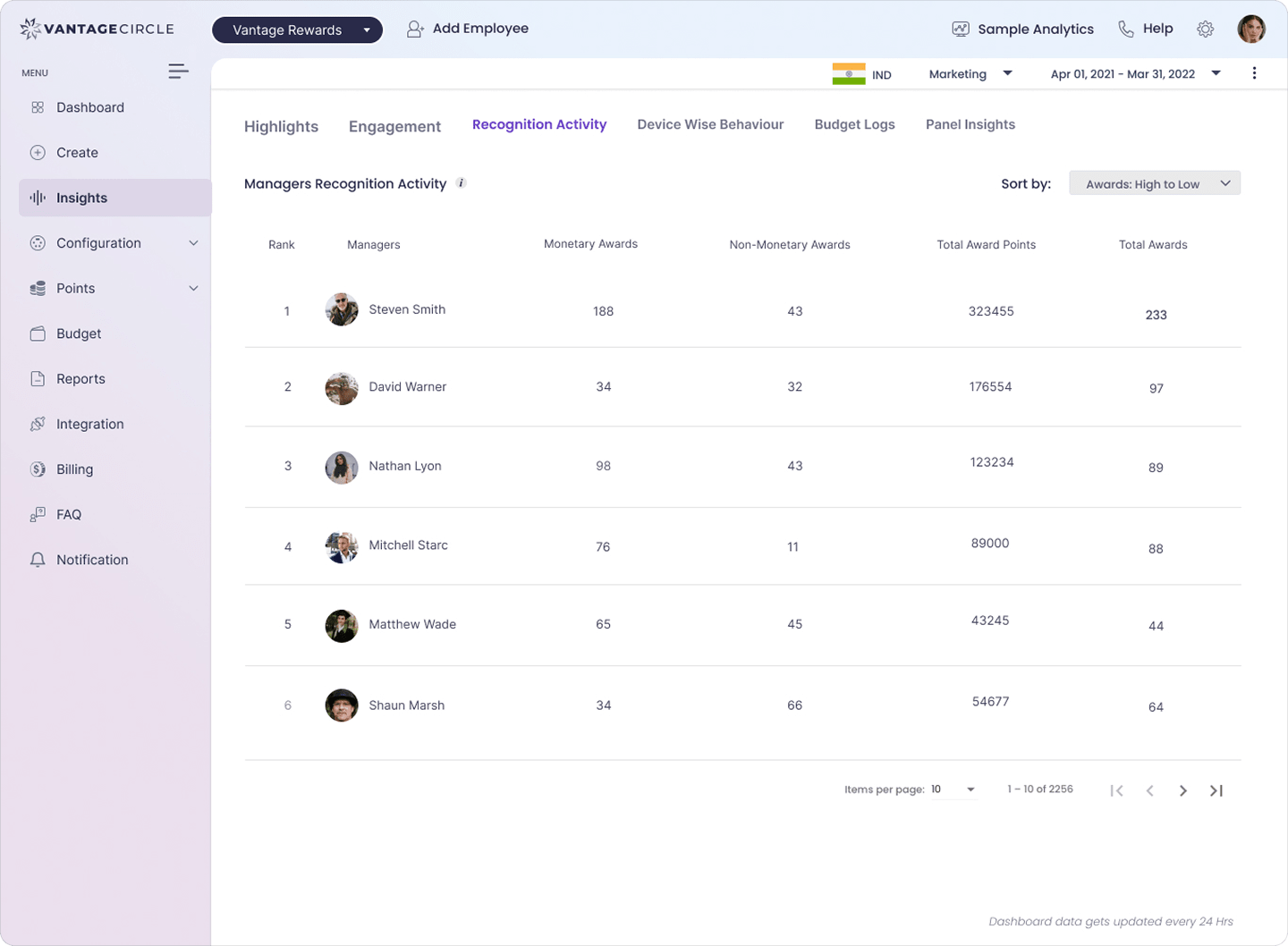
This is where a recognition record becomes valuable and takes a pivotal role. Recognition Analytics gives managers a time-stamped history of peer and manager recognition. The social recognition feed also acts as a searchable record of employee achievements. Managers can review a full year of contributions through specific examples instead of relying on what they remember most recently.
Source: Vantage Circle
The goal is to make reviews fairer by replacing incomplete memory with clear evidence. This is achieved with recognition tools like Vantage Recognition, which make it easier to maintain and retrieve records.
For example, an employee may have led a difficult data migration in April, supported two new hires in June, and experienced a slower period in September. Memory may focus only on September. But a complete record shows the full picture, covering the proof of every contribution made and how others recognized it at the time.
That is a clear difference between a review that feels accurate and one that leaves an employee feeling misunderstood.
How to Write a Performance Review (With Examples)
A strong performance review can be written in three steps: first, describe the result using a specific example; second, explain the strength or improvement area it reveals; and third, connect it to a goal for the next review period.
Specificity should be at the core. Vague praise and criticism are all unhelpful because they do not inform employees what they should continue, change, or improve in their daily work.
Balance also matters. A review only filled with praise may feel positive but offer little direction. On the other hand, a review focused only on criticism feels discouraging and fails to support improvement. Hence, the most effective reviews avoid extremes and recognize achievements while also addressing areas for growth.
Make sure that every comment is supported by evidence and connected to a clear goal. Following this structure makes review writing much easier.
Here are a few examples of what specific, evidence-based comments can look like:
"Led the Q1 platform migration two days ahead of schedule, coordinating three teams with zero downtime."
"Consistently raised the quality bar in code review, though documentation lagged on two projects this quarter."
"Grew from reluctant presenter to leading the client QBR (quarterly business review) in six months."
"Strong individual output, with an opportunity to delegate more so the team scales beyond you."
"Met every deadline, and the next stretch is owning the roadmap, not just the tickets."
Additional resource: 150+ Performance Review Comments & Examples for Managers
How to Deliver a Performance Review Conversation
An employee performance review should be a two-way conversation and not be reduced to a one-sided judgment.
Start by setting the context, sharing the assessment with specific examples, and leaving enough time for the employee to respond. Although a written review provides direction, conversations allow employees to share their perspective, explain challenges, and discuss their goals.
The following three things separate conversations that build trust from those that erode it:
First, balance feedback. Recognize genuine strengths before discussing areas for improvement, so the review feels supportive rather than unexpected.
Second, be specific. Saying “be more proactive” offers little guidance. A comment such as “I would like you to identify risks during the planning stage, as you did during the product launch” gives the employee a clear action to take.
Third, encourage dialogue. Give employees space to discuss their experiences, obstacles, and development goals.
Reviews also land better when feedback is linked to shared standards rather than personal opinions. Core Value alignment gives managers a clear reference point by linking employee contributions to the organization’s values. This changes the message from “this is what I think of your performance” to “this is how your work reflects the values we have agreed are important.”
That shift can reduce defensiveness and make feedback feel fairer.
What Not to Say in a Performance Review: 7 Mistakes
You must be aware of the seven common mistakes that can make performance reviews ineffective. The root cause of these mistakes is managers treating reviews as a final judgment instead of a conversation.
Let’s learn about these mistakes so that you can avoid them moving forward.
Recency bias: A manager judges the entire review period based only on the last few weeks. Managers can avoid this by reviewing evidence collected throughout the year, which helps create a fairer assessment.
Vague ratings: A rating such as “meets expectations” tells nothing about the work without an example. Every rating should, in fact, be supported by a specific result or behavior.
Saving up surprises: If employees hear about a serious performance concern for the first time during the annual review, the failure lies with the manager, not the employee. Important issues should be discussed immediately when they arise, not left to be addressed during reviews.
Comparing to peers: Comments such as “You are not as strong as John” create more resentment than improvement. Employees should be measured against agreed goals and expectations, not against their peers.
The one-way lecture: A review where only the manager speaks never leads to change. Employees should have a comfortable space that inspires them to share their perspectives, challenges, and goals.
No follow-up: A review without an action plan or future check-in will make no difference. Feedback should lead to clear next steps and continued support.
Careless language: Personal, subjective, or inconsistent comments can create legal risk for the organization. Instead, feedback should remain specific, work-related, and focused on observable behavior.
The goal is not to frighten managers into saying the wrong thing. It is to help them prepare well in advance to have a fair, clear, and useful conversation.
The Future of Performance Reviews: Continuous vs. Annual
Before you jump to any conclusions, let me be clear that performance reviews are not simply moving from annual to continuous. They are becoming a combination of both.
Annual reviews still provide a formal record for decisions related to performance, development, promotion, and compensation. The problem only arises when one annual meeting is expected to cover an entire year. When feedback arrives too late, recent events tend to receive more attention, and employees may hear important concerns for the first time.
This helps explain why 44% of employees rated their performance management process as a failure, compared to only 12% of executives and HR leaders, according to BetterWorks’ 2024 research. The gap shows that completing the process does not necessarily make the process useful to employees.
Regular check-ins, on the other hand, can address this problem by giving managers and employees time to discuss progress, obstacles, priorities, and development while action can still be taken. Adobe’s Check-in model, for example, replaced traditional annual ratings with ongoing two-way conversations about performance and career growth.
Vantage Influencers Podcast
Why traditional performance reviews fail to drive real employee growth, and the mindset shift leaders need to turn evaluations into development conversations.
— Kavitha Ramaiah, Director, People Development at GlobalLogic
Listen to the EpisodeHowever, continuous feedback should not mean adding more meetings without purpose. Each check-in should lead to clearer expectations, practical support, or an agreed next step.
Hence, it is safe to say that the strongest approach combines regular conversations with a formal review. Ongoing check-ins support improvement during the year, while the annual review combines those discussions into a clear summary, rather than delivering a surprise.
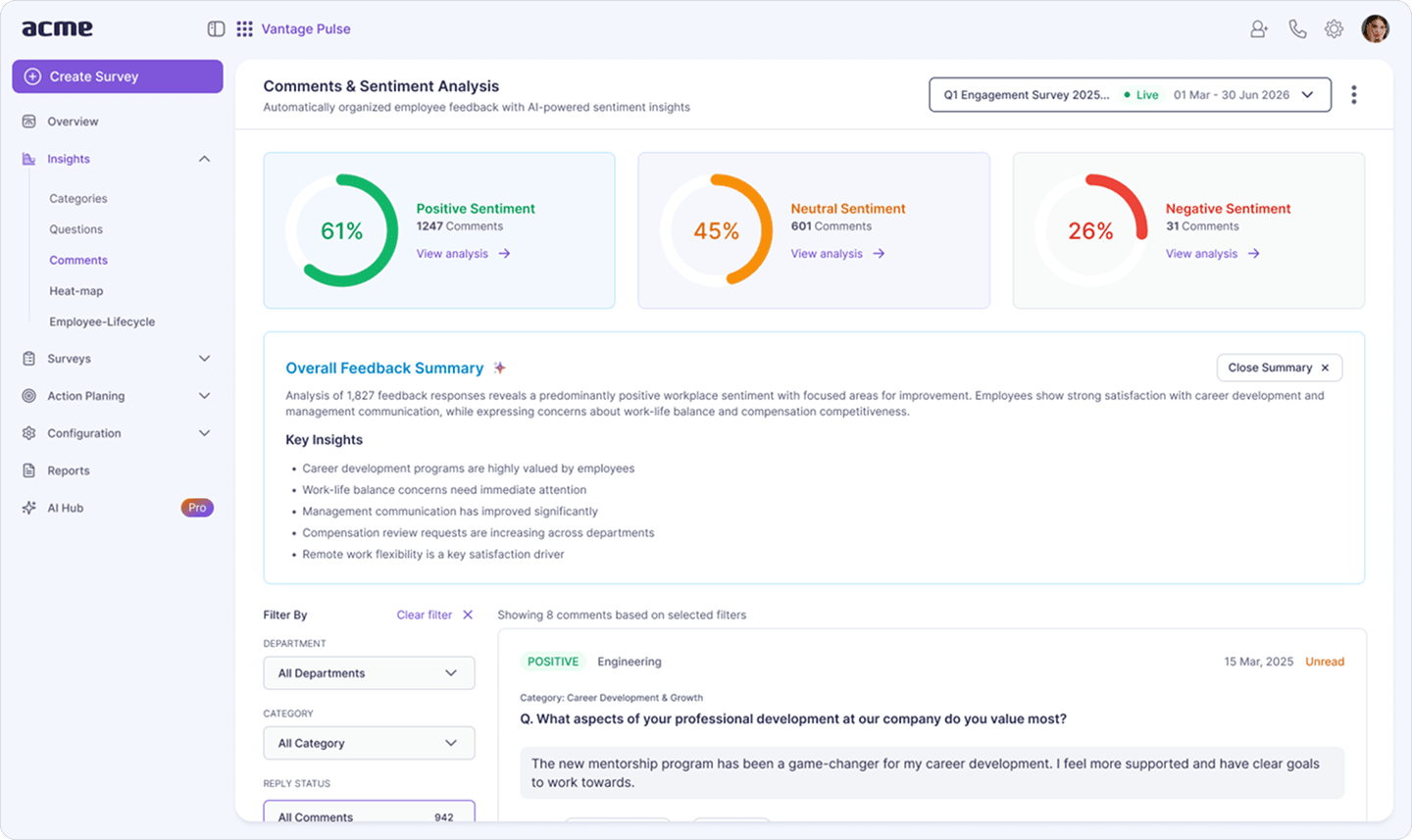
Regular check-ins work best when they are backed by a listening system like Vantage Pulse that runs short, recurring surveys between reviews. This way the managers see sentiment and engagement trends as they develop instead of discovering them at year-end.
Conclusion
A good performance evaluation should leave employees with clarity and not just the relief that the meeting is over. This depends on preparation, specific feedback, honest conversation, and consistent follow-up.
The goal should move beyond improving the annual review to creating a workplace where feedback happens regularly, making the formal review a summary rather than a surprise. Start by using records instead of memory. That one change can make a big difference in making the entire process fairer, clearer, and more useful.
FAQs
What is an example of a good performance review?
A good performance review pairs a specific result with the strength it shows and a goal for next period, for example: "You led the Q1 migration two days early with zero downtime, which shows strong project ownership. Next, I'd like to see you mentor a peer through the process."
What do you say in a performance review?
Say what went well with specific evidence, name the gaps honestly and behaviorally, and agree on clear goals for the next period. Balance recognition with development, keep every point tied to real work rather than personality, and spend more of the meeting listening to the employee's perspective than talking at them.
How do I write my performance review?
Write your self-review by leading with your biggest wins and the evidence behind them, owning your gaps honestly, and connecting both to the goals you want next. Be specific, use numbers where you can, and frame growth areas as directions rather than apologies.
What not to say during a performance review?
Avoid vague ratings without examples, comparisons to coworkers, brand-new criticism the employee has never heard, and subjective or personality-based remarks that create legal risk. Never turn the meeting into a one-way lecture. Keep every comment specific, behavioral, and tied to the work rather than the person.

Riha Jaishi is a Content Marketing Specialist at Vantage Circle and host of the HR Vantage Influencers podcast, sharing insights that help organizations build recognition-rich, people-first cultures!!
Connect with Riha on LinkedIn.