
Boredom at work is often treated as a light-hearted topic. Employees joke about slow afternoons, repetitive meetings, or tasks that feel like they could be done on autopilot. It is easy to discuss because, on the surface, boredom feels harmless.
But when boredom becomes constant, it turns into something more serious.
This is often called “boreout.” It happens when employees spend too long in roles that offer too little challenge, variety, or purpose. They may still show up, finish their tasks, and appear productive, but mentally, they begin to disconnect from the work.
Research shows why this should not be ignored. A 2024 study by University of Notre Dame found that suppressing boredom can prolong its negative effects on productivity. Similarly, a PubMed-indexed study by Kawada links workplace boredom to higher turnover intentions and psychological distress.
If you are an HR leader reading this, that last sentence is your problem statement. Because boredom sits quietly in your organization, below the surface of exit interviews, outside the scope of most engagement surveys, and invisible in performance reviews, until it walks out the door.
This guide gives you the diagnostic, the comparison and the framework to address it. And if you are the one who is bored, you will find 10 evidence-backed tactics that actually work.
What is boredom at work?
Boredom at work is a sustained feeling of being under-challenged, where a role offers too little variety, purpose, or mental engagement. It is not a passing slow day. It is a pattern that continues over time.
The term "boreout" was first introduced by Philippe Rothlin and Peter Werder in their 2007 book Boreout!, and BBC's reporting on Finnish researcher Lotta Harju's work brought it to wider professional attention. Harju's research found that boreout produces effects that closely mirror burnout: disengagement, cynicism, and eventually, voluntary turnover. The difference is the trigger. Burnout comes from too much. Boreout comes from too little.
And yes, it is normal to feel bored at work sometimes. Most professionals experience periods of low stimulation, especially in cyclical, process-heavy, or tenure-heavy roles. The problem is not the occasional slow afternoon. The problem is when under-stimulation becomes the default state.
Chronic boredom is a signal that something in the job design, career trajectory, or team structure needs to change. Normalizing it without acting on it is where organizations lose good people.
Employee engagement research consistently shows that boredom is one of the earliest precursors to disengagement. And disengaged employees do not quit immediately. They stay, and they disengage quietly, which is often more damaging than an outright exit.
Boredom at work statistics: What research says
The data on workplace boredom is clear: it is widespread, it is costly, and it is under-measured by most organizations.
The hidden cost of workplace boredom
The most important takeaway from this data is not the scale. It is the mechanism. Notre Dame's study found that when employees push boredom down and power through, the boredom does not go away. It accumulates and resurfaces with a stronger hold on their focus. This has direct implications for how managers respond when they notice a team member going through the motions.
Boredom vs burnout vs quiet quitting: a comparison
These three states look similar on the surface, but they have different triggers, different energy signatures, and they require different HR responses. Treating them as interchangeable will waste your intervention budget and frustrate the employees you are trying to support.
| Dimension | Boredom / Boreout | Burnout | Quiet Quitting |
|---|---|---|---|
| Trigger | Under-stimulation: too little challenge, variety, or purpose | Chronic overload: too much demand with too few resources | Disillusionment: unmet expectations around recognition, growth, or fairness |
| Energy state | Low, idle, and mentally disengaged | Depleted, exhausted, and emotionally drained | Deliberately constrained: doing the minimum on purpose |
| Time horizon | Develops quietly over months and worsens without intervention | Builds over sustained high-pressure periods | Often triggered by a specific incident or prolonged neglect |
| Common signal | Clock-watching, low initiative, and disinterest in development | Exhaustion, cynicism, reduced output, and physical symptoms | Meeting expectations while declining discretionary effort |
| HR remediation | Job redesign, challenge injection, and recognition linked to purpose | Workload audit, recovery time, and mental health support | Trust-rebuilding, recognition, and open career conversations |
Why the distinction matters
At first glance, boreout, burnout, and quiet quitting can look almost the same. In all three cases, employees may seem less energetic, less proactive, and less emotionally invested in work. That is why managers often mistake one for the other.
But the table above shows the real issue- the cause is different in each case.
A burned-out employee is overwhelmed and needs recovery. A bored employee is under-stimulated and needs meaningful challenge. A quietly quitting employee may be responding to broken trust, poor recognition, or limited growth. When HR treats all three as the same problem, the solution can miss the mark.
For example, giving more work to a burned-out employee can make exhaustion worse. Giving more time off to a bored employee may not solve the lack of purpose. And offering new tasks to someone who feels undervalued may not rebuild trust.
That is why diagnosis matters. Before designing an intervention, HR needs to understand whether the employee is exhausted, under-challenged, or emotionally withdrawing from the organization.
Why HR teams need to tell them apart
Misidentifying the state leads to the wrong prescription. Burnout language clusters around words like "exhausted," "pressure," and "overwhelmed," while boredom surfaces through "monotonous," "underutilized," and "stuck." Quiet quitting often shows up as a drop in eNPS (Employee Net Promoter Score) with little change in workload or stated stress levels. These are patterns that pulse survey data can reliably surface, making it one of the clearest diagnostic tools available to HR leaders.
Getting this distinction right is the first step in any meaningful HR intervention.
7 causes of workplace boredom
Workplace boredom is rarely random. It follows predictable patterns rooted in job design, management practices, and organizational structure. Here are the seven most common.
1. Job-demand mismatch: under-challenge
The Job Demands-Resources (JD-R) model identifies a clear imbalance: when an employee's skills significantly exceed the demands of their role, chronic under-stimulation follows. The brain needs a challenge to sustain engagement. When the role doesn't provide one, the mind wanders, and eventually stops returning.
2. Repetitive task design
High-repetition, low-variation roles are the most common breeding ground for boreout. Customer service queues, data entry, and compliance-heavy processing work are common examples. The task itself is not always the problem. The absence of variety or periodic cognitive challenge is.
3. Lack of autonomy
Employees who have little control over how, when, or where they complete their work lose a key engagement driver. Autonomy creates ownership. Without it, even work that was once interesting can start to feel like going through the motions.
4. Misaligned skills and role
When an employee is placed in a role that underutilizes their expertise, boredom is almost inevitable. This is common after a reorg, when a high performer is moved laterally into a steadier role, or when a team's scope narrows without the headcount adjusting accordingly.
5. Disconnection from purpose or outcomes
An employee who cannot see the impact of their work has no feedback loop to sustain motivation. This is especially common in large organizations where the distance between an individual contribution and the final outcome is significant. Job satisfaction research consistently links perceived meaningfulness to sustained engagement.
6. Lack of social interaction
Isolated work is draining in a different way than under-challenge, but the result is similar: disengagement. Remote roles with no structured collaboration, individual contributor positions with low cross-team exposure, and environments where peer interaction is limited all contribute to boreout over time.
7. Career stagnation
An employee who has been in the same role for years without a visible growth path will eventually disengage. Not from inability, but from a rational conclusion that there is nothing left to stretch toward. Employee development opportunities are one of the strongest protective factors against chronic boredom at work.
Signs you (or your team) are bored at work
Boredom at work announces itself through behavioral patterns, not just self-reports. Knowing how to read both is essential for managers who want to act before disengagement becomes departure.
6 individual signs: how to tell if you are bored at work
You watch the clock constantly
When did I last lose track of time because I was absorbed in a task?
You procrastinate on work that used to feel easy
Am I avoiding this because it is hard, or because it feels pointless?
You feel restless, irritable, or low-grade frustrated
Is this stress from too much, or frustration from too little?
You have stopped volunteering for projects or stretch work
Do I believe there is anything here worth stretching toward?
You daydream about other roles or companies more often
Is this occasional curiosity, or a consistent pull toward the exit?
Your motivation drops even for tasks you once enjoyed
Has the role changed, or have I outgrown it?
5 team-level signals visible in pulse data
When boredom spreads across a team, it shows up in aggregate data before it surfaces in individual conversations. Here is what to watch for:
- A drop in eNPS without a clear trigger event (no reorg, no leadership change, no policy shift)
- A shift in open-text sentiment toward words like "monotonous," "underutilized," or "stuck"
- An increase in lateral exits without accompanying performance issues
- A decline in voluntary collaboration and discretionary effort on cross-functional projects
- A spike in PTO usage without a corresponding rise in burnout language
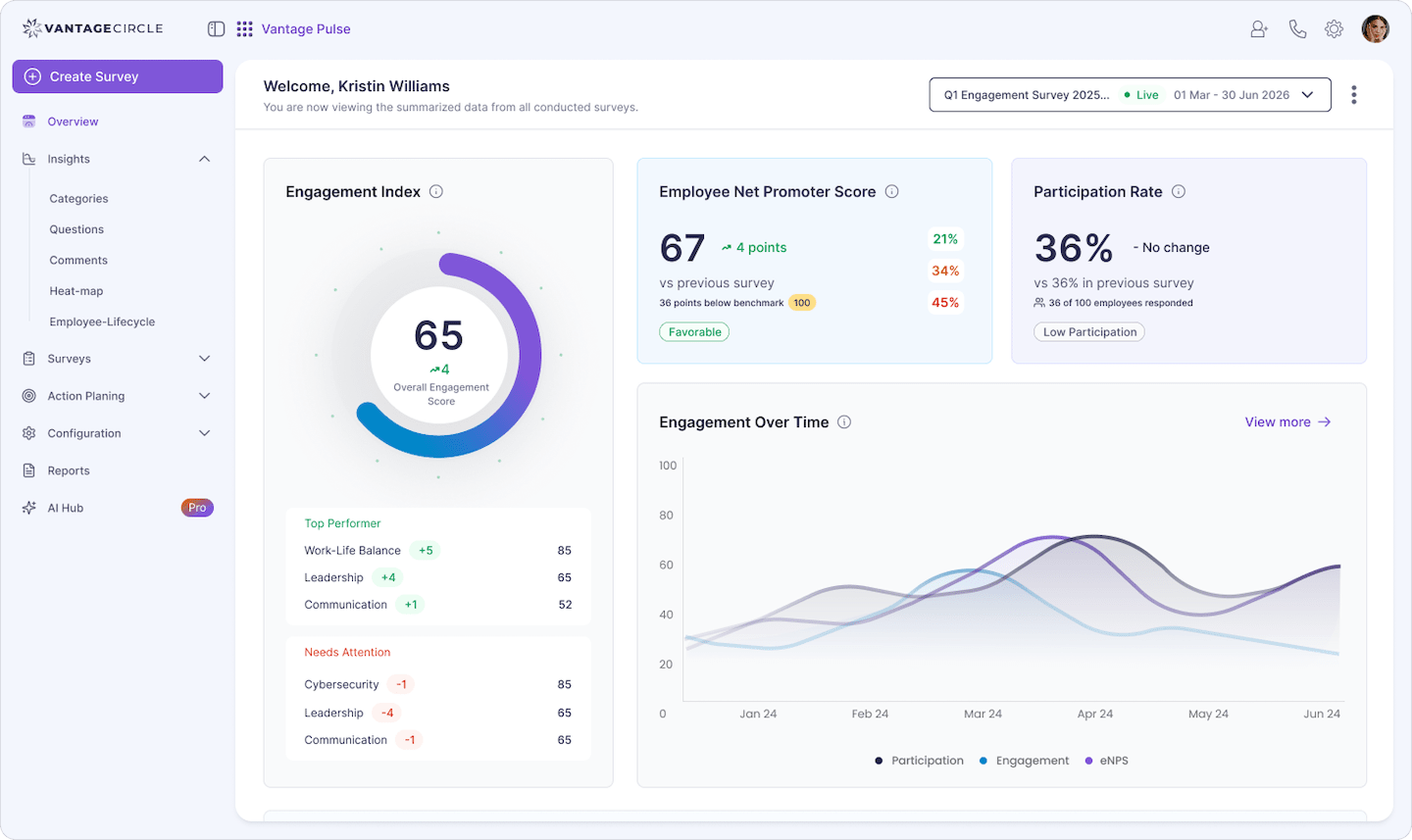
The challenge is that bored employees rarely escalate directly. They are not unhappy enough to raise their hand, but they are disengaged enough to start looking outward. That is where running sentiment analysis on open pulse-survey responses with the help of tools like Vantage Pulse becomes critical, so that HR leaders can see the signal before it becomes a resignation.
What to do when you are bored at work: 10 evidence-backed tactics
If you are bored at work, the most counterproductive thing you can do is suppress it. Notre Dame's research shows that employees who push through boredom without addressing it are less able to redirect their attention afterward. The boredom compounds. So act on it.
1. Reframe: connect your work to your why
BetterUp’s research on meaning and purpose at work shows that employees place a high value on meaningful work and that meaning is linked to stronger workplace outcomes. For employees experiencing routine boredom, one practical step is to reconnect daily tasks with the broader outcome they support. Spend 10 minutes mapping your current tasks to the people, goals, or business results they help enable, even when the link feels distant.
2. Carve out a side quest
Ali Abdaal describes workplace “side quests” as small, self-directed challenges that can make boring work feel more engaging. This could be a documentation overhaul, a competitive analysis, a faster way to handle admin work, or a small process improvement idea. The goal is not to abandon your main responsibilities, but to create a small stretch inside your current role.
3. Gamify a recurring task
Gamification in the workplace applies game mechanics to routine work: time challenges, streaks, personal records, peer competitions. If you complete the same task dozens of times a day, competing against your own best time is a low-effort way to reinject stimulation.
4. Take a learning hour
When employees feel under-stimulated, learning can give that unused mental energy a better direction. Encourage them to use the learning benefits already available to them, whether it is a course, certification, workshop, or internal learning program.
The goal does not have to be a complete career shift. Even a few hours a week spent building a skill close to their current role can help employees feel a renewed sense of movement, growth, and purpose
5. Mentor or pair with a peer
Sharing what you know and learning how a peer approaches the same problem adds variety and social connection to work that has gone flat. Peer learning also tends to surface new angles on familiar tasks, which is often enough to reactivate engagement.
6. Redesign your environment
Environmental cues shape cognitive engagement. A change of desk, a different time of day for deep work, a new playlist, or a rearranged workspace can reset the association between your physical surroundings and boredom.
7. Move: don't suppress, alternate
Notre Dame's 2024 study found that alternating between periods of boredom and stimulating activity is more effective than pushing through. Physical movement, a short walk, a brief stretch, or a few minutes away from the screen creates the pattern break the brain needs to reengage. Vantage Fit's team wellness challenges add a social layer to that movement, so employees aren't doing it alone.
8. Ask for a stretch assignment
The most direct solution is to ask for more meaningful work. If your role no longer feels challenging, bring it up with your manager as a growth-focused conversation rather than a complaint. The key is to frame your request with clarity, ownership, and constructive intent, similar to how you would approach constructive feedback, so the discussion feels solution-oriented instead of negative.
9. Apply the 3-month rule
The 3-month rule in a job is the principle that most roles take at least 3 months before they begin to feel genuinely engaging, as the initial learning curve flattens and the real scope of the work becomes clear. If you are newer than 3 months in, boredom may be temporary. If you are well past 3 months and still feel chronically under-stimulated, that is a signal worth addressing directly.
10. Know when boredom is a signal to leave
Not every boredom problem is solvable within the current role. If you have asked for stretch assignments and been denied, if your career path is genuinely blocked, and if the work is structurally unchangeable, staying purely out of obligation is not loyalty. It is a slow drain on both parties.
What HR leaders and managers can do about workforce boredom
The most important thing HR leaders can do about workforce boredom is make it measurable. You cannot address what you cannot see.
1. Measure it: set up pulse signals for boredom-language detection
Use pulse surveys with open-text fields on a consistent cadence. Set up keyword tracking or word cloud analysis to flag when "monotonous," "underutilized," or "stuck" appear in responses. A team-level eNPS drop without a clear external cause is also a reliable early indicator.
2. Redesign jobs using the JD-R framework
The Job Demands-Resources (JD-R) model gives you a structured lens for job redesign. Evaluate which roles have chronically low demands relative to the employee's skill level. The fix is usually one of three things: increase scope, increase autonomy, or increase social connection. Not every role can be fully redesigned, but most can be modified at the margin.
3. Build challenge into routine work
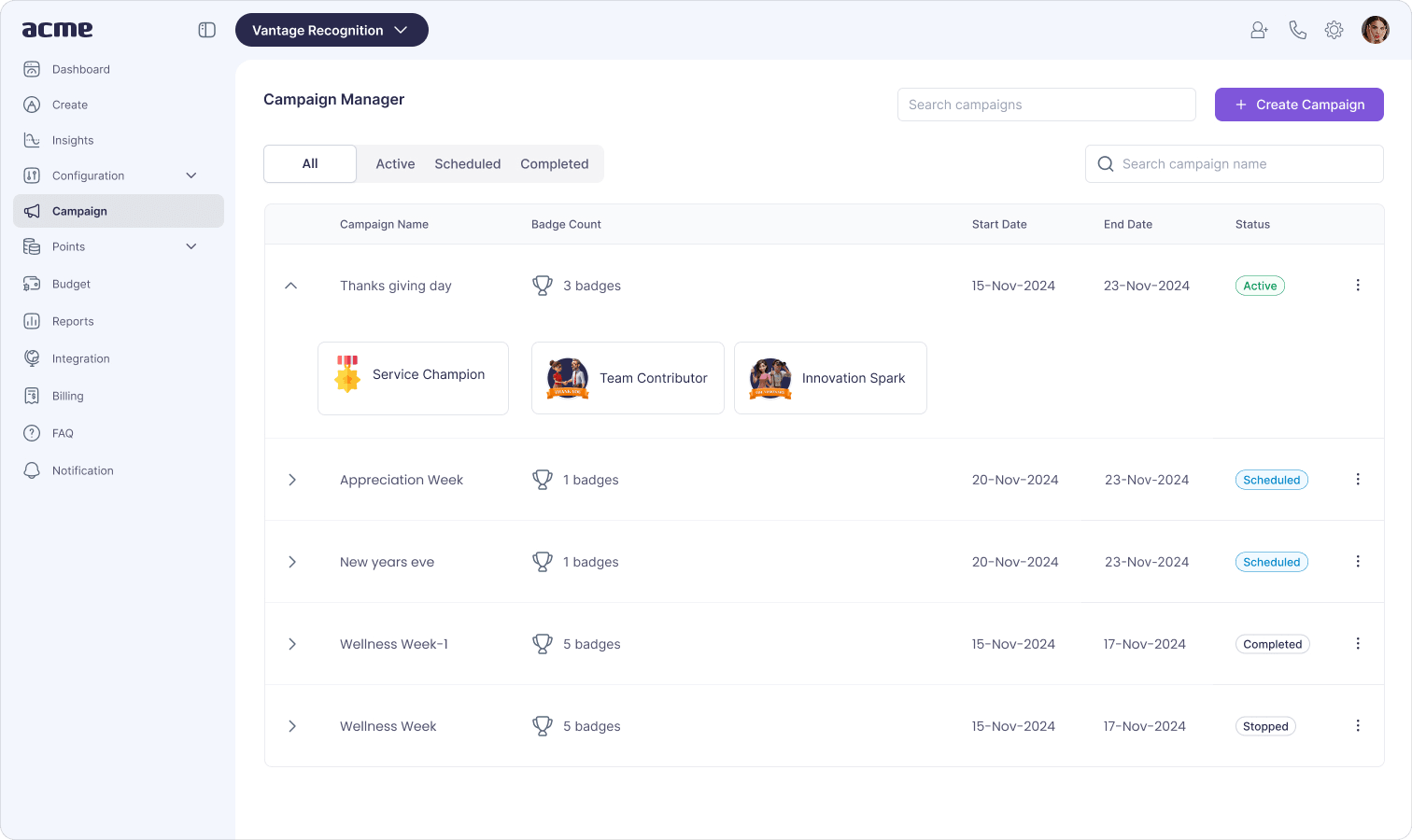
Time-bound campaigns give bored employees something to look forward to. A "Skill Stretch Month," a "Cross-team Collab Sprint," a peer-nominated fun award work because they are short, social, and a little different from the usual routine. Most modern recognition platforms let you set these up quickly, so the idea does not die before it goes live.
 [Image Source:Vantage Recognition]
4. Reinject purpose through values-tagged recognition
Boredom often grows when employees cannot see how their work matters. This is where recognition can help.Managers do not always need to redesign the entire role. Sometimes, they need to recognize the work in a more specific way. Every time recognition is linked to a company value or business outcome, routine tasks start feeling more connected to a larger purpose.
For example, instead of saying, “Great job, Lilly,” a manager can say, “Lilly, your quality check helped prevent a client escalation. That shows real commitment to excellence.” Such recognition shows the employee the impact of their work. And when people can see their impact, the work feels less disconnected.
5. Invest in lateral mobility, not only vertical
Not every bored employee wants a promotion. Many want variety. Creating structured opportunities to contribute to adjacent teams, rotate through projects, or take on cross-functional responsibilities keeps skills active and reintroduces the novelty that routine work erodes over time.
6. Train managers to spot under-stimulation early
The best employee engagement strategies start with a manager who asks "Are you challenged?" as often as they ask "Are you okay?" Train managers to recognize the behavioral signals of boreout: withdrawal, reduced initiative, declining interest in development. Then give them the tools to respond.
When workplace boredom is a sign of something deeper
Chronic boredom that persists across roles and contexts can sometimes signal something beyond job design. This is important to address directly.
If you are experiencing persistent low mood, loss of interest in activities beyond work, withdrawal from relationships, or feelings of worthlessness alongside boredom at work, these may be signs of depression, not boredom alone.
Workplace boredom and depression can coexist and reinforce each other. Boredom does not cause clinical depression, but chronic under-stimulation can worsen low mood in people who are already vulnerable. Kawada's study found that sustained workplace boredom is associated with psychological distress beyond simple disengagement.
If this resonates, please reach out to a mental health professional or your organization's Employee Assistance Program (EAP). Wellness resources at the organizational level can be a starting point, but if the signals go deeper, treat them as such. This guide is not a substitute for clinical support.
Frequently asked questions
Is it normal to feel bored at work?
Yes, occasional boredom at work is normal and experienced by most professionals. Cyclical roles, slow seasons, and periods between projects naturally produce low stimulation. The concern is chronic boredom: a state that persists regardless of task type, is not linked to a specific phase, and begins affecting motivation and output consistently. That kind of boredom is a signal, not a phase.
How do you handle boredom at work?
Handle boredom at work by addressing its source rather than suppressing it. Notre Dame's 2024 research shows suppression worsens the effect over time. The most effective approaches are: requesting a stretch assignment, initiating a self-directed side project, taking a structured learning break, or speaking directly with your manager about a role redesign. If the boredom is structural, short-term tactics help, but a bigger conversation is needed.
How to tell if you are bored at work?
The clearest signs that you are bored at work are persistent clock-watching, low motivation even for tasks you previously found engaging, frequent daydreaming about other roles, and a noticeable drop in your willingness to take initiative. If you feel restless, irritable, and disengaged consistently across multiple weeks, and these feelings are not linked to stress or overwork, boredom at work is the likely explanation.
What is the 3 month rule in a job?
The 3-month rule in a job is the principle that most roles take at least 3 months before the work begins to feel genuinely engaging. In the first few weeks, every task involves learning, which provides stimulation. Once the learning curve flattens, the real texture of the role becomes clear. If boredom sets in before the 3-month mark, give it time. If it is still present and intensifying at month 4 or 5, it is worth addressing directly with your manager.
What is the difference between boredom and burnout?
Boredom comes from too little: too little challenge, variety, or meaning. Burnout comes from too much: too much demand, pressure, and sustained depletion without recovery. Both reduce output and engagement, but they require opposite HR responses. Giving a burned-out employee more responsibility will worsen their state. Giving a bored employee less to do will worsen theirs. The diagnostic distinction matters before any intervention is applied.
Can workplace boredom cause depression?
Workplace boredom does not directly cause clinical depression, but chronic under-stimulation can worsen low mood in people who are already vulnerable. Kawada's 2023 PubMed study found that sustained workplace boredom is associated with increased psychological distress beyond simple disengagement. If you are experiencing boredom alongside persistent low mood, loss of interest in things outside of work, or feelings of worthlessness, please speak with a mental health professional or your organization's EAP.
Should I quit my job because I am bored?
Quitting because of boredom is the right call in some situations, and the wrong call in others. First, try: requesting a stretch assignment, having a direct conversation with your manager about growth, and giving any changes at least 60 days to take effect. If the role is structurally unchangeable, growth is genuinely blocked, and sustained effort over 3 to 6 months has not shifted the dynamic, staying purely out of obligation will cost you more than the transition will.
Make boredom visible before it becomes turnover
Boredom at work is one of the most preventable causes of voluntary turnover, and one of the least measured. The organizations that address it earliest are the ones with the data to see it coming.
Vantage Pulse gives HR teams the real-time sentiment tools to detect boredom-language patterns, track eNPS movement by department, and surface the team-level signals that individual conversations miss, while Vantage Rewards gives managers the mechanism to reinject purpose and challenge through values-tagged recognition and time-bound campaigns.
You don't need a new strategy. You need visibility, and the right response once you have it.

This article is written by Shaoni Gupta. Shaoni Gupta is a content marketing specialist at Vantage Circle, with expertise in scriptwriting and copywriting in the field of employee rewards and recognition.
Connect with Shaoni on LinkedIn.


