
Team building communication games are structured exercises that expose exactly where a team's communication breaks down: vague instructions, poor listening, unclear non-verbal cues. They work because the failure shows up in a low-stakes game first, not inside a real deadline later.
Most teams don't have a communication problem in the abstract. They have a specific, repeatable failure mode, and nobody's named it yet. Not out loud, anyway.
Gartner's 2024 survey of marketing leaders found that 84% report high "collaboration drag" in cross-functional work, the friction created by too many meetings, too much feedback, and unclear decision rights. Organizations with high collaboration drag are 37% less likely to hit their revenue goals.
84% of marketing leaders report high "collaboration drag," and organizations with high collaboration drag are 37% less likely to hit their revenue goals. (Gartner, 2024)
I'd push back slightly on reading that 37% as pure cause and effect. Correlation gets murky in survey data like this. But every team I've watched blow a deadline over an unclear handoff makes me believe the underlying pattern is real, even if the exact number is soft.
A communication game is a cheap, fast way to find that failure mode before a client finds it for you. Fourteen of them are below, sorted into what works in person and what works over a screen, with the lesson attached to each one.
Key Takeaways
- Communication games work because the failure shows up in a low-stakes game first, not inside a real deadline later. That's the whole mechanism.
- 14 games across 4 categories: in-person, digital/remote, icebreaker/verbal, and non-verbal. Each one isolates a different communication skill.
- Running the game isn't the finish line. Naming the specific behavior that worked, out loud, right after the game ends is what actually makes the lesson stick.
- A free downloadable worksheet with all 14 games, instructions, and facilitation notes is available further down, ready to print and run.
🎲 14 Games at a Glance
| # | Game | Category | Time |
|---|---|---|---|
| 1 | 🎨 Back-to-Back Drawing | In-Person | 10-15 min |
| 2 | 🧭 The Minefield | In-Person | 15-20 min |
| 3 | 🥪 The PB&J Instruction Game | In-Person | 10 min |
| 4 | 🎂 Birthday Lineup | In-Person | 5-10 min |
| 5 | 🖍️ Virtual Pictionary | Digital/Remote | 5-10 min |
| 6 | 📝 Collaborative Story Relay | Digital/Remote | 10-15 min |
| 7 | 🔐 Virtual Escape Rooms | Digital/Remote | 45-60 min |
| 8 | 🤥 Two Truths and a Lie | Icebreaker/Verbal | 10-15 min |
| 9 | 🎯 Human Bingo | Icebreaker/Verbal | 10-15 min |
| 10 | ☎️ Broken Phone | Icebreaker/Verbal | 5-10 min |
| 11 | 📖 Storytelling Relay | Icebreaker/Verbal | 10-15 min |
| 12 | 🎭 The Mime Game | Non-Verbal | 10 min |
| 13 | 🎬 Charades | Non-Verbal | 15-20 min |
| 14 | 😄 Facial Expressions | Non-Verbal | 10 min |
What Are Team Building Communication Games?
The short version: each one isolates a single communication skill and forces it to work under low stakes, giving clear instructions, listening without interrupting, reading a gesture instead of a sentence, building on an idea instead of talking over it.
An icebreaker's job is different. Icebreakers get a room comfortable. These games do something narrower, and more useful: they force a skill to either hold up or visibly fail in front of the group.
McKinsey's State of Organizations 2023 report, built on a survey of 2,500 business leaders across 16 industries, found that only 25% of respondents describe their organization's leaders as engaged, passionate, and truly inspiring.
Only 25% of respondents in McKinsey's 2,500-leader survey describe their organization's leaders as engaged, passionate, and truly inspiring. (McKinsey & Company, State of Organizations 2023)
Read that twice. Three out of four leaders aren't landing their own message with their own people, and that's before you get anywhere near the rank and file.
A well-run communication game names a smaller, faster version of that same gap. Twenty minutes, not a leadership offsite.
Run the wrong game and you get a fun twenty minutes with nothing left behind it by Friday. Run the right one, and follow it with real recognition, and the behavior tends to stick.
In-Person Communication Games for Teams
Four in-person games surface where a team's communication actually breaks, more reliably than a trust fall or another round of small talk: Back-to-Back Drawing, The Minefield, the PB&J Instruction Game, and Birthday Lineup.
🎨 Back-to-Back Drawing (Barrier Game)
Back-to-Back Drawing exposes instruction clarity faster than almost anything else on this list, and it needs nothing but two chairs and a pen.
Two people sit back to back. One holds a simple image, a house, a boat, a stick figure clutching a balloon, and describes it using only words. No gestures. Neither can see the other anyway. No peeking. The other has a blank sheet and has to draw exactly what they hear.
The results are rarely close, and that gap is the whole exercise. A "square in the middle" means one thing to the describer and something entirely different to whoever's holding the pen. Run it twice. Once with no questions allowed. Once where the drawer can ask. The second round usually lands closer, and not by accident, it's the entire argument for two-way communication over broadcasting instructions and hoping they land.
🧭 The Minefield
The Minefield is really a pacing test dressed up as a trust exercise, and most team activities skip pacing entirely.
Scatter objects, cups, bags, cones, across open floor to build an imaginary minefield. One person goes in blindfolded. A partner guides them through by voice alone, no touching allowed. Hit an object and the pair starts over from the beginning.
What breaks down here is rarely the instructions themselves. It's timing. A guide who talks too fast overwhelms the blindfolded partner completely. One who waits a beat too long causes a collision that a single word, said sooner, would've avoided. I've watched this exercise expose who over-explains under stress and who goes quiet exactly when clarity matters most. Both patterns are worth knowing about a colleague well before a real deadline finds it out the hard way.
🥪 The PB&J Instruction Game
Blunt, on purpose. Ask a volunteer to write step-by-step instructions for a peanut butter and jelly sandwich, then follow them literally, only literally. "Put peanut butter on the bread" gets followed by holding the jar flush against the loaf and waiting.
Teams laugh through this one every time, which is exactly why it works this well. Nobody gets defensive about a sandwich.
That's the whole point. No need to dress it up further.
🎂 Birthday Lineup (Silent Non-Verbal Game)
Line the team up by birth month and day, January 1st through December 31st, without speaking, writing, or mouthing a single word.
What's left is gesture, pointing, and whatever improvised sign language a group invents on the spot, and most teams get resourceful faster than you'd expect. Five to ten minutes, works for any group size, and it slots into a standing meeting without anyone having to clear their calendar.
Where a Communication Game Turns Into Something Real
Most teams run one of these four, get a laugh, and go back to their desks. The person who gave the cleanest Back-to-Back Drawing instructions, or the guide who found the right pace through the Minefield, usually gets a nod and nothing else. That gap between a good moment and a remembered one is the subject of the section a bit further down.
Digital and Remote Communication Games
Three games work well when body language and in-person cues aren't available: Virtual Pictionary, Collaborative Story Relay, Virtual Escape Rooms.
Remote teams don't need these games less than in-person teams. If anything, they need them more, and I didn't fully believe that until I watched it play out on a distributed team myself. An in-person team catches a colleague's confusion from a raised eyebrow. A remote team gets a paused video feed and has to guess.
🖍️ Virtual Pictionary / Whiteboard Sketching
Same premise as the classic game, just run through a shared digital whiteboard instead of a paper pad. One person sketches a word or phrase, everyone else guesses in chat or out loud, badly, usually.
The Josh Bersin Company's research on remote and hybrid culture found that employees who talk openly about their remote work experiences with colleagues are five times more likely to be productive. Five times, not five percent. That's not a rounding-error effect, and a five-minute Pictionary round before a standing meeting is a strange, genuinely low-cost way to manufacture a sliver of that talk.
📝 Collaborative Story Relay
One person opens a story with a single sentence in a shared doc or chat thread, and each teammate after that adds a line, building on what came before rather than steering it off somewhere new.
"Building on" is the operative phrase here, not "correcting." A relay where every third person redirects the story into their own idea turns into a mess fast, and the mess itself is diagnostic. A team that can't build on a colleague's sentence in a low-stakes story usually can't build on a colleague's half-formed idea in a real planning meeting either. Same muscle, lower stakes.
🔐 Virtual Escape Rooms
Virtual escape room platforms drop a remote team into a shared puzzle solvable only by pooling information nobody has individually. One person sees a code. Another sees the lock it opens. Neither piece works alone.
I used to recommend these as a default remote pick. I've walked that back some. They're the most expensive option here, usually a paid booking, and the puzzle-solving skill doesn't transfer to daily communication as cleanly as the free alternatives above. Worth the spend once a quarter. Not worth it every week.
For teams building a broader remote culture beyond a single exercise, virtual team building games covers the wider category these three sit inside.
Icebreaker and Verbal Communication Games
Four games round out the list for teams that want something lighter and verbal-first: Two Truths and a Lie, Human Bingo, Broken Phone, and Storytelling Relay.
🤥 Two Truths and a Lie
Two Truths and a Lie is the one everyone already knows, and it still earns its spot. Each person shares three statements, two true and one false, and the group votes on the lie.
The value isn't really in the guessing. It's in what people choose to reveal along the way, which says more about a team's comfort level than whoever "wins" ever will.
🎯 Human Bingo
Human Bingo asks for something more active. Everyone gets a card of traits, has run a marathon, speaks three languages, and has to track down a colleague who matches each square through actual conversation.
Not a scroll through the group chat looking for clues. A real conversation. That distinction is basically the entire reason this one beats most other icebreakers.
☎️ Broken Phone
Broken Phone is closer to a diagnostic than a game. A message gets whispered person to person down a line, and whatever comes out the other end rarely resembles what went in.
Every handoff loses something. The more hands a piece of information passes through before it reaches a decision-maker, the less it looks like what was actually said, and that's the whole reason this belongs on a work team's list and not just a kid's birthday party.
📖 Storytelling Relay
Storytelling Relay closes it out. One person opens with a sentence, everyone after adds a line, building on the last one instead of steering off into their own idea.
Run it in person and you get something the digital version can't fake: tone, pacing, the beat of silence before someone commits to a direction. Quieter team members tend to do well here, for what it's worth.
These four run back to back inside a fifteen-minute meeting slot, no equipment beyond a whiteboard or shared doc. For a broader icebreaker rotation, icebreaker games covers more ground.
Non-Verbal Communication Games
You've probably heard that 93% of communication is non-verbal. That figure gets repeated constantly, and it's a stretched reading of research that actually measured something narrower: how people judge someone's feelings and attitudes when their words and tone contradict each other, not communication in general. The stretched version is wrong.
The narrower point still holds up. When what someone says and how they say it don't match, people trust the how.
Three games worth running here: the Mime Game, Charades, and Facial Expressions.
🎭 The Mime Game
The Mime Game asks people to act out a scenario, a task going wrong, a customer complaint, a product launch gone sideways, without a single sound. Everyone else has to name it.
It sharpens what actors call physical storytelling, and most people are far worse at it than they assume walking in.
🎬 Charades
Charades needs no real introduction. The office version works exactly like the party version, minus the awkward cousin who takes it too seriously. One person acts silently, the team guesses.
What makes it useful beyond entertainment is the pressure it puts on gesture precision. Vague gestures get vague guesses. Vague instructions get vague deliverables. Same failure, different costume.
😄 Facial Expressions
Facial Expressions is the quiet one on this list, and the most revealing. Team members take turns expressing a single emotion, frustration, confusion, excitement, using only their face. Everyone guesses.
People who read faces well here tend to read a colleague's Monday-morning mood accurately too, and people who miss the guesses usually miss it in real meetings as well. That's a claim I can't fully prove, honestly. It's just held up every single time I've watched someone run this twice with the same group, months apart.
From Game to Real Recognition: Making the Lesson Stick
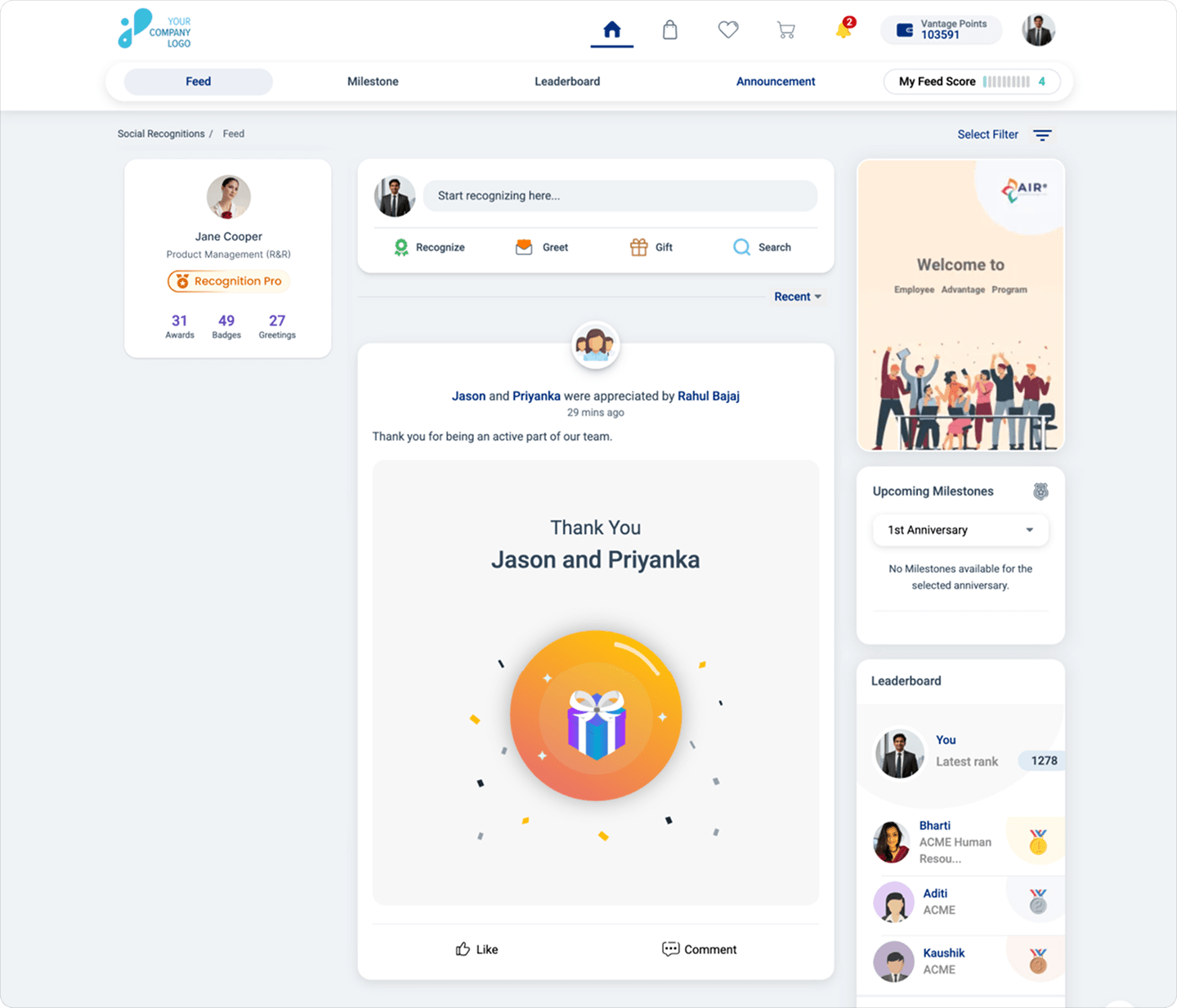
Screenshot: Vantage Rewards, Social Recognition Feed
A communication game usually ends the moment it's over, and the lesson gets forgotten by the next meeting. Most team-building guides treat the exercise as a closed loop: play it, laugh, move on. Nobody asks what happens next.
Aon's Say, Stay, Strive engagement model names communication and collaboration among its core engagement drivers, the factors that feed into whether people speak positively about their employer, stay, and put in real effort. Communication games touch those drivers directly. Most organizations just don't close the loop on it.
What I've seen repeatedly in workshops that do this well is much simpler than a formal program. Someone names the specific behavior that worked, out loud, in front of the team, right after the game ends. It can be as plain as, "Priya's instructions in that drawing exercise were the only ones everyone followed exactly." No certificate. No ceremony. Just the behavior, named, in public.
Another way to close the loop: use a recognition platform to acknowledge the person who performed well in the exercise, so the moment doesn't rely on someone remembering to say it out loud.
That's the piece that turns a one-off exercise into something the team actually carries forward.
| Vantage Circle Feature | How It Reinforces the Game's Lesson |
|---|---|
| Peer-to-Peer Recognition | Lets any teammate, not just the manager, call out the specific communication behavior that worked right after the game ends. |
| Social Recognition Feed | The team playing a Back-to-Back Drawing round is usually small. A feed post puts that moment in front of the wider company, past the room it happened in. |
| Core Values Alignment | If clear communication is a stated company value, tying recognition from these games to that value makes it concrete instead of a line on a poster. |
| Manager Recognition | Remote teams get fewer natural moments to observe communication in action. A virtual game gives a manager one real moment to point to instead of generic monthly praise. |
| Vantage Pulse (Sentiment Analysis) | A fun game doesn't guarantee communication actually improved. Sentiment tracking is how a team checks whether the lesson shows up weeks later, not just in the room. |
Let any teammate call out what worked
Vantage Rewards makes peer-to-peer recognition public the moment it happens, so the person who nailed the Back-to-Back Drawing instructions gets called out right after the game ends, not forgotten by Friday.
Explore Vantage RewardsConfirm the lesson stuck, weeks later
A fun game doesn't guarantee communication actually improved. Vantage Pulse's sentiment tracking shows whether it did, past the room the game happened in.
Explore Vantage PulseI'd push back a little on treating recognition as a guaranteed fix. One shout-out after one game won't rewire how a team communicates by itself. Paired with the game and repeated across a few sessions, though, it's the difference between an activity and a habit.
Conclusion
None of the games above are complicated. That's the whole point. A team that can't give clear instructions in a five-minute drawing exercise isn't going to communicate better on a real project just because the deadline carries more weight.
Run one of these monthly, not once a year at an offsite. Go back to that Back-to-Back Drawing round from the top of this piece. The moment worth catching isn't the finished sketch. It's whoever's instructions got followed without a single clarifying question. Name that, out loud, the way the recognition section above describes. That's the gap between a game everyone forgets by Friday and a habit that actually changes how the team talks to each other.
FAQs About Communication Games
Q1. What are good communication games?
A: The ones that hold up at work isolate a single skill. Back-to-Back Drawing for instruction clarity. The Minefield for trust and pacing. Charades or the Mime Game for reading non-verbal cues. A good communication game produces a visible, specific failure or success within minutes, not a vague feeling that "that was fun."
Q2. What are the 10 communication activities?
A: Ten reliable ones, across in-person and remote: Back-to-Back Drawing, The Minefield, the PB&J Instruction Game, Birthday Lineup, Virtual Pictionary, Collaborative Story Relay, Two Truths and a Lie, Human Bingo, Broken Phone, and Charades. Different piece of communication each time. Instructions. Listening. Non-verbal reading. Collaborative storytelling.
Q3. What is a good communication icebreaker game?
A: Two Truths and a Lie, or Human Bingo. Their job is getting a group comfortable talking, not isolating a skill under pressure, so save Back-to-Back Drawing and The Minefield for a team that already knows each other a little.
Q4. What are some fun non-verbal communication games?
A: The Mime Game, Charades, and Facial Expressions. All three strip words out entirely and lean on gesture, expression, and tone, which is where most of an in-person conversation's meaning actually lives anyway.
Q5. What are some fun communication games?
A: Charades and Virtual Pictionary, most consistently. Low stakes, familiar format. Want something less classic? The PB&J Instruction Game gets the biggest laughs, because following bad instructions literally is genuinely funny to watch.
Q6. What are 7 good communication skills?
A: Active listening, clarity, non-verbal awareness, empathy, giving and receiving feedback, adaptability across channels, and confidence under pressure. Communication games each hit one or two of these directly. Back-to-Back Drawing hits clarity. The Minefield hits trust and pacing. Facial Expressions hits non-verbal awareness and empathy at the same time.

He has worked in the human resources environment and has elevated recognition and rewards through his insightful and detailed writing. He aims to enhance the practice of Recognition in the workplace with new ideas and innovation that will help shape the work culture. For any related queries, contact editor@vantagecircle.com


