Employee onboarding survey questions measure how new hires experience their first 7, 30, 60, and 90 days on the job. Ask short, anonymous, milestone-based questions at each stage so you catch problems while you can still fix them.
Most new hires decide whether they made the right choice much earlier than companies think. Not at the first review. Often not even after the first month. The signs usually show up in the first couple of weeks: confusion, silence, hesitation, a slower kind of disengagement. If you only find out during an exit interview, the moment to act has already passed. Onboarding surveys help you spot those early signals while the employee is still willing to be won over.
Key Takeaways
- New hires decide whether to stay in their first few weeks, long before it shows up in attrition data.
- Run short surveys at four milestones: a Day 7 pulse, then 30, 60, and 90 days, each measuring a different risk.
- Keep every survey to 6-10 anonymous, process-focused questions, and always include one open-text question.
- Ask about the process, not the person, so new hires answer honestly.
- In small teams where anonymity is impossible, promise confidentiality instead, pool responses, or switch to a structured 1:1.
- The payoff comes from acting on the results and closing the loop, not from collecting them.
What is an Onboarding Survey?
An onboarding survey, sometimes called a new hire survey, is a short set of questions you send new employees at fixed points in their first three months. The questions mix rating scales, multiple choice, and open text to capture both numbers you can track and the context behind them. The goal is to see how training, role clarity, and team integration are actually landing, not how you hope they are landing.
The stakes are specific. SHRM reports that roughly 20% of employee turnover happens within the first 45 days. That is one in five new hires gone before they have really started. A good onboarding survey turns that blind spot into something you can see and fix.
The 30-60-90 day framework
Do not wait until the end of onboarding to ask for feedback. A lot can change in three months, and one long survey at the end will miss most of that shift.
Start with a quick pulse around Day 7, while the first week is still fresh. Then follow up with short check-ins at 30, 60, and 90 days. The Day 7 pulse helps you understand their first impression: whether they felt welcomed, prepared, and clear about what came next. The later surveys show how that experience holds up once the new hire starts doing the work, building relationships, and deciding whether they can see themselves staying.
Each milestone tells you something different. Keeping the surveys short also matters, because new hires already have enough to figure out.
The four checkpoints break down like this.
| Milestone | What it measures | What it surfaces | Key metric |
|---|---|---|---|
| Day 7 | Logistics and welcome | First-day setup failures, a cold start | Pulse / sentiment |
| 30 days | Role clarity and training | The job not matching the pitch, training gaps | Engagement score |
| 60 days | Team integration and manager fit | Isolation, a manager who is not investing | eNPS |
| 90 days | Retention and alignment | Flight risk, weak connection to the mission | eNPS and intent to stay |
Day 7: first-week pulse questions
The first week is about whether the basics worked and whether the person felt welcome. Keep this one very short, around five to ten questions, so it feels like a quick check-in rather than homework.
- How would you rate your first day overall?
- Did you have the equipment, accounts, and access you needed on day one?
- Was the information you received before your start date clear and helpful?
- How welcome did you feel during your first week?
- Was it clear who to go to with questions?
- How clear are your tasks and priorities for these first weeks?
- Were you introduced to the people you need to work with?
- How well does the job so far match what you expected from the interviews?
- Do you feel comfortable asking questions when you are unsure?
- What one thing would have made your first few days better?
30-day onboarding survey questions
By 30 days, new hires can tell you whether the role matches the pitch and whether they have what they need to do the work. This is where expectation gaps and training holes show up first, and where they are still cheap to fix.
- Does your role match what was described during hiring?
- How confident are you in your core responsibilities?
- How effective has your training been so far?
- Do you have the tools and software you need to do your job?
- Has your manager set clear goals for your first 90 days?
- How regularly do you have one-on-one time with your manager?
- Have you received useful feedback on your work?
- How well has your team included you, in person and remotely?
- Do you know where to find the information and documents you need?
- How would you rate the balance between independent work and collaboration?
- Does the company culture match what you were told it would be?
- How comfortable are you raising concerns with your manager?
- Have clear short-term goals been set for your first 30 days?
- How supportive has HR been with your onboarding questions?
- What part of your onboarding has been most useful so far?
- What aspect of your role do you find most challenging?
- What additional support or training would help you perform better?
- Overall, how satisfied are you with your onboarding so far?
60-day onboarding survey questions
The 60-day mark is about belonging and the manager relationship. The work might be going fine, but a new hire who still feels like an outsider here is far more likely to leave, and that rarely shows up in their output until it is too late.
- How much do you feel like part of your team now?
- Have your colleagues been welcoming and willing to help?
- Does your manager check in with you regularly, not only when something goes wrong?
- How clear are you on how your performance will be measured?
- Can you do the core parts of your job without constant help?
- How well do you understand how decisions get made here?
- Do you feel respected by the people you work with?
- Have you built at least one strong working relationship?
- How well does the reality of the job match what you expected at 30 days?
- How confident are you that you can meet your goals?
- Do you understand how your work connects to wider company goals?
- Have you had the chance to contribute your ideas?
- How manageable is your workload as you ramp up?
- How clear are the company policies that affect your daily work?
- How connected do you feel to the company's mission at this point?
- What is working well, and what is getting in your way?
90-day onboarding survey questions
This is your first real retention read. By now the new hire knows whether they want to stay, and the answers here tell you whether the last three months built someone who is committed or someone who is quietly keeping their options open.
- Have your responsibilities become clearer since you started?
- Do you see a clear path for growth here?
- How clear are the success criteria for your role?
- Is a formal performance review scheduled, and do you know what it covers?
- Do you still have regular check-ins with a manager or mentor?
- How satisfied are you with communication within your team?
- Do you feel fully integrated into the company culture?
- How well does this role align with your longer-term career goals?
- Are there projects you are genuinely excited to work on?
- Do you feel recognized for your contributions?
- How supported do you feel around work-life balance?
- Have you run into any compliance or ethical concerns?
- How confident are you in your decision to join this company?
- Would you still choose to join if you were deciding today?
- How likely are you to recommend this company as a place to work?
- If you could change one thing about your onboarding, what would it be?
Onboarding survey question types
The format you choose shapes the kind of answer you get back. A good onboarding survey uses a few types together.
- Rating scale (Likert): Respondents rate a statement from 1 to 5, "Strongly Disagree" to "Strongly Agree." This gives you a score you can trend over time and compare across teams, with more nuance than yes or no.
- Multiple choice: Quick to answer and easy to spot patterns in. If most new hires rate role clarity as "Somewhat Clear," you know exactly what to fix.
- eNPS: A single 0 to 10 loyalty question that splits your new hires into promoters, passives, and detractors. It is the fastest read on whether onboarding is building advocates or skeptics, and it is worth understanding how eNPS works before you rely on it.
- Open-ended: Free text that catches the specific issues a rating scale never will. Include at least one in every milestone survey.

Source: Vantage Pulse
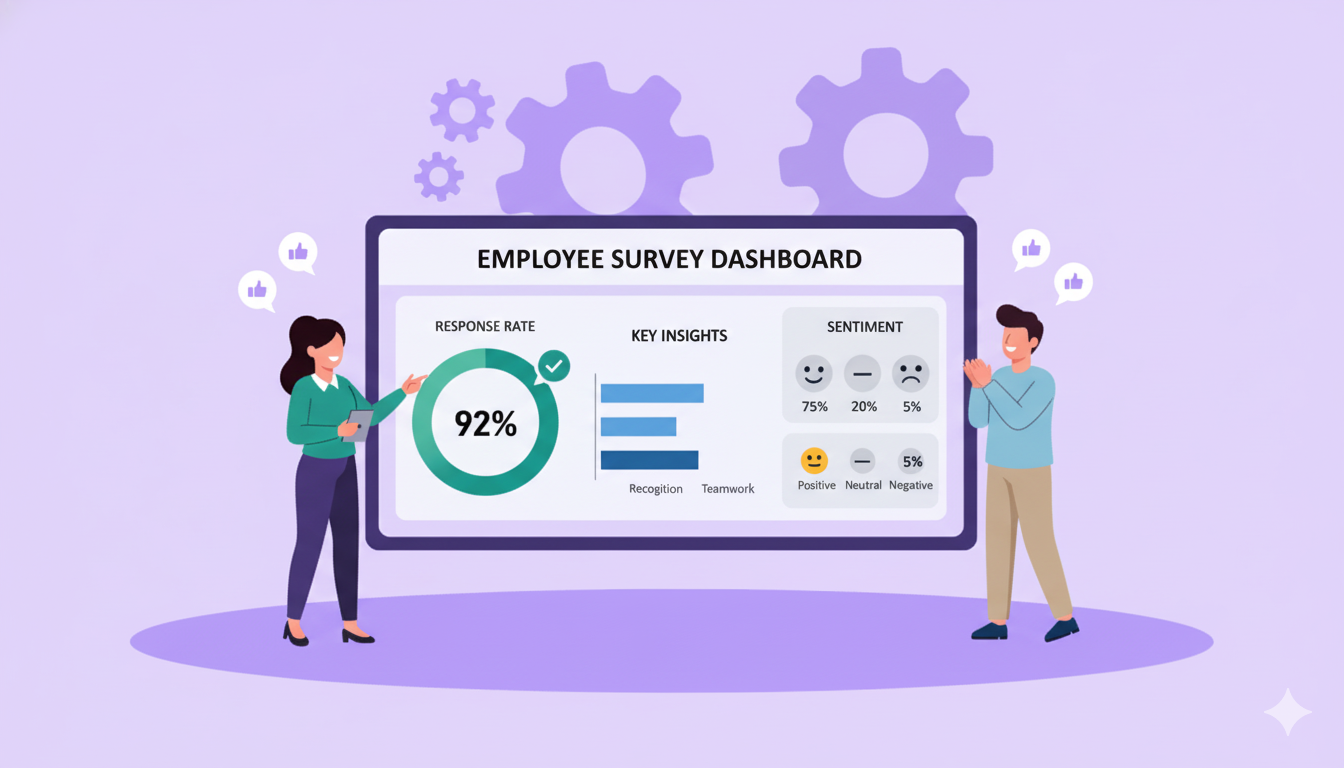
Open text is the most useful format and the hardest to process by hand. AI-powered sentiment analysis sorts free-text comments into positive, neutral, and negative automatically, so you can see recurring themes across hundreds of responses without reading every line. Vantage Pulse does this on every open-ended question.
Best practices for rolling out onboarding surveys
Scheduling surveys at the right milestones is the easy part. Getting honest, useful answers takes a few deliberate choices.
- Set expectations before you launch. Send a short note explaining why the survey exists, that it is anonymous or confidential, and that it measures the process, not the person. People who understand the purpose participate at far higher rates.
- Keep questions anonymous where you can, and process-focused always. Ask "How clear were the instructions for your role?" not "Are you struggling?" The first invites honest feedback. The second invites a defensive answer. If your hiring volume is too low for real anonymity, see the section below before you promise it.
- Choose a platform built for this. A tool that automates the milestone triggers and protects anonymity removes the manual work that makes onboarding surveys slip. If you are still comparing options, this list of employee survey tools is a good starting point.
- Close the loop. Within two weeks of each survey, tell the new-hire group what you heard and one thing you are changing. People who never see a result stop responding, and they stop trusting that feedback matters.
- Watch the trend, not just the snapshot. One cohort tells you how this month's hires felt. Comparing cohorts over time tells you whether onboarding is getting better or worse, and lets you test a fix on the very next group of starters.
Onboarding surveys in small teams: when anonymity is not realistic
Most onboarding survey advice assumes you have enough new hires to keep responses anonymous. Plenty of companies do not. If you hire two or three people a month, or a department onboards a single person, anonymity is an illusion. The manager will know exactly who wrote what from the context alone. Promising anonymity you cannot deliver is worse than not promising it, because the first time someone feels identified, you lose their trust and everyone they talk to.
Here is how to handle onboarding feedback when the numbers are too small to hide behind.
- Promise confidentiality, not anonymity. Be honest about it. Tell new hires their feedback goes to HR, stays confidential, and is used to improve the process, and that it will not be passed to their manager with their name attached. Confidentiality you can keep beats anonymity you cannot.
- Set a reporting threshold. Do not break results down by team or department until you have a minimum number of responses, commonly five. Below that, only report company-wide rollups so no single answer is exposed.
- Have HR hold the raw responses, not the manager. Route feedback to someone outside the new hire's reporting line. The manager sees themes and aggregate scores, never individual comments tied to a name.
- Pool new hires into rolling cohorts. Instead of reporting on one person at a time, combine a quarter's worth of starters into a single group so no individual response stands out.
- When the group is genuinely tiny, talk instead of survey. A structured 30 or 90-day conversation, run by HR or a skip-level manager, beats a survey of one. Keep the same milestone questions, just ask them in person.
- Lean on the process questions. Questions about setup, training, and documentation are far less sensitive than questions about a specific manager. When identity cannot be hidden, weight the survey toward process feedback and save the manager-relationship questions for a confidential conversation.
The honest version: a survey of one is not really a survey. It is a conversation with a worksheet. Treat it that way and you will get more out of it than a form that pretends nobody will know who answered.
Why onboarding surveys matter
The case for asking is mostly a case about cost and timing.
- Early turnover is expensive. Replacing an employee can cost up to 20% of their annual salary, according to the Center for American Progress. Catching a problem at day 30 is far cheaper than backfilling a role at day 100.
- Most onboarding is not working. Only about 12% of employees feel their company does onboarding well, according to Gallup. Surveys show you exactly where yours falls down.
- New hires rarely raise issues directly. Nerves and the desire to make a good impression keep people quiet. An anonymous survey gives them a safe way to flag a problem before it becomes a resignation.
- Onboarding sets the tone for everything after it. It is the first chapter of the employee lifecycle, and the benchmarks you set here inform every later stage, from development to retention.
How to read the results and act on them
Collecting answers is not the point. Acting on them is, and that is where most onboarding programs stall. The fastest way to act is to see where scores are weak before you read a single comment.
A heatmap does that at a glance. Onboarding scores are colour-coded red to green across departments and milestones, so a weak spot, say a low team-integration score in one department at 60 days, is obvious without digging through a spreadsheet. The eNPS view splits each new-hire cohort into promoters, passives, and detractors and tracks the trend, so you can tell whether last quarter's fix actually moved the number.
This is where acting on feedback pays off. AccessOne hit a 67% participation rate in its first month, well above the 30 to 50% benchmark, and an eNPS of 45 against an industry average of 10 to 30. More importantly, they could watch the effect of their changes in real time.

Seeing honest feelings in real numbers? Priceless. We could actually watch morale lift after each change.
Cassidi Ross, HR Coordinator, AccessOne
You do not have to run any of this manually. Vantage Pulse can trigger each milestone survey automatically from a new hire's start date, collect responses, and surface the scores so the analysis is done for you.
Turn onboarding feedback into action
Good onboarding surveys do not just tell you how new hires feel. They show you where the process is breaking before someone decides to leave. Ask at the right milestones, keep each survey short, protect trust, and close the loop. That is how onboarding feedback becomes retention work, not just another HR form.
FAQs
1. How can onboarding surveys improve employee retention?
Onboarding surveys surface early frustration or confusion that often leads to turnover. By spotting and addressing these issues in the first weeks, you make new hires feel supported, which improves engagement and the likelihood they stay long-term.
2. How long should an onboarding survey be?
Keep each milestone survey to about 5 to 10 questions, or roughly two to three minutes. New hires are already overwhelmed, and a short survey gets a far higher response rate than a long one. Use the milestones to spread questions out rather than asking everything at once.
3. When should I send 30, 60, and 90-day surveys?
Trigger each survey from the employee's start date: a quick pulse around day 7, then fuller surveys at 30, 60, and 90 days. Automating the timing matters, because a 30-day survey that arrives on day 50 measures the wrong moment.
4. What is a good eNPS for new hires?
As a rough guide, a new-hire eNPS below 0 is critical, 0 to 20 is at risk, 20 to 50 is building, and above 50 is strong. Track the trend across cohorts rather than fixating on a single number, since the direction tells you more than the snapshot.
5. Can I use onboarding surveys for remote employees?
Yes, and they matter more for remote hires. Surveys help you check whether remote workers feel connected to the team, have the resources they need, and understand the culture, all of which are harder to read from a distance.
6. How do I get honest feedback in onboarding surveys?
Make responses anonymous where your numbers allow it, keep participation voluntary, and be clear that the survey measures the process, not individual performance. When people trust that their answers will be handled carefully and actually used, they answer honestly.
7. What if my team is too small for anonymous onboarding surveys?
In small teams a manager can often guess who said what, so do not promise anonymity you cannot deliver. Promise confidentiality instead: route responses to HR, report only company-wide rollups until you have at least five responses, and pool new hires into rolling quarterly cohorts. When a cohort is just one or two people, run the same milestone questions as a structured conversation rather than a form.

People, culture, and what makes employees genuinely engaged, I write about it all, with practical insights HR teams can actually use.
Connect with Sahil on LinkedIn.