
Employee recognition in financial services is the structured practice of acknowledging contributions across banking, advisor, operations, compliance, risk, and fintech roles. In a sector where compensation is heavily regulated and voluntary turnover is a persistent cost, recognition is one of the most powerful retention tools available to HR teams globally.
Most financial services firms have a recognition problem. Not because they do not care about their people. Because they borrowed a program designed for a generic corporate workforce and dropped it into one of the most complex, regulated, and distributed sectors in the economy.
A branch banker in Ohio and a fintech engineer in Austin do not respond to the same recognition triggers. A credit union compliance officer and a retail investment advisor do not have the same visibility problem. An annual awards ceremony does not fix either. And yet, that is what most firms are running.
This blog breaks down how employee recognition actually works across the four sub-segments of financial services, what practices move the retention needle, and how Vantage Circle delivers it at scale.
Financial Services Has a Recognition Problem
Recognition in financial services is chronically underdeveloped. The data does not suggest it. It proves it.
Gallup research finds that employees who do not feel adequately recognized are twice as likely to say they will quit in the next year. In financial services, where replacing a licensed professional can cost between 50% and 200% of that person's annual salary, that is not a culture metric. That is a budget line.
In the US, the Bureau of Labor Statistics Job Openings and Labor Turnover Survey (JOLTS) 2024 shows persistent voluntary quit rates across the finance and insurance sector, particularly in customer-facing and operations roles. These are not interchangeable positions. Every departing employee takes institutional knowledge, client relationships, and regulatory fluency with them. That cannot be onboarded back in 90 days.
And yet, according to Gallup's 2025 State of the Global Workplace report, only 20% of employees worldwide are engaged at work. In financial services, where burnout is documented in audit, risk, and junior banking cohorts, that number is not a baseline. It is an indictment.
The firms closing this gap are not relying on pay alone — and for good reason. In financial services, how much you can pay people is often restricted by regulation. In the US, FINRA Rule 3220 limits what firms can give. The UK, India, Canada, and most major markets have similar rules. So when the pay lever is limited, recognition becomes the next most powerful tool HR has. The firms seeing the best retention results in 2026 have built recognition programs that are consistent, visible, and values-based — and that sit completely outside regulatory risk. The results show up where it matters: fewer people leaving licensed and tenured roles, faster hiring on critical positions, and better eNPS scores from the teams most at risk of burnout.
Tim Ringo, award-winning HR consultant, former global human capital lead at IBM and SAP SuccessFactors, and author of Solving the Productivity Puzzle, laid out the underlying dynamic in his conversation on the Vantage Influencers Podcast:
Extrinsic motivation is the money and rewards. Intrinsic motivation is you buy into the organization and you want to work there. And getting the balance between those two things is really important and very powerful in terms of creating engagement and then more productivity and performance.
That balance lands differently in financial services than in almost any other sector. When regulation limits what the extrinsic lever can do, the intrinsic side — recognition, belonging, the visible sense that an institution sees the work — stops being a cultural supplement. It becomes the retention strategy.
Recognition Looks Different Across Four Sub-Segments
The single biggest mistake financial services HR teams make is treating recognition as one program for one workforce. It is not. It is four workforces, with four distinct cultures, four different visibility problems, and four different reasons people leave.
One program will not fix all four. Here is where each sub-segment breaks down. For a broader look at engagement across the sector, see employee engagement in BFSI.
Banks
Retail banks run large, distributed networks. Branch-level contributions rarely surface at the corporate level. A teller who closes 50 transactions a day with zero acknowledgment will be gone in 18 months. That is not a prediction. It is a pattern. The visibility gap between branch floors and corporate leadership is the core problem — and most bank recognition programs do nothing to close it.
Credit Unions
Credit unions are tenure-rich institutions built on member trust. Their workforce culture rewards loyalty, and their members feel the difference when long-tenured staff leave. The problem is not that credit unions do not value loyalty. It is that they have no structured mechanism to signal it. Without one, long-tenured employees have nothing to point to that tells them the institution noticed.
Fintech
Fintech workforces are flat, fast, and peer-driven. Engineers and product managers in fintech do not wait for quarterly performance reviews to know how their work is landing. They expect real-time signals, and they trust peer credibility over hierarchical approval. A recognition program built on manager-to-report acknowledgment alone does not register for this cohort. It is the wrong channel for the way they work.
Insurance
Insurance workforces run on invisible wins. An underwriter who catches a mispriced risk. A claims handler who resolves a complex case before it escalates. A compliance officer who flags an exposure no one else saw. None of these appear in a revenue report. None get applause. And none of the people doing this work feel seen unless someone builds a mechanism to see them. Insurance HR teams without that mechanism are not just missing a culture opportunity. They are quietly losing the most valuable people they have.
Three Practices That Actually Work
Three recognition practices consistently move retention outcomes across financial services firms: peer recognition for back-office contributions, values-based campaigns instead of discretionary cash, and tenure milestone programs.
Peer Recognition for Back-Office and Compliance Teams
Back-office and compliance roles produce the most critical wins and the least visible ones. The structural fix is not complicated: any employee should be able to recognize any colleague, that recognition should be tied to a named value, and it should be visible to the full organization rather than buried in a manager's inbox. When that mechanism exists, contributions that never appear in a performance dashboard start surfacing where they belong — in front of leadership, attached to real behavior, before the person carrying them starts looking elsewhere.
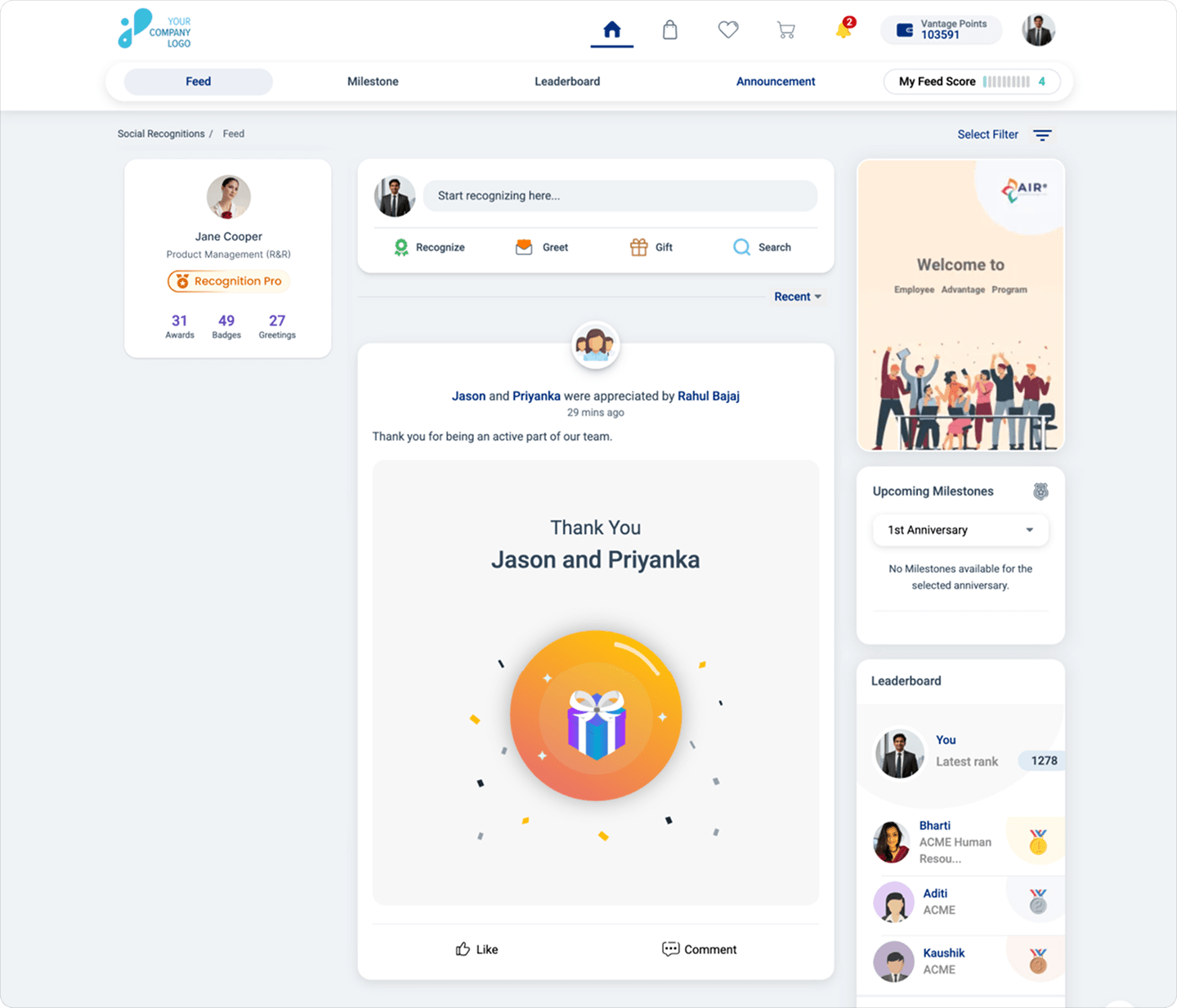
Vantage Recognition's peer-to-peer recognition is built on that model. Any employee can recognize a colleague. The recognition is tied to a named company value. It appears in the social recognition feed where managers and leadership can see it. It does not touch cash compensation. And it creates an audit trail that is clean under regulatory review.
Values-Based Campaigns Instead of Discretionary Cash
Discretionary cash bonuses in financial services carry regulatory risk. Recognition campaigns tied to defined organizational values do not. When criteria are set before the campaign launches, eligibility is scoped in advance, and the rationale is documented at the point of recognition, the program is defensible. Vantage Recognition core-values alignment maps every recognition event to a named value, which is exactly the kind of structured documentation that regulated financial institutions require. See how employee recognition programs can be structured to meet these requirements.
Philippa Mathewson knows this from the inside. A people and culture leader with 40 years of experience across financial services, she has led global recognition programs across major financial services organisations spanning Europe, Africa, the USA, Asia, and the Middle East. In her episode of the Vantage Influencers Podcast, she identified exactly what most financial institutions get wrong:
The thing that is actually missing is the culture of recognition and appreciation, where it actually becomes part of the DNA of an organization. And one of the best ways to do this is to link your recognition program into the values of the organization.

For institutions operating under regulatory scrutiny, that link is not just good culture practice. It is the compliance-safe alternative to discretionary cash.
Tenure Milestone Programs
Financial services workforces carry decades of institutional knowledge in senior roles. That knowledge does not transfer. A credit union loan officer who has managed the same member relationships for fifteen years is not replaceable by someone who reads the file. A claims manager who knows every carrier quirk in the book took years to build that fluency. Years of service awards at structured milestones — five, ten, fifteen, twenty years — are the signal that the institution understands the value of continuity. Without them, long-tenured employees have no mechanism to feel that loyalty is noticed before they decide it is not.
Vantage Recognition long service award tracking surfaces upcoming anniversaries, automates milestone recognition workflows, and gives employees a catalog of reward choices at each tenure band. Tax treatment of length-of-service awards varies by country — check local tax authority guidance before designing your program. For US and Canadian organizations specifically, see the service awards and tax benefits guide for the US and Canada.

The AIRe Framework: How to Know If Your Recognition Program Is Actually Working
The above three practices define what a working program looks like in financial services. The harder question follows: once a program is running, is it actually working, or is it just running activity? Most financial services HR teams cannot answer that with confidence.
Vantage Circle developed the AIRe Framework specifically to answer it. It is a structured way to design, audit, and strengthen recognition programs across four core dimensions. In financial services, each dimension has a specific pressure point.
A — Appreciation
Acknowledge the work that is invisible.
In financial services, the most critical contributions — a compliance catch, a risk flag, a client relationship held together — rarely surface. Appreciation is the mechanism that makes them visible before the person carrying them decides to leave.
I — Incentivization
Make recognition worth aspiring to.
When cash incentives are constrained by regulation, peer badges, public recognition feeds, and milestone awards become the incentive layer. Incentivization in AIRe means recognition is structured so that people actively want to earn it, not just receive it passively.
R — Reinforcement
Recognize the behaviors the institution actually needs.
In most financial services firms, recognition defaults to revenue outcomes. Reinforcement asks a harder question: are you recognizing risk awareness, client integrity, and regulatory accuracy? Because those are the behaviors that keep the institution out of trouble and clients in the book.
e — eMotional Connect
Make recognition feel like it was meant for that person.
In high-burnout cohorts — audit, risk, junior banking, ops — emotional connection is the difference between recognition that lands and recognition that is ignored. A generic certificate does nothing. A specific, timely acknowledgment from a peer or manager changes how someone feels about showing up tomorrow.
For US-based financial services organizations, Vantage Circle's AIRe Benchmarking Report for the United States gives HR teams a data-backed view of how their recognition programs measure against each dimension — a useful starting point for evaluating or rebuilding your program.
Does Your Recognition Program Pass the Financial Services Test?
Run through this checklist. Every box you cannot check is a gap that is costing you people.
Recognition Program Audit
For financial services HR teams. Check every statement that applies to your organization.
See gaps in your program? Vantage Circle can close them.
Book a Free DemoHow Vantage Circle Handles Recognition for Financial Services Teams
Vantage Circle is built for exactly the environment financial services HR teams operate in: compliance-heavy, geographically distributed, and tolerance for program failure is zero.
Vantage Recognition gives financial services organizations a single platform where every recognition event is documented, tied to a named value, and visible in a company-wide feed. Peer recognition, manager recognition, long-service awards, and spot awards all run in one system with one audit trail. No workarounds. No spreadsheets. No gaps a regulator can question.
Recognition analytics surface which teams and managers are actively recognizing, where coverage is thin, and how recognition activity tracks against employee Net Promoter Score (eNPS) data from Vantage Pulse. That means HR leaders stop guessing and start managing recognition the same way they manage any other business metric.
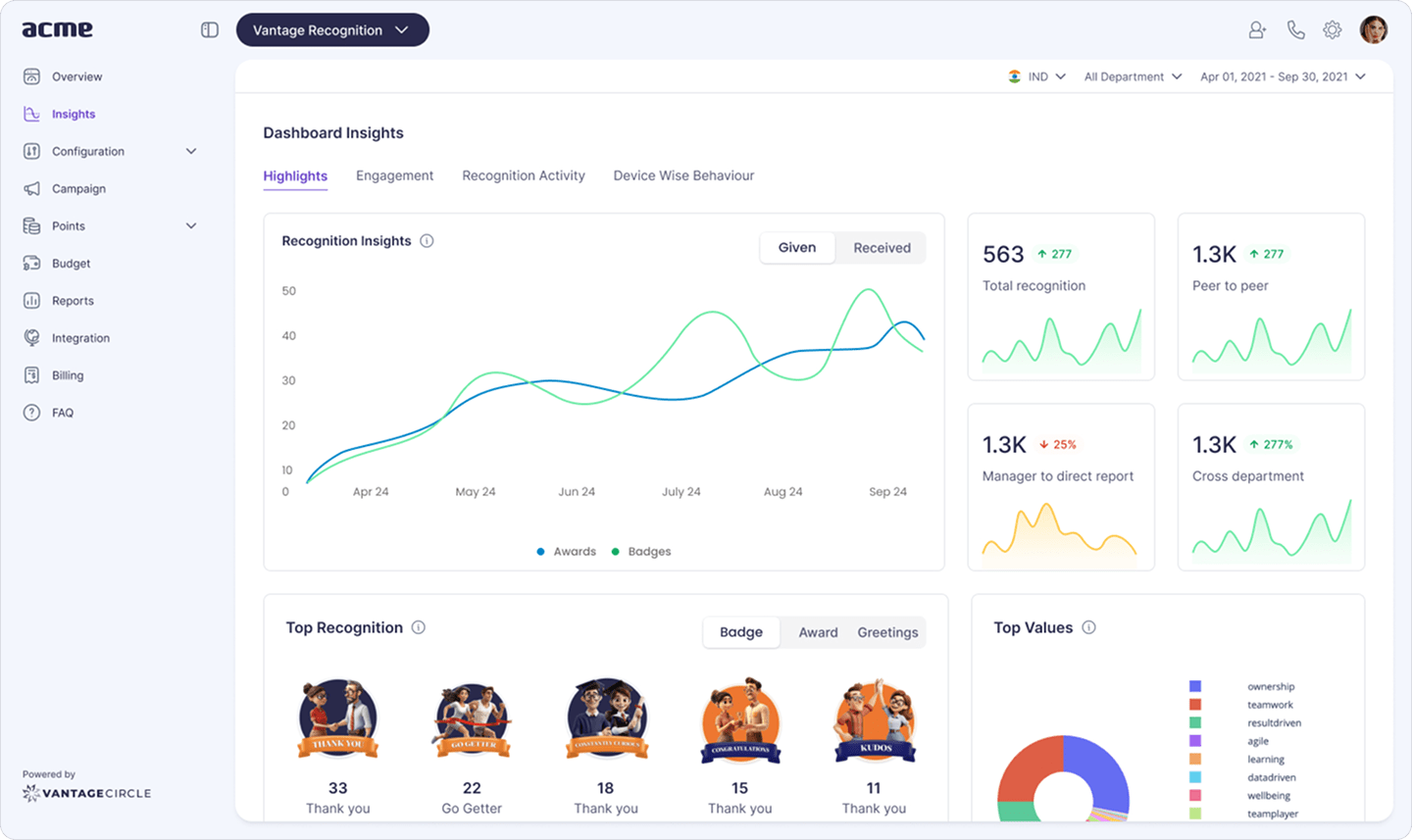
For distributed workforces, the platform runs across web, mobile, and Microsoft Teams. Branch staff, remote ops teams, and in-office employees are all in the same recognition ecosystem. Budget controls, eligibility rules, and approval workflows are configurable by role and region, which is not a nice-to-have for organizations operating across multiple regulatory environments simultaneously. It is a requirement.
The organizations with the sharpest retention results are not running the most elaborate programs. They are running programs that are consistent, documented, and tied to values that actually mean something to the people doing the work. That is what Vantage Circle makes operationally possible. Learn more about building high-impact employee recognition programs and how employee retention strategies anchor to recognition at their core.
FAQ
1. Does employee recognition in financial services create regulatory risk?
It can, if structured incorrectly. Non-cash, values-based recognition tied to documented criteria generally does not trigger restrictions under FINRA Rule 3220 or equivalent regulations, which target gifts intended to influence business. A structured program with set eligibility criteria, named values, and maintained records is defensible under regulatory review; undocumented spot cash bonuses are not.
2. How do you recognize employees who never appear in a revenue report?
Deliberately, by tying recognition to behavior rather than outcome. Peer-to-peer recognition lets colleagues name specific contributions in real time, making back-office and compliance work visible to leadership. A compliance officer who flags an exposure before it becomes a problem did something worth recognizing — the fact that nothing went wrong is precisely the point.
3. What are some examples of employee recognition in financial services?
Examples include a peer recognition post for a compliance catch, a manager message tied to a client retention conversation, a long-service award at a branch banker's ten-year milestone, and a values-based campaign spotlighting underwriting accuracy during a high-risk quarter. What these share is specificity: the contribution is named, the value it maps to is explicit, and recognition is visible beyond the immediate team.
4. How do you run a recognition program across a distributed branch network?
Start with platform access — branch and remote staff need the same ability to give and receive recognition as corporate teams. Beyond that, manager accountability is essential: recognition coverage reports showing which branches are active and where gaps exist let HR address turnover risks before people leave.
5. Why do financial services firms lose employees if compensation is already competitive?
Because compensation is table stakes, not a differentiator. In a sector where pay is heavily benchmarked and often constrained by regulation, the experience of working at an institution becomes the real differentiator. Employees who do not feel recognized do not announce it — they accept the next offer.
The Bottom Line
Financial services firms running no recognition program, or a generic one built for a different workforce, are losing people they cannot afford to lose. That cost is not abstract. It is a licensed relationship manager who took 18 months to fully ramp. A compliance officer who knew where every regulatory exposure lived. A branch manager who had the trust of every customer on their book. Gone because no one acknowledged the work.
Structured, values-tied, documented recognition changes that outcome. It is not complicated to build. But it is impossible to sustain without the right platform and the organizational will to use it.

Susmita Sarma is a Digital Marketer at Vantage Circle, making employee recognition less of a checkbox and more meaningful - helping organizations say we value our people and truly mean it.
Connect with Susmita on LinkedIn.