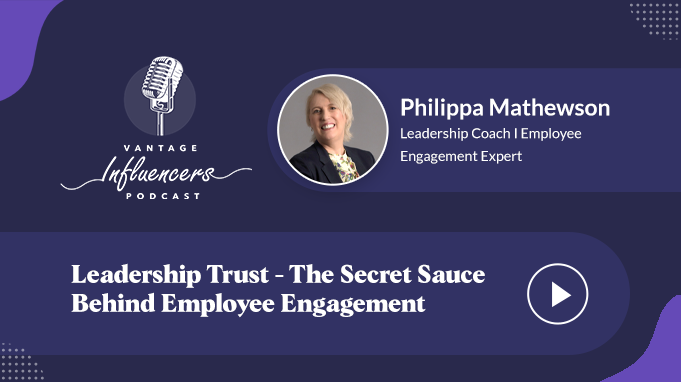
Leadership Trust - The Secret Sauce Behind Employee Engagement
Episode Overview
Philippa Mathewson opens the conversation by challenging how most leaders think about trust: it isn't a soft add-on to strategy, it's the foundation underneath it. She pushes back on the idea that trust and engagement are too intangible to actively design, measure, and monitor, arguing that treating trust as unmeasurable is exactly why it stops being a priority for so many organizations. Her mindset shift, which she calls heart count rather than head count, reframes leadership as something people feel through presence, not something delivered through directives.
She's equally direct about what breaks trust and what rebuilds it. Micromanagement, unmet commitments, and leaders who claim to care without acting on it top her list of trust killers, while competence, consistency, and genuine curiosity about what people actually need are what earn it back. Philippa also makes the case that psychological safety has become the real test of leadership today: when people believe they can speak up without being punished for it, engagement becomes possible. Without that foundation, she argues, recognition programs, engagement surveys, and culture campaigns end up as decoration rather than substance.
Episode Highlights
- Trust isn't a soft skill for Philippa Mathewson; it's something leaders have to actively design, measure, and monitor like any other business priority.
- Her core philosophy: leadership is about heart count, not head count, meaning leaders lead from the front, walk beside their teams, and know when to step back and let people fly.
- Before taking on any client, she checks that a leadership team's actual behavior, not just its stated values, matches four personal values: adventure, joy, growth, and collaboration.
- She names leadership buy-in, vision and values embedded in daily work, individual development plans, and a genuine culture of recognition as the four pillars of employee engagement that actually stick.
- Her trust-building checklist for leaders: demonstrate competence, act with integrity, show genuine care, stay dependable, and resist the urge to micromanage.
- She flags psychological safety as the leadership lesson she's focused on most recently, arguing that people only engage fully when they can speak up without fear of punishment or rejection.
About the Guest
Philippa Mathewson, Employee Engagement Expert
Philippa Mathewson built her career across three very different worlds: retail and contact-center leadership in the UK travel industry, senior HR roles in banking (including migrating over 2,000 roles from the UK to India and leading employee engagement for roughly 15,000 employees at Barclays Bank), and now her own consultancy focused on employee engagement and leadership development. She works with organizations of all sizes on engagement strategy, culture initiatives, and leadership curricula, using her own 4xE model, Envision, Energize, Enable, and Enhance, to help teams and leaders find their strengths and close their gaps.
Connect with Philippa on LinkedIn
Host
Susmita Sarma, Vantage Influencers Podcast Host
What You Will Learn
- Why trust needs to be treated as something leaders actively design, measure, and monitor, not something they simply hope for.
- What "heart count, not head count" means in practice, and how it changes the way leaders show up day to day.
- The four things Philippa checks for before taking on a new leadership team as a client.
- Which employee engagement initiatives actually move the needle: leadership buy-in, vision and values, growth and development, and recognition.
- A practical checklist for building trust in leadership: competence, integrity, genuine care, dependability, and letting go of micromanagement.
- Why psychological safety has become the clearest signal of whether a team is actually engaged.
Key Topics & Timestamps
| Timestamp | Topic |
|---|---|
| 00:00 | Cold open: why trust is never optional for leaders |
| 01:08 | Philippa's path to leadership across travel, banking, and her own consultancy |
| 07:29 | Defining her leadership style: heart count, not head count |
| 10:12 | What she checks before partnering with any business or leadership team |
| 16:07 | The four pillars of employee engagement that actually work |
| 27:32 | Practical tips for building and nurturing trust in leadership |
| 36:27 | The leadership lesson she's learned lately: psychological safety |
| 39:01 | The one change she'd make in the world of work |
| 40:08 | Podcast, book, and movie recommendations |
| 42:46 | How to connect with Philippa |
Full Transcript
Click to read the full episode transcript
Welcome to the Vantage Influencers Podcast. This podcast is sponsored by Vantage Circle, the simple and AI-powered rewards and recognition platform for employee engagement. For leaders, trust is never a choice, and today's leaders are more aware of the importance of maintaining it. But what happens when trust is broken? Can we gain it back? Stay tuned, as today Philippa Mathewson shares her thoughts on why it's critical to design, measure, and monitor trust throughout an organization's operations. Philippa Mathewson is an experienced and accomplished, high-performing senior leader with 40 years of experience. She has worked in people and culture development and change across various sectors, including financial, travel, and professional services. She has held senior leadership roles in customer service, sales, global transitions, talent, and employee engagement.
Susmita Sarma: Welcome to the show, Philippa.
Philippa Mathewson: Thank you so much, Susmita. It's lovely to be here.
Susmita Sarma: Great to have you on our show today, Philippa. It would be great if you can brief us about your background, your path to leadership, and what you're up to now.
Philippa Mathewson: Absolutely, I would love to. Well, Susmita, I actually started work over 40 years ago, back in 1992, I think it was. I'm very happy to have had three careers in my lifetime.
I started off as an administration assistant. I left school not really knowing what I wanted to do, I'm originally from the UK, and I got a little job as an admin assistant in a travel agency, making tea, coffee, doing a bit of filing and some typing, the kind of thing you'd expect. But it was there that I absolutely fell madly in love with the travel industry, and I was very fortunate that over a period of 24 years in travel, I worked my way up from that admin assistant role to selling holidays in retail, becoming a manager, doing some training, and then becoming an area manager running about 21 different shops.
Around the time of the dot-com boom, I realized that contact centers were going to be very big, so I moved from retail into contact centers. Towards the end of my time in travel, I was running contact centers in different locations across the UK for big brands like Expedia, Thomas Cook, and other such companies. But unfortunately, 9/11 hit the travel industry hard, and it went through terrible, terrible times. Because I was in senior leadership roles at that time, my role was made redundant three times in three years. So I decided it was time to get out of the travel industry, and that's when my second career started.
That's when I joined the banking industry. The transferable skill I had was running contact centers, so I ran a large contact center for a big UK bank in the North East of England for a couple of years. That's where I heard about a secondment the bank was doing, transferring some roles from the UK to India. I came over to India on a three-month secondment and landed in Mumbai in August 2006 to help transition some roles from the UK to India. That three-month secondment ended up being 18 months, because secondments never run to plan.
During that time, I moved to Delhi and helped the organization I was working for open up a captive contact center in Noida. I spent a long time with that organization in various roles, some operational, sales or customer service, some in project management, and a long stretch heading up learning and development for them. I also had a short stint in South Africa. But I finished up working for that organization in what I call my dream role, heading up employee engagement for the bank across roughly 15,000 employees in India.
So that was a very long journey. But just over five years ago, some tragic events happened in my life. I lost three very important people in my life very quickly and very suddenly, and it made me wake up. I'd always wanted to run my own business but never had the guts to do it, being a corporate kid all my life. Realizing that life was precious and short gave me the confidence to set up my own business. So now I'm in partnership with my business partner, and I focus particularly on employee engagement and leadership. I work with organizations, some small, some large, helping them with their employee engagement strategy, plans, implementation, and all the things that go along with that exciting topic. So that's a little bit about me, Susmita.
Susmita Sarma: So I'm sure that you're enjoying your current role.
Philippa Mathewson: Oh, I absolutely love it, Susmita. I get such joy out of doing what I do and working with the people I work with. I consider myself one of the luckiest women on earth.
Susmita Sarma: Setting up something for oneself is a dream for a lot of people, and as you said, you had some real down periods in your life. There's a quote I remember: you don't know how strong you are until being strong is the only option you have left with.
Philippa Mathewson: Absolutely, I resonate with that completely. You don't know how strong you are until you have no choice but to be. I've come out the other side stronger and enjoying life more than I ever have. I should be coming to the end of my career now, I turn 60 next year, but I'm still as full of life as I ever was, and it's given me a real renewed sense of energy.
Susmita Sarma: For most people, once they hit their 60s, the career graph starts to go down. But for you, from 1992 to 2022, the graph is still moving up. Congratulations, and I wish you all the best for the future.
Philippa Mathewson: Thank you so much.
Susmita Sarma: Okay, so Philippa, over this whole journey of work, how would you describe your own leadership style? How do you see yourself as a leader, with so many years of experience specializing in engagement, company culture, and leadership development across multiple business sectors?
Philippa Mathewson: That's a million-dollar question for me. I always remember this kind of question from interviews. I think over the years I've really learned that people perform at their peak when they're truly connected to the organization and the people they're working with. There's a well-known idea in leadership that sums this up brilliantly: when people are financially invested, they want a return; when people are emotionally connected, they want to contribute.
To me, leadership is all about heart count, not head count. That means leading from the front, walking by their side, and also leading from behind. Leading from the front means you have to walk the talk, do what you say you're going to do, and live and breathe the organization the way you want your people to live and breathe it. Walking by their side is about the journey. Nobody comes into work thinking, "I'm going to do my worst today." People naturally want to do their best, and when you walk alongside them and show that you're a human being rather than a lofty leader on a pedestal, you really do get the best out of people. And leading from behind means there's a time to let your people fly, to let them get on and do things not necessarily your way but their own way, adding their own value, while you're there as a safety net if they need you. It's really important that as leaders we let our people spread their wings.
Susmita Sarma: Brilliant answer, Philippa. I'm curious to know, what's the first thing you do when you partner with a business owner or a leadership team?
Philippa Mathewson: It's an interesting one. I want to go back a step before that, if I may, Susmita, because even before I start to partner with a business owner or a leadership team, I need to make sure that they align with my own values. My values are adventure, joy, growth, and collaboration, and that's really important for me to feel connected to the people I work with.
When I talk about adventure, I mean taking chances, even risks, being willing to venture into the unknown and step into an exciting journey. At the end of the day, life is an adventure, and we only get the most out of it when we put our hearts and souls into it and are prepared to take risks. My second value, joy, is about being really passionate about what we're doing, being in it for the journey and not just the destination. I think people feel most valued when they work with strong intrinsic motivation and a deep sense of meaning. They should love what they do and do what they love, and that's what brings joy.
Growth, as cliché as it sounds, is about unlocking true potential, not just for the individual client but for their organization, and for me too. Life is one big growth opportunity, one big learning opportunity, and when we unlock that growth we truly inspire ourselves to be the best we can be. My final value is collaboration: engaging fearlessly and wholeheartedly, with dynamic energy, while building a true partnership. It should be like the three musketeers: all for one and one for all.
So even before I start working with a client, I do a lot of research to make sure that the essence of who they are is open to adventure, joy, growth, and collaboration; it doesn't have to be their stated company values, but the underlying openness needs to be there. The next thing I think is vital, especially in employee engagement, because engagement can seem very intangible, is building trust with the people I'm working with. I do this by really listening to what they have to say: what challenges they face, what outcomes they actually want to achieve. So often, consultants or companies working with clients are driven by their own agenda, but we really have to understand what outcome the client wants, and that means asking lots of questions to get to the heart of the challenge. I like to describe it as unpeeling an onion: it has multiple layers, and the only way to get through them is by asking questions and listening to the answers.
Of course, it's important to be honest and transparent, that goes without saying when you're building trust. But it's equally important to show that you're vulnerable. I've found it's okay to admit when you don't know something, as long as you go and find out and get back to them. We're all human, we all have a vulnerable side, and if you show your own vulnerability, the client will be vulnerable with you too. But above all, what encompasses all of this is showing how much you care about them and their organization. Some of the things I like to do are getting involved in focus groups, listening in on senior leadership meetings, and seeing the company's results and how they're achieving them. Because when I work with an organization, it should never be a "them and me," it should be "we." I'm as much a part of that organization as they are, and that helps build trust too.
So in summary, prior to working with a business owner or a leadership team, it's important for me to make sure our values are aligned so we're coming from the same place, and then, although there are many more steps to follow, the next one is building trust, because employee engagement is such an intangible topic that it can be difficult to talk about unless you've built trust with your potential client.
Susmita Sarma: You've been known and appreciated for your extensive knowledge and experience, your personality, and your commitment to making a real difference to the people you work with. Since employee engagement has been your area of expertise throughout your career, it would be great if you could share some of the most effective employee engagement initiatives you've taken up and seen great results with.
Philippa Mathewson: Susmita, you're after my tips, are you? Well, I'm more than willing to share. There are a few things I'd like to share here, some big and some small.
The first thing I think is so important is getting leadership buy-in, whether that's C-suite in a large organization or a business owner in a much smaller one; the leadership team needs absolute buy-in. Without that, any employee engagement initiative you try to implement will never even get off the starting blocks. I've found that the best way to do this is to make sure the employee engagement strategy and plan connects clearly to the business objectives, and to measure it. A lot of people say employee engagement can't be measured, but I go back to the old adage: what gets measured gets done. It's really important that any leadership team, no matter how big or small, actually buys into employee engagement and sees how it connects, connecting the dots for them: if we do this, this, and this, then the outputs we can expect are this, this, and this. Leadership buy-in is critical, and unfortunately many leaders say they buy into it, but it becomes a tick-box exercise.
Another piece I'd share is about vision and values. Many organizations put together their vision and values, sometimes paying large consulting firms to help them do it, which is wonderful. But once we've got our vision and values, what do we do with them? They have to be part of the DNA of the organization. Colleagues on the front line need to understand how what they're doing day to day links into the vision, values, and goals of the organization, so they can understand the contribution they make. One of the things I do is hold vision and values workshops to help colleagues link what they do daily into the values, because at the end of the day, most organizations have goals, KRAs, objectives, KPIs, whatever you want to call them, which represent the "what." Very few organizations focus on the "how," which are the behaviors, the actual values of the organization. So something as simple as including values as part of the performance development process is very useful, so colleagues understand not just what they've achieved but how they achieved it, and how is just as important as what. You'll only achieve your goals if you behave and live the values, so one little trick is to make sure your values are part of your performance development process, so you measure the how as well as the what, because ultimately the how drives the what.
Another tip, and these two tend to come up together: I've never been part of an employee engagement survey or staff satisfaction survey where two key things don't come out in the top two or three, and that's growth and development, and recognition. Everybody wants growth and development; they want to develop and be the best they can be. Depending on the size of the organization, even the smallest of organizations, five or ten people, can do something that helps with the development of their people. One simple trick is to have what I call an IDP, an individual development plan, for absolutely everybody in the organization. In India, culturally, we tend to think of individual development plans as a bad thing, something you're put on if you're not performing. But if you create a culture where everybody has an individual development plan, with a two-pronged approach, how can I be the best I can be in my current role, and how can I develop myself for my future role, growth and development becomes something everyone benefits from. I swear by individual development plans. When I was head of learning and development at a previous organization, I had 72 trainers working with me, and in one year around 62 to 63 percent of those colleagues were promoted, either within my department or elsewhere in the organization, purely down to IDPs, because we were focusing on them every single month and giving our colleagues the opportunity to grow.
And if I touch on recognition, I can't say that word without smiling, because it's one of the simplest changes we can make in employee engagement, but it's also a real challenge for many organizations. Organizations recognize that recognition and appreciation matter to people, and they bring in fantastic platforms like Vantage Circle to help them recognize and appreciate people. But what's often missing is the culture of recognition and appreciation, where it actually becomes part of the DNA of the organization. One of the best ways to do this is to link your recognition program into the values of the organization, so people are appreciated for the behaviors and values they display. Unfortunately, we're living in a society, and I think COVID had a real impact on this, where the thank-yous and well-dones aren't as prevalent as they used to be when we were all in the workplace together. It happened a lot at the beginning of COVID, and I'm sure you've seen the surveys that showed employee engagement scores went through the roof at the peak of COVID, because managers and leaders were ringing up their people to ask if they were okay and thank them for what they were doing. But now that working remotely has become the norm, that's a big challenge, because it's not happening as much anymore, it's fallen by the wayside. Just a simple thank you, a well done, a leader ringing up a colleague and saying, "I really appreciate what you did, thank you so much, what you did meant this," and then ending the call there, with no hidden agenda about business results, that simple three-minute call makes all the difference to people.
So just to recap: leadership buy-in is an incredibly powerful driver for employee engagement, because without it, you don't get engagement. Vision and values means making sure people understand how what they do daily links into the vision, values, and goals of the organization. Growth and development, something as simple as IDPs, costs nothing and helps your people see how they can grow in their current and future roles. And recognition, cultivating that culture so it becomes part of the DNA of the organization, is critical to making sure any employee engagement initiatives are successful.
Susmita Sarma: I'm so proud to say that at Vantage Circle, we're all very much appreciating each other on the platform, and our managers and our CEO are all encouraging us to appreciate one another. Even now, with the pandemic almost over in the office and some of us working from home, everyone still gets recognized regularly, and it's become part of our culture, which is great.
Philippa Mathewson: Yes, absolutely, I totally agree with that. I've interacted with a number of people at Vantage Circle, and you can really feel that in how they engage with you. The most important thing about recognition is that it needs to start at the top of the organization and work its way down, because one of the greatest challenges is that senior leaders, whether that's the CEO, the C-suite, or business owners in smaller organizations, often don't feel that being recognized themselves is important, and because of that, they do very little recognizing of others. Of course, knowing how you all are at Vantage Circle, I know that doesn't happen there. You get as much appreciation flowing top-down as you do bottom-up, which is brilliant.
Susmita Sarma: Thank you so much, Philippa, for such a detailed answer. Moving forward, let's talk about today's topic: leadership trust, the secret sauce behind employee engagement.
Philippa Mathewson: It is indeed.
Susmita Sarma: Without it, leadership is doomed. So what tips do you have on how we can make sure trust in leadership is nurtured and developed within our organizations?
Philippa Mathewson: It comes down entirely, Susmita, to the way we behave as leaders. I have some personal tips, if you like, on how we can actually develop more trust in the workplace.
The first is about demonstrating competence in our roles. That doesn't necessarily mean that if you're leading a large organization you need to know the ins and outs of every role under your remit; it's about having the knowledge, not necessarily knowing exactly how to do the job yourself. By demonstrating competence, I mean showing that we have the expertise needed for the role and position we hold. Unfortunately, I think a lot of people are promoted into leadership roles simply because they were good at the job they were doing before, and leadership is a whole career in itself. We have to demonstrate that we're competent as leaders, that we can achieve results, solve problems, and make decisions, because demonstrating competence really inspires others to have trust and confidence in us. I'm sure you can think of leaders, and I certainly can, who I haven't had confidence or trust in, and a lot of the time it's because I didn't believe in their competence as a leader. That's a great place to start.
I also feel that as leaders we need to be believable. We have to act with integrity, be honest no matter how difficult the situation, and do this consistently, in line with the values of the organization. We have to treat people fairly, walk the talk, and really build trust in those relationships. We have to behave in an ethical manner. I'll be very honest and candid here: one of the things I hear a lot, having worked with so many business owners and business leaders, is that people are sometimes hired into roles just to hit diversity numbers. Even though I'm a woman myself, I have a real issue with that, because I feel the right person should get the job, regardless of gender. I've been asked a number of times by recruitment contacts whether I know someone who could fill a role, and when I say yes, they ask, "Is it a woman?" I say no, and I'm told they're only interested in hiring women for that role. I know it's an important and contentious issue, but unless we treat people fairly, act with integrity, and behave ethically, we're never going to earn the trust of our people.
We also need to genuinely care about and be connected to people, which means really focusing on them, having great communication skills, and recognizing their contribution. Caring about others really builds trust, because people don't care how much you know until they know how much you care. I remember a CEO at a previous organization who was absolutely amazing: the company was spread across multiple floors and buildings in the same city, and every week he made a point of walking the floors and saying hello to everybody, varying his time so he caught different people, sometimes at ten in the morning, sometimes at five in the evening, stopping to ask people how they were doing. It showed such care and connection that it was incredible to watch, and I learned a huge amount from that. When I became a leader myself, it was something I always made sure to do.
Being dependable is really important too. Following through on your commitments builds trust: doing things in a timely manner, doing what you say you'll do, holding yourself accountable and holding others accountable. Not doing what you say you will do erodes trust completely, and you hear this a lot, especially from more junior members of a team, that their leader said they'd do something and didn't. So being dependable and reliable matters, but so does making sure you're part of the team, being loyal to the people you work with, and providing a buffer for your team when things aren't going well, while also making sure senior leadership knows what a great job the team, or individuals, are doing. That makes your team look great, makes you look great, and shows your people that you're a team player.
My final tip, and I could talk for hours on this subject, is: don't micromanage. I think it's the death of trust. Teams and people need to feel that they have a purpose, a goal, a cause, and they want to feel part of that. It's not enough for people to feel they're just doing what they're told because someone is "the boss"; they need to understand the why, the how, the what, and the when. As long as we set our people up for success, any failure they make is something to learn from, and we often learn better from our mistakes than from getting it right the first time. We should encourage our people to take a few risks and step out on their own; micromanaging destroys trust in any organization. So to summarize: demonstrate competence, be believable and act with integrity, genuinely care about others, be dependable, show that you're as much part of the team as your people are, and don't micromanage them. If you have an open enough relationship with your people, they'll come to you if they don't know how to do something. It really does work.
Susmita Sarma: I'm sure there are other points too, Philippa, and on top of all these skills and qualities, another thing leaders have to do is keep learning continuously. Is there any leadership lesson you've learned lately that you'd like to share with our listeners?
Philippa Mathewson: Continuous learning is so important, particularly in employee engagement, because when people feel they're learning, they become more engaged with the organization. But one thing I've really learned, and this has come to the fore recently, is how important psychological safety is in the workplace. Colleagues should never feel that they'll be embarrassed, punished, or rejected for speaking up, and our role as leaders is really to create the right environment so our colleagues can thrive; they'll only get that if they feel psychologically safe. When people feel psychologically safe, it's easier for them to engage with the organization, whether that's in a team meeting, solving problems, or collaborating on projects. Engagement is very important, but people won't engage without that safety, and in a world where the majority of people are still working remotely, even in a hybrid way, it's harder to create that environment than when everyone is in the office together, because that everyday people-connection, the water-cooler or coffee conversations we used to have, just isn't there in the same way. So psychological safety is something I've been reading a lot about recently, and it's helping me see things in a different light.
Susmita Sarma: That safety, that willingness to have a difficult conversation with a teammate, so that anyone can come to you and discuss their problems or issues with their manager.
Philippa Mathewson: Absolutely, absolutely. And that's why leadership trust is so important, because if people don't trust you, if you haven't created that environment as a leader, it's never going to happen.
Susmita Sarma: Okay, so now, Philippa, if there was something you could change in the world of work or leadership, what would it be?
Philippa Mathewson: Oh, I can only choose one? All right, I'd say genuinely care about your people, and show it. I talked about this earlier, it's about heart count, not head count. When I hear HR departments or sales teams talk about "headcount," I cringe inside. It's about genuinely connecting with and caring about people, and showing it. It's easy for a leader to say, "Of course I care about my people," but what are you actually doing about it? How do they know you care? That's the crux of the matter, and if I could change one thing in the world of leadership today, that's what I'd change.
Susmita Sarma: Lovely, absolutely. So is there anything you've read, watched, or listened to lately that you think our listeners might enjoy, any book or podcast, maybe?
Philippa Mathewson: Yes, there are a couple, actually. I've recently switched to listening to podcasts, and I find it really good, when I'm making breakfast in the morning or getting ready, to put one on and learn something. One I've been listening to recently is called Boss Files, hosted by a former news reporter who interviews global CEOs, innovators, and entrepreneurs and uncovers the stories behind their success. It's a really good podcast that I'd recommend to leaders.
A book I've just reread, I read it many years ago but picked it up again recently, is Good to Great by Jim Collins. It was published over 20 years ago, but it's got so many brilliant ideas that you can apply to any organization, no matter how big or small, and it's still as relevant today as it was when it was first published.
And finally, I'm not really a movie buff, but I love looking to movies for inspiration, and I'll give away a little bit of my own thought process here: I always look to the Star Wars movies. There's some great leadership lessons in those films, as there are in many others, but one of my favorite quotes of all time comes from The Empire Strikes Back, when Yoda says to Luke Skywalker, who's trying to get his spaceship out of a marshy swamp and says, "I'll try," Yoda turns around and says, "Do or do not, there is no try." I think that's one of the greatest lines of all time.
Susmita Sarma: Okay, Philippa, great. So lastly, if our listeners wanted to connect with you, what would be the best way to do that?
Philippa Mathewson: The best way is to reach out to me on LinkedIn, it's the quickest and easiest way to reach me, and I know you'll be putting the link to that in the podcast notes, so I'd just encourage people to do that.
Susmita Sarma: Okay, great. Thank you so much, Philippa, for sharing your leadership knowledge today. Our listeners will surely learn a lot from this episode, and I learned a lot from it too. I really enjoyed having this conversation with you today. Thank you so much once again for joining me on the Vantage Influencers Podcast. I hope to have you back again soon.
Philippa Mathewson: Thank you so much, it's been an absolute pleasure. Have a fabulous day.
FAQ
What does Philippa Mathewson mean by "heart count, not head count"?
It's her way of describing leadership that shows up through genuine presence rather than authority. It means leading from the front by living the values you expect from others, walking alongside your team through the day-to-day work, and knowing when to step back and let people find their own way, rather than treating people as numbers to be managed.
What are the biggest trust killers for leaders, according to Philippa?
She points to micromanagement, failing to follow through on commitments, and leaders who claim to care about their people without ever showing it in action. She also flags hiring or promotion decisions that ignore competence in favor of optics, arguing that any of these erode trust faster than they can be rebuilt.
Why does Philippa say employee engagement initiatives often fail to stick?
Because they skip the groundwork. She argues that leadership buy-in, values that are actually lived rather than laminated on a wall, structured growth plans like individual development plans, and a genuine culture of recognition all have to be in place together. Without leadership buy-in especially, she says, no initiative gets off the starting blocks.
How does psychological safety connect to trust, in Philippa's view?
She sees it as the practical test of whether trust actually exists. When people believe they can speak up, raise problems, or admit mistakes without being punished or embarrassed, they engage more fully with their work and their teams. Without that safety, she argues, no other engagement effort will land.
Related Reading
Also listen on