
Talk to any HR leader running a recognition program past the six-month mark, and you will hear the same story. The launch was a hit. Activity spiked in the first quarter. Then somewhere around month nine, the dashboard started looking strange. The same 15 managers were sending most of the recognitions. Entire departments had gone quiet. The platform was working perfectly. The managers, for whatever reason, had stopped showing up.
If that sounds familiar, you are not alone. In our work across hundreds of recognition programs, this is the most common pain point we hear. The instinct is to send yet another reminder campaign, another CEO email, a points bonus week. None of it sticks. Here is what most program owners miss. Manager participation is not a motivation problem. It is a diagnosis problem. When activity stalls, it almost always traces back to four specific structural reasons: time pressure, skill or confidence gaps, missing accountability, or platform friction. Once you name the dominant gap, the right fix becomes obvious.
This blog is for the HR leader who owns a recognition platform and now needs managers to actually use it. By the end, you will have a benchmark to measure your gap, a 30-second diagnostic to name it, and a fix matrix that pairs each root cause with a tactic that works. Let's get into it.
The 30-Second Diagnostic Before you read another line, answer four yes/no questions:
- Do fewer than half of your managers send at least one recognition every 30 days?
- When managers do recognize, are the messages generic or template-thin?
- Is recognition behavior absent from manager performance reviews?
- Do managers actively use Slack or Microsoft Teams but ignore your recognition platform?
Each "yes" points to a different gap type. Hold onto your answers. We will come back to them.
How Bad is the Manager Participation Problem?
Before we fix the gap, let's size it. The numbers are not subtle, and they belong in every CHRO conversation about engagement this year.
Start here. Gallup research shows managers account for at least 70% of the variance in team engagement scores across business units. Read that twice. The difference between your most engaged team and your least engaged one is mostly explained by who manages them, not by perks or pay. Recognition is one of the few daily manager behaviors that moves this dial.
Meanwhile, engagement is sliding. Gallup's 2024 measurement of 79,000 U.S. employees found only 31% are engaged, the lowest level in a decade. Younger workers and middle managers carry most of that decline.
Now look at the managers themselves. A Gartner 2024 survey of 805 HR leaders found 75% say their managers are overwhelmed by expanding responsibilities, and 69% say managers are not equipped to lead change. Leader and manager development has topped the HR priority list for three years running.
Add to that the McKinsey Health Institute research on workplace burnout, which flags middle managers as one of the most exhausted populations at work. They sit between executive expectations and team capacity, absorbing friction from both sides.
Put those findings together and the picture gets uncomfortable. Managers are your single biggest engagement lever and your most overloaded population at the same time. Asking them to "just recognize more" without removing friction is asking them to fail. For more context, see our employee recognition statistics library and the deeper read on the manager recognition gap.
| Source / Year | Stat | What It Means for Manager Participation |
|---|---|---|
| Gallup, State of the American Manager | 70% of engagement variance is explained by the manager | If managers are absent in recognition, you are leaving 70% of the engagement lever on the table |
| Gallup, 2024 U.S. workforce | Only 31% of employees engaged, a 10-year low | The macro trend is declining. Manager-led recognition is one of the few proven reversers |
| Gartner, 2024 HR Leader Survey (805 HR leaders) | 75% say managers are overwhelmed by expanding responsibilities | Time pressure is the dominant gap. Removing friction matters more than another reminder |
| Gartner, 2024 HR Leader Survey | 69% say managers are not equipped to lead change | Skill and confidence gaps are systemic, not personal. Train the message, not just the platform |
| McKinsey Health Institute | Middle managers are among the most burnout-exposed segments at work | The biggest engagement lever is also the most exhausted. Design accordingly |
What Counts as Healthy Manager Participation?
One of the most important questions we get on almost every customer call is: "What does good actually look like?" Most HR leaders have a gut feeling their participation is low but cannot tell you if their number is bad, average, or quietly excellent. That uncertainty is why most recognition programs stay stuck.
Let's fix the measurement problem before the behavior problem. Three numbers belong on every recognition dashboard, and you need them together.
- Monthly Active Manager % is the share of managers who send at least one recognition in a rolling 30-day window.
- Recognitions per Active Manager counts how often the active group is recognizing.
- Recognition Coverage is the share of employees who received at least one manager recognition in the past quarter.
Together they tell you who is participating, how habitual it is, and whether participation is reaching everyone or clustering around a few favorites.
Here is what good looks like, drawn from patterns we see across enterprise programs.
| Tier | Monthly Active Manager % | Recognitions per Active Manager / Month | Coverage % (per Quarter) | Diagnosis |
|---|---|---|---|---|
| Tier 1: Critical | Under 30% | 0 to 1 | Under 40% | Program is at structural risk. Most employees are invisible to leadership |
| Tier 2: Inconsistent | 30 to 50% | 1 to 2 | 40 to 60% | Activity exists, but is patchy. Coverage gaps will surface in next pulse survey |
| Tier 3: Healthy | 50 to 70% | 2 to 4 | 60 to 80% | Program is working. Focus shifts to depth and quality, not just frequency |
| Tier 4: High-performing | 70%+ | 4+ | 80%+ | Recognition is embedded as a manager habit. Now protect against fatigue and inflation |
Two things to remember as you read the table. First, coverage is the metric that tells the truth. A program where 20% of managers send 80% of recognitions will look healthy on raw volume, but the coverage number will show what is really happening: most employees are not being recognized by their own manager. That is the gap that shows up the next time you run a pulse survey. Second, monthly active manager % is your early-warning signal. It moves a quarter or two before coverage does, so if a slip is coming, this number tells you first. Watch coverage to know if the program is working. Watch active manager % to catch problems before they spread.
The 4 Reasons Managers Don't Participate
Here is what years of working with enterprise recognition programs has shown us. Almost every participation problem traces back to one of four root causes, and most organizations have two of these four gaps active at once. For example, a skill gap stacked on top of a tooling gap, or a time-pressure problem layered with missing accountability. That stacking is exactly why blanket "recognize more" campaigns rarely move the needle, because a single tactic can only fix one cause at a time.
The diagnosis matters because each gap needs a different fix. A skill gap will not respond to a leaderboard. A tooling gap will not respond to training. Misdiagnose, and you burn a quarter on the wrong solution.
1. Time Pressure (The Most Common Gap)
This is the gap most HR leaders underestimate, and the one we always check first. Middle managers are running on the thinnest margins they have run on in a decade. Spans of control keep widening, the burnout data keeps deepening, and recognition lands at the bottom of the priority list. When a thank-you feels like one more task in an overloaded queue, it loses every prioritization battle.
You can spot this gap from the data alone. Recognitions cluster around the end of the quarter or just before a town hall, with a flat baseline in between. Managers describe recognition as "when I get a minute" or "I keep meaning to." That is not a participation problem. That is a workload problem wearing a participation problem's costume.
2. Skill or Confidence Gap (The Hidden Gap)
This one used to surprise us, until we started looking at the data. The Gartner numbers above tell the story. More than two-thirds of HR leaders say managers are not equipped to lead change, and recognition behavior sits inside that same skill set. Put a manager who has never been trained on feedback in front of a recognition platform, and they freeze on the blank-page problem. They do not know what to say, how specific to be, or whether public recognition will read as performative.
The symptoms are very different from time pressure. These managers are active in the social feed and present in Slack. But the recognitions they send, when they do send, are thin: "Great job!" "Thanks for the effort!" No value tag, no specific behavior, no story. This is a skill problem, not a motivation one, and reminder emails will not solve it.

VANTAGE INFLUENCERS PODCAST
"Get skill development to your frontline and middle managers as quickly as you can. That's where engagement goes to die. It's in the middle of your organization."
— Summer Davies, Founder, Leadership by Summer Davies
Listen to the Episode3. Accountability Gap (The Cultural Gap)
Hard truth. If recognition behavior is not measured, it is not real. In organizations with weak accountability, recognition stays optional. No leadership modeling from the C-suite, no manager scorecard, no consequence for going quarters without acknowledging the team. So managers, being rational humans, focus on what gets measured.
The symptom is distribution skew. The top 20% of managers send 70 to 80% of all recognitions, and the bottom half sends almost nothing. This is not a tooling or skill problem. It is a culture and KPI problem, and you will not solve it without involving the CEO.
4. Tooling or Friction Gap (The Technical Gap)
This is the gap nobody wants to talk about, because it implicates the platform itself. When the product adds friction, managers vote with their feet. Common sources: no mobile experience, no Slack or Microsoft Teams shortcut, clunky logins, missing single sign-on (SSO), and recognition workflows over three clicks.
The symptom is platform-specific absence. Managers are active in your other tools, including HRIS (Human Resources Information System), engagement surveys, and Slack. They are simply missing from the recognition platform. This is a product problem that recognition leaders mistake for a behavior problem, then throw training at for a year.
| Gap Type | Two Yes/No Questions | If Yes |
|---|---|---|
| Time Pressure | 1. Do your managers describe recognition as "one more thing"? 2. Do recognitions cluster around the end of quarter? | Read the Time Pressure fix below |
| Skill or Confidence | 1. Are most manager recognitions one-line generic notes? 2. Did fewer than half of your managers receive formal recognition training? | Read the Skill Gap fix below |
| Accountability | 1. Does the top 20% of managers send 70%+ of recognitions? 2. Is recognition absent from manager performance reviews? | Read the Accountability fix below |
| Tooling or Friction | 1. Is recognition unavailable from inside Slack or Teams? 2. Do managers complain about the mobile or login experience? | Read the Tooling fix below |
The Fix-By-Gap-Type Matrix
OK. You have named the gap. Now what? Most blog posts hand you a generic "10 tips to engage managers" checklist at this point, and you have probably already tried half of it. That approach does not work because not every manager has the same gap. The fix has to match the root cause, or you will be running another reminder campaign in three months.
Here is what works for each of the four gaps.
Fix for Time Pressure: Reduce Recognition to Under 60 Seconds
If the gap is time, your job is to remove every second of friction between the impulse to recognize and the act of recognizing. There is no point training a manager to write a great recognition if it takes five minutes to find the platform. Three changes do the heavy lifting.
First, push recognition into the tools managers already live in. A social recognition feed inside Slack or Microsoft Teams turns a 30-second action into a public moment without context-switching. Second, enable mobile and voice-to-text recognition so managers can dictate a message between meetings. Third, surface a single-click prompt after meaningful interactions: a closed deal, a project milestone, a peer mention.
When the time cost drops below a minute, recognition stops competing with other priorities. It becomes background behavior.
Fix for Skill Gap: Train the Message, Not Just the Tool
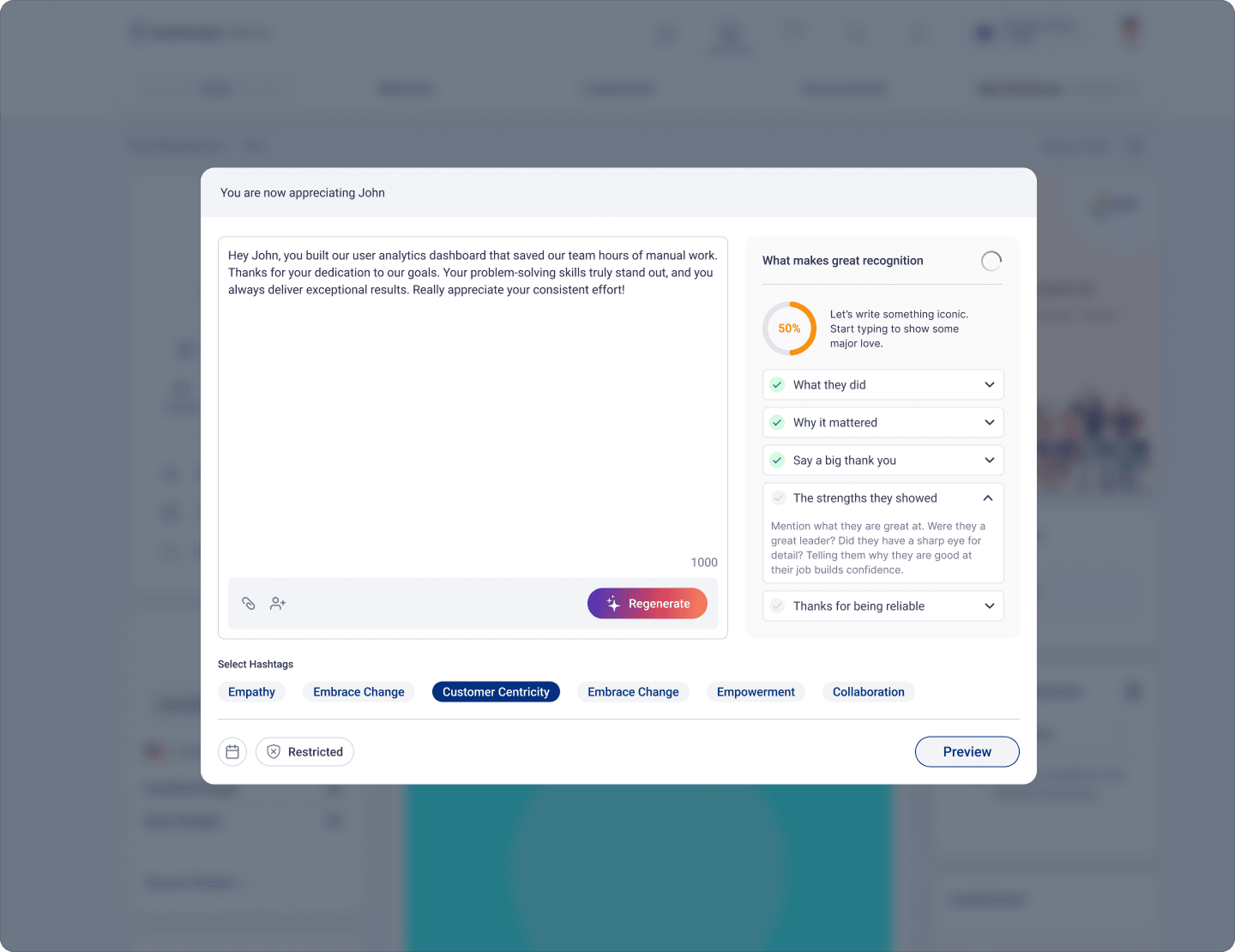
Remember, managers do not skip recognition because they do not care. They skip it because they do not know what to say. The fix has to be structural prompting, not motivational enthusiasm.
Three moves work. First, tie every recognition to a company value. A built-in prompt of "You demonstrated [Value] when you did [X]" removes the blank-page problem and pulls recognition back into your culture story. Second, give managers 5 to 7 templates they can adapt in seconds. Third, model the behavior at executive level. When the CEO recognizes publicly with specificity, every manager underneath starts to mirror the rhythm.
Fix for Accountability Gap: Make It a Measurable KPI
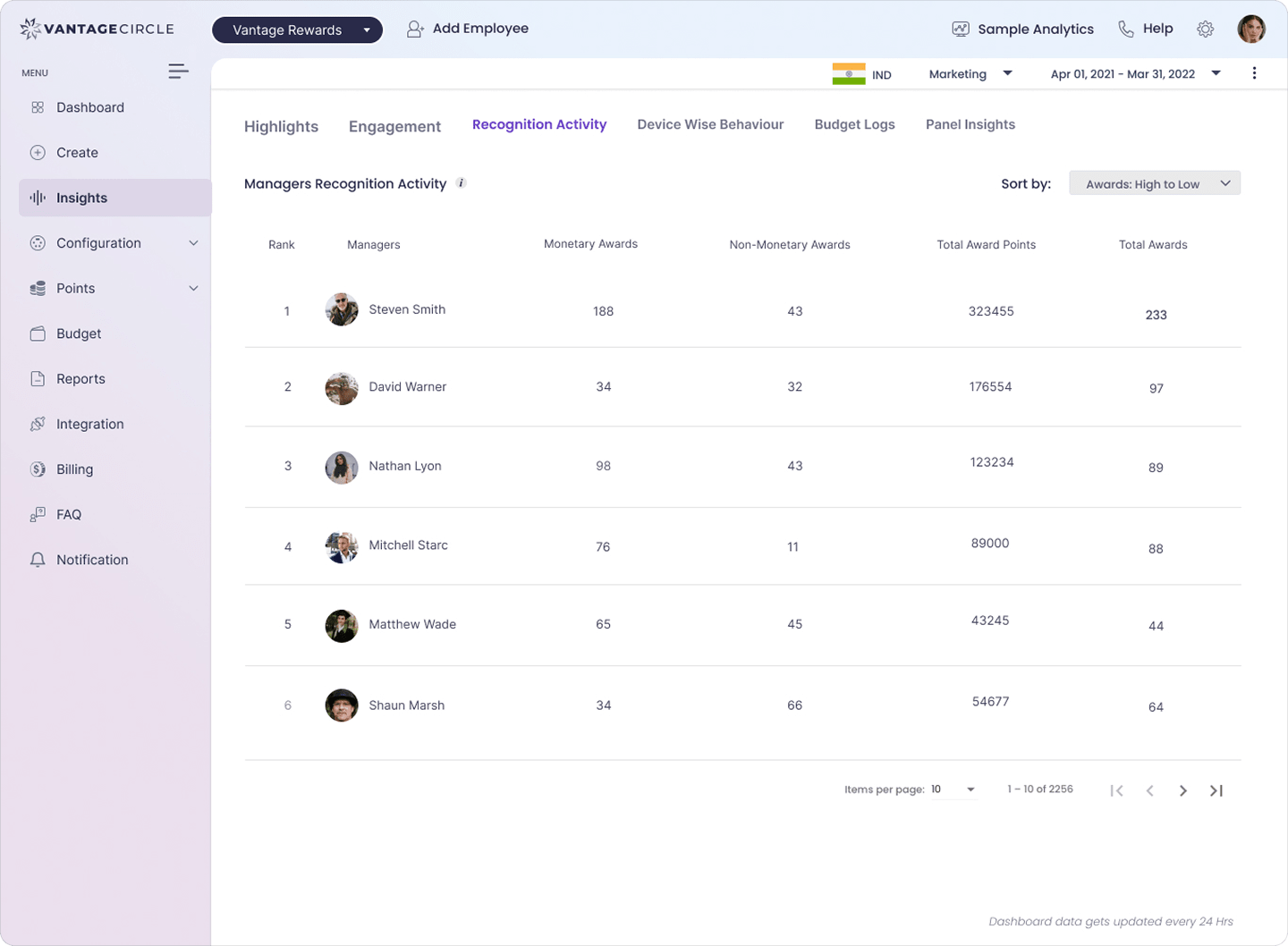
When recognition is voluntary, it stays voluntary. We have not seen a single program climb out of Tier 2 without making this shift, no matter how charismatic the program owner. The fix is to make recognition visible and measurable.
Three tactics move the needle. First, add a manager recognition KPI to performance reviews. Not a vanity number, but two anchored metrics: percent of direct reports recognized per quarter, and recognition consistency over time. Second, publish department-level leaderboards. Activity asymmetry stops being invisible the moment it appears in a dashboard the VP can see. Third, send a monthly participation digest to each people leader, so the data lands in their inbox before HR has to ask.
Fix for Tooling Gap: Audit the Friction Map
Before you launch any campaign, run a friction audit. Time the path from "I want to recognize someone" to "recognition sent" on the three surfaces managers really use: laptop, phone, and chat tool. If it takes more than 60 seconds on any of them, you have a tooling problem, no matter how the platform looks in the demo.
Three fixes resolve most friction. Implement SSO with your identity provider so managers never face a separate login. Build a Slack or Teams integration that surfaces recognition as a slash command. Add HRIS sync so org charts and direct-report lists auto-populate. Each of these removes a reason to delay.
| Gap Type | Top 3 Fixes | Owner | Time to Impact |
|---|---|---|---|
| Time Pressure | Slack/Teams integration, mobile recognition, single-click meeting prompts | IT + Recognition Program Owner | 30 to 45 days |
| Skill or Confidence | Value-tagged recognitions, templates, executive modeling | HR + Internal Comms | 45 to 60 days |
| Accountability | Recognition KPI on review, leaderboards, monthly participation digest | CHRO + People Managers | 60 to 90 days |
| Tooling or Friction | SSO, Slack/Teams integration, HRIS sync | IT + Recognition Vendor | 45 to 75 days |
How to Measure Manager Participation
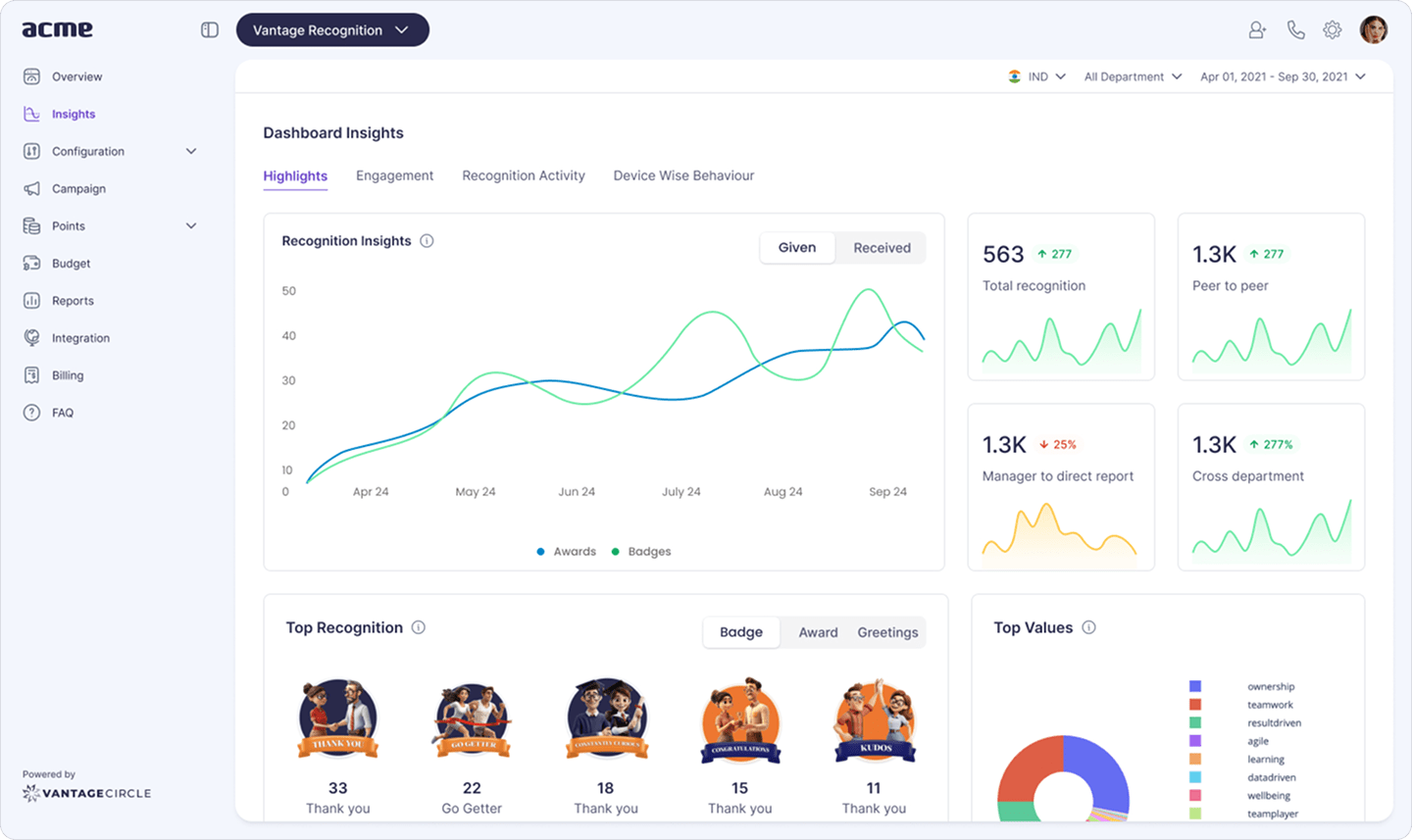
Here is the part most programs skip, and it is what separates programs that compound from those that plateau. You need five metrics on one dashboard. Most HR leaders track one or two and assume the rest will follow. They will not. The full picture only appears when you watch all five together.
| Metric | Definition | Target | How to Pull |
|---|---|---|---|
| Monthly Active Manager % | Share of managers sending at least one recognition in a rolling 30 days | 50%+ minimum, 70%+ aspirational | Recognition platform analytics, filtered to manager role |
| Recognitions per Active Manager / Month | Average count of recognitions sent by managers who are active | 2 to 4 per month minimum | Same dashboard, segment by active subset |
| Recognition Coverage % | Share of employees who received at least one manager recognition per quarter | 60%+ minimum, 80%+ healthy | Recognition platform coverage report |
| Distribution Skew | What share of all recognitions comes from your top 20% of managers | Under 60%, ideally 40 to 50% | Manager-level recognition export, sorted |
| Manager-to-Direct-Report Ratio | Average recognitions per direct report per manager per quarter | 2+ per direct report per quarter | Manager-level export joined with HRIS direct-report list |
Two of these deserve a closer look. Distribution skew is the one most HR leaders never check, and it exposes program fragility fastest. A 90/10 skew means your program is one resignation away from collapse. Coverage ties activity to outcome. Coverage gaps tend to show up in employee Net Promoter Score (eNPS) before they appear in attrition, which is why pairing recognition analytics with a pulse instrument matters.
Use recognition platform analytics to track the activity side and pulse surveys to track the felt side. Tracking only one half is why most programs plateau at Tier 2 and never climb out.
The 30-60-90 Day Re-Launch Playbook
When a program has flatlined, the instinct is to fire up another campaign. New theme, new poster, big email from the CEO. Resist it. Campaigns without diagnosis are how programs slide from Tier 2 down to Tier 1, because all you have done is push more managers into a system that was already failing them.
What works is a 90-day arc in a specific order: diagnose first, equip second, activate third. Get the sequence wrong, waste the quarter.
| Phase | Activities | Owner | Success Metric |
|---|---|---|---|
| Day 0 to 30: Diagnose + Baseline | Pull all 5 metrics. Run the 4-gap diagnostic. Host two manager focus groups. Baseline departmental sentiment | Recognition Program Owner + HRBP | Named dominant gap type + baselined dashboard |
| Day 31 to 60: Train + Equip | Roll out gap-specific fixes. Distribute templates, integrate Slack/Teams, run manager toolkit sessions, audit friction | HR + IT + Internal Comms | Tooling fixes shipped, training delivered to 90% of managers |
| Day 61 to 90: Activate + Measure | Launch leaderboard. Tie recognition KPI to performance review. Send monthly participation digest. Re-pulse | CHRO + People Managers | Monthly active manager % up by 15 to 20 points from baseline |
Common re-launch mistake: Do not launch a leaderboard before fixing tooling friction. You will surface activity gaps the platform cannot yet support, which makes the leaderboard read as a callout rather than a coaching signal. Sequence matters.
To pressure-test your relaunch against the usual traps, our piece on employee recognition mistakes is a fast read, and the broader pillar on building a comprehensive employee recognition program puts this work in context.
Summing It Up
Let me bring this back to where we started. Manager participation is not a motivation problem. It is a diagnosis problem. Once you name the dominant gap, whether that is time, skill, accountability, or platform friction, the right fix becomes obvious, and the dashboard starts moving inside a quarter.
The HR leaders we see winning on recognition do three things differently. They benchmark before they campaign. They sequence fixes against the gap they actually have, not the one they assumed. And they pair activity analytics with felt-state pulse data, so coverage decay never sneaks up as attrition.
If you are ready to diagnose your manager participation gap, book a 15-minute Vantage Recognition consultation and we will walk through your dashboard with you. The numbers will tell you which gap you have. We will help you decide what to do about it.
FAQ
What does a recognition program manager do?
A recognition program manager owns the design, rollout, communication, measurement, and continuous improvement of a company's employee recognition strategy. The role sits inside HR or Total Rewards, partners closely with IT, internal comms, and people managers, and is accountable for the participation and coverage metrics that turn a recognition platform into a measurable cultural lever.
What is the 30-60-90 rule for managers?
The 30-60-90 rule is a structured framework for a manager's first 90 days in a role. The first 30 days are for observation and listening. The next 30 are for relationship-building and trust. The final 30 are for action and small wins. Tied to recognition, the rule means new managers should make recognition a Day 1 habit, not a Day 91 ambition.
What are the 5 C's of retention?
The 5 C's of retention are Care, Connect, Compensate, Coach, and Communicate. Recognition cuts across three of them. Care shows employees they are seen. Connect builds the relational fabric. Communicate keeps appreciation visible. A manager who recognizes consistently operates three of the five C's at once, which is why recognition is one of the strongest predictors of retention.
How do you get reluctant managers to participate in recognition?
Diagnose before you nudge. Reluctance usually maps to one of four gaps: time pressure, skill or confidence, accountability, or tooling friction. A reluctant manager rarely needs more reminders. They need the right fix for their dominant gap. Train the skill-gapped, integrate tools for the friction-gapped, add KPIs for the accountability-gapped, and remove time cost for the overloaded.
What is a healthy manager recognition participation rate?
A healthy program sees 50 to 70% of managers active every 30 days, with 2 to 4 recognitions per active manager per month and 60 to 80% recognition coverage each quarter. Below 30% monthly activity, your program is in critical territory and most employees are invisible to leadership. Above 70%, recognition is embedded as a manager habit.
How often should a manager recognize each direct report?
A practical benchmark is two meaningful recognitions per direct report per quarter, with at least one tied to a specific company value. Frequency matters, but specificity matters more. A single recognition that names a behavior and a value will move engagement further than a string of generic "great job" messages. For ideas, see our peer-to-peer recognition guide.

Nilotpal M Saharia is an Assistant Manager, Content Marketing at Vantage Circle and a recognition-and-rewards (R&R) strategist with 9 years of experience spanning Marketing, HR, and content strategy. He helps HR leaders turn employee recognition and leadership research into practical workplace programs.
Connect with Nilotpal on LinkedIn.