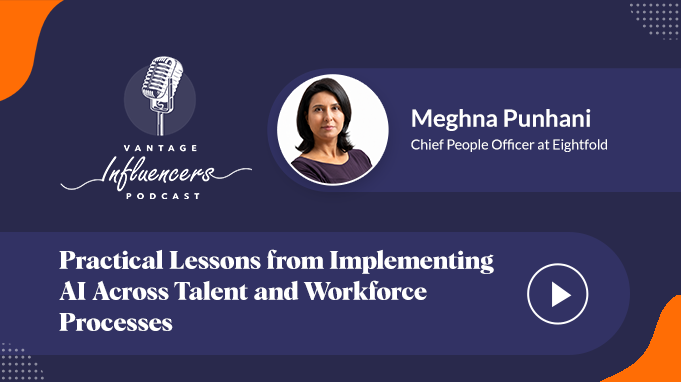
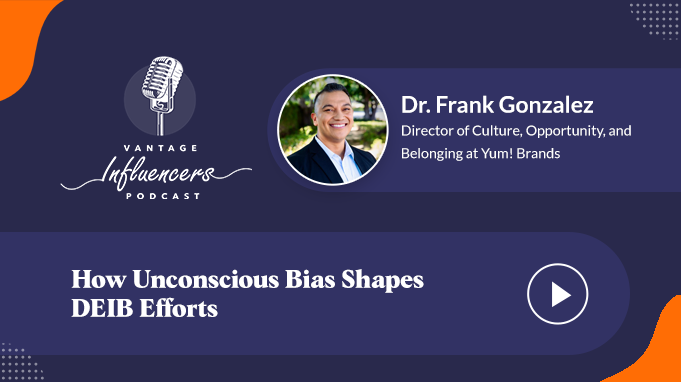
How Unconscious Bias Shapes DEIB efforts
Episode Overview
Dr. Frank Gonzalez opens this episode of the Vantage Influencers Podcast by pointing out that everyone carries bias, including himself, and that awareness only sharpens when you deliberately pulse-check your own thinking with other people. He walks through the roots of unconscious bias: our brains reward fast decisions, we resist change, our emotions color how we interpret situations, and we lean hard on past experience and routine. To make this concrete, he traces his own moment of reckoning back to an early role in healthcare, where he watched families get separated over decisions nobody had thought to question, simply because that separation had become the unquestioned status quo. Naming the practice out loud, he explains, and replacing it with structured family conferences produced a measurable, sustained drop in those separations, proof that bias hiding inside "how things are done" can be broken once it's made visible.
From there, the conversation turns to what happens when organizations try to act on that awareness. Dr. Gonzalez describes a hiring and career-pathing initiative built on reading hundreds of open-ended survey responses rather than only the numbers, which surfaced biases like favoring familiar or likable candidates over qualified ones, and led to a 15x increase in the pipeline of underrepresented talent within ten months. He also introduces "followership" as the flip side of leadership, the influence every employee has in shaping how bias plays out around them, and lays out how he runs bias workshops: voluntary rather than mandatory, built to recruit future facilitators, and designed to sit with discomfort rather than rush toward closure. He closes by cautioning that AI tools for hiring and communication can just as easily encode old biases as remove them, unless organizations keep asking whose needs the tool is built to serve.
Episode Highlights
- Frank Gonzalez argues that unconscious bias hides inside routine, past experience, and our brain's push for fast decisions, and that naming it out loud is the first step to breaking it.
- A powerful example from his early healthcare career: family separations that were treated as normal until leadership started asking why, leading to a sustained drop once family-conference alternatives were introduced.
- A hiring and career-pathing initiative built on reading hundreds of qualitative survey responses uncovered bias favoring familiar or likable candidates and delivered a 15x increase in the pipeline of underrepresented talent in just ten months.
- Followership, described as the mirror of leadership, shapes how bias gets reinforced or challenged long before it reaches a leader's desk.
- Bias workshops work best as voluntary "workshops," not mandatory "trainings," and should be designed to recruit future facilitators rather than depend on one person.
- AI tools for hiring and communication can just as easily bake in old biases as remove them, so the real safeguard is constantly asking whose needs the tool serves and who it leaves out.
About the Guest
Dr. Frank Gonzalez, Director of Culture, Opportunity, and Belonging at Yum Brands
Dr. Frank Gonzalez has spent two decades working in diversity, equity, inclusion, and belonging across public and corporate organizations, starting in healthcare and health and human services before moving into corporate DEIB leadership. He holds a Doctor of Philosophy in Organizational Leadership and Management, focused on workplace personality and leader-follower relationships, and combines data-driven program design with hands-on training and facilitation. At Yum Brands, he leads culture, opportunity, and belonging initiatives for a global workforce, applying frameworks such as Corn Ferry's and Deloitte's DEIB maturity models to hiring, career pathing, and retention.
Connect with Frank on LinkedIn
Host
Riha Jaishi, Vantage Influencers Podcast Host
What You Will Learn
- Why unconscious bias hides inside routine, past experience, and quick decision-making, and how to start noticing your own.
- How reading qualitative survey responses, not just scores, can surface hidden hiring and promotion bias.
- What "followership" means and why it matters as much as leadership in shaping culture.
- How to design bias workshops people actually want to attend, and why voluntary beats mandatory.
- What to watch for when using AI tools in hiring, job descriptions, or internal communication.
- Why organizations should expect DEIB work to never feel "finished."
Key Topics & Timestamps
| Timestamp | Topic |
|---|---|
| 01:56 | Frank's professional journey, identity, and values |
| 05:16 | Recognizing the impact of unconscious bias on organizational culture |
| 14:14 | Turning qualitative survey data into visualizations that surface bias |
| 21:23 | Aligning DEIB goals with broader business outcomes |
| 26:51 | Followership as the foundation for reducing bias |
| 33:19 | Designing training and workshops that address unconscious bias |
| 40:02 | Emerging trends and technologies shaping the future of DEIB |
Full Transcript
Click to read the full episode transcript
Welcome to the Vantage HR Influencers podcast. This podcast is sponsored by Vantage Circle, the simple and AI-powered rewards and recognition platform for employee engagement.
In an era where diversity, equity, inclusion, and belonging are more significant than mere buzzwords, it's essential to understand the forces that drive these initiatives. Unconscious bias, an often overlooked aspect of human psychology, plays a major role in shaping the success of DEIB initiatives, influencing everything from organizational culture to decision making.
Having said that, in today's episode, we will focus on unraveling how unconscious bias impacts DEIB efforts. This exploration is about understanding the subtle, yet powerful influences that can either support or hinder the progress of creating inclusive workplaces. From exposure to training that opens our eyes to biases, to using new tools designed to combat them, we'll look at how progressive organizations are advancing their DEIB initiatives.
Riha Jaishi: So hello listeners, welcome to the Vantage HR Influencers podcast. I'm your host, Riha, and today we have with us Dr. Frank Gonzalez, Director of Culture, Opportunity and Belonging at Yum Brands. Welcome to the show, Frank. It's wonderful to have you with us today.
Dr. Frank Gonzalez: Thank you, my friend, and thank you everyone. Thank you for listeners dialing in, and thank you for the invitation. Look forward to a great conversation.
Riha Jaishi: We are looking forward to the conversation as well. Okay, so to kick things off, can you briefly take us through your professional journey so far, Frank? Our listeners and I are eager to learn about your journey.
Dr. Frank Gonzalez: Sure. Well, I think my journey starts a little bit with my identity. So Frank, I use he, him, his pronouns, identify as a cisgender male ambivert, meaning I have a balance between introversion and extroversion, but I certainly like my reflective and quiet time, dark brown skin, identify as Mexican American living in the continental US, proud father of a six year old who will be seven in a few months, and husband to my spouse of what will soon be 14 years of marriage.
And one of the quotes I've always lived by is a quote by Cesar Chavez that says, grant me the courage to serve others, because in service there's true life. I love that quote, I live by that quote, because it can be manifested in so many different ways.
You mentioned my official title, yes, Director of Culture, Opportunity, and Belonging with Yum Brands, which is a global brand with well over a million employees around the world. I've been navigating two decades of DNI work in various public and corporate entities. But I always, always focus on the relationships, the influence on people, their own growth, what's helping them, what's holding them back.
Officially, I hold a Doctor of Philosophy in Organizational Leadership and Management. My emphasis and my passion is around people's personality, but personality in the sense of how we build relationships with each other, as well as in-group, out-group dynamics. I didn't take a straight path to get here. I spent a lot of time in workplaces before ever going back for postgraduate degrees, making sense of things through experience before going back to school.
Within in-group, out-group dynamics, a lot of it is the leader and employee relationships that we often overlook, which I know we'll get into.
And I'll end my journey the way I started, with my identity, but also my values. I always ask my directs, my peers, my leaders, a kind of 360 view, whether I'm being true to three things: being genuine, trustworthy, and approachable. I believe when we approach this kind of work, or any work related to humans and the employee experience and helping others, those are three things worth living by.
But a lot of my experience comes from different kinds of industries, global, local, startup, mid-size, large companies, as a consultant or in-house. So that's a little bit about myself, my friend.
Riha Jaishi: That's such an inspiring journey, Frank, really loved it. Thank you for sharing your experience. So with your permission, I would like to delve further into the topic.
Dr. Frank Gonzalez: Yes. Sounds good. Let's do it.
Riha Jaishi: Okay, great. So as you know, unconscious bias can subtly influence many aspects of organizational culture and decision making. So could you share a moment in your career where you first recognized the kind of impact unconscious bias can have on organizational culture?
Dr. Frank Gonzalez: Absolutely. I have so many examples of that, but I'll try to stick with the first time I recognized it, because we all have it. I myself have it. I try to intentionally look at what my biases may be by pulse-checking with others nowadays. Hey, this is what I'm thinking, tell me differently, play the advocate on the other side of this thought process, et cetera.
I'd like to start with a couple of approaches before I get into that first time I saw it. When I look at the unconscious bias that we all have, there are over 200 known biases that are well researched and can be categorized. I encourage listeners to search "cognitive bias codex," a great visualization, and since this is an AI rewards and recognition platform, definitely look at this visualization. It categorizes the things we remember, our experiences, and this human need to take action really, really quickly, so our decisions happen right away. Something happens and we're wired to solve it, so we act right away.
Then there are two other parts of how our brain is wired: having not enough information, or having too much information that becomes overwhelming. That's one approach, the cognitive bias codex. Hopefully that lands with some folks. There are different biases, some really fun ones. If you know the global brand IKEA, there's a well-researched bias around it, meaning that when we build something ourselves, we develop a bias toward it. There are so many different biases, and maybe some of them will land with you.
The other thing is just the change around us. Change is a really big barrier that we'll get into in a little bit. We're so used to, in our formative years, being around friends and family who influence us, the neighborhoods we grow up in, the experiences all around us from those who care for us. As humans, we're wired to avoid change.
In business, in organizations, we're all about short-term goals, KPIs, and successes. We're also very emotional creatures, meaning we have feelings toward something, and depending on the culture you grew up with, we either embrace those feelings or avoid them.
The last two are also part of that codex bias: one is experiences. We rely a lot on our past experiences, and that's where a lot of the foundation of bias comes from. For 10, 20, 30, 40 years of our life, we've navigated it already, so we rely on those experiences and tap into them, right, wrong, or indifferent.
The last one is routine. As humans, we love routine, there's something in it for wellness and well-being. We love waking up around the same time, doing the same things, having the same conversations with the same people. Breaking that routine can almost feel like a path toward unwellness.
But the first time I really experienced this was in healthcare. If you look at my background, I actually started formally in healthcare. Within health and human services, there are so many different departments: residential treatment centers, hospitals, protection services for youth, children, adults, and the elderly.
One of the first things I witnessed, and I want you to take a moment to envision this: you're growing up, pick an age under 10, maybe six or seven, with your family, and think about all the routine you have. Where you sleep, where you eat, who you talk to, whether you go to school. Now imagine you're suddenly taken from your family and placed even just 30 or 40 miles away, outside your neighborhood, outside your familiar surroundings. Think about what that would really feel and look like. Unfortunately, some listeners may have experienced this closely, personally or within their network.
That's what I witnessed in the workplace, because in healthcare you see it right away. In my first six months, I saw children and families separated, not for very long and not very far, but so much was happening where nobody knew this family, this routine was different from what we were used to. I would get a lot of calls, almost like social work, people saying "I've never had this age group in my home before" or "I've never had this culture in my home" in temporary foster placements. I'd have very intentional conversations: what's the routine, have you talked to them, what's going on. People used me as an outlet.
But here's where the unconscious bias really took place. It wasn't in those conversations, it was in going to leadership and asking, why did we even break this family apart? Where was the risk? What was going on? Why did we need to do this? It turned out to be the status quo culture setting the tone for what was acceptable and unacceptable.
Fast forward, and yes, there is a happy ending. It came from having those conversations and surfacing that this wasn't normal, even though it was routine for the system. What we instilled in that organization was something called family group conferences and family team meetings, building a support system around families instead of separating them. We saw a significant, sustained drop in family separations quarter over quarter, year over year.
That's just healthcare. It's not always as drastic in tech, finance, or other industries, but the gravity of what can happen is real. That was my first real introduction to bias. What you can do is break the bias, because people rely on their experiences, their environment, and unwritten processes around them, and nobody questions whether that's actually the norm.
So I'd challenge you to ask how you can break the norm in your own environment and question what might be bias versus what folks are simply unaware of.
Riha Jaishi: I really must say those are some really amazing insights that you've given. This idea of the cognitive bias codex, and the roles of change, experience, and routine, these are things our listeners and I should really reflect upon, right?
Dr. Frank Gonzalez: Absolutely. Absolutely.
Riha Jaishi: Okay, so moving ahead, can you describe a specific project or initiative where you successfully managed to integrate qualitative survey data into visualizations to highlight issues related to unconscious bias, and what was the outcome, if you may say so?
Dr. Frank Gonzalez: Absolutely. Most recently, going back to 2023, the situation was that we couldn't find talent based on the geographical location of our corporate offices and hubs, we didn't have career pathing, and we had low engagement scores. So we came up with two initiatives to build an end-to-end employee experience: an equitable hiring project and a career pathing initiative.
One of the first steps was using a framework or maturity model to visualize where different functions actually stood. Are you at level zero or one, just getting started? Are you emerging? Are you advanced or leading? You can't assume the whole organization, or even each function, is at the same level. Finance might be at level one, HR at level two or three, and operations might already be more advanced.
We built a framework around leadership, courageous conversations, development, and hiring. We combined that with good practices like reviewing the most recent engagement scores, not just celebrating the positives like favorability above 80% in different categories, but actually looking at the bottom half and asking where the unfavorable experiences were, particularly around career pathing, hiring, and retention.
I looked at those surveys, but more importantly, I read every single qualitative open-ended response in those engagement scores. That takes time, we're talking about several hundred responses, and not everyone does this because people worry about being identified or how their feedback will be used. But reading through all of those open responses, not just the quantitative Likert-scale data, is where the real insight comes from.
We also ran something we called a stay survey, a mix of Likert-scale questions on favorability alongside open, qualitative questions like "what's your experience here" and "why do you stay." We looked at new hires specifically, gathering feedback at their first 30, 60, and 90 days.
The core problem we were solving was that we couldn't attract and keep talent. We approached it almost like a hypothesis, using a leadership model built around three categories that we applied across the entire employee experience, from hiring through retention and promotion: how do you lead yourself, meaning growth mindset; how do you coach or accept coaching; and how do you lead others. A lot of us actually operate more in a self-growth or coaching mindset than in a leading one. We added questions to hiring to understand what candidates were really thinking, and applied the same thinking to promotions, mid-year reviews, and individual development plans.
From the hiring side, we increased our pipeline of underrepresented talent by up to 15x within a 10-month pilot. The promotion piece also contributed to retention, since growth doesn't always mean a lateral move. We saw retention and engagement scores go up, and people started to feel they had a real pathway with the organization.
The hiring pilot also surfaced additional biases: familiarity, likability, inconsistency, comparing candidates to each other instead of to the job description, and not actually using stated qualifications in the final decision. The most critical piece was documenting and visualizing every touch point in the process, along with where the opportunities were, so leaders understood it clearly. We also built out our coaches as a kind of funnel, developing a 2.0 and 3.0 version of the program, because these initiatives aren't one-time wins. You have to keep growing and evolving them rather than getting too comfortable with early success.
Riha Jaishi: Frank, what you're describing with qualitative data visualizations really helps us understand the pervasive nature of unconscious bias and how prevalent it is everywhere. It also shows the potential of data-driven approaches to drive significant organizational change. Now, moving ahead, considering your strategic work with operational plans and employee feedback, what are some innovative approaches you've implemented or seen that effectively align DEIB goals with broader business outcomes?
Dr. Frank Gonzalez: When I think about new approaches, I think less about brand-new ideas and more about who or which functions haven't been included yet. My approach starts with including operations and marketing. Operations is usually where the business grows or generates revenue, and it's often overlooked. Marketing, where an organization has one, handles creative services, commercialization, and messaging, and it's also often overlooked, even though it's an untapped resource for how you can communicate DEIB work internally. So step one is starting with those two functions and assessing their maturity.
The next step is combining different maturity models. I don't get any royalties from mentioning this, but I use a combination of Corn Ferry's and Deloitte's inclusive frameworks. Corn Ferry's uses the acronym MORAT: marketing, operations, risk management, awareness, and talent, scored on a scale of one to four, from basic to progressing, advanced, and leading.
The key is visualizing progress by period or quarter, understanding the business, sourcing initiatives from feedback and listening tours, and attaching a clear objective or impact to each one so people can see their progress or regression. You attach KPIs, an owner, and a cost, and I approach it like project management where the owner or sponsor is never me. It has to be someone within that function, a senior leader, so there's real accountability, and the squad is made up of people from within that function so they have ownership. There's usually a lot of upfront pushback, like "Frank, we hired you to do this," but in order for a function to actually mature and eventually lead and own the work, someone within it has to sponsor it. I'm there to support throughout, but I won't be the long-term owner.
Assessing maturity is a mix of qualitative and quantitative input. You have conversations with different teams: some don't understand it yet and have no processes but are excited, they're at a one or two. Others are advanced or leading, they have examples, active practices, and only come to the DNI team for a consult or additional feedback. In between, some have processes written down and some passion but not yet full purpose behind it.
Those are the innovative parts, at least in how I interpret it: get buy-in, treat it like a comms plan or change management initiative tied to a business priority, and give it a real timeframe. Deloitte's model is similar, also one through four, and used widely by global organizations, starting at "compliant," because many people still see DNI as something they have to do rather than want to or need to, all the way up to "leading" and fully integrated with ownership and accountability.
So to sum it up, always include operations and wherever the real business priorities sit, along with a marketing or creative team, because in my experience they tend to be the most open and can help you communicate and scale the work across the organization.
Riha Jaishi: These strategies truly show how embedding DEIB into the fabric of organizational metrics and goals can drive real, substantive change, and reinforce the importance of diversity and inclusion in achieving broader business success.
Okay, so I came across a statement in your bio that reads, and I quote, "followership value as a foundation to lead," unquote. Could you explain how this principle influences reducing unconscious bias and strengthening DEIB initiatives?
Dr. Frank Gonzalez: First of all, I appreciate you digging that up, because that's absolutely something I live by. Thank you for that.
I'd start by asking you and the listeners to just think, with no right or wrong answer, about what your own definition of leadership is. Take a moment, pause, and ask yourself: what is leadership?
The operational, measurable piece of it still comes down to social psychology, which deals with the thoughts, feelings, and behaviors we're influenced by based on the presence, real or perceived, of others. In business, that's usually the positional leader we're influenced by, even someone we've never personally met, only seen at town halls or virtually, like a CEO or the C-suite. We may never interact with them directly, but they still influence our thoughts, feelings, and behaviors. That's the influence we're talking about.
So what is followership? It's been studied and operationalized for just as long as leadership, but it's often overlooked. Followership is the mirror of leadership. How are we influenced? What do we expect and accept in the workplace? Put differently, how do we differentiate ourselves and create our own path?
There are always more followers than positional leaders in any organization, your team, your function, but also your own coach. I call leaders coaches, because that's the expectation I hold as a follower. My boss is a coach, but that coach is also a follower to someone more senior, who's accountable to the C-suite, who's accountable to the CEO, who's accountable to shareholders and customers, and the circle continues.
Looking at the world through followership means asking how we're influenced and how we differentiate ourselves. I recently posted something on LinkedIn describing different typologies of followership. There's the destructor, someone with negative energy. There's the doer, who responds quickly, answers emails and calls right away, and shows a lot of activity. There's the dancer, a neutral follower who just moves with the rhythm of the team without being very visible. There's the delegator, who hands off influence and deliverables to others. And then there's the differentiator, which in my view and research is the highest level of followership, someone who balances doing and delegating well. Differentiators are the ones who tend to come up in conversations about promotions, merit raises, and visibility, because those formal HR conversations during mid-year reviews or calibrations naturally focus on people who've differentiated themselves.
So the pathway toward leadership really starts with looking at yourself, looking at others, viewing your own coach as a follower too, and building your own influence and visibility by doing or delegating in a way that differentiates you.
But I'll say this, followership is hard. There's a wellness piece to it. Depending on someone's DNI background and experiences, there's a need to reassure authority figures, a sense of security in staying neutral or going along with others, a desire for camaraderie and not wanting to be in the out-group, and a kind of social desirability that holds people back, sometimes consciously, sometimes unconsciously, as a follower.
That's a long answer, but I wanted to give real context. Followership, to me, is a value and a foundation for leadership.
Riha Jaishi: Frank, just like this principle stood out to me in your bio, it really does sound like a unique and powerful approach to leadership, this idea of differentiating yourself and understanding how you influence others. I believe it genuinely helps create a more harmonious and effective workplace when leaders embrace it.
Okay, so since you have such strong expertise as a trainer and conflict facilitator, how do you approach your training and workshops when addressing unconscious bias, and what unique challenges does that pose for you?
Dr. Frank Gonzalez: Those who know me and have been in workshops with me going back to the early 2000s will tell you I haven't changed my methodology too much. There's still a needs analysis: talking with operations, business leaders, skip-level conversations, understanding priorities, and coming up with five or fewer objectives for any workshop, whatever we end up calling it. We've called this work many different things over the years, and that's fine.
I always approach it with a bit of honesty and a bit of humor and fun, some music to set the tone, some lighter examples before getting into the heavier material, because DNI training and workshops can get heavy. I'll often use myself as an example, like the first time someone asked me about my race, ethnicity, gender, or culture and neither of us really understood the other. A few laughs before the heavier conversations helps, because you can't expect people to be vulnerable and share unless you're willing to do the same first.
A few approaches that don't get talked about enough: first, making it voluntary. A lot of organizations want to make DNI training mandatory because they want completion-rate KPIs, 80, 90, 100 percent. But research shows that mandatory training only gets people to master the objectives for the moment, and application drops off within about 90 days. Voluntary participation leads to people actually mastering the content long term. I also prefer the word "workshop" over "training," because a workshop implies breakouts, activity, and action plans, not just one-way communication from trainer to audience.
Second, I treat every workshop as an opportunity to scale and recruit. I'm always thinking about how to identify other potential facilitators within the room and build a train-the-trainer pipeline, because people who are passionate about this work are worth recruiting as future facilitators. Nobody's going to listen to me long-term, but they will listen to their own functional leaders, who can speak to specific, real examples of applying this work.
The last thing I'd mention is that the deeper you go, the more likely confidentiality and HR issues come up, sometimes as an unfortunate byproduct of people getting genuinely vulnerable. Some things have to be reported to employee relations to keep people safe, there's no true "what happens here stays here" rule in this kind of work. I try to manage that with clear rules of engagement that I reestablish each time, so people understand it's there to keep everyone safe.
I also spend a lot of time with leaders who are neutral or fearful. If you're fearful, chances are your own leader or coach carries some fear too. The way through that fear is to actually name it: is this fear, or is this just resistance to change? Writing it down, talking about it, and working through it in breakout activities often shows people that what felt like an ambiguous fear is really something specific they just haven't addressed yet. Neutral and fearful leaders are often the biggest barrier to breaking unconscious bias.
Riha Jaishi: True, I can see how these approaches help create a safe and comfortable space, help people acknowledge hidden biases, and pave the way for a deeper understanding and commitment to change, which in turn helps create a more inclusive and equitable workplace culture, right?
Dr. Frank Gonzalez: Right. Right.
Riha Jaishi: So, we're nearing the end of today's session, but before we wrap up, are there any emerging trends or technologies you believe will significantly influence how organizations address unconscious bias and DEIB? Could you share some for our listeners?
Dr. Frank Gonzalez: I still think AI platforms, tools like ChatGPT or Copilot, can be powerful if the parameters guiding them are always set with the question of who's not at the table, who's excluded. I've seen programs that unintentionally exclude people from scholarships or hiring because job descriptions used jargon that wasn't understood by everyone. The emerging piece is treating AI almost like a consulting exercise: when setting or resetting AI parameters, ask whose needs are met, whose aren't, who benefits, and who's excluded. That question applies to any AI platform or visualization tool, whether it's about accessibility for visual or auditory needs, or about exclusion and inclusion in hiring. Even asking a platform to generate a job posting means it's aggregating information that already exists, so we still have to be willing to invent and reinvent things ourselves, and that comes with some discomfort.
On trends, there's been a lot of experimentation, virtual reality programs, and even some unconscious bias initiatives that toured around almost a decade ago, but those tend to lose momentum because they put people in a very comfortable setting. That works fine for a live workshop, but when people are using AI tools from the comfort of their own office, home, or hybrid setup, there has to be some built-in discomfort. That's where a framework like courageous conversations comes in.
Courageous conversations were developed specifically for unconscious bias work. I'll close with its core ideas: speak your truth, meaning your own lived experience; stay engaged, because our communication has actually decreased as AI and technology have advanced, so staying engaged matters more, not less; and expect some discomfort, because discomfort is what leads to real growth and to actually breaking unconscious bias.
The last point, which runs counter to how most organizations think, is that you have to expect and accept non-closure. You'll rarely walk away from an AI interaction, a platform, or a deliverable and say "this is complete." It won't be, and that's fine. Organizations need to accept that this work doesn't have a true finish line, and approach it with that same courageous-conversation mindset.
Riha Jaishi: Some amazing insights on trends and technology, Frank, really loved it. I'm sure they have the potential to shape how DEIB efforts evolve across workplaces, right?
Dr. Frank Gonzalez: So right, my friend, so right.
Riha Jaishi: Okay, so Frank, we've come to the end of our session. First of all, thank you so much for joining us today and sharing such incredible insights. It's been more than a pleasure hearing your perspective on how DEIB initiatives are heavily influenced by unconscious bias.
Dr. Frank Gonzalez: Absolutely.
Riha Jaishi: We truly appreciate your time and expertise, and I'm sure our listeners are walking away with a lot to reflect on. Anything you'd like to add, Frank?
Dr. Frank Gonzalez: Just know that I'm always happy to be of encouragement, so reach out. I'm active on platforms like LinkedIn. We're all in this together when it comes to people, and to making better experiences for each other.
Riha Jaishi: Definitely, Frank. And to our listeners, thank you for tuning in. We hope you found today's conversation as enlightening as we did. Until next time, take care, and we'll see you soon.
Thanks for listening to the Vantage HR Influencers podcast. Please subscribe to the Vantage HR Influencers podcast on Apple Podcasts, Spotify, and our YouTube channel for new episodes.
FAQ
What is unconscious bias and why does it matter for DEIB?
Unconscious bias refers to the automatic judgments people form because of fast decision-making, past experience, routine, and resistance to change. Dr. Frank Gonzalez explains that because everyone carries some form of it, DEIB efforts succeed only when organizations actively surface and question the unwritten assumptions behind everyday decisions rather than assuming good intentions are enough.
How can organizations use survey data to uncover hidden bias?
Dr. Gonzalez recommends going beyond quantitative scores like Likert ratings and reading the full set of qualitative, open-ended survey responses, even when that means working through hundreds of entries. That deeper read is what revealed hiring biases such as favoring familiar or likable candidates over qualified ones.
What is "followership" and how does it relate to leadership?
Followership is the influence every employee has on how bias gets reinforced or challenged, independent of their position. Dr. Gonzalez describes it as the mirror of leadership: how people respond to authority, what they accept as normal, and how they differentiate themselves shapes culture just as much as decisions made at the top.
Should DEIB training be mandatory or voluntary?
Dr. Gonzalez favors voluntary workshops over mandatory training. His experience is that mandatory sessions produce short-term compliance that fades within about 90 days, while voluntary participation leads to deeper, longer-lasting engagement with the material.
Related Reading
Also listen on