Overcoming Cross-Cultural Issues In The Workplace
Episode Overview
Luc Jones opens the conversation by challenging a comfortable assumption, that cultures are fundamentally different from one another. He argues the opposite: most people across the world share similar ambitions, and what looks like a deep cultural divide is often just an accumulated stereotype, some grounded in truth, most exaggerated. Drawing on a life split between Britain and French-speaking Canada, and long stretches spent living across Eastern Europe, Central Asia, and India, he explains why a Russian who does not smile immediately and an Indian who smiles constantly are both simply behaving in ways that make sense within their own social context, not signs of coldness or warmth. He extends the same logic to unconscious bias, arguing it can never be eliminated because people naturally gravitate toward others with shared backgrounds and interests, but it can be managed by judging candidates and colleagues on what they can do rather than on instinctive comfort.
The conversation moves from theory to practice as Luc lays out what actually helps organizations bridge these gaps: rotating people through offices in other countries, encouraging candid conversations about how colleagues prefer to work and be addressed, and resisting the urge to hire only people who look and think like the existing team. He is candid about the limits of good intentions, noting that boards and hiring panels that never leave their home market tend to fall behind, while consciously seeking out people with different backgrounds sharpens decision-making. He also broadens the definition of cross-cultural friction beyond geography, pointing to age as an underexamined divide: capable professionals in their fifties and sixties are increasingly screened out of hiring pipelines simply for feeling unfamiliar to younger recruiters, a bias he considers just as damaging as any national stereotype. His closing message is simple: travel, ask questions, observe without judgment, and treat every difference as neither good nor bad, just different.
Episode Highlights
- Luc argues cultural differences are usually exaggerated stereotypes, pointing to his own book on why Russians rarely smile immediately as a generalization that holds a kernel of truth.
- He treats unconscious bias as unavoidable but manageable, saying the fix is judging people on capability rather than on instinctive familiarity.
- Job rotations and short placements in other offices, he says, do more to build cross-cultural fluency than any classroom training.
- He points out that in India, work and personal life stay separate, while in parts of Eastern Europe the two blend completely, a difference newcomers need to be told about rather than guess at.
- Ageism gets flagged as its own form of cross-cultural bias, with experienced professionals in their fifties and sixties routinely screened out simply for feeling unfamiliar to younger hiring teams.
- His advice for anyone relocating or working across cultures: ask colleagues directly how they like to be addressed and how work gets done, rather than assuming.
About the Guest
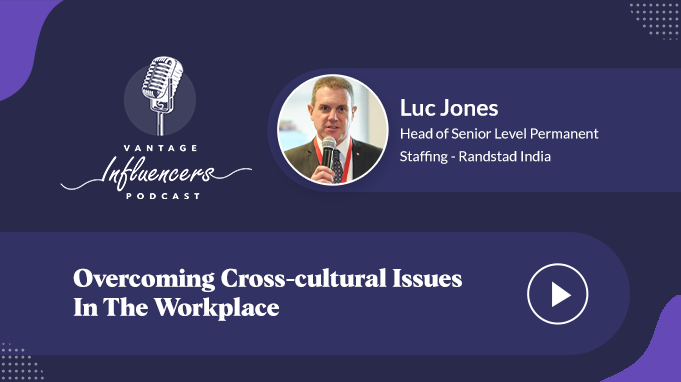
Luc Jones, Head of Senior Level Permanent Staffing - Randstad India
Luc Jones is a recruitment executive with a multicultural background of his own, British by nationality with a mother from the French-speaking part of Canada. Based in Bangalore, he has lived and worked across Eastern Europe, Central Asia, and India, and has visited more than 150 countries, an experience he says permanently changed how he reads cultural stereotypes. He wrote a book about why Russians rarely smile at strangers, hosts a YouTube channel called Luc Jones The Other Way that pushes back against sensationalist travel content, and remains an outspoken advocate for cross-border curiosity over assumption.
Host
Sanjeevani Saikia, Vantage Influencers Podcast Host
What You Will Learn
- Why cultural stereotypes usually contain a kernel of truth, and how to separate that from the exaggeration
- Why unconscious bias can never be fully eliminated, and how to manage it in hiring decisions
- How company-sponsored relocations and short placements build cross-cultural fluency faster than training programs
- Why ageism and generational bias deserve the same deliberate attention as cultural bias
- How to navigate unfamiliar workplace norms, from personal space to communication styles, without causing offense
- Why travel and curiosity, not policy alone, are what ultimately dissolve cross-cultural friction
Key Topics & Timestamps
| Timestamp | Topic |
|---|---|
| 02:05 | Luc's path into international recruitment and life across cultures |
| 02:48 | How Luc defines cross-cultural issues, and why stereotypes hold a grain of truth |
| 04:58 | The specific challenges organizations face from cultural differences |
| 08:35 | Whether unconscious bias drives these challenges, and how to manage it |
| 12:18 | Strategies for building a culturally sensitive workplace |
| 24:38 | Real examples of cross-cultural initiatives that worked |
| 32:22 | How organizations can measure success in addressing cross-cultural issues |
| 38:59 | Ageism, the generation gap, and emerging workplace trends |
| 42:35 | Luc's closing advice for listeners |
Full Transcript
Click to read the full episode transcript
Welcome to the Vantage HR Influencers Podcast. This podcast is sponsored by Vantage Circle, the simple and AI-powered rewards and recognition platform for employee engagement.
In today's globalized and interconnected world, workplaces are increasingly becoming melting pots of diverse cultures, backgrounds and perspectives. Yet, within this magnificent diversity lies a profound challenge: the need to confront and transcend cross-cultural issues in the workplace. It's no longer sufficient to merely acknowledge the differences. We must wholeheartedly embrace the immense value that diversity brings. Our journey today is to understand why this is an absolute imperative for businesses and institutions yearning to thrive in an ever-changing global landscape.
So without further ado, let's dive into the fascinating realm of cross-cultural dynamics in the workplace and explore how it can shape a brighter, more innovative future for us all.
Sanjeevani Saikia: Hello listeners, welcome to another episode of Vantage Influencers Podcast, where we explore a wide range of HR topics that are sure to grab your attention and inspire you. I'm your host, Sanjeevani Saikia, and today we will be having a conversation on overcoming cross-cultural issues in the workplace. And for the same, I have with me Luc Jones, Head of Senior Level Permanent Staffing, Randstad India. Hi, Luc.
Luc Jones: Hi, good morning.
Sanjeevani Saikia: First of all, I would like to wholeheartedly thank you for giving your invaluable time and joining us in today's episode. Before we dive deeper into today's topic, overcoming cross-cultural issues in the workplace, could you kindly walk us through your corporate journey so far?
Luc Jones: Sure, absolutely, no pleasure. Well, my name is Luc Jones. I'm British, although my mother is from the French-speaking part of Canada, Quebec. I have 25 years of experience in international recruitment. I've worked in many countries, mostly in Eastern Europe and Central Asia, and now I'm based in Bangalore in India, recruiting for multinational companies and local firms. And obviously, cross-cultural issues are at the very heart of what we do.
Sanjeevani Saikia: Wonderful. Thank you for sharing your journey with us. Luc, today we will be discussing cross-cultural differences in the workplace. So to get us started, how do you define cross-cultural issues, be it in the workplace or anywhere for that matter? How do you like to go about defining it?
Luc Jones: Sure. Well, there are approximately 8 billion people on this planet and we're all different in some way, although I think there are more things that unite us than divide us. But obviously, there are specifics to each national group, or to cultural groups within certain countries. There are also lots of stereotypes, and some of these are actually true. So to give you a simple example, I wrote a book called Why Russians Don't Smile, because I was based in Moscow for many years. This is a stereotype that foreigners have, but there is some truth in it. And people are now asking me when I'm going to write a book called Why Indians Always Smile, because the view of people from outside of Asia is that Indians, and Asians in general, do smile a lot. It's obviously lovely, nice and welcoming, maybe because the climate is warmer and it makes people warmer at heart. But if I look at why Russians don't smile immediately, well, they don't, simply because they don't see it as a reason to, unless there's actually a reason to begin with. We might smile at people because we want to make them feel comfortable, whereas in Russia, where it's a lot colder, they don't see the need for that. So again, there are generalizations, there are stereotypes, but the whole issue of cross-cultural work is about overcoming these and getting people to work better together.
Sanjeevani Saikia: Really interesting. As organizations strive to create inclusive environments, they often encounter unique challenges stemming from cultural differences among employees. I believe these challenges can manifest in various ways. So could you help us identify those challenges that arise due to cultural differences?
Luc Jones: One of the reasons why I'm a big fan of travel in general is because I think it opens people's eyes and smashes the stereotypes people have. If you're from another part of the world, especially from Europe or North America, and you've never been to India before, your perception is usually shaped by what you've seen in a Bollywood movie. People think there are dancers going down the street and elephants on either side, or people sitting on mountaintops doing yoga and chanting mantras, or they've watched Slumdog Millionaire, and that becomes their impression of India. Then they get here and it's rather different. But you could say the same about almost any country. If you ask people what's the first thing that comes into their head when they think of Australia, it's probably kangaroos and boomerangs, and again, it's rather different when you arrive. So the important thing is for people to realize that we're all people. Most people in the world have similar ambitions and goals, we all want to get on in life. The important thing is to be sensitive to how other people live and behave.
I regularly hear this: officially there are 195 countries in the world, and I've been to 156 of them, so 39 to go. Many of those have been as a tourist, some for work. One of the interesting things I've found is that a lot of people love to think everywhere else in the world is dangerous except where they come from themselves, which I find rather bizarre. I'd blame the media for this. When I mention I've been to places like Syria, Sudan, Tajikistan, Venezuela, or North Korea, people's reaction is, isn't it dangerous there? And when I ask why they think so, it's usually because they saw some documentary on CNN or BBC. No journalist ever became famous by writing about the trains running on time. News requires sensation, and most of the time things just carry on as normal. People want to live their lives, and that's why I encourage travel.
Coming back to the actual workplace, this is why I think having a diverse office is a great help, because first of all it makes things a lot more interesting. I'm the only non-Indian among about 3,000 staff here, so I stick out a little bit. I'm based in Bangalore, which is a melting pot for people from all over the country, lots of languages, lots of different cultures. India is an extremely diverse country, so there's a good example.
Sanjeevani Saikia: Yeah, and that was a really interesting perspective from your side. Do you believe that all of this arises from underlying unconscious biases? I think unconscious biases may hinder cultural collaboration, so how can we proactively identify it, and what should we do about it in the first place?
Luc Jones: I think unconscious bias exists everywhere, and we will probably never get rid of it totally because it's human nature. If you think about it, you're friends with people who have similar interests to you or a similar background, that's normal. I mix with some of the foreigners here, and there are things I have more in common with other Europeans than I might with local Indians. And people will usually hire other people who are similar to themselves. So what do you do about that? I look at what somebody can do rather than just whether I like them. I have to take into account whether this person would fit into the team, how they'd get on with everybody else. That's human nature, as I said. But I also say to people that the important thing is we've all got one goal at work, and that's to be successful, to do what we need to do. I think a lot of it is also about a combination of education and discussion.
One of the things people find when they come to India, or Asia in general, is that it's very rare that you'll hear the word no. One of the first things I was taught when I came to India was that if somebody says "yes, but", that probably means no, or "I'll look into it", which is generally a no. We're guilty of this a little bit too. We say "not really" when we actually mean no. Whereas in East European or Russian culture, you'll immediately get a blunt no. You can be thrown aback by this, it's very blunt, but at least you know where you stand. For us, it's a bit vague when somebody says "I will do my best", which is basically a polite way of saying no. It lulls you into a false sense of security. So a lot of it is education, practice, and meeting other people, and asking people questions about what they do in their society.
For example, for some people timekeeping is extremely important. Germans love to plan ahead, most could tell you what they're doing a year from now, it'll be in their diary. Whereas other cultures can't tell you what they're doing tomorrow. Pluses and minuses to this, the important thing to remember is none of it is right or wrong, or good or bad, it's just different, and you have to take that into account. So yes, I do like planning ahead to some extent, but I don't want to live my entire life in the future.
Sanjeevani Saikia: Luc, I think you would agree organizations that prioritize cultural sensitivity create an inclusive and harmonious environment where employees from diverse backgrounds thrive. So it's important to explore effective strategies that organizations can implement. According to you, what strategies can organizations implement to foster a workplace which is culturally sensitive?
Luc Jones: What I've seen many companies do is move some people around. I think allowing placements or visits to other offices in other parts of the country or the world is very useful, along with encouraging people to discuss things and ask questions like how something would be done in another society. One simple example: in India, people make friends at work, which is great, but personal life is kept very separate. Whereas in other places I've worked, like Eastern Europe, work and personal life are totally entwined and mixed in, which some societies find quite strange. In the UK, where I'm from, it's probably somewhere in the middle, though there are people who keep to themselves, go to work, leave, and don't really interact with their colleagues. So the important thing is that people are aware of how certain things are done in certain places, and that can be helped by inviting people from other offices.
I like it when people have the opportunity to live and work abroad. I'm a huge fan of travel, especially when people are a bit younger, going off to travel and get some work experience abroad. I've talked to people working here in India with me, and I ask if they've been outside the country. Someone might say they did a two-year placement in the US, studying or working, and I always ask what they took away from it, what their expectations were beforehand, usually based on some Hollywood movie, and what it was actually like day-to-day.
One of the things I encourage, if somebody's moved to a new country, is to get involved with people and ask them what they do. For example, I've found that Indians are extremely welcoming and friendly, and I think a lot of the world could learn from that, that's not a compliment, it's just an observation. On the other hand, I do find the society here extremely conservative compared to what I'm used to, especially having worked in Russia and other countries in that region. There's a huge diaspora of Indians abroad, nearly 20 million, but most of them tend to go to English-speaking countries or the Middle East, because it's more familiar. A lot of the countries I've worked in, like Uzbekistan and Kazakhstan, are actually closer to Delhi than Bangalore is, but people know next to nothing about them, they might as well be on the moon. If you asked most people the capital of Kazakhstan, even highly educated people, I'd bet 99% wouldn't know, because they don't need to. And because the country's name ends in "stan", people tend to associate it with Afghanistan or Pakistan, which isn't accurate at all. When I tell people it's an oil-based economy and that we were placing people there, it's totally different from how they expected.
So I find that sharing information is extremely useful. Nowadays there's so much on the internet, and the important thing is to move away from sensationalist clips, and this isn't just the media, even vloggers can be like this. One of the reasons I created my own channel, called Luc Jones The Other Way, is to actually show non-sensationalist content. Because many people will go to North Korea and film themselves saying "look, I'm in North Korea", when actually it was absolutely fine. Yes, there are rules just like everywhere else, but you're not going to become famous by showing something normal.
Sanjeevani Saikia: Yes, so you have mentioned social media, so how can it have an impact? Can you elaborate on this? I think our listeners would love to know how social media can have an impact on this particular subject.
Luc Jones: One of the things I do is travel around India quite a lot, I've been to 15 states already in my first year, and I post a lot on Facebook and Instagram, LinkedIn I use more for work, but a few photos when we're opening a new office in Calcutta or Delhi or Mumbai. I post a lot of pictures so friends back home who don't come here might see it and think about visiting. I'm not promising a flood of tourists among my friends, but you never know, a few have come and a few are planning to. The important thing is to show what it's actually like.
I find it interesting that when I'm visiting tourist sites, people often come up and ask for a selfie, that happens quite often, though not so much in Bangalore, where I walk around and nobody pays me any attention because there are a lot of foreign people living or working here. But at tourist sites, people are very friendly and genuinely curious about what you're doing there. We sometimes find this a little intrusive, because in Europe it's unusual to walk up to strangers and ask them questions. But I don't see it as anything bad, we assume people are trying to sell us something, but in most cases they're not, they're just interested in whether you're working here, whether it's your first time, whether you like it. In that respect, it's lovely, and I think we could learn a bit from that.
I've also found that in Europe you get very used to doing everything yourself, whereas in India, even in the office, we have several office assistants who do pretty much everything. They're now used to the fact that I make my own coffee, but if you look at other managers, they have someone doing it for them. So you pick these things up.
Most people are sensitive to the fact that someone coming from elsewhere may not be aware of every part of the local culture, and you can mention this. There are also companies that offer cross-cultural communication courses about how things are done, which we typically recommend if you're going to move somewhere, or join a new organization headquartered outside India. Ask people how they like to work, what it's like in their home country, what the differences are. To give an example, one German colleague who relocated recently told me that Indians are extremely proactive, which he liked, because in ex-socialist countries people tend to be the opposite, waiting for something to happen rather than going and doing it. But sometimes this can go too far, you might have a situation where someone rings a person in Germany, and if they don't get an answer straight away, they start phoning other people. In Germany, that's not how it works, you phone different people for different purposes, and Germans will start overanalyzing why someone is ringing five different people with different roles. So again, it's not wrong, it's just a different way of getting things done, and it takes time and a combination of education and discussion.
A lot of it also depends on what you're looking to achieve, whether you're planning to move somewhere, visit somewhere, or stay but work in a different environment, and in all cases, ask people. For example, with Indian names, it's not always obvious to a foreigner which part is the first name and which is the surname. But it's perfectly okay to ask people how they like to be addressed, because in some cultures, like China, Vietnam, and Korea, the surname comes before the first name, though it can sometimes be reversed. Some people prefer a nickname, or a shortened version of a longer name. So it's absolutely fine to ask people how they like to be addressed and whether there's a particular way something should be done. Ask colleagues, don't ask a hundred times, but observe too. Most people will excuse a mistake if it's clearly a cultural difference, but try not to repeat it too often. And if you see someone doing something that's fine in their culture but not in yours, take them aside privately and explain how things are done differently here, rather than telling them what they shouldn't do. That's absolutely fine if it's done tactfully.
Sanjeevani Saikia: Interesting, I'm really enjoying this conversation myself. As we discuss the importance of cross-cultural understanding in the workplace, it's inspiring to learn from real-life examples. Can you share any examples of cross-cultural initiatives that have been implemented successfully? I think our listeners would be very interested to know.
Luc Jones: Sure, absolutely. What I've seen, taking India as an example, is that when people are posted to other markets for some time, some go on business trips for a week, some go on a placement for a year or two and then come back, they can share a lot of the knowledge they've gained, and there are also regional meetups with people from other offices. We shouldn't ever lump Asia into one group, in the same way we shouldn't lump Europe into one group. For example, in addition to over twenty offices in India, we have sizable offices in China, Japan, Malaysia, and Singapore, and further offices in Australia and New Zealand. These countries are all quite different from each other, so you can't generalize. What happens in Japan is totally different from what happens in India. Japan is a very conservative work society, extremely hierarchical, and it's unusual for women to be promoted into senior positions, though this is changing. There are stereotypes that everyone wants to work for a Japanese company for their entire life, and that a woman works as a receptionist for a couple of years, then gets married, has a child, and never comes back to the office. There's still some truth to that, but it's changing, many people still join one company and stay, but not everyone.
In India, there was a tendency for people to think they had to go abroad if they wanted to better themselves, and that's still there to some extent. When I asked someone why, they said it's either that the grass is always greener on the other side, or fear of missing out. My advice to people is that if you have the chance to go abroad, go for it, but don't automatically assume the grass will be greener, there are pluses and minuses to every country. I'd definitely encourage the experience, but many Indians have told me that if they're in a reasonably senior position in India, they have a lot done for them. I find it surprising that people earning ten or fifteen lakhs a month have their own cook, whereas I've never had one and probably never will, because I like cooking. In North America, even a senior executive earning one or two hundred thousand dollars a year will mow their own lawn. One senior colleague told me he'd been offered jobs in Europe, but here he has a driver, a cleaner, his own chef, and a nanny, which he'd be unlikely to get in most other countries, maybe in Dubai. So again, it's not good or bad, sometimes you need to go there to see it, and I'd absolutely encourage people to travel. If you have the chance to spend time studying, working, or seeing other cultures, it opens your eyes, and I find people are generally a lot richer once they come back. But don't assume everything will be handed to you on a plate.
I've met a lot of Indians who spent five, ten, or fifteen years abroad, and out of curiosity, since my job is to ask people about their careers, I ask why they came back. Many who went to Canada said they just couldn't handle the winter, it's brutal there, and if you come from a country that's warm year-round, suddenly wrapping up for four or five months a year just to go to the shop is a big adjustment. Others have told me India is chaotic, organized chaos, but very family-oriented, whereas families in Western society are much less close. Sure, I call my parents now and then, my sister lives in Chicago, my brother's in London, I'm in Bangalore, my parents are in the southwest of England, and we visit each other in North America a couple of times a year, we keep in touch, but it's nowhere near as close as families here. What I notice is that family is extremely important in India, much more than it is for us, and again, that's not good or bad, some families here are extremely conservative, and some let you go off and do what you want, so it's important not to generalize, though there will always be some generalization within certain societies. The important thing is to take those cultural sensitivities into account, while being aware that it's not the same in every country.
One observation I've made is that the divorce rate in India is under one percent, whereas in Europe it's probably in the 20s, 30s, or 40s percent. When I used to work in Moscow, there were women who were 33 years old and on their third marriage, with zero stigma attached, it was almost viewed as normal. Whereas here, people would look at that as shocking. But the important thing is not to judge, it's important that people have the choice to do what they want without being judged. I think this is actually a mistake that Western countries make, that we unfortunately seem to think our way of doing things is superior, the best way, the only way, and if someone doesn't do it that way, something's wrong with them. I think we could learn to open ourselves up more on this. I notice this in people who don't travel much, they tend to be quite insular. So to finish up on this, I'd say let's all go out and meet more people, it's not just about getting on a plane, sometimes it's about meeting people even in your own hometown. Do open your eyes, take advantage of opportunities to speak, talk, and meet people from different cultures.
Sanjeevani Saikia: Luc, we are arriving at the end of today's episode, but before we let you go, there's one last thing both our listeners and I would love to know your take on. How can organizations measure the success of their efforts to address cross-cultural issues in the workplace? What do you have to say about this?
Luc Jones: This is very difficult to measure, because in theory you could ask how someone would have done if they'd stayed in one place, but you don't know, you can only measure it against other people. I'd say that if you brought someone from another location here, or sent someone somewhere, and they mixed in well and were successful, that's got to be considered a success. I've seen organizations that are very homogenous, that, going back to the unconscious bias point, only hire people like themselves. I worked for one company, I won't mention the name, where the board of directors back in the home country was essentially a group of older men who could barely use email, living in a completely different generation, used to a secretary printing out a sheet of reports each day for them to sit around and discuss. They never visited any of the other offices, had no idea where most of the locations were, and didn't really care. They had no concept of diversity, it was purely about numbers, and I remember telling them that if they understood people as well as they understood numbers, it would be a very successful organization. Ultimately, they were taken over because they didn't adapt, though things are changing a lot.
I work in recruitment, and many of the people we place, I handle executive hiring, are around my own age, maybe slightly younger or older. But a lot of the recruitment we handle is for people in their twenties and thirties. How are you supposed to relate to people like that if you live in a different world? So it's not just about coming from a different culture, it's also generational. I didn't have my first mobile phone until I was about 26, I grew up in a world with no internet, no LinkedIn, definitely no social media. If you wanted to speak to someone, you picked up the phone and called them, or you came back to a pile of papers to deal with, then email came along and things evolved. But if you want to connect with younger people, you have to understand how they think, and you're not going to do that by surrounding yourself with identical people.
So when I say cross-cultural, this can include age, and it's probably a separate topic on its own, but there are real issues with ageism, where you send the CV of a candidate in their early fifties and the client's reaction is that the person is too old, before they've even been interviewed. Whether that's legal or not is a separate question, but I think to myself, I've just turned fifty myself, what's the problem? Unfortunately people have prejudices, they look at a CV and almost search for a reason not to interview someone, or decide the person won't be a good fit without even giving them the benefit of the doubt. It's not necessarily based on race or sex, it can be age, and that's an issue. So one of the things I do in my job is try to persuade people to meet a candidate anyway, to let the person speak for themselves rather than being screened out on paper.
I also found this interesting, growing up in a bilingual household speaking both English and French is a bit unusual for someone British, most of us don't speak another language. My brother joined a French company and started an interview in English, and when the interviewer saw on his CV that he spoke fluent French, he asked how, and my brother explained that our mother is from Quebec. The tone of the interview improved considerably after that because the interviewer found a connection with him, and he got the job. I'm sure that wasn't the only reason, but it probably helped. So I find that if you can seek out a connection with someone, it helps a great deal, and one thing I'd say to people meeting someone new is to ask a bit about their background, where they're from, where else they've lived, who they've worked with, what they like, you connect with people much better when you have something in common. I don't think that's necessarily unconscious bias, it's just natural human behavior that we make friends with people who have similar interests to ourselves.
Living as a foreigner abroad, you sometimes become friends with people you wouldn't necessarily be friends with in your own country, because the only thing you have in common is that you're both foreigners there. I go traveling around India with other foreigners because many of the places we visit might not be of much interest to locals, since we're here for a limited time while they're here forever. It's the same in any country, I started visiting more of the UK myself once tourists from elsewhere asked if we could go visit certain places, and I realized I'd never been either, so we'd go, because visitors are in no rush to see things, whereas we're trying to fit in as much as possible during our limited time.
Sanjeevani Saikia: Look, since you've mentioned ageism as well as lack of diversity, bridging the generation gap itself is going to be quite a task, I believe. But do you see or expect any changes coming in the future? Are you seeing any emerging trends right now that will help this evolve going forward?
Luc Jones: Honestly, unfortunately, not much, and this isn't just an India issue, it's global. What I'm seeing is that in almost every country, people are living longer, which is obviously a good thing, but if people receive pensions, or even if they don't, they need money, and if you retire at 65 but continue living for many more years, who's going to pay for it? So countries are trying to extend the pensionable age, and if it was 65, they're trying to push it to 67 or 69, and people resist this because they were ready to retire and now have to work longer. But I understand it too, the money has to come from somewhere. So the difficulty is that companies say they want to hire young people, and you end up with a gap where people in their fifties and sixties, who are very capable and experienced, are suddenly considered unwanted because they're seen as too old.
My usual advice is, first, don't lose your job in the first place, and try to stay current, connect with what the latest trends are. That doesn't mean you need to be watching every teenage trend online, but at least be aware of what's changing in your industry. In terms of job seeking, what you did twenty or thirty years ago is probably not very relevant to what's happening today, so you don't need to put all of it on your CV. Try not to give people a reason to discriminate against you, don't put your date of birth, don't put the years you attended university, it doesn't matter, just put your last ten or fifteen years of experience, not your last thirty. There are some little tricks like that, but there is prejudice in this, and it is an issue.
Some people don't want to work for a corporate job until they're 68, some want to do something different, consulting or freelance work, but it's important to understand the limitations of that too, that you might not get a steady paycheck, and to think about what happens if things go wrong, if you were made redundant tomorrow, how long would your savings last? People need to ask themselves where they see themselves in five, ten, or fifteen years, and what the worst-case scenario looks like. I've run sessions on this in the past and could talk for another hour about it, but I think the most important thing is to keep abreast of the latest trends and stay relevant.
Sanjeevani Saikia: Wonderful, Luc, we've reached the end of today's podcast. Do you have any message for our listeners? Our audience might also want to stay in touch with you, so it would be great if you could tell them how they can reach out.
Luc Jones: Sure, absolutely. I'd say open your eyes, be open to how things are done elsewhere, observe, and if you can, travel, talk, and meet people from other cultures, it might even be within your own country. Avoid stereotypes, but ask people questions, how is this done differently in your culture, what's important to you? Please do check out my channel, Luc Jones The Other Way, I'm also on LinkedIn and Instagram, where you can see my photos from travels to some more unusual places. And I wish you all the very best of luck.
Sanjeevani Saikia: Wonderful, Luc, it's been a pleasure to have you as our guest today. Your insights and expertise have been invaluable, and we're grateful for the time you've taken to share your knowledge with our listeners. Thank you so much.
Luc Jones: Thanks a lot to you. You're welcome.
Thanks for listening to the Vantage HR Influencers Podcast. Please do subscribe to Vantage HR Influencers Podcast on Apple Podcasts, Spotify, and our YouTube channel for new episodes.
FAQ
Are cultural differences in the workplace usually as big as they seem?
Not according to Luc Jones. He argues that most perceived divides are stereotypes, some with a grain of truth, but that people across cultures generally share the same core ambitions. The real skill is learning to separate genuine cultural specifics from exaggeration.
Can unconscious bias in hiring ever be fully eliminated?
No, and Luc doesn't pretend otherwise. He says it's human nature to gravitate toward people who feel familiar, but the fix is to evaluate candidates and colleagues on capability and fit rather than instinctive comfort, and to actively seek out people who don't look or think like the existing team.
What is the single most effective way to build cross-cultural understanding at work?
Direct exposure. Luc points to job rotations, short placements in other offices, and simply asking colleagues how they prefer to work and be addressed, rather than assuming, as more effective than formal classroom training.
Is ageism a form of cross-cultural bias?
Luc treats it that way. He describes experienced professionals in their fifties and sixties being screened out of hiring pipelines simply for feeling unfamiliar to younger recruiters, and argues this generational blind spot deserves the same deliberate attention as national or ethnic bias.
Related Reading
Also listen on