Nov 17, 2022

Redefining The Rules Of Success For Working Women
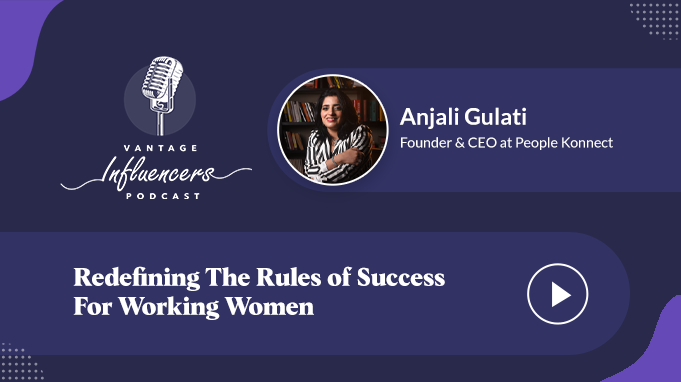
Redefining The Rules Of Success For Working Women
Listen on Spotify Click to load player

Episode Overview

In this episode of Vantage Influencers, host Susmita Sarma sits down with Anjali Gulati to talk about a word many organizations use loosely: empowerment. Anjali pushes back on the idea that anyone can hand a woman her empowerment from the outside. It only happens, she argues, when a woman decides to take ownership of her own life and career, and the real work lies in building the systems and support that make that decision possible.

She traces her own path through what she calls the three Ms, marriage, mobility, and motherhood, and explains how each shift became less a setback and more a catalyst for how she thinks about building inclusive workplaces. The conversation moves through practical territory: why the word "flexibility" often matters more to women than its actual use ever will, why menstrual leave policies count even for employees who never take the days, and how the gender pay gap keeps compounding the moment a woman stops negotiating for herself. Anjali also has direct advice for women returning from a career break and for those just starting out: measure your own worth honestly, stop discounting the life experience a break can teach, and treat financial independence as a non-negotiable, not an afterthought.

Episode Highlights

  • Empowerment isn't something one person gives another. It happens when a woman decides to take ownership of her own career and choices, and the surrounding support system exists to enable that decision.
  • Anjali built her organization around what she calls the "three Ms," marriage, mobility, and motherhood, treating each life transition as a source of resilience rather than a career setback.
  • A workplace becomes more supportive the moment it offers real flexibility. Even employees who never use it say the option itself changes how included they feel.
  • Research cited in the conversation found that 68% of women accept an initial salary offer without negotiating, and coaching women to ask for their real worth starts with believing they deserve it.
  • Career breaks taken for motherhood or caregiving shouldn't be treated as a blank space on a resume. The life skills built during that time carry real value that hiring conversations often ignore.
  • Advice for women just starting out: build financial independence deliberately, learn to drive for the freedom it brings, and be explicit with family about your ambitions instead of assuming they'll be understood.

About the Guest

Anjali Gulati, Founder & CEO, People Konnect

Anjali Gulati is the Founder and CEO of People Konnect, an HR talent solutions company she built after working at Tata Teleservices and ICICI Bank. What started as an executive search firm has grown into a full-service HR and D&I consulting practice, running initiatives like Back to the Front to help women restart their careers after a break, along with community platforms such as She Maker Summit for women in manufacturing and WINS (Women in Sales), supported by LinkedIn. She holds a postgraduate degree in Human Resources and is based in Mumbai.

Connect with Anjali on LinkedIn

Host

Susmita Sarma, Vantage Influencers Podcast Host

What You Will Learn

  • Why true empowerment can only come from within, and what that means for programs designed to "empower" women
  • The "three Ms" framework, marriage, mobility, and motherhood, and how each shaped a career built on including more women
  • What initiatives like Back to the Front look for when helping women return to the workforce after a break
  • Why flexibility policies, including menstrual leave, matter even to employees who never use them
  • How to recognize and stop the habit of discounting your own value during a salary negotiation
  • Practical advice for young women just entering the workforce, from financial independence to being upfront about your ambitions

Key Topics & Timestamps

Timestamp Topic
00:47 Introducing Anjali Gulati, founder and CEO of People Konnect
01:44 Her journey through marriage, mobility, and motherhood into entrepreneurship
05:13 The Back to the Front campaign and helping women return to work
05:46 What "empowerment" really means, and building a full D&I consulting practice
10:26 Why flexibility and menstrual leave change how supported women feel at work
14:42 The gender pay gap and advice on negotiating a higher salary
20:52 Advice for young women just starting their careers

Full Transcript

Click to read the full episode transcript

Welcome to the Vantage HR Influencers Podcast. This podcast is sponsored by Vantage Circle, the simple and AI-powered rewards and recognition platform for employee engagement. Before, during, and even after the pandemic, women worldwide have found it challenging to balance the demands of their careers and families, which has made it difficult to concentrate on their professional growth. To handle shifting patterns in a new economy, women must consider skill-building, reskilling, and upskilling now more than ever before.

Susmita Sarma: Welcome to the Vantage Influencers Podcast. I'm your host, Susmita. Today we'll be talking about the different skills that working women must have and how they can empower themselves. My guest today is Anjali Gulati, the founder and CEO at People Konnect. Welcome to the show, Anjali.

Anjali Gulati: Hi, thank you so much for having me.

Susmita Sarma: Thank you so much for joining me today. It would be great if you could take a moment to give our audience some background on yourself.

Anjali Gulati: Sure. By education, I'm an HR professional. I had a couple of corporate jobs before I moved out and started People Konnect. We began as an executive search firm, and about 13 years ago we grew into a fully equipped HR talent solutions company. I live in Mumbai, so that's a quick introduction.

Susmita Sarma: So you're talking about People Konnect, right?

Anjali Gulati: That's right.

Susmita Sarma: I was going through your profile, and you'd written that you drew strength from your own journey through what you call the three Ms, marriage, mobility, and motherhood, to set up People Konnect. Would you like to share that story? How did you first get involved in this?

Anjali Gulati: Sure. I come from an army background, my father was in the army, and we saw a lot of movement growing up. I think that really taught us to be agile and adaptable, because you have to quickly settle into a new place, make new friends, and start at a new school. That gave us a strength early on, that whatever the situation, you find your way through and move on.

I moved to Bombay about 19 years ago for a job. My parents were living in a smaller city at the time. I'd finished my MBA and was staying with them when a bigger opportunity came up, and I decided to try moving to a larger city. I'd never lived in Mumbai before, and there's always that fear of how you'll survive in a city that size. But once I got here, I settled down, got married, and my husband has really been the wind beneath my wings. When I wanted to start out on my own, he's the one who gave me the confidence, in fact he gave me my first few thousand rupees to get started and said, if you make this work, I'll know you can carry it through. That support mattered a lot through the entrepreneurial journey, because it isn't easy. There are times you're working around the clock, and a lot of ups and downs you have to live through, but having that support makes all the difference.

And then, of course, motherhood is what really pushed me into this entrepreneurial space. I quit my corporate job when my son was born. At the time I was working with ICICI Bank, and I knew the demands of that job combined with a newborn would be tough to manage. So I started with a work-from-home setup, and over time we moved into a small office, then another, and the team kept growing. We've continued to hire a lot of women who are coming back to work after a break, because I've seen up close how difficult that journey can be, and that's what put me in the mindset that I needed to do this for more women. That's how we started.

Susmita Sarma: Is it an all work-from-home format at your office?

Anjali Gulati: No, no, we're fully work-from-office now. We went back after the pandemic.

Susmita Sarma: Brilliant, Anjali.

Anjali Gulati: And out of the 40-member team we have now, 38 are women.

Susmita Sarma: Brilliant. We'll talk more about that, since you clearly have a sizable number of women employees in your organization. But before that, one of the verticals at People Konnect is the Back to the Front campaign, isn't it, which is about empowering women across sectors and life stages, including those looking to restart their careers through workable, sustainable strategies. Could you tell me more about what you're doing on working women's empowerment and helping women come back to work?

Anjali Gulati: I want to start with the context of what empowerment actually means, because I don't think any of us have the power to use that word on someone else's behalf. Empowerment for a woman is when she empowers herself, when she decides to empower herself. Nobody else can empower anyone. So when people say "I'm working on this for women's empowerment," I don't agree with that premise at all. It's about a woman taking ownership and saying she wants to do something with her life, and then figuring out how we can enable that journey.

Susmita Sarma: Empowering ourselves.

Anjali Gulati: Yes, exactly. Like I mentioned, the reason I got into this is because I went through that journey very closely myself. I have two children now, one was the reason I started, and the other came along during the journey. Also, because we were a hiring company, a lot of our clients, about eight or nine years ago, when diversity only meant "show us more women" or "we only want to hire more women," would tell us to send more women for every position we worked on. That's what really set the ball rolling for us. We realized that if you want to increase the number of women in the workforce, you have to look elsewhere too, because there's a whole pool of women who take a break, for motherhood, for caring for aging parents, or for other reasons, and at some point they're ready to come back. So how do we enable that journey for them? How do we tell them, here's an opportunity, and here's an employer who's looking for you? That's basically what we set out to do, bridge that gap.

Over time we've become a full-service D&I consulting organization. That means we work with organizations to find out how inclusive they actually are today, through a survey process, and we work with leaders on how they can be more inclusive across the board, not just with women, but in communication, in how they build teams across ages, backgrounds, and ethnicities. We also continue to work directly with women. One part is helping them come back. The other is within organizations, because we know there are a few rungs missing in the ladder for women, so we work on developmental inputs like owning your career, personal branding, and impactful communication, giving women what they need to reach the next level.

We also have a network of senior women available to us, it started as a WhatsApp group for senior women leaders, and has since grown into a much wider circle. These are senior women who've been CXOs or entrepreneurs across various fields, and they're incredibly generous with mentoring and sharing their own journeys with other women. We've also incubated two events over the last three years. One is called She Maker Summit, specifically for women in manufacturing, we've run three editions, all virtual, so we could reach plants in remote locations that an in-person summit wouldn't reach. The women we've seen in these plants are so inspiring, it's a pleasure to showcase them to other women who are studying or on a break, to show how they've built successful careers and created an ecosystem for themselves to succeed. The other is something we've just started called WINS, Women in Sales, and LinkedIn has lent their name to us for the next two years to help drive that agenda.

Susmita Sarma: Great initiatives, Anjali. Do you have any specific HR practices you'd like to share, especially for the women employees you have, any rules or practices around that?

Anjali Gulati: I think the key element, given the pandemic and the kind of expectations people have from the workplace today, is flexibility. The moment you give a woman a bit of flexibility, she may or may not even use it. I might still be in office from 9:30 to 6:30 every day and never need that flexibility, but just knowing it's available to me when I want it makes all the difference. Just the fact that an organization is supportive, that it recognizes I have a life outside of work and some days I may need to dip into that, is often enough for a lot of women to take that leap. Even with menstrual leave, I'd say it's a good idea to keep one or two days available. Not everyone will take it, because not everyone needs it, but it's there if someone wants to use it.

Susmita Sarma: Exactly. So in corporates, when we talk about working towards gender equality, the skills required for men and women to succeed are essentially the same, we know that. But at the same time, there is no denying that men are regarded as having certain strengths that women don't.

Anjali Gulati: But on the other side, women have so many strengths that men don't have. So it's really an equation that works for both sides.

Susmita Sarma: Some skills are still seen as more male-oriented, and therefore less appropriate for women. Based on your own work and life experience, what are the fundamental skills you believe women in particular need to learn to move closer to equality and advance in the workplace as a whole?

Anjali Gulati: I think the whole idea of telling women to "be more like men," be more assertive, be more authoritative, doesn't work for me personally, because we're innately who we are, we have our own emotional strengths. I think it's time to play those strengths up rather than focus on what we supposedly lack. The strengths we bring to the table deserve recognition, and I want to bring my whole self to work and do the best I can, developing my strengths while either working on the areas I'm not as strong in, or building a team around me that covers those gaps so I can play to my strengths. That understanding of where you can excel, who you are, and where you need to develop, is really the starting conversation, rather than framing it as men being the "stronger" gender. Society is made up of equal men and women, and it's time we represented that in our organizations. Even in families, we're starting to see couples work together as a unit, splitting responsibilities and helping each other. Why shouldn't organizations work the same way?

Susmita Sarma: Also talking about the gender pay gap, that's another problem women face head-on. Failing to negotiate a better salary can create difficulties throughout an entire career. I was reading some research showing that 68% of women accepted the pay initially offered to them without negotiating, which is a huge percentage. Do you have any advice for women looking to negotiate a higher salary?

Anjali Gulati: Believe in yourself. That's the most important thing. Even in the hiring we do today, we coach candidates and tell them exactly what they should be asking for and why, and how to make that case. A lot of times, we, and I mean women in particular, discount ourselves and assume no one will recognize our worth, or that the other person, the organization, will be fair to us anyway. It's not that organizations want to be unfair, but if I'm earning 20 lakhs and I'm okay with a 10 to 15% hike, I'm not even asking for the 30% I might actually deserve.

When we work with women who are coming back to work, we start from the very beginning, building their CV, their elevator pitch, how they introduce themselves in the first two minutes, all the way up to the salary negotiation itself. It's disheartening to see organizations today still say, "if your salary when you left was 15 lakhs, we'll match that," without recognizing the life experience gained during a three, four, or five year break. If a woman took that break for motherhood, which is around 70% of the cases we see, motherhood is a teacher like no other. It teaches you to multitask, to think of several things at once, and it puts a level of responsibility on you that's a life lesson in itself. To discount that experience isn't fair, and that's what we coach women to say, not to sound rude or arrogant, but to ask for the right value for themselves. That conversation matters just as much for women already in organizations, asking for a promotion or a new role, because a lot of the time we don't feel 100% ready, so we settle. We should be asking, if I'm going to put in this much effort, what do I need in return, and how do I make that happen?

Susmita Sarma: Is it also because a wife's salary is often treated as a secondary income to the family? Maybe that's where the notion comes from, that whatever we get is fine.

Anjali Gulati: You'd be surprised, some women are actually asked in interviews, "if your husband is doing so well, why do you even need to work, why are you negotiating?" People actually say this to women in interviews. It's infuriating, because I'm not bringing value as part of a unit, I'm bringing it as an individual. Why should what my husband earns matter? I'm putting in the effort, I have the education and experience, so value me for what's rightfully mine. And there are plenty of cases where women earn more than their husbands too. The whole premise of that conversation is wrong.

Susmita Sarma: Anjali, you've trained so many women for their professional advancement. Do you have any personal sources of inspiration in your field?

Anjali Gulati: Many. Closer to home, it's my own mother, she taught us to be fiercely independent, and she still is. She's a doctor, she drives, and even though my father was in the army and we moved constantly, she set up a new clinic wherever we went and still made time for us as kids. I've had a working mother my whole life, and that really helped put things in perspective for me. I hope I can be that for my own daughter too. Professionally, I've been surrounded by so many women who've charted their own careers and done really well. I think everyone needs to be surrounded by people who lift them up rather than pull them down, because even on a day when you're not feeling your best, there's usually someone ready to help if you reach out. Building that network, people you can talk to and lean on, is really important.

Susmita Sarma: Before we wrap up, what would you like to tell young women who are listening, who are just starting to work? What do you want them to know about the workplace today?

Anjali Gulati: That's an interesting question, because there's so much I wish I'd known at that age. First, always be independent. My father used to tell my sisters and me that there were two things he wanted us to learn. One was to be financially independent, he said his job was to give us the education that would make that possible, and whether we chose to work or not after that was our choice, but we should always be able to earn our own living. The second was learning to drive, because it gives you a kind of independence, you're not dependent on someone else to get from one place to another, and it changes how you approach life. So those were my lessons growing up, being financially independent and knowing your self-worth.

My advice to women who are studying or just starting out: find a way to stay financially independent, always. Even if it's less money, even if you need to slow down or work fewer hours at some point, because life happens, that's fine, but have a plan to come back to it, whether that's returning full-time or building something of your own with the effort it takes to start. Be clear about what you want to do with your own life, because we're all responsible for our own balance sheet. Fifteen years down the line, you don't want to look back and wish you'd done something differently, so make each decision carefully.

On the family and support side, it's important to be clear about your expectations and your ambitions, so there's no mismatch. If you're asking for support, that also means being clear about what you need, because if you don't tell people you want to work, they won't necessarily understand that on their own. Even when women are coming back to work, we tell them to have that conversation with their children too, even young kids, to say, mama's going back to work, this is going to change, and here's where I need you to help. It's about creating an ecosystem where everyone around you can help you succeed.

Susmita Sarma: And taking that first step yourself.

Anjali Gulati: Always. It starts inside us. If we want to make it happen, it will happen, and then nothing can stand in the way.

Susmita Sarma: That's a fitting way to end our conversation today, Anjali. How can our listeners reach out to you if they'd like to?

Anjali Gulati: I'm on LinkedIn as Anjali Gulati, and I'm pretty responsive there, also on Instagram. My email is anjali@peoplekonnect.co.in, that's People Konnect spelled with a K.

Susmita Sarma: Anjali, thank you so much for joining me today and sharing your expertise, we hope to have you back again soon.

Anjali Gulati: Thank you so much, it was a really interesting conversation.

Susmita Sarma: We've been speaking with Anjali Gulati. This is your host, Susmita. Thank you for listening to the Vantage HR Influencers Podcast. Please subscribe on Apple Podcasts, Spotify, and our YouTube channel for new episodes.

FAQ

What does Anjali Gulati mean by "empowerment"?

Anjali argues that empowerment can't be handed to a woman by an organization or another person. It happens when a woman decides to take ownership of her own life and career, and the real work is building the systems that make that decision possible.

What are the "three Ms" Anjali refers to?

Marriage, mobility, and motherhood, the three life transitions Anjali says shaped her own path into entrepreneurship, and which she now treats as a framework for understanding the breaks many women take during their careers.

Why do so many women avoid negotiating their salary?

Anjali points to research showing that 68% of women accept the salary initially offered to them without negotiating, often because they discount their own worth or assume an employer will be fair without being asked.

How can organizations better support women returning from a career break?

By recognizing that a break for motherhood or caregiving builds real skills rather than leaving a resume gap, and by offering genuine flexibility. Even employees who never use it report feeling more supported simply because the option exists.

Also listen on

You might also like

Follow on