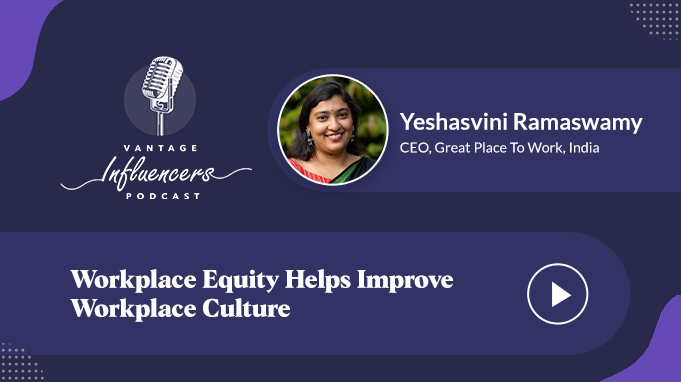
Workplace Equity Helps Improve Workplace Culture
Episode Overview
Yeshasvini Ramaswamy opens by making a case for equity as the natural next step beyond equality in workplace conversations. She draws a sharp line between the two: equality means treating every applicant or employee identically, the same screening process, the same policy applied to everyone, while equity means recognizing that people arrive at work from different starting points, social or economic, and building the support systems needed to close those gaps over time. She frames diversity, equity, and inclusion through a formula she believes every leader should be tracking: diversity plus equity plus inclusion equals belongingness. Diversity, in her telling, is simply being invited to the party; inclusion is being asked to dance once you're in the room; equity is the assurance that pay, promotions, and growth opportunities are never limited by bias, conscious or not.
She goes on to argue that the shift toward hybrid and remote work has permanently widened the talent pools leaders can draw from, which makes it harder to justify overlooking historically underrepresented groups, and turns DEI from a nice-to-have into a business necessity, since a workforce that doesn't reflect an increasingly diverse, global customer base risks losing relevance with those same customers. She's candid that equity work takes courage: real change means accepting that parts of an organization may resist it, and that the payoff shows up gradually, not in the next quarter. She closes by tying gender equality and support for the LGBTQIA community to the same underlying principle, arguing that normalizing these conversations, rather than treating them as exceptional, is what makes an equitable culture stick.
Episode Highlights
- She defines workplace equity through a simple formula: diversity plus equity plus inclusion equals belongingness, the metric she believes every CEO should be measuring today.
- She distinguishes diversity, inclusion, and equity with a party analogy: diversity is being invited, inclusion is being asked to dance, and equity is knowing your pay, promotions, and growth are never limited by bias.
- On equality versus equity, she explains that equality means treating every applicant the same way, while equity means building a support system around people from disadvantaged backgrounds to close real gaps.
- She argues remote and hybrid work have permanently opened up global talent pools, making it harder for leaders to justify overlooking historically underrepresented groups.
- She frames DEI as a business imperative rather than a checkbox for optics, since organizations serving global, diverse customers need a workforce that reflects them.
- She credits normalizing conversations, rather than treating them as exceptional, as the fastest way to build genuine acceptance around gender equality and the LGBTQIA community at work.
About the Guest
Yeshasvini Ramaswamy, CEO, Great Place To Work India
Yeshasvini Ramaswamy is recognized as one of India's leading serial entrepreneurs, combining deep expertise in organizational behavior, artificial intelligence, and investment management to bring analytical rigor to business transformation projects. She has led numerous projects for Fortune 100 companies, represented India in the Fortune Most Powerful Women program, and received the Times Power Women Award for Excellence in Entrepreneurship. She is a Fellow of the Institute of Directors and is actively involved in community work through fundraising and global advisory boards supporting NGOs in rural entrepreneurship, education, and health.
Host
Gautam, Vantage Influencers Podcast Host
What You Will Learn
- What workplace equity actually means, and how it differs from equality
- Why Yeshasvini Ramaswamy considers belongingness, measured as diversity plus equity plus inclusion, the metric every leader should track
- How the shift to hybrid and remote work has permanently expanded talent pools and made DEI a business necessity
- Practical first steps organizations can take to promote workplace equity without expecting immediate, uniform buy-in
- Why she believes DEI is a business imperative tied to serving diverse, global customers, not just an HR initiative
- How normalizing conversations about gender equality and the LGBTQIA community builds genuine, lasting acceptance
Key Topics & Timestamps
| Timestamp | Topic |
|---|---|
| 01:19 | Introducing Yeshasvini Ramaswamy and her background |
| 03:13 | What workplace equity really means |
| 05:45 | How DEI builds a sense of belongingness at work |
| 12:01 | The real difference between equality and equity |
| 14:04 | Practical ways organizations can promote workplace equity |
| 18:14 | Why DEI is a business imperative, not just optics |
| 21:53 | Promoting gender equality as a lever for workplace equity |
| 24:06 | Recognizing the LGBTQIA community during Pride Month |
| 26:25 | Closing thoughts on building an equitable, global workforce |
Full Transcript
Click to read the full episode transcript
Welcome to the Vantage HR Influencers Podcast. This podcast is sponsored by Vantage Circle, the simple and AI-powered rewards and recognition platform for employee engagement. Workplace equity is all about making employees feel empowered and leveling the playing field for every employee. When organizations promote equality in the workplace, they benefit from the competitive advantage of employing diverse talent. Equity in a workplace refers to fair treatment for all. Transparency is evident in cause and effect, where everyone expects the same in terms of consequences and rewards. When there is equity, there is equal opportunity. When importance is given to equity, it creates a positive work environment for both the employees and the employer.
Hello, listeners. Welcome to Vantage Influencers Podcast. I am your host, Gautam.
June is Pride month and a celebration of human rights. Thus, today's episode is dedicated to the topic Workplace Equity Helps Improve Workplace Culture. Organizations must have a forward-thinking ideology and aim to work toward fostering an equitable future for their employees. And we have with us just the right person to enlighten us on how promoting workplace equity improves company culture. She is none other than Yeshasvini Ramaswamy. Yes, you guessed it right, the CEO of Great Place To Work India. Yeshasvini Ramaswamy is recognized as one of India's leading serial entrepreneurs. She combines deep expertise in organizational behavior, artificial intelligence, and investment management to bring analytical rigor to business transformation projects. She has led numerous projects for Fortune 100 companies. She represented India in the Fortune Most Powerful Women program and received the Times Power Women Award for Excellence in Entrepreneurship. She is also a Fellow of the Institute of Directors. She is actively involved in community work through fundraising and participating on global advisory boards of high-impact NGOs in rural entrepreneurship, education, and health. Hello, Yeshasvini. Welcome to the show.
Yeshasvini Ramaswamy: Gautam, thanks for having me over.
Gautam: Thank you so much for joining us today. I'm sure our listeners will have a lot to learn from you. So to begin with, I would like you to introduce yourself to our listeners and give a brief about yourself, like your hobbies, interests, and anything I might have missed mentioning about you.
Yeshasvini Ramaswamy: Well, I think you were very kind in your introduction, Gautam. I've had a very interesting career so far. What about me? I think I'm a simple girl at heart. I have a very simplistic, uncluttered view of life. I think my motto is live and let live. And I'm really looking forward to this conversation, so I think we should begin.
Gautam: Sure. In that case, we could just jump to the topic. If I were to ask you, according to you, what is workplace equity?
Yeshasvini Ramaswamy: I think the word equity has taken on a lot of currency lately, and I cannot stress enough the importance of business leaders investing more in creating this conversation in their workplaces. Creating an equitable workplace culture is the need of the hour. You see, Gautam, I think the pandemic has disrupted a lot of the traditional way of working.
Gautam: Definitely.
Yeshasvini Ramaswamy: Right. So we used to go to the office. The office has come home, and this has opened up a lot of opportunities for talent to work from anywhere in the world. Your office can actually be anywhere. So the whole ecosystem of talent has been disrupted permanently, thanks to the pandemic. And because it's been disrupted, I am no longer limited to hiring people from a particular city or a particular background just because my office is situated here. Working remotely has opened up so many talent pools that it becomes imperative for business leaders to do the right thing, which is to take the conscious decision to reach out to groups that are socially or economically, or both, underrepresented, and give historically underrepresented groups a chance, because the time is right now for us to do the right thing. And equity, even though it's a popular word, requires a lot of courage and a lot of honest conversations to really make it happen within workplace culture. It cannot be limited to just lip service.
Gautam: Sure. Thank you so much, Yeshasvini, for giving that description of workplace equity and what it means to you. But when we hear the word workplace equity or equality, I know both are different, but what we directly relate to is DEI, or diversity, equity, and inclusion. So how does DEI play an important role in nurturing a great company culture?
Yeshasvini Ramaswamy: Yeah, I think the way I look at it is from a different lens. I think one of the most important metrics today, and for at least a couple of years down the line, will be a metric of belongingness that every CEO should measure. Now, for me, if I were to draw out a formula for measuring belongingness, it would be diversity plus equity plus inclusion equals belongingness. And this stems from what we are facing today, isn't it? We're having very diverse pools of talent working in our organizations, so it becomes imperative that they feel included. A simple example and distinction between diversity, inclusion, and equity: equity was a later term that got added in. I think in the initial days it used to be called D&I.
Gautam: Yes.
Yeshasvini Ramaswamy: And you may have heard about it, or our listeners may have heard about it. For those who've heard about it, please be patient, but it's a very simple distinction. Diversity is your tick in the box. So let's say you want to throw a party, you would invite this community, maybe that gender, from different backgrounds, and that's it. But inclusion is once they turn up at the party, you invite them to dance with you. That's inclusion, whether they're feeling included. And equity is that nobody in the organization should ever doubt that their chances at fair pay, promotion opportunities, opportunities to innovate, opportunities to grow, opportunities to travel, are limited in any way because of biases that exist in the system. A lot of these biases can be conscious, like a preference for a certain community for a certain job, or in some cases it may even be an unconscious bias where you don't know about it, but the system works in a particular way regardless. Equity is all about ensuring and encouraging your employees so that there is no doubt in their mind that this is a place where they can be themselves. And for me, if you build these three things very strongly and with the right intentions, it will create a sense of belongingness. And a sense of belongingness is so crucial, Gautam, in today's world, because we're all in hybrid. Look at us, the way we're talking right now, it's not face to face at all, we're probably in different cities, and the same thing happens inside organizations. In fact, in the last two years there has been growth across a lot of industries, be it retail, banking, or IT, and there are companies where we've done research showing that more than 40 to 50% of the organization has never seen the office. They've all joined virtually. And if I take that a step further, there have been people who've joined and left virtually. So there's actually a section of the population that we've never met. And if I really want to bring in new best practices and innovate, I think I have to invest in developing that sense of belongingness. So for me, DEI then becomes a no-brainer.
Gautam: I would completely agree with you on this, because only when an employee feels that they belong to a place will they have the engagement, the drive to work, and the ultimate productivity that contributes to the company's success. And I think that's what lies with leaders and HR: how you level the playing field, how you avoid showing any sort of discrimination or bias. But I think bias is also sometimes rooted in prejudice, and that's also because some people come from a very privileged society and mindset. So once we're able to eradicate those prejudices, is that when we can create that sense of belongingness? Don't you agree?
Yeshasvini Ramaswamy: Yeah, but I'd like to take a step back here. For me, eradicating prejudices may happen, may not happen, but what is absolutely essential is acceptance today in the corporate world, and really taking the dialogue out of HR and putting it directly with business leaders. Because I think the HR community is doing a fantastic job translating the expectations that leadership has into an employee experience. And the pandemic has again given us so many role models and inspiring stories within the HR community that we could talk about. But I always say that culture is set by the CEO. HR is responsible for translating that culture into an employee experience, into employee engagement. But if you delegate culture entirely to HR, then more often than not, you won't have a great culture in your organization. So I think the first step is for us to accept that there are biases in the system, and we need to do something about it.
Gautam: Right. So when we think about such biases or prejudices or inequality, we tend to say that we need to promote equity, but people tend to forget that equality and equity are different. What they call promoting equity is often what they're actually doing for equality. So could you explain the difference between equality and equity?
Yeshasvini Ramaswamy: That's an interesting question. I think equity is more of a long-term dialogue. Let's say I'm coming from a socioeconomically deprived background. Equity would mean that you create a support system around me that not only makes me feel supported, but also, if there are any insecurities, gaps, or weaknesses I may have, whether social or economic, you work to correct them. Equality, on the other hand, means that irrespective of who you are, you can come and apply to my company.
Gautam: Yes.
Yeshasvini Ramaswamy: Right. Take the job application process, and I'm simplifying it, since we have limited time, but this is such an interesting question. It's fairly simple: let's say I have a policy stating anybody can apply to my organization for a particular role, and all applicants will be treated equally, meaning the screening process and everything else is the same. That's treating people equally. Equity is when you sit down and have a compensation conversation, a career-mapping conversation, and take their socioeconomic background into account while structuring something for them. So equity is far deeper and far more long-term than equality.
Gautam: Sure, I completely get that. So when we speak about promoting workplace equity, and I'm asking this because you're the CEO of Great Place To Work, how can companies promote workplace equity to improve their company culture?
Yeshasvini Ramaswamy: It's not easy, and I think we all appreciate and understand that. It's like practicing justice, and that's not easy either, because there will always be one party thinking you've been unfair. Isn't it?
Gautam: Yes.
Yeshasvini Ramaswamy: So executing and administering justice is not easy, it's a complex process, and it's the same thing with equity. So coming back to your question on how organizations can take the step forward, my submission is: take the first initial steps rather than running way ahead, because the moment you take some steps, there will be communities within your own company who may not look at it positively. We had this dialogue fifteen years ago when we were advocating for women in the workforce. Within the IT sector, nobody even blinks about it now, but there was a time when I was part of a team advocating very heavily for more women in the workforce, and that led to a section of the community of men thinking women were getting preferential treatment, which goes against the philosophy of equality, isn't it? So I keep telling people it sounds good, it says all the right things, but if you're really committed to it, you should be okay with a few sections of your community not being on board. You need the courage to make some of those unpleasant decisions, because the benefits you'll see are only in the long term. You won't have short-term wins. So that's one thing. And two, communicate a positive intention. Even when you talk about the LGBTQ community, just communicating about it and creating awareness goes a long way toward making it normal. The more exclusive you make it, the more difficult it becomes to make it mainstream. I think the trick is to communicate about it and be normal about it, because the moment you're normal about it, the people around you become normal about it too. And that's a good thing, because we've had a lot of instances where the intentions were always right when hiring people from these communities, but there was such a song and dance about it that everybody started treating them differently from day one, and then the company wondered what went wrong.
Gautam: Right.
Yeshasvini Ramaswamy: So my advice is: just be normal about it. The moment you're normal about it, people become normal about it too, and acceptance rises significantly. So I think we should do a lot of these things: creating awareness would be the first step, backed up with policies that are easy to implement, where the changes are visible. Recruitment could be a great function for executing some of this. Promotions can become part of it too. Start that way, and then move into more serious conversations. There's a second part to this, and I know it's a long answer, but it needs to be stated.
Gautam: It's okay.
Yeshasvini Ramaswamy: HR isn't for HR's sake, it's for the business. Similarly, the conversation around DEI isn't about being part of a "woke culture." I think it's a business imperative, and let me explain why quickly. One of the things happening today is that businesses across the globe are digital and borderless. Once you're digital and borderless, your consumers can be anywhere. Take an e-commerce business, for example. What would you want to sell, Gautam, if it were your business? Maybe a packet of tea or something?
Gautam: Yeah, or I would rather sell our rewards and recognition program.
Yeshasvini Ramaswamy: Right. Whether it's rewards and recognition or a packet of tea, you can't say someone needs to be from a particular community or country to apply, or to buy from you. So if your consumers are becoming global and diverse, your workplace culture has to be reflective of the consumers you serve. The hotel and hospitality industries are great examples of this. There are many great workplaces in hospitality that invest heavily in DEI, because the customers sitting in their cafes and bars are diverse. Whether it was consciously introducing African Americans into the workforce a few decades ago, or bringing in different groups as part of the workforce today, it was simply a reflection of the customers engaging with them. So it's no longer a nice-to-do thing. The complexities we're all navigating today, with the pandemic accelerating the hybrid work culture, mean that talent can now work from anywhere in the world, and similarly, consumers can come from anywhere in the world. I think that just makes DEI center stage.
Gautam: I think that was a great response, and our listeners will have a lot to gain from it.
Yeshasvini Ramaswamy: And I'm glad, I'm glad.
Gautam: Well, I think it's an amazing response, because diversity isn't just about acceptance, it's also a business imperative, since we have to reach out globally, and it's all about outreach. Only when a company's values are visible and known to be equitable can it attract more consumers as well. That was a great point. And when you spoke about advocating internally, and there being pushback, how do you think promoting gender equality is a great way to promote equity in the workplace? I'm not talking only about women here, this is about all genders. Do you think promoting gender equality is a great way to promote equity in the workplace?
Yeshasvini Ramaswamy: Why not, if it's working? That would be my take, because sometimes the energy around this is so high that we all end up trying to boil the ocean, and that's really not possible. My take is: whatever is working, don't tinker with it, let it happen. And when it comes to the dialogue around women, a lot of people starting their careers today may not realize, or may take the women's issue for granted, but fifteen years ago it was hugely different. I keep coming back to the same point I made a couple of minutes ago: equity is always long-term, it can't be a quarter-on-quarter thing. It's taken us fifteen years to get where we are, and even then, this progress is concentrated in specific sectors. There are still industry verticals that don't prefer women. The women's movement is largely visible in IT and ITES, and public sector banks have traditionally had a good gender mix. But there are many industries where the conversation around women is still a challenge, especially at the leadership level. At the entry level, as a country, we've come a long way, but women at the leadership level remain a huge challenge.
Gautam: I completely agree with you on that. And after speaking about gender equality, we also remember the LGBTQ community. Organizations across the world are celebrating Pride Month right now. Do you feel supporting the LGBTQIA community and recognizing them is a great initiative toward creating an equitable workplace culture, and setting an example as well?
Yeshasvini Ramaswamy: Absolutely. I couldn't express more excitement about this month. I look forward to it every year, one, because it's so colorful, and two, because it forces us to think about questions we may not normally think about in our daily lives. Whether or not I come from the LGBTQ community, the sheer fact that this community today has a voice, that it can really talk about its issues, and that companies are taking positive, affirmative action toward this, is huge. I can't stress enough how much progress has been made, breaking so many stereotypes all at once this month. So I'm hugely excited about Pride Month, not just this year but every year. This is something I look forward to. And especially with this community, we see that for them, it's not just a job, Gautam. A lot of employees today take up a job for the salary, and if they get a better salary elsewhere, they may move on. But for this community, the conversations we've had tell us that each member looks at a job as their identity. It's much beyond a job. So the sense of commitment, the sense of loyalty, the intention to give their best every single day, is something we should all celebrate together.
Gautam: Wow. Thank you, Yeshasvini. On that note, I'd like to wish you a happy Pride Month.
Yeshasvini Ramaswamy: Thank you, Gautam, to you too.
Gautam: So how would you like to conclude your thoughts on this topic, workplace equity improving workplace culture, for India or globally? What's your opinion?
Yeshasvini Ramaswamy: Globally. I think everything has to be seen in the context of the work environments we're operating under, and the pandemic isn't fully behind us yet. There are conversations about a fourth wave, and I'm sure there will be multiple smaller waves after that. The world as we knew it has changed so much, who would have thought global skies would go quiet, that we couldn't fly from one country to another? I don't think we ever imagined a possibility where we couldn't fly to another country. So a lot has changed for us, and I think the acceleration of technology is a huge plus for the dialogue around DEI, because talent pools are now global, aspirations are global, the world is shrinking, and it has all kinds of people in it. So my message would be to invest more in inclusive technology and strategize your workforce in a way that is equitable and diverse, because that's the right thing to do. And beyond it being the right thing to do, you'll see that globally, businesses are being pushed toward this, because that's the direction the economy is steering these conversations toward.
Gautam: Thank you. And I think we should celebrate more. Pride Month should become louder, more colorful, and more people should come and have these conversations.
Gautam: Thank you, Yeshasvini, for this enlightening conversation. And now that we're slowly approaching the end, would you tell our listeners how they can reach out to you?
Yeshasvini Ramaswamy: My Twitter handle is @yeshasvini, and listeners can reach out to me there.
Gautam: Thank you so much, Yeshasvini, for that amazing knowledge-sharing session on how workplace equity helps improve company culture. We're truly delighted to have had you with us today.
Yeshasvini Ramaswamy: Thank you, Gautam, for inviting me over. I must also say thank you to all my colleagues at Great Place To Work India for being so supportive of these kinds of dialogues within the organization, and for the amazing work they do with all our certified organizations. So thank you also to the community of Great Place To Work certified companies. Thank you, Gautam, for having me over.
Gautam: Sure, and I'm sure our listeners will be enlightened after listening to you. And with this, we've come to the end of this episode. Listeners, for more informative conversations, stay tuned and keep listening to the Vantage Influencers Podcast. Thanks, Yeshasvini, that was great.
FAQ
What is the difference between workplace equity and equality, according to Yeshasvini Ramaswamy?
She explains that equality means treating every applicant or employee identically, for example, running the same screening process for every candidate, while equity means recognizing that people start from different social and economic positions and building the support systems needed to close those gaps. Equity, she argues, is a far deeper and more long-term commitment than equality.
What formula does she use to explain belongingness at work?
She frames it as diversity plus equity plus inclusion equals belongingness, and argues this is the metric every CEO should be tracking. She illustrates the distinction with a party analogy: diversity is being invited, inclusion is being asked to dance, and equity is knowing your pay and promotion opportunities are never limited by bias.
Why does she call DEI a business imperative rather than just an HR initiative?
Because businesses have become digital and borderless, their customers are increasingly diverse and global, and a workforce that doesn't reflect that diversity risks losing relevance with the very customers it serves. She points to the hospitality industry's heavy DEI investment as an example of this principle in action.
What does she recommend as a first step for organizations wanting to promote workplace equity?
She recommends starting with visible, easy-to-implement policy changes, such as in recruitment and promotions, rather than attempting sweeping changes all at once. She's candid that pursuing equity takes courage, since parts of an organization may resist it, and that meaningful results take years, not quarters.
Related Reading
Also listen on