
A spot award or on-the-spot recognition is one of the best and quickest ways to deliver meaningful rewards and recognition to your employees.
Today, organizations understand the significance of appreciating their employees. But instead of service awards or "employee of the month" awards, spot awards are more commonly offered in modern reward systems.
This shift is often perceived as a positive one. Because when done right, spot awards can serve as instant motivation for employees while also being cost-efficient for businesses.
This article will talk about the spot award and how it can provide value to your employees and your organization.
Let's start with some basics.
What is a Spot Award?
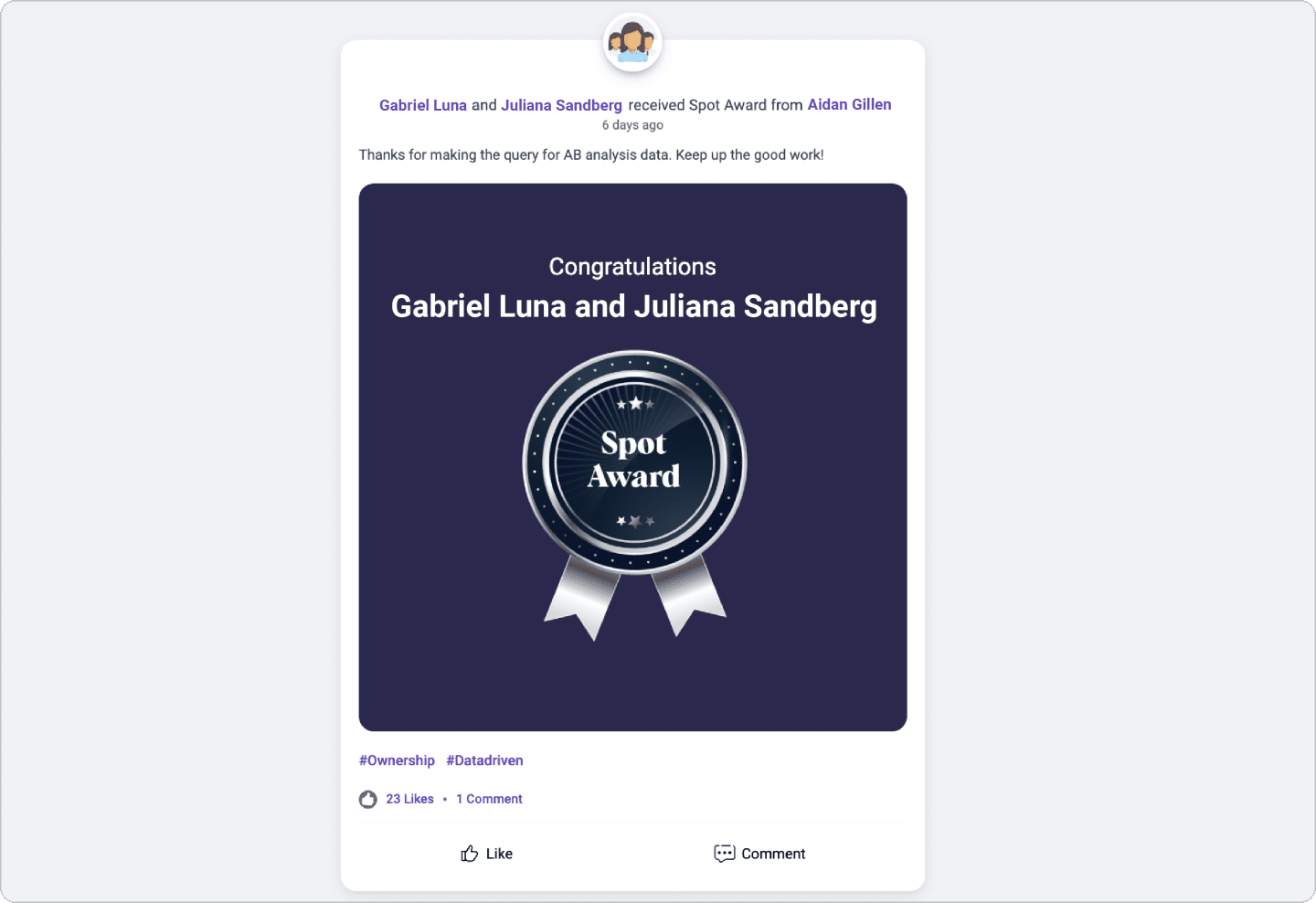
Spot awards are a form of employee recognition where you recognize exemplary performance or behavior as and when it happens.
The main purpose of spot awards is to let employees know that you have noticed their efforts. At the same time, it reinforces the values that are important to your organization.
Two of the most important characteristics of spot awards are:
1. They are instant rewards.
We call them "spot awards" because they are delivered "on the spot".
In today's world of instant gratification, employees find little value in getting praise for something they did months ago.
Also, the workforce today consists mainly of millennials, who prefer on-the-spot recognition to yearly reviews. They need acknowledgment as soon as they achieve a goal or excel at work.
2. They may involve monetary or non-monetary benefits.
Spot awards may include non-monetary forms of appreciation, like a social shout-out, certificates, company logo items, etc.
You see, sometimes a pat on the back could be all it takes to get an employee through the daily grind. These gestures help build an emotional connection between the company and the employee.
However, spot awards can also involve monetary benefits like cash, bonuses, or discounts. In fact, it works the best with a point-based reward system where you can give monetary incentives to employees for their efforts.
Employee of the Month vs. Spot Awards: What's the Difference?
The Employee of the Month award is like receiving a thank-you letter for something you did last month. It's well-intentioned, but the moment it was meant to celebrate has already passed. Spot awards close that gap entirely. Instead of recognizing one person on a fixed monthly schedule, they let you celebrate anyone, anytime, for contributions that are happening right now. For HR leaders managing diverse, fast-moving teams, that urgency is what makes recognition actually land.
Let's take a look at this table to understand the differences -
| Feature | Spot Award | Employee of the Month |
|---|---|---|
| Timing | Immediate (within hours/days) | Monthly cycle |
| Frequency | Multiple per week across org | One per month (or one per department) |
| Selection | Manager or peer-driven, in the moment | Committee or voting-based, retrospective |
| Specificity | Tied to one specific action/behavior | Tied to overall monthly performance |
| Reach | Anyone can receive multiple awards | Only one winner per cycle |
| Motivation Effect | Reinforces specific behaviors in real time | Can create competition; may not reinforce specific actions |
When Should You Give a Spot Award?
Spot Awards should be presented at moments when an employee's contribution significantly exceeds the expectations of their role, directly impacting project success or enhancing workplace culture.
Here are some examples of moments or ideal opportunities for spot awards -
1. Exceptional Performance:
Reward your employees with spot awards when they significantly surpass their job responsibilities. Celebrate outstanding performance that contributes to the success of a project or the organization.
2. Innovation and Creativity:
Reward your employees for the development of innovative solutions or creative problem-solving. Celebrate innovation that enhances efficiency, reduces costs, or drives the organization forward in a meaningful way.
3. Leadership and Teamwork:
Recognizing individuals who demonstrate exceptional leadership qualities, foster teamwork, or contribute to a positive team environment, especially under challenging circumstances.
4. Customer Satisfaction:
For contributions that directly lead to increased customer satisfaction or resolve complex customer issues, highlighting the importance of customer focus in the organization’s values.
5. Operational Improvements:
Acknowledging efforts that result in significant operational improvements, process optimizations, or quality enhancements, contributing to the organization's efficiency and effectiveness.
6. Cultural Contributions:
Celebrating actions that significantly contribute to the organization's culture, such as embodying core values, promoting diversity and inclusion, or enhancing employee engagement and morale.
What is the Importance of Spot Awards
People like to be recognized. From the new hire to the veterans, everyone in your company wants to know that their work adds value to the organization. In fact, research says that the primary reason for employees quitting jobs is not getting enough recognition.
To retain and motivate your people, your organization needs a vibrant recognition culture. And spot awards can be a perfect addition to your reward and recognition program to drive your organizational outcomes.
They can help organizations build a value-based recognition culture by rewarding employees who go above and beyond their duties while encouraging initiative and creativity.
Some benefits of having a spot award program are:
Motivation
Spot awards involve giving recognition to employees for their good work almost immediately or as soon as possible. This timeliness of spot awards makes them extremely effective in motivating employees. According to a study, 69% of employees report they would be motivated to work harder if they felt their efforts were better appreciated.
When given regularly, spot awards can increase overall employee satisfaction.
Engagement
With higher motivation, employees become absorbed and enthusiastic about their work. They see the organization's vision as their own and make an effort to drive business success. Thus, the spot award can be vital to employee engagement.
Gallup research shows that when recognition satisfies even one key criterion, such as timeliness or specificity, employees are 2.9 times more likely to be engaged. That level of engagement translates into measurable gains in motivation and performance.
Productivity
It is a well-acknowledged fact that rewards and recognition help enhance the performance and commitment levels of employees. People are more likely to put in consistent efforts over time if they sense their efforts are being noticed and acknowledged. In this context, spot awards have emerged as an extremely powerful tool in boosting the workforce's effectiveness. Highly engaged teams achieve 23% higher productivity, according to Gallup's extensive workplace studies.
Getting appreciated boosts morale by creating 'oxytocin' in the body. People under the influence of this 'love hormone' perform better, and it helps them understand what they're doing right. Their dedication increases, and their performance levels improve.
Retention
According to a Glassdoor survey, 53% of employees say they would stay longer in a company if they felt appreciated. When employees are content with their jobs, they are less likely to hunt for new ones. This is why, in the long run, spot awards can help raise employee retention rates.
Signs Your Team Needs More Spot Recognition
Sometimes, the absence of recognition speaks louder than any engagement survey. Here are six telling signs that your team could benefit from more timely, meaningful appreciation.
1. Low Employee Engagement Scores
If your engagement surveys are consistently returning lukewarm results, a lack of recognition is often the hidden culprit. Employees who don't feel seen for their contributions gradually stop going the extra mile. Before overhauling your entire HR strategy, ask yourself: when was the last time someone on your team was recognized in the moment for good work?
2. High Turnover Rates
When good employees leave, it's rarely just about the paycheck. More often, they're leaving because they feel undervalued. If you're noticing a pattern of exits among your high performers, it's worth examining whether your recognition culture is keeping pace with their contributions.
3. Managers Rarely Give Praise
Recognition flows from the top down. If your managers aren't in the habit of acknowledging their team's wins, that gap will trickle through the entire organization. A manager who only gives feedback during annual reviews is missing dozens of opportunities every month to build trust and motivation.
4. Employees Seem Disengaged in Meetings
Disengagement in meetings is often a symptom of a deeper disconnect. When employees don't feel their contributions matter, they mentally check out. If you're noticing less participation or fewer ideas being shared, it may be time to rethink how visibly you're celebrating effort.
5. Good Work Goes Unnoticed Publicly
Does your organization have a way to publicly celebrate employee achievements? If standout contributions are only acknowledged privately, employees miss out on the motivational boost that comes from peer recognition. Public recognition reinforces positive behavior not just for the individual, but for the entire team watching.
6. Team Morale is Visibly Low
Low morale can be hard to pinpoint but easy to feel. Quieter conversations, less collaboration, a reluctance to take initiative. When team energy dips without an obvious cause, it's often because people feel underappreciated. A consistent spot recognition practice can act as a steady morale boost, reminding your team that their efforts are valued.
Spot Award Examples
Monetary Spot Award Examples
1. Cash Award - A straightforward monetary reward for immediate recognition of exceptional work.
2. Gift Cards - Versatile rewards that can cater to the interests of the employee for shopping, dining, or travel.
3. Bonus - Additional financial incentives that can be given instantly for surpassing project goals or exceptional performance.
Non - Monetary Spot Award Examples
1. Social Media Shout-Outs - Public recognition via company social media platforms or internal channels, celebrating the employee's achievements and making them known across the organization.
2. Certificates and Trophies - Personalized awards that recognize specific accomplishments, contributing to the employee's sense of achievement and pride.
3. Time Off - Additional personal or vacation days as a reward for hard work, offering rest and relaxation as a form of appreciation.
4. Company Swag - Small but meaningful tokens of appreciation, such as treats or company-branded merchandise, can make employees feel valued and recognized.
5. Wall of fame – A wall, in the office or virtual, is used to put up photos of employees doing great work.
6. Digital Recognition Badges - Digital recognition badges are virtual symbols given to employees to recognize their achievements, contributions, or skills. These badges serve as tangible, visual representations of excellence, motivating individuals and boosting workplace morale, productivity, and retention.
Spot Awards Programs Best Practices
As we discussed, the primary objective of spot awards is to recognize employee efforts and behaviors instantly.
To get the best possible outcome from this method of recognition, organizations can adopt the following best practices:
Establish Specific and Diverse Criteria
Define clear, diverse criteria for awards that cover a broad spectrum of achievements and behaviors. Make sure that the employees clearly understand the wide range of contributions they can offer to win a spot award. For example, criteria could include -
- Innovation,
- Teamwork,
- Customer service excellence, and
- Leadership.
You can also provide examples of past winners to offer clarity and inspiration.
Train And Empower Managers
Empowering managers to offer spot recognition can make the program truly successful.
Manager-to-employee recognition helps build a strong culture of appreciation at the ground level. Employees feel truly happy and proud being instantly recognized by their superiors. It also assures them that they are on the right path in executing their business goals.
You can support managers with a digital employee recognition tool, sufficient budget, and a clear recognition workflow involving minimal approvals. They should be trained on when and how to offer spot awards (such as public or private recognition). This would encourage managers to reward and recognize employees when they see good performance or behavior.
Promote a Culture of Peer Recognition
Encourage a culture where peer recognition is valued alongside managerial recognition.
Choose a platform where employees can nominate their peers for Spot Awards. This not only increases the avenues for recognition but also builds a more cohesive and supportive team environment.
Utilize Technology for Efficiency and Visibility
Adopt digital recognition platforms that facilitate easy nomination, tracking, and announcement of awards. These platforms can offer visibility across the organization, allowing all employees to see who has been recognized and for what achievements.
In 2021, we conducted a study on R&R trends for remote working. Based on 248 responses from industry experts, we got the following key findings:
- 58% of HRs said adopting digital R&R platforms impacts overall engagement and retention.
- 79% of respondents want an agile R&R platform for remote employees.
- 55% of respondents want mobile-friendly R&R platforms for remote workers.
- 53% of respondents said digital R&R platforms enhance HR efficiency while working remotely.
Moreover, using a digital platform helps streamline the administrative process. It makes managing the process easier as the company scales up.
Incorporate Recognition into Regular Communications
Regularly include recognition stories and Spot Award winners in company communications, such as newsletters, meetings, and intranet posts. Sharing these stories can amplify their impact, inspire others, and reinforce the behaviors and achievements that the organization values most.
Calling out successful employees publicly for their achievements makes them cherish such moments for a long time.
For more social visibility, you can announce through social media, a digital recognition platform, a "Wall of Fame" feature, or a team meeting.
Ensure Transparency and Fairness
Develop a transparent process for how Spot Awards are decided and distributed. Ensuring a transparent process includes
- Clear communication about the criteria,
- The nomination process, and
- The selection mechanism.
Fairness can be further ensured by having a diverse committee review nominations or by rotating the decision-makers periodically.
Measure Impact and Gather Feedback
Implement mechanisms to measure the impact of the Spot Award Program on employee engagement, satisfaction, and retention.
To find out the impact, you may ask questions to employees like:
- Are you clear on the organization's goals and what behaviors we expect from our people?
- Do you think you'll get recognized if you do good work?
- Are your satisfied with the type of recognition you get?
- Do you feel motivated to keep giving your best at work?
Regularly gather employee feedback about the program's effectiveness and areas for improvement. Use this data to continually refine and adjust the program to meet the needs of the workforce better.
Common Challenges in Implementing Spot Award Program
1. Ensuring Consistency
You may have to deal with multiple departments while recognizing employees. So, ensuring consistency while rewarding employees across various teams and departments is crucial.
Inconsistencies in award distribution can create perceptions of favoritism or bias, undermining the program's fairness and effectiveness.
2. Budget Constraints
Financial limitation is another important factor that comes into play while rewarding employees. It can restrict the number of awards given or the value of each award.
Thus, you must balance budget constraints while still making the awards meaningful for your employees.
3. Managerial Engagement
The success of Spot Award Programs often depends on managers who need to recognize and nominate employees for awards.
Getting busy managers to actively participate and use the program effectively can be challenging. That is why it’s important to train and empower managers.
4. Cultural Fit
Integrating a Spot Award Program that aligns with the company culture can be difficult for some organizations. For example, organizations with a more traditional or hierarchical structure may require a change in their mindset.
Thus, some organizations may require a shift in their company culture towards a more recognition-focused mindset.
Master Your Spot Awards Program With Vantage Recognition
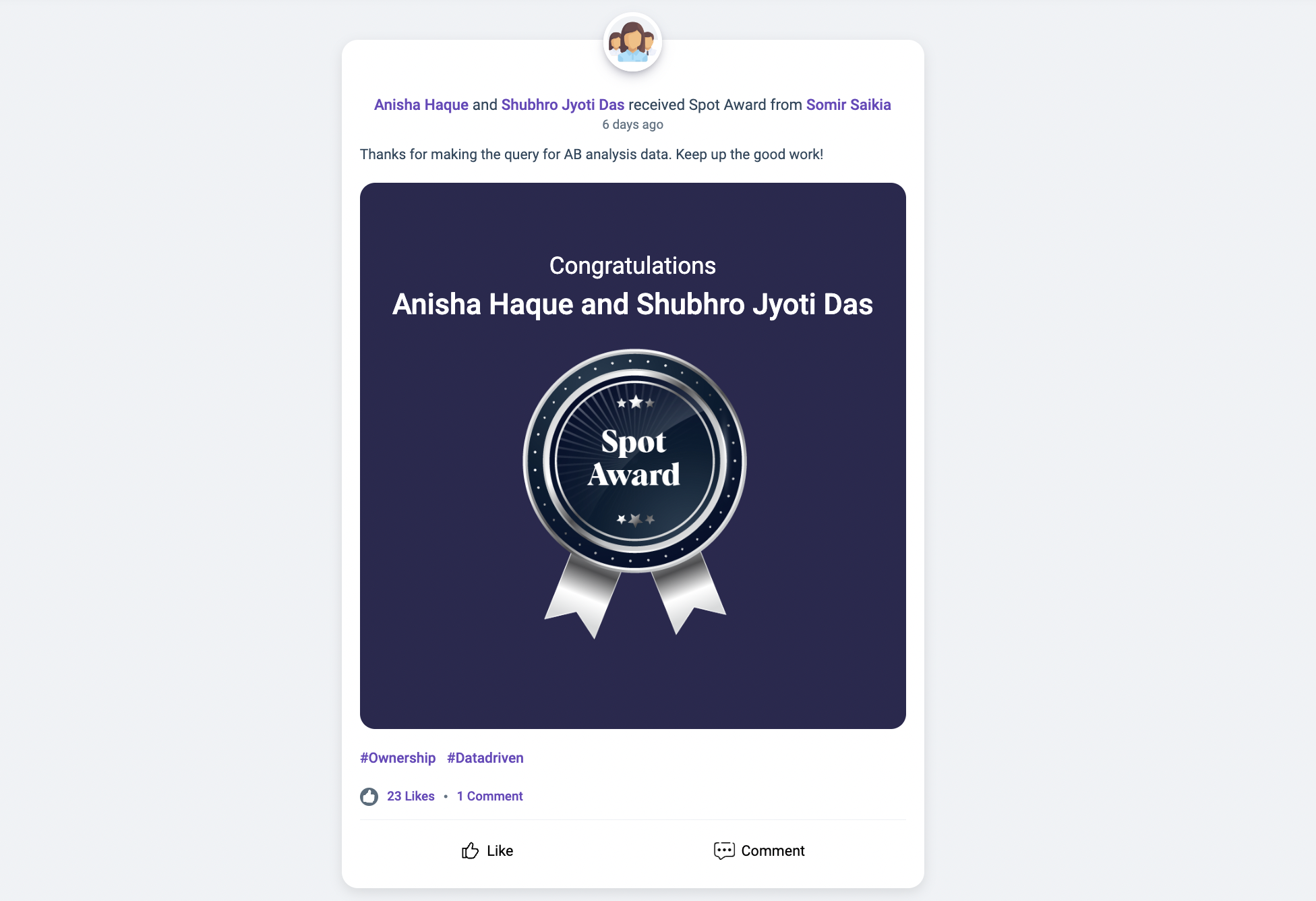
Running a spot award program manually is harder than it sounds. Tracking nominations, managing budgets, ensuring fairness across teams, and keeping records of who was recognized and when. All of this adds up quickly. Without the right system in place, even the best-intentioned programs become inconsistent and difficult to scale.
That's where Vantage Recognition comes in.
Vantage Recognition is an AI-powered recognition platform that takes the administrative weight off your plate, so you can focus on building a culture of appreciation rather than managing spreadsheets. Managers can instantly recognize and reward their team members, view their allocated budget in real time, and route approvals through a simple, transparent workflow.
For global teams, our SOLI (Standard of Living Index) framework ensures that reward points are fair and meaningful regardless of where your employees are located. And with an extensive redemption catalog spanning gift cards, experiences, and merchandise, employees can choose rewards that actually matter to them.
Vantage Recognition also integrates seamlessly with the HRMS and communication tools your teams already use, so recognition fits naturally into your existing workflow. A built-in analytics dashboard gives HR leaders a clear view of recognition patterns, budget utilization, and program health.
Summing up
In recent years, spot recognition has emerged as one of the most effective ways of boosting employee motivation and engagement. It harnesses the power of showing gratitude. And when leaders share their gratitude, positivity spreads among employees, and they want to continue doing good work.
But every employee has unique needs. Remember to put a little thought behind your spot recognition strategy.
Use digital tools to make recognition regular, efficient, and seamless and align your rewards with the company goals. When executed properly, a timely and authentic reward program can be "the" best way to foster an appreciation culture.
Frequently Asked Questions
Q. What does spot award mean? What is the full form?
"Spot award" is not an acronym; there is no "full form." The word "spot" comes from "on the spot," meaning immediately. It refers to the practice of recognizing and rewarding employees at the moment (or very shortly after) they do something noteworthy.
Q. What is a spot award on a paycheck?
When you see a spot award on your paycheck, it means your employer gave you a monetary recognition bonus, typically for a specific achievement or behavior. It will usually appear as a separate line item under supplemental wages. Note that spot awards are subject to income tax and FICA withholding, so the net amount will be lower than the gross award value.
Q. What are the criteria for a spot award?
Common spot award criteria include: exceeding role expectations, solving a critical problem creatively, delivering outstanding customer results, demonstrating leadership or teamwork in a crisis, driving operational improvement, or modeling company values visibly. The best programs define 5–8 specific criteria tied to organizational values.
Q. Are spot awards taxable?
Yes. In the US, both cash and non-cash spot awards are generally taxable as supplemental income under IRS rules. Cash awards are always taxable. Non-cash awards are taxable at fair market value, with limited exceptions for de minimis fringe benefits. Employers must withhold taxes and report awards on W-2s. Consult your tax advisor for jurisdiction-specific guidance.
Q. How much should a spot award be worth?
Spot awards typically range from $10 for micro-recognition to $500+ for exceptional contributions. Most fall in the $25–$150 range. The amount matters less than the timeliness and specificity. A $25 gift card given the same day with a personal note often means more than a $200 bonus delivered three months later.
Q. What is the difference between a spot award and a spot bonus?
A spot award can be monetary or non-monetary (a public shoutout counts). A spot bonus is always monetary, typically in the form of cash added to a paycheck. Spot awards are generally smaller and more frequent; spot bonuses are larger and less frequent.

Nilotpal M Saharia is an Assistant Manager, Content Marketing at Vantage Circle and a recognition-and-rewards (R&R) strategist with 9 years of experience spanning Marketing, HR, and content strategy. He helps HR leaders turn employee recognition and leadership research into practical workplace programs.
Connect with Nilotpal on LinkedIn.