
Most employee of the month programs are introduced with good intentions and quietly resented within a year. The reason is rarely the prize. It is that nobody outside the selection committee knows what is being measured, so every winner looks like a judgment call and every non-winner draws their own conclusion.
An employee of the month award is a recurring recognition program that names one employee each month against a stated set of criteria. The criteria are what separate a program employees trust from one they read as a popularity contest, and most programs never publish them.
Below: what makes criteria hold up, the five structural reasons these programs fall flat and how to fix each one, nine reward ideas employees actually rate, and wording you can copy for the certificate, the letter and the announcement.
What Is the Employee of the Month Award?

The employee of the month award is a formal recognition program that highlights one employee's contribution each period, selected by a panel, typically managers or a mix of managers and peers, against criteria the company has defined in advance. The panel reviews nominations at the end of each cycle and names one winner.
The award itself can take many forms: a certificate or plaque, a cash bonus or gift card, a public announcement on the company feed, or extra time off. The format matters less than the process. Employees care far more about whether the selection makes sense than about what the winner actually gets.
The employee of the month award is one of the most common recognition methods for a reason: it is low-cost, visible, and repeatable. But the same structure that makes it easy to run also makes it easy to get wrong.
What qualifies someone for employee of the month?
The criteria that hold up under scrutiny are specific, visible, and tied to something employees can self-assess. The ones that cause disputes are vague, unmeasurable, or so broad that any manager could justify any winner.
| Criterion | Why it works or fails | How to make it measurable |
|---|---|---|
| Customer satisfaction score improvement | Works: tied to data employees can track month to month | Use the employee with the highest CSAT improvement, not the highest absolute score |
| Peer nominations with a written reason | Works when structured; fails when it becomes a popularity vote with no accountability | Require nominators to cite a specific project or behavior in writing before the vote is counted |
| On-time delivery rate | Works: objective, visible, hard to dispute | Pull from project management data rather than a manager's recollection |
| "Culture fit" or "attitude" | Fails: vague, subjective, no two managers interpret it the same way | Define the specific behaviors that demonstrate it, or remove it from the criteria entirely |
| Cross-team collaboration | Works: broadens the eligible pool; fails when remote employees are invisibly excluded | Count documented cross-functional project contributions, not impressions |
| Innovation or new ideas submitted | Works: motivating; fails when the same few people dominate every channel | Log ideas through a shared channel so quieter contributors are counted alongside louder ones |
Why Most Employee of the Month Awards Fall Flat

Employee of the month awards fail for five structural reasons, not because recognition is a bad idea: the criteria are unpublished, one winner a month makes recognition scarce, the same profile of person keeps winning, the award replaces day-to-day feedback instead of supplementing it, and nobody measures whether it changed anything.
| Failure mode | What employees actually experience | The structural fix |
|---|---|---|
| Criteria are unpublished | Every winner looks like a judgment call. Non-winners draw their own conclusions about who the company actually values. | Publish the criteria a full cycle before the first award. One sentence per criterion, written so an employee can self-assess against it. |
| One winner a month makes recognition scarce | In a 50-person team, 49 people did not win this month. In twelve months, most employees will never be named at all. | Add peer-to-peer recognition between cycles so the monthly award becomes the headline of an ongoing culture rather than the only moment anyone is noticed. |
| The same profile keeps winning | Employees in visible roles or on high-profile projects get nominated repeatedly. Everyone else assumes the game is rigged. | Track who has and has not been recognized over rolling six-month windows. If the same roles keep appearing, adjust the criteria rather than the winner. |
| The award replaces day-to-day feedback | Managers treat the monthly award as their recognition strategy. The 49 non-winners receive nothing between cycles. | Run the award alongside a regular cadence: weekly shout-outs, manager check-ins, peer acknowledgements. The award should punctuate that culture, not substitute for it. |
| Nobody measures whether it changed anything | The program runs for years on the assumption it is working. Nobody checks whether engagement improved or whether employees value it. | Run a short pulse survey two quarters after launch. One question is enough: does recognition feel fairer than it did six months ago? |
This video breaks down why the criteria matter more than the prize:
The scarcity problem nobody does the maths on
On a 50-person team, one winner a month rations recognition instead of distributing it, and employees feel it: a Gallup study (2024) tracking employees over two years found that well-recognized employees were 45% less likely to have left their job than those who went unrecognized.
The monthly award can still anchor the program. But it cannot carry the whole weight of recognition for a team that size. Peer-to-peer recognition removes the rationing problem by making appreciation continuous rather than monthly.
Not Sure Which R&R Platform Is Right for You?
Our Buyer's Guide covers everything you need — evaluation criteria, must-ask vendor questions, and a side-by-side comparison framework.
Download the Buyer's GuideHow to Run the Program So It Holds Up
Run the program in five steps: publish the criteria, set a nomination route, decide the reward before the first cycle, announce it the same way every time, and check after two quarters whether it changed anything.

Publish the criteria
Write the criteria before you announce the award. Keep each criterion to one sentence, written so an employee can self-assess. Publish them in the same place you publish the announcement: the intranet, a Slack channel, the company newsletter. If employees cannot find the criteria without asking HR, they are not public enough.
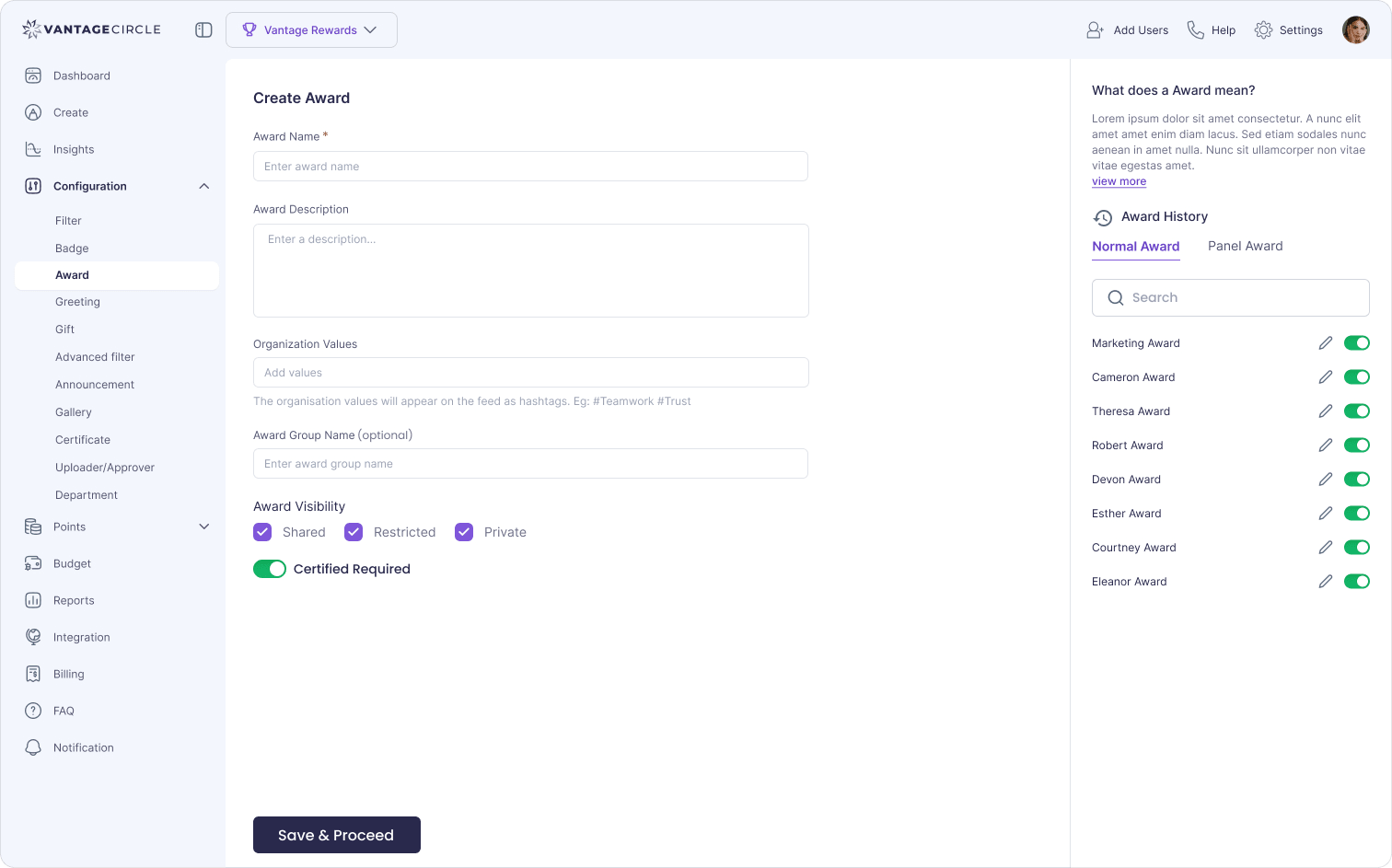
Tying each award to a stated company value gives the selection committee a shared standard and gives every winner a reason they can explain to a colleague who asks why. Vantage Recognition ties each recognition to a specific company value at the point of nomination, which turns the criteria from a document into a built-in constraint.
Set a nomination route
Decide who can nominate: managers only, peers, or both. Each has trade-offs. Manager-only nominations are faster but reinforce visibility bias. Peer nominations are broader but need a written reason to prevent them from becoming a popularity contest.
The simplest approach: open nominations to peers and managers, require a one-sentence written reason tied to a published criterion, and let a small panel make the final decision. More detail on structuring the full nomination process is in the employee of the month nomination guide.
Decide the reward before the first cycle
Announce the reward at the same time you announce the criteria. Changing the prize after employees have already calibrated their effort against the original reward damages credibility faster than almost anything else.
Consult the team before deciding. What one group values, another may not. A remote team may prefer a cash equivalent over a reserved parking spot. A junior team may value a public shout-out more than a gift card.
Announce it the same way every time
A program that runs differently each month reads as improvised. Use the same format, the same channel, and the same timing every cycle. Employees should be able to predict when and how the announcement will happen. Vantage Recognition's campaign management feature enforces a consistent cadence, which matters most in the months when HR is busy and the process is most likely to slip.
Measure it after two quarters
Check whether the program is doing what you built it to do. A short pulse survey with two questions is enough: does recognition feel fairer than it did before the program launched, and do employees understand why winners are selected?
If the answers are no, the fix is almost always in the criteria or the nomination process, not in the reward itself. Vantage Pulse's anonymous response feature makes it possible to ask these questions without attributing the answers, which is the only way to get honest data about whether the award looks fair to the people who did not win.
Employee of the Month Award Ideas
The award ideas employees value most are the ones that give back time, choice or visibility. Physical trophies tend to be the opposite: high in employer spend, low in what employees actually say they want.
Time and flexibility rewards
1. Extra paid time off. One or two additional days off, usable within the quarter, is one of the most valued non-cash rewards in practice. It costs the company relatively little in real terms, requires no logistics, and works equally well for in-office, hybrid, and fully remote employees. Let the winner choose when to use the days rather than assigning a fixed window. The autonomy is part of the reward.
2. Flexible schedule for the month. Allow the winner to set their own start and end times for the award period, bypass the standard approval process for schedule changes, or work from wherever they choose. For teams where schedule flexibility is the exception rather than the norm, this carries real weight. It communicates that the company trusts the person with something it does not normally extend to everyone, which is exactly what recognition should feel like.
3. A no-meeting week. Calendar protection from non-essential meetings for one full week: no status updates, no optional syncs, no recurring check-ins that could have been an email. This is particularly valued by employees whose work requires sustained focus and who routinely lose large blocks of productive time to fragmented schedules. Block it in the calendar before announcing it, so the winner does not have to negotiate it themselves.
Choice and monetary rewards
4. Gift cards. A direct cash equivalent the employee spends however they choose, with no employer involvement in the decision. Gift cards tend to beat employer-selected merchandise because they eliminate the guesswork about what the person actually wants. A $100 gift card to a retailer the employee chooses is worth more to them than a $150 branded item they would not have bought. See gift card incentive ideas for practical amounts by role and region.
5. Learning budget. A set amount, typically between $200 and $500, to spend on a course, certification, conference, or book of the employee's choice. This works especially well for employees who view professional growth as part of their compensation package. It signals that the company sees the winner as someone worth investing in beyond their current role. See training and development options for program ideas that fit different career stages.
6. Subscription or experience voucher. A streaming service, a restaurant credit, a spa booking, a concert ticket, or any experience the employee selects for themselves. The key is letting the employee make the choice rather than assigning a generic subscription. Experiences tend to be remembered longer than physical items, and the process of choosing the experience is itself a form of recognition.
Visibility and growth rewards
7. Social recognition post. A public acknowledgement on the company's recognition feed naming what the employee did and why it mattered. A 2024 WorldatWork industry report found that employees who received at least one recognition a month were 33% more likely to say they were not job hunting, compared with peers who received none. Visibility is one of the least expensive ways to deliver that. Write the post around the specific behavior, not around the award, and it doubles as a signal to the rest of the team about what the program is actually measuring. The Vantage Recognition social feed puts that acknowledgement in front of colleagues who would otherwise only see a name on a noticeboard.
8. Mentoring session with a senior leader. One-on-one time with an executive, a specialist, or a leader the employee has identified as someone they want to learn from. This costs nothing in budget and signals something money cannot easily communicate: that the company considers this person's growth worth a senior leader's calendar. Let the employee choose the person and set the agenda. The meeting should feel like access, not like a formality.
9. Feature in the company newsletter or intranet homepage. A short write-up about what the employee did, written from the employee's perspective where possible, published where the whole company will see it. Unlike a one-time announcement, a written feature can be shared, linked back to, and referenced in performance conversations months later. It also gives the employee something concrete to point to when explaining what they were recognized for. Keep it specific: a feature that describes the work is more meaningful than one that describes the person.
What to Write: Award Letters, Announcements and Certificate Wording
Award wording works when it names the specific behavior and its effect rather than praising the person in general. "For consistently clearing the weekend support backlog before Monday standup" is more meaningful than "for outstanding dedication." The more specific the language, the more clearly the winner understands what they did right and the more clearly other employees understand what the criteria actually mean in practice.
Certificate wording (4 examples)
Award letter to the employee (3 examples)
You are [Company Name]'s Employee of the Month for [Month].
Over the past four weeks, you [specific contribution: e.g., led the migration of three client accounts without a single service interruption]. The team noticed, and so did we.
This recognition comes from your peers as much as from leadership. You were nominated by [N] colleagues, each of whom cited [the same specific behavior].
Thank you for the work. We are glad you are here.
[Sender Name], [Title]
Congratulations on being named Employee of the Month for [Month].
Your customer satisfaction scores improved from [X]% to [Y]% this period, the largest single-month improvement on the team. More than the number: the way you handled [specific situation] set a standard others on the team have already started following.
That kind of work deserves recognition. This is it.
[Sender Name], [Title]
You have been named Employee of the Month for [Month], nominated by your team for your contribution to [Project Name].
When [describe the challenge: e.g., the timeline compressed by two weeks and the scope did not], you stepped in and [describe what they did]. The project delivered on time. That outcome belongs to the team, and a significant part of the team's success belongs to you.
[Sender Name], [Title]
Team announcement (3 examples)
[Name] is our Employee of the Month for [Month].
This month's award recognizes [specific contribution]. [One sentence on the impact it had on the team or the business.]
If you have worked with [Name] on [project or task], you already know why. If you haven't yet: this is a good introduction to the kind of work we want to celebrate here.
Congratulations, [Name].
[Sender]
[Name] was nominated for [specific behavior]. The nomination described it this way: "[direct quote from nomination if available, or paraphrase]."
This is exactly the kind of [criterion: e.g., cross-team collaboration / customer focus / initiative] we built this award to recognize.
[Sender]
Why: [two-sentence description of what they did and why it mattered].
Add your congratulations below. [Name] reads this channel.
[Sender]
A short presentation speech (2 examples)
[Name] did [specific thing]. What made it stand out was not just the outcome but how it happened: [brief description of the behavior that made it notable].
We built this award to recognize exactly this kind of work. [Name], congratulations."
[Read the nomination or paraphrase it.] That is what this award is for: work that the people closest to it notice first.
Congratulations to [Name]."
For general appreciation letters beyond the monthly award, the appreciation letters guide has 15 templates across more recognition scenarios.
Award Name Ideas
Name the award after the behavior it rewards rather than the time period, and you immediately make the criteria clearer. "The Extra Mile Award" tells employees what matters. "Employee of the Month" tells them nothing except that it happens monthly.
A few examples: the Problem Solver Award for employees who find a path through the hard problems; the Team Engine Award for the person whose work made everyone else's work easier; the Raised the Bar Award for consistent performance that shifted what the team considers standard.
For a full list of award name ideas across categories, the employee award titles guide covers naming by recognition type.
Three Fixes That Turn a Struggling Program Around
Most programs that struggle can trace it back to one of three fixable gaps. Here is what each fix looks like in practice.
Publish the criteria before the first cycle, not after. Without published criteria, the panel meets, picks a winner, and announces the result. Employees get the announcement with no context, and the question that follows is always some version of "why that person?" Publishing the criteria a full cycle in advance does not eliminate questions, but it changes them to solvable ones: "how do we measure that criterion?" and "can I nominate someone for next month?"
Add peer nominations with a written reason. A peer who nominates a colleague already knows what that colleague did, and that written reason becomes part of the announcement. The winner then hears not just that they won but what specifically their peers valued, which is what makes recognition land instead of drifting past.
Check recognition distribution across the team every six months. This surfaces a pattern most teams suspect but rarely confirm: certain roles are consistently absent from nominations. The fix is usually to the nomination process. Those roles are not visible enough in day-to-day work for peers or managers to think of them at nomination time.
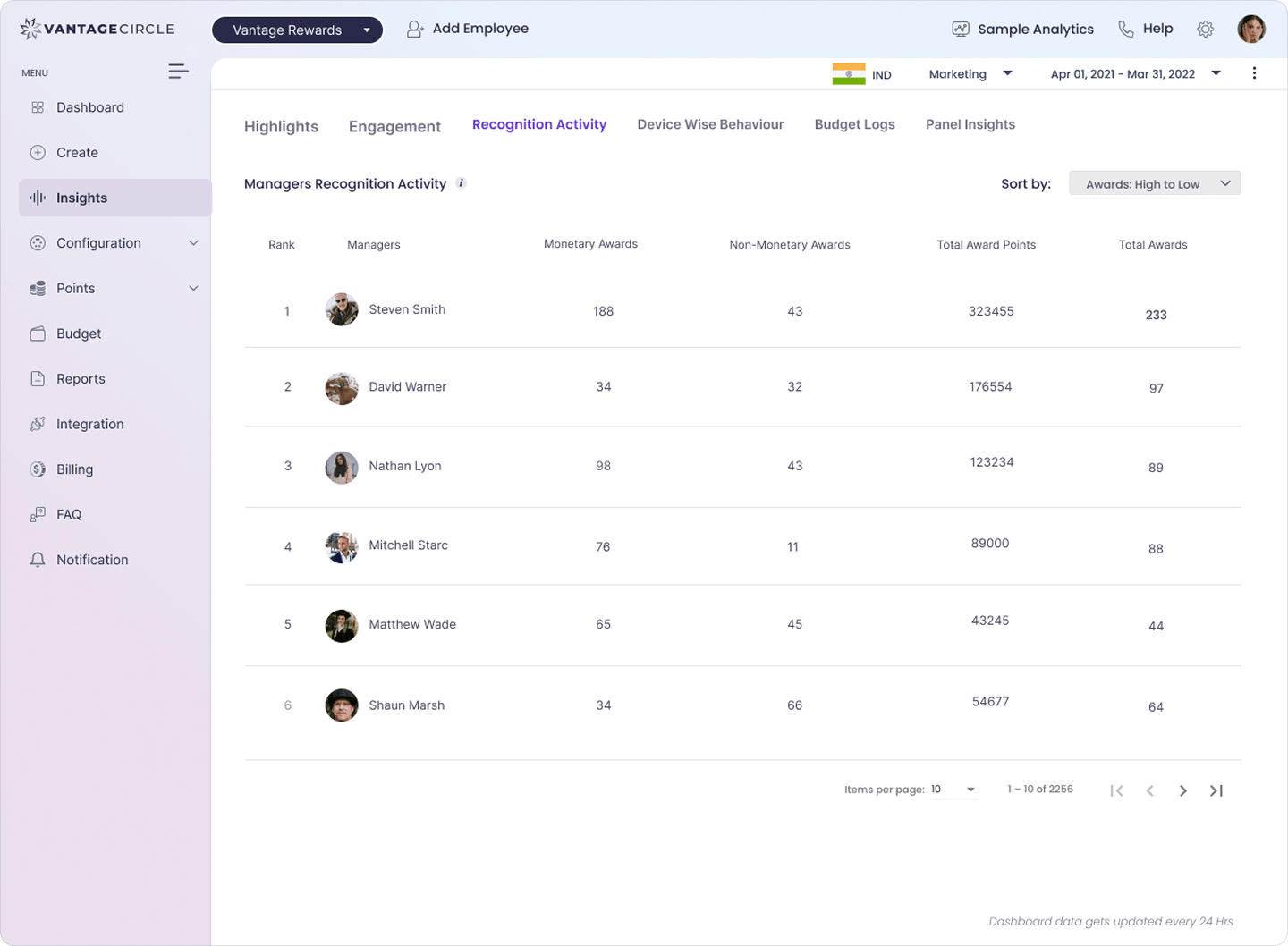
Recognition analytics in Vantage Recognition surfaces exactly this pattern: who has been named, how recently, and whether recognition is distributed across the team or concentrated in the same handful of visible roles.
Frequently Asked Questions
1. What qualifies someone for employee of the month?
The qualifications that hold up are specific, visible, and published before the first cycle runs: a measurable KPI improvement, a peer nomination tied to a specific project, or a contribution to a stated company value. Vague criteria like "positive attitude" produce disputes because no two managers apply them the same way.
2. Does employee of the month count as an award?
Yes. It is a formal recognition program and counts as an award in both the practical and HR-reporting sense. Cash bonuses and gift cards are typically taxable income, while some non-cash rewards may qualify for different treatment depending on your jurisdiction. Consult your payroll provider for the specifics.
3. Are employee of the month awards a good idea?
Yes, under three conditions: the criteria are published before nominations open, the award runs alongside a regular recognition cadence rather than replacing it, and the selection process is transparent enough that non-winners understand why the winner was chosen. Skip those conditions and the program is more likely to breed resentment than engagement.
4. What is the wording for the employee of the month award?
The wording that works names the specific behavior and its impact rather than praising the person in general terms, for example: "For solving the [Project Name] bottleneck the team had been working around for three weeks." Ready-to-use wording for certificates, letters, announcements and a short speech is in the section above.

She is a Digital Marketer at Vantage Circle, making employee recognition less of a checkbox and more meaningful - helping organizations say we value our people and truly mean it.
Connect with Susmita on LinkedIn.