
What do you think happens when a recognition program launches smoothly, but managers still do not use it?
At first, everything looks on track. The platform is live. The demo went well. The budget was approved. HR has done its part; the campaign is ready, and everyone expects recognition to start flowing immediately.
Weeks pass by, hoping that you will witness a positive change. But the dashboard tells you a different story, unimagined of.
Half the managers have not sent a single recognition. Not because the platform failed. Not because the team ignored the launch email. But because the people who were expected to drive the program were never truly brought on board.
That is where manager recognition buy-in matters.
Manager buy-in means people managers who genuinely understand, support, and use the recognition program, not just tolerate it. And that support must be earned before launch, not assumed after it.
Because a manager who was never convinced in the first place has little to no reason to start now.
So, how do you really earn real buy-in from managers? You start by understanding the issues and addressing managers' objections one by one.
Recommended Read: Why Managers Don't Participate in Your Recognition Program (2026 Fix)
Why Manager Buy-In Matters More Than Executive Approval
There is no denying that executive approval funds a recognition program. But a manager buy-in is a major factor in deciding whether anyone uses it. That distinction gets missed in most implementation plans, and it's exactly why programs with generous budgets and a confident launch email still show flat activity six months later.
According to a Gallup workplace survey, the most memorable recognition comes most often from an employee's manager (28%), followed by a high-level leader or CEO (24%)
As you can see, employees are more inclined to be recognized by their managers than by the CEO or senior leaders. A manager who skips recognizing employees misses a chance to build trust and motivation. They're removing the single most meaningful source of it from their team's daily experience, and no executive town hall can substitute for that.
This is also why a recognition program launch feels more like a change management project than a software rollout. Basically, you're not asking managers to adopt a new tool. You're asking them to change a daily habit, publicly, in front of their team, and that only sticks when the people involved in the change are genuinely convinced that it's worth doing.
Manager buy-in should not be checked only after the platform goes live. It needs to happen prior to the launch because it keeps the recognition program moving. Without buy-in, even a good platform can go unused by the managers who have the biggest influence on employees.
The problem may not be obvious at first. A few active managers can make the usage numbers look fine. But managers who do not believe in the program may stay quiet and inactive. Over time, this can affect their teams. eNPS scores may start to drop before anyone realizes that low recognition from managers is part of the problem.
Why Managers Resist Recognition Programs
Most managers do not skip recognition because they are against it, but because they are busy. Research from Appraisd found that 31% of employees see a lack of time as the biggest barrier to giving recognition.
When managers have a full platter, recognition is often shoved to the bottom of the list. It's not that they don't value it; there's just no clear reminder or built into their routine.
Time pressure is one of the most common reasons managers resist recognition, but not the only one. When managers push back, they usually raise a few predictable objections. Each one points to a different problem underneath.
| Manager objection | What's really being said |
|---|---|
| "This is just more work for me." | Recognition looks like a new task stacked on an already full plate. |
| "Recognition isn't really my job, that's HR's." | Nobody has told this manager that recognition is a manager's responsibility, not something a program runs on their behalf. |
| "I don't have budget or approval to give rewards." | The manager is picturing a slow, formal approval chain that likely doesn't exist. |
| "My team doesn't need it, we're already fine." | The manager is going on instinct, not on any real understanding of how their team actually feels. |
| "I don't know what to say or how often." | A blank recognition box is intimidating, and no one has given this manager a starting structure. |
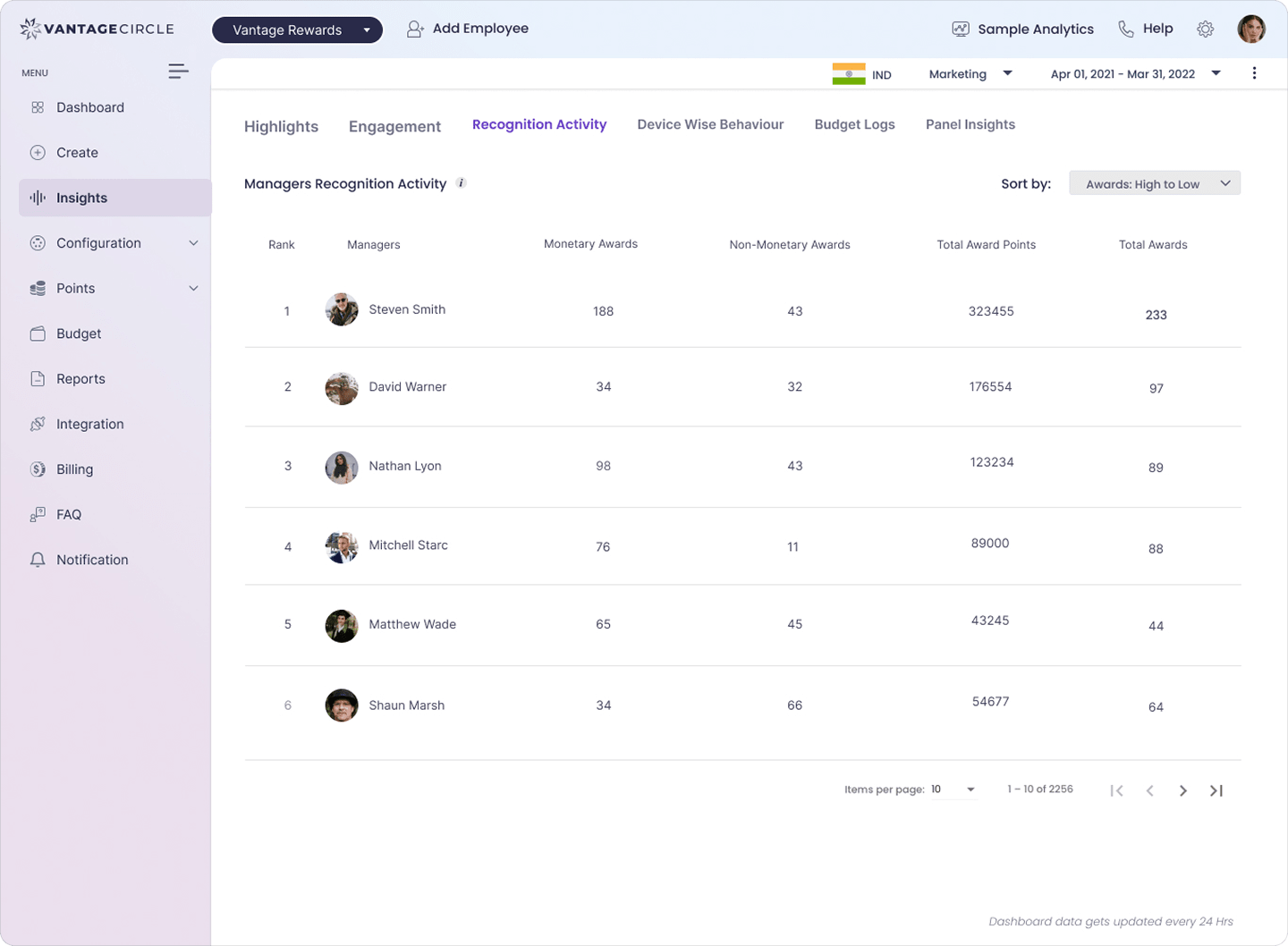
A manager who claims that their team is "fine" without recognition is usually working off a hunch, not a dashboard. Recognition Analytics exists for this very moment.
Instead of trying to change a manager's opinion, show them how often their own team gives recognition compared to the company average. The highlighted gap can clearly set its point than a conversation alone could.
Source: Vantage Recognition
Getting Manager Buy-In: 6 Common Objections and Direct Rebuttals
Managers may resist recognition for various reasons, but the six common objections listed below often arise when a program is new.
The key is not to explain their resistance in the HR language. That can make skeptical managers tune out quickly. Instead, address the concerns in the words managers use and understand, with a clear response to each one.
"This is just more work for me."
This objection centers around time, not motivation. So, the solution should make recognition easier, not expecting managers to try harder.
If managers can recognize someone directly in Slack or Microsoft Teams, or use a quick prompt after a meeting, it can take less than a minute. When it becomes that easy, recognition no longer feels like another task. It becomes something managers can do naturally during the day.
"Recognition isn't really my job, that's HR's."
HR can set up the platform, run campaigns, and share reports. What HR cannot replace is a manager's own words when someone on their team does something worth recognizing.
Recognition from a direct manager feels more personal because it comes from someone who closely observes the employee's work. A company-wide shoutout can never match the weight of recognition from a direct manager.
Once managers understand that their role cannot be replaced by HR or a platform, "recognition is HR's job" becomes a weak excuse.
"I don't have a budget or approval to give rewards."
Most organizations that take recognition seriously plan their budgets in advance, rather than having managers request approval each time.
Having a fixed manager recognition budget removes the long approval process. It allows managers to recognize someone the same day they notice good work, rather than waiting for multiple sign-offs.
"My team doesn't need it, we're already fine."
This hunch, when converted into clear data through an eNPS survey, can expose the gap between how a manager thinks their team feels and how employees feel about recognition.
That gap can shift resistance into curiosity. Once the data is visible, it becomes harder to say the team does not need recognition.
"I don't know what to say or how often."
Research by Appraisd shows that 15% of employees said their uncertainty around what to do was a barrier to employee recognition.
Core Values Alignment makes recognition easier by connecting every message to a specific company value. Instead of starting from a blank page, managers get a simple structure: choose the value and describe the behavior.
That small structure can make recognition feel much easier. It helps managers move from "I'll do it later" to sending a message, especially when they want to recognize someone but aren't sure what to say or where to start.
"Nobody above me does it, so why should I."
This objection is often valid. If leaders never publicly recognize people, managers will not believe recognition is truly important, no matter the plethora of reminders HR sends.
The solution is not another rule. Senior leaders need to go first, and they need to do it often enough for managers to see that recognition is part of the culture. One public recognition from a leader has the highest potential to influence skeptical managers more than weeks of internal reminders about the platform.
Recommended Read: Navigating Leadership Accountability in Recognition Practices
The Manager Buy-In Roadmap: Three Milestones to Full Adoption
Manager buy-in does not happen on a fixed timeline; it occurs in three stages. If you push managers too quickly, the change usually does not stick.
First, their biggest objection needs to be answered in a way they accept. Second, they need to send their first recognition, even if it is simple. Third, recognition needs to become something they do on their own, without reminders.
| Milestone | What Changes for the Manager | HR's Role |
|---|---|---|
| Objection Cleared | The manager stops arguing and starts asking how, not whether | Address the specific objection directly, in the manager's own words, not a generic FAQ |
| First Recognition Sent | The manager crosses from theory into practice, even if the first attempt is generic | Make the first send effortless: templates, a value prompt, a nudge at the right moment |
| Recognition Becomes Routine | The manager recognizes someone without a reminder or a campaign prompting them | Step back from personally prompting and let scheduled nudges carry the occasional reminder instead |
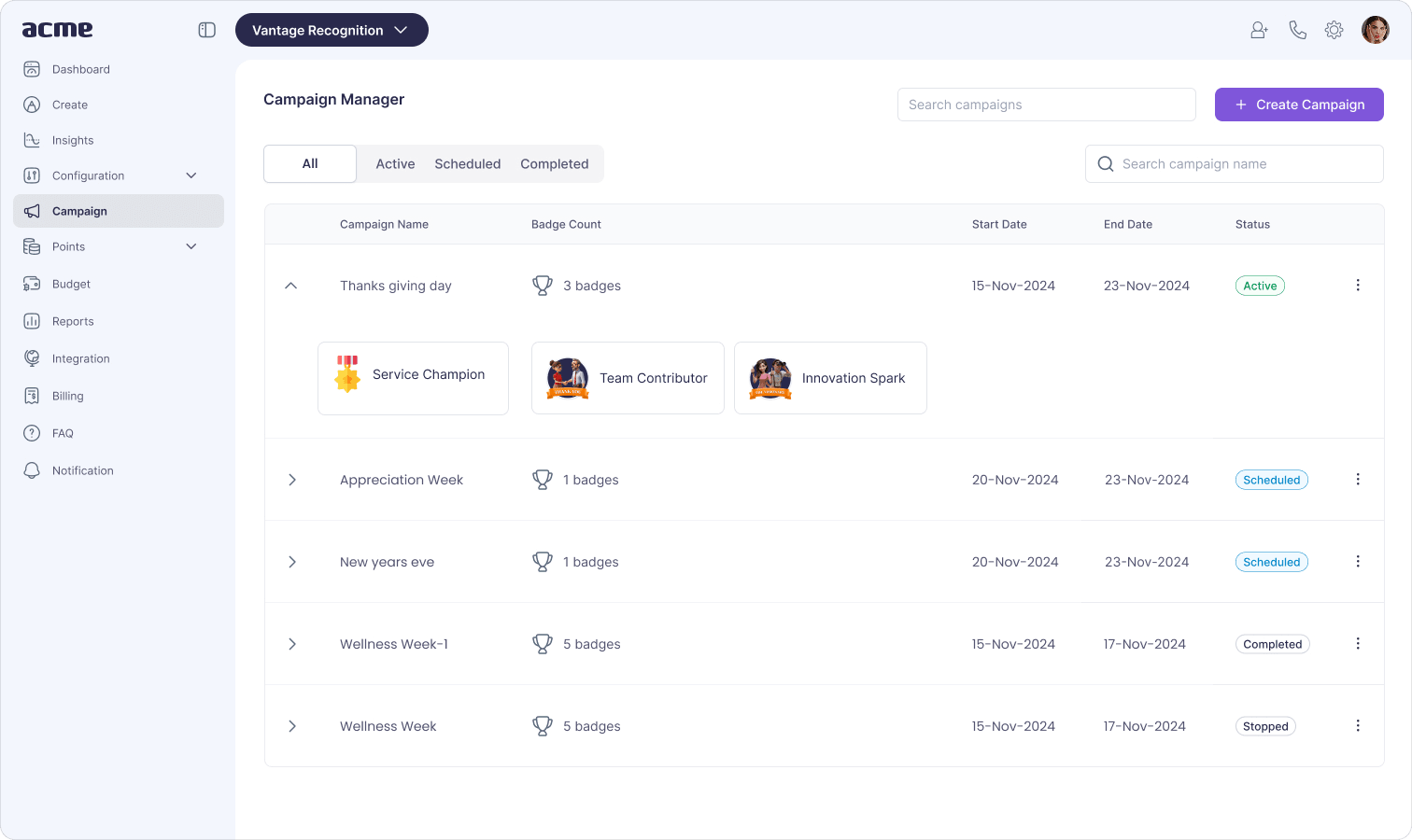
Scheduled nudges matter the most in the space between the first two milestones.
HR should not have to remind every manager personally to recognize someone every week. Campaign Management can automatically send those reminders. In the initial weeks, this can help turn a manager's good intentions into action before the habit forms.
Source: Vantage Recognition
The important thing is not the number of days but the milestone. A manager who answers their objection in week one and sends their first recognition in week two is further ahead than a manager who has been "meaning to do it" for two months. Measure the milestone, not the calendar.
Picture two managers who both raised the same objection, "I don't know what to say." One gets a Core Values Alignment prompt, sends recognition the same day, and starts repeating without reminders the next month. The other only gets a generic reminder email, keeps delaying it, and is still stuck after ninety days.
Same objection. Same platform. Different outcome. One manager moved through the milestones, while the other never cleared the first one.
How to Know Buy-In Is Working
The earliest sign of manager buy-in is simple: Look for how many managers send at least one recognition within their first 30 days of the program.
Do not wait for a detailed dashboard to spot the problem. If the first 30-day number is low, the later numbers are highly unlikely to improve on their own.
Once managers start recognizing regularly, the focus changes. It no longer centers around buy-in. It becomes more about consistency. At that stage, once the habit is formed, the challenge shifts from convincing to sustaining the practice of recognition over time.
Recommended Resource: The Manager's Playbook for Celebrating Small Wins
While managers are still building the habit, teams should not have to wait. A peer-to-peer recognition channel can keep appreciation flowing by taking the pressure off managers who are still steadily getting comfortable.
Final Thoughts
By now, you ought to agree that manager buy-in is not won in one launch meeting. It is earned objection by objection, through clear answers, simple tools, visible leadership, and a roadmap that meets managers where they are.
The real test is not about managers attending the demo. It is whether they have begun to see the value in recognition and have started recognizing employees on their own.
If a manager has not sent a single recognition while their peers have started making it a habit, buy-in has not happened yet. That is the moment to step in, understand the resistance, and address it directly.
Start with the objection your managers are actually raising, and free yourself of the assumption you had about them. Because once you solve the real barrier, recognition stops feeling like another HR initiative and starts becoming part of how managers lead.
FAQs
How can managers recognize employees?
The simplest way is specific and timely: naming exactly what someone did and why it mattered, as close to when it happened as possible. That can be a message tied to a company value, a shoutout in a team channel, or a private note. What makes it land isn't the format. It's the specificity.
What things do managers do to recognize employee performance?
Beyond a verbal or written thank-you, managers who recognize well consistently do three things. They name the specific behavior instead of praising in general terms. They do it soon after it happens rather than saving it for a review cycle. And they occasionally make it visible to the wider team rather than keeping every acknowledgment private.
How long does manager buy-in typically take?
There's no universal number of days, and any source that gives you a single exact figure is guessing. What is consistent across rollouts is the shape of the curve: buy-in becomes visible once a manager sends their first recognition, not before. Everything before that first send is persuasion. Everything after it is habit-building.
What if a manager still won't participate after reaching the final roadmap milestone?
If a manager hasn't sent a single recognition by the point their peers have made it routine, that's no longer a buy-in conversation. It's a performance conversation, and it belongs with their own manager, not inside the recognition program.
Does manager buy-in look different for hybrid or remote teams?
The objections stay the same, but the friction changes. A manager who only sees their team on video calls loses the small in-person cues that usually prompt recognition, like walking past someone's desk right after they solved a hard problem. That makes prompts and templates matter more for distributed teams, not less, since the moment that would have triggered recognition in person has to be manufactured deliberately instead.

Riha Jaishi is a Content Marketing Specialist at Vantage Circle and host of the HR Vantage Influencers podcast, sharing insights that help organizations build recognition-rich, people-first cultures!!
Connect with Riha on LinkedIn.