Avoiding Tokenism In Diversity Initiatives
Episode Overview
Amrita Pandey joins the show to unpack why organizations chase the appearance of diversity, equity and inclusion without doing the harder work of building it into their culture. She makes the commercial case first, pointing to research showing that companies with diverse, inclusive frontline decision making teams are far more likely to beat their financial targets, and that gender diverse teams significantly outperform homogenous ones. From there she defines tokenism plainly: a symbolic gesture, like hiring one person from an underrepresented group or elevating them to a title, that lets an organization look inclusive on paper while the underlying culture and power structures stay unchanged.
Her sharpest, most concrete point comes when she names the specific trap most companies fall into: putting a single employee from a diverse background in charge of DE&I and treating that person as the spokesperson for their entire community, then assuming one individual's lived experience represents everyone who shares their identity. She pairs that warning with practical fixes any HR team can act on right away, like replacing maternity leave with gender neutral primary care leave, extending medical coverage to partners regardless of marital status, and removing gender tags from workplace washrooms. Her larger argument is that transparency beats performance: an organization that openly admits its team is not diverse yet and shows it is working on the problem builds more trust than one that stages diverse imagery for its website while its actual headcount tells a different story.
Episode Highlights
- Companies with diverse, inclusive frontline decision making teams are more likely to exceed their financial targets, and gender diverse teams outperform homogenous teams by a wide margin.
- Tokenism is a symbolic, perfunctory gesture built to keep up appearances, not something practiced or lived inside the organization every day.
- A major pitfall is placing someone from an underrepresented group into a leadership title without giving them the power and influence that should come with that position.
- Token employees are often turned into the default spokesperson for their entire community, even though one person's experience never reflects an entire group.
- Simple, low cost policy changes, like renaming maternity leave as gender neutral primary care leave and removing gender tags from washrooms, can make an outsized difference.
- Organizations that are honest about not yet being diverse, and say so publicly, build more credibility than ones that stage diverse imagery that does not match their actual workforce.
About the Guest
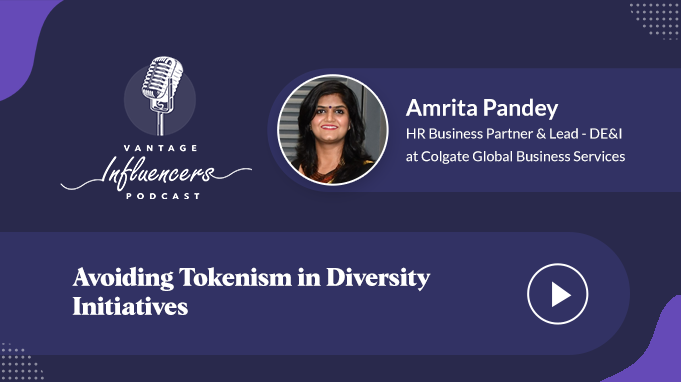
Amrita Pandey, HR Business Partner & Lead - DE&I at Colgate Global Business Services
Amrita has over thirteen years of HR experience spanning talent acquisition, employer branding, project management, and HR business partnering. She earned her Bachelor of Technology from SRM Institute of Science and Technology and her MBA from the Xaviers Institute of Social Service, and built her career at organizations including Tata Consultancy Services, Hero MotoCorp, and Nomura before joining Colgate Global Business Services, where she now leads the DE&I portfolio alongside her HR business partner responsibilities.
Connect with Amrita on LinkedIn
Host
Susmita Sarma, Vantage Influencers Podcast Host
What You Will Learn
- Why diversity, equity and inclusion function as three distinct levers that, combined, strengthen an organization's culture and its financial performance.
- How to recognize tokenism in your own organization, from symbolic hires to the spokesperson pressure placed on diverse employees.
- Practical, low cost HR policy changes that make leave, benefits, and facilities genuinely gender neutral and inclusive.
- Why leadership buy-in, not just a dedicated DE&I team, determines whether a diversity strategy succeeds or stalls.
- The long term business case for avoiding tokenism, including higher retention, competitive advantage, and a healthier company culture.
Key Topics & Timestamps
| Timestamp | Topic |
|---|---|
| 00:00 | Cold open: the promise and peril of diversity and inclusion efforts |
| 01:02 | Introducing guest Amrita Pandey, HR Business Partner and DE&I Lead at Colgate Global Business Services |
| 01:33 | Amrita's career path from Patna to Chennai engineering, Tata Consultancy Services, Hero MotoCorp, and Colgate |
| 04:26 | Why DEI matters and the financial case for diverse, inclusive teams |
| 09:40 | Defining tokenism and why it is dangerous for organizations |
| 12:05 | How organizations can avoid tokenism and build meaningful opportunities |
| 17:08 | Concrete HR policy examples: gender neutral leave, washrooms, and medical coverage |
| 21:54 | The long term benefits of avoiding tokenism: retention, advantage, and culture |
| 26:00 | Closing thoughts and how to connect with Amrita on LinkedIn |
Full Transcript
Click to read the full episode transcript
Welcome to the Vantage HR Influencers Podcast. This podcast is sponsored by Vantage Circle, the simple and AI-powered rewards and recognition platform for employee engagement. Diversity and inclusion efforts have gained significant momentum in recent years, and organizations are increasingly recognizing the importance of creating inclusive environments. However, there is a big danger lurking: the tendency to tokenize individuals or groups, reducing diversity to mere appearances rather than embracing its true value. In this episode of the Vantage Influencers Podcast, we explore the pitfalls of tokenism and its impact on employees and organizations, and discuss practical strategies to ensure that diversity initiatives go beyond symbolic gestures.
Susmita Sarma: For the same, I'm your host, Susmita, and I welcome Amrita Pandey to join me today. Amrita is the HR Business Partner and Lead, DE&I, at Colgate Global Business Services. Welcome to the show, Amrita. Thank you for joining us today in this episode. Before we dive into our topic, could you please introduce yourself to our audience and tell us a little bit more about your background and what you are currently working on?
Amrita Pandey: Thanks for the question, Susmita. Basically, I am born and brought up in a place called Patna, which happens to be the capital of the state of Bihar. I finished most of my education up until 12th standard from Patna itself, and thereafter I moved to Chennai to pursue my engineering. After that, I worked briefly for a period of two years at Tata Consultancy Services, and thereafter I pursued my MBA in the field of human resources. Then I joined an organisation called Hero MotoCorp, which happens to be one of the world's largest two wheeler manufacturers. That was in Delhi, and after Hero MotoCorp, I joined Colgate Global Business Services, which happens to be my current organisation as well. I am currently donning the profile of an HR Business Partner. If I have to talk about my HR career so far, I started in the field of talent acquisition, which also had some semblance of employer branding. I've done project management, but most of my HR trajectory has revolved around the HR business partnering space.
Apart from that, if I talk about a couple of quick highlights in my HR career: in the space of employer branding, I once had the opportunity to lead a national level project for Hero MotoCorp, an internship in partnership with MTV and LinkedIn called "MTV LinkedIn Get a Job." It was an intern hiring show that MTV used to air, back in 2017.
I thoroughly enjoy my HR business partnering work, and recently I've been given the profile of diversity, equity and inclusion, which I'm quite passionate about, because I feel that if it's done in the right way, it can take an organisation leaps and bounds ahead, not just in terms of building the cultural fabric, but also in terms of contribution to the top line of the organisation. Maybe we can explore that further in our podcast.
Susmita Sarma: Yes, that is why we are talking about a very important topic on DE&I today: tokenism, and how we can avoid it. First of all, fantastic experience and qualifications, Amrita. With your wealth of experience, we are excited to have you here to share your insights on avoiding tokenism in diversity initiatives. So let's start with the basics. Let's begin by discussing diversity, equity and inclusion in general. Can you talk about why DEI initiatives are so important in today's workplaces, and how they can benefit both employees and the organisation?
Amrita Pandey: Okay, like you said, Susmita, let's touch the basics so that our listeners are able to understand what exactly we are talking about. If we break up diversity, equity and inclusion: diversity refers to the wide and varying range of groups within a community or population, whether that's ethnicity, religion, ability, sexual orientation, and countless other dimensions. Inclusion is the active engagement of all members of that community or population, and equity is the treatment part of it, meaning a fair and just treatment of these members from diverse backgrounds, regardless of whatever their identity is. These are three separate pieces which, when lumped together, become a very strong lever for building the culture of an organisation.
Now, why is diversity, equity and inclusion important in a workplace? I can give you a zillion reasons, but we are in a business centred world, and the net question that comes to everyone's head is: what about the top line? So let me break it down. A recent industry survey found that about 75 percent of companies with diverse and inclusive frontline decision making teams exceed their financial targets compared to companies that are not. If we break it down further, gender diverse and inclusive teams outperform gender homogenous and less inclusive teams by an average of 50 percent. That's your top line, that's your financial performance, and this isn't me saying it. This comes from a survey of hundreds of companies.
Now let's break down why this happens. Inclusivity fosters a sense of belonging for employees, creates a safe space for people to voice their opinions, gives them a seat at the table, and in turn breeds innovation. So a strong, diverse, equitable and inclusive strategy is something any company that wants to foster innovation would want to have. This inclusion can also improve business decision making. When everyone, regardless of their background, ethnicity, colour, origin, or sexual orientation, feels they are in a safe space and have a seat at the table, they're more likely to speak up openly, share their perspectives, and voice their ideas on a variety of topics, from new products to new markets, and hence generate newer and more innovative ideas for the organisation to solve a business problem.
Those are the financial metrics organisations can look at. Now coming to the non-financial metrics: a recent study found that 70 percent of job seekers today consider diversity a factor in evaluating a prospective employer. And we are at a juncture where there's an advent of Gen Z job seekers, so if you look at this number from a Gen Z standpoint, it goes even higher, because that generation tends to be more open to ideas, more pragmatic, and more accepting. So if an organisation is forward looking and trying to future proof itself, it has no other way to go but DE&I. It prioritizes and creates environments where individuals can thrive, contribute their unique perspectives, and make a positive impact overall.
Susmita Sarma: Absolutely. Great points, Amrita. So now, if we shift our focus to the specific issue of tokenism in diversity initiatives, can you explain to our audience what tokenism is and why it's crucial to address in the context of diversity initiatives?
Amrita Pandey: Okay, so tokenism, the word itself is quite self-explanatory: you do something just to keep up with appearances. It's just a token. It's not ingrained, it's not a part of your culture, it's not assimilated within, but it's a token: a sort of perfunctory change that you make just to keep up with appearances, or to decorate your organisational profile so that you seem like an organisation that is diverse, equitable and inclusive in nature, when the reality is far from it. Basically, you're not practicing or living and breathing DE&I every day. You're just doing it so that you are perceived in the marketplace as a DE&I oriented organisation, and so that you can, in a manner of speaking, stay in step with the crowd, because that's what everybody is doing today.
I think this is a very major pitfall that organisations can fall into, and if steps aren't taken cautiously to walk away from tokenism, there's a much higher chance that you'll fall prey to it. It's just a symbolic effort to hire a small number of people from underrepresented groups to appear as if there is equality within the workplace. But there is a huge difference between being diverse in your hiring efforts and seeming diverse in your hiring efforts. Appearing diverse to prevent criticism leads to tokenism, and to frustrated employees who feel like they were only hired to check a diversity box. So that is what tokenism is.
Susmita Sarma: So it's kind of an artificial or superficial, symbolic effort to promote diversity without genuinely caring about the systemic issues or the opportunities for underrepresented groups.
Amrita Pandey: Absolutely, Susmita. You've just hit the right chord. Great explanation.
Susmita Sarma: So how can organisations ensure they are not engaging in this process of tokenism, and instead create more meaningful opportunities for these groups? What are the steps they can take to achieve this?
Amrita Pandey: Okay, sure. So number one, an organisation must assess the landscape. You look internally at your organisation and see where you're placed in terms of your DE&I vantage point. Maybe you've just started, maybe you're in the middle, or maybe you've really matured as a DE&I champion. You need a good understanding of your landscape; that's your starting point.
Number two: if there is a clear underrepresentation of minorities in your organisation with regard to leadership positions, typically what organisations do is hire people from minority or underrepresented groups and put them in executive positions. So one option is that you put them in a leadership position just for a tokenism perspective. The other, more important option is that you place them in an executive position and give them the power and influence that comes along with it. If you're doing that, you're doing it right.
It's also very telling that in organisations which call themselves DE&I champions, and there's a lot of noise about them being front runners in DE&I, it typically happens that the person from your own diverse background, or from the LGBTQIA+ community, ends up leading the DE&I space. So token employees are often made the spokesperson for the underrepresented group they belong to. It's important to recognize that diverse employees are, first and foremost, individuals. While we can and should encourage employees to voice their opinions and beliefs on certain subjects, the lived experience of one employee will not be reflective of that entire group as a whole. So as an organisation, we must ensure we listen carefully to any feedback or insight that employee has, and avoid attaching any negative or positive stereotype to an employee's minority group.
Susmita Sarma: Did you want to add something?
Amrita Pandey: No, please continue. Yeah, and it's also very important to know, Susmita, that diversity is an all hands on deck effort. Sure, it's great to create a team dedicated to diversity and inclusion efforts, but realising there is a problem is only step one, which I called out earlier as well. Everybody in the organisation needs to be on board if you want your DE&I strategy to succeed, and I'm especially talking about the leadership team. You need buy-in from them. If you're doing it from a tokenism perspective, where it's just "good to have," it's better not to do anything at all. If you feel your organisation isn't ready from a cultural standpoint, park it, and revisit it sometime in the future when you think your organisation is mature enough to handle it.
And last but not least, one of the worst things you can do is display imagery of yourself as a diverse team on your website or social media platform when the actual makeup of your organisation doesn't reflect that. It's okay to acknowledge that your team is not diverse yet and that you're working on it. Transparency about your DE&I efforts goes a long way.
Susmita Sarma: Right, your current position.
Amrita Pandey: Correct. And if an organisation indulges in the opposite, there are multiple repercussions that will negatively impact the employee experience of that organisation. So these are a couple of things that, if an organisation takes cognizance of, it will not fall into the rut of creating a negative employee experience for underrepresented or diverse groups.
Susmita Sarma: I think, Amrita, for organisations working on diversity and inclusion, it's important to have some mention of it in their policies, practices and procedures as a whole.
Amrita Pandey: Absolutely. Because without mentioning it in our policies, I don't think we can incorporate a diversity lens into the organisation. Otherwise it just remains the tokenism we spoke about earlier.
Susmita Sarma: So are there any examples of specific HR policies or practices that can be adjusted or implemented to promote genuine diversity and inclusion that you can talk about?
Amrita Pandey: I'll talk about it from a marketplace perspective, in terms of what organisations today are doing. Let me start with a very simple, relatable example. We give maternity breaks to our women employees. What about a scenario where a man is the primary caregiver? What if the baby is to be taken care of by the man? That's a real possibility. Or consider a scenario where same gender partners have adopted a baby. What about them, if they want to take time away from work? Where does your inclusion come into question in a scenario like that?
Now, what about a scenario where you have washrooms in your organisation? We always go with gender tags: men, women, when it comes to washrooms. But what about our homes? We have gender neutral washrooms at home. Then why do we change it at the workplace? We don't have a man-woman tag on our washrooms at home. So let's not be hypocrites here. There's a lot of talk about feminism, and I'm a strong feminist myself, but I don't like the idea that to fortify feminism we always say "men don't do this, men don't do that," while not giving them an avenue. What if a man wants to take care of a newborn baby? We don't even talk about such things today. It's called maternity leave, so let's call it that: I think our conversations need to change. Don't call it maternity leave, call it primary care leave. Make it gender neutral.
These are simple quick wins that any organisation can have, and they have a huge impact. When we already have gender neutral washrooms at home, what's the need for a gender tagged washroom at the workplace? Again, that's a very high impact, quick win any organisation can implement.
In terms of policies, most organisations have medical coverage. So why include only your wife, or only your spouse? Why can't you say your medical facilities will cover your partner? Not everybody is going to get married, after all. I think these simple steps, from a policy standpoint, will make a huge difference in the society of tomorrow and the society of today, because this conversation has come a long way, and it's time we all sit up, listen, and think in a more inclusive way. It can't happen with just one person doing a lot of work; it has to be a broader trend that everybody accepts and adapts their thinking around. It can start with one person, but it has to reach a universal level.
Susmita Sarma: Simple things that we've discussed just now, but when it comes to implementation, there'll probably be only a few top companies that step up to make these changes to their HR policies.
Amrita Pandey: Sure, but let's be a little kinder here. I think many organisations have already started putting their foot in the door, so the ripples have already begun. It'll take some time for it to mature and bloom, but the changes have really started trickling in. Let's see how it builds up from here.
Susmita Sarma: That's great news. Hopefully, in the coming years, we'll see a big difference in our workplaces. So quickly, can you talk about the long term benefits organisations can expect, if we see changes happening in workplaces, specifically around avoiding tokenism and fostering genuine diversity and inclusion?
Amrita Pandey: I think number one would be that you create a safe space for everybody in your organisation. When every opinion is valued and people aren't scared to speak their minds, or are imbibing the values of being courageous, you get higher retention of employees. Nobody wants to leave a good organisation, even for more money. People want to be in a good organisation, a healthy, thriving culture where they feel they can be their authentic selves. So that's win number one: your turnover goes down, and you protect your bottom line from the cost of attrition.
Number two would be creating a competitive business advantage. Let me give you an example: Abraham Lincoln had a very diverse cabinet, which in fact comprised his arch rivals, and his cabinet is considered one of the most successful cabinets in the entire presidency history of the United States of America. The reason was that it comprised people with diverse opinions and diverse voices, so there wasn't an echo effect of homogeneous views where everyone just agreed with one person. Instead, there was a lot of debate, discussion, and opinions being shared, and that's how you create an advantage for yourself: by discussing and debating a lot of opinions and counter opinions, and finally funnelling down to something that makes sense. Research has also shown that organisations with diverse teams are 33 percent more likely to outperform their rivals in profitability. So that's the second lever: it gives you a delta in terms of competitive business advantage.
Number three would be company culture. Workplace culture is the sum total of the values, beliefs and behaviours that contribute to an organisation's unique social and psychological environment. When you have an organisation with people from underrepresented groups of different sexual orientations, genders, races and ethnicities, people start feeling it's a safe space to be in. When you ensure equity for these diverse groups, everyone has complete access to the same opportunities regardless of background or circumstance, and maintaining an inclusive environment allows everyone to feel comfortable sharing their ideas and bringing their authentic selves. A lack of that difference can lead to an echo chamber where everyone simply agrees with one another without considering other viewpoints, and that gets completely disregarded. So these are a couple of the benefits that come with having a diverse, equitable, inclusive workplace.
Susmita Sarma: Thank you for sharing this information, Amrita. Those are definitely very compelling outcomes: the long term benefits for organisations that successfully avoid tokenism. So we've reached the end of this conversation today. Your expertise and perspective have undoubtedly resonated with me and our audience. We'd like to give our listeners the opportunity to reach out to you for further inquiries or discussions if they want to. Would you tell us how they can reach out to you?
Amrita Pandey: Absolutely. Susmita, I'm quite active on LinkedIn, so I'd request listeners to reach out to me on my LinkedIn profile. You can try searching for Amrita Pandey.
Susmita Sarma: Sure, I'll link to the profile in the show notes.
Amrita Pandey: Yeah, that'll be great. I think that's one way they can connect with me, and I typically respond within a day or two. Apologies if my turnaround isn't within 24 hours, but I try to respond to as many messages as I can.
Susmita Sarma: Sure. So before we conclude today, Amrita, I'd like to take a moment to express my sincere appreciation to you. Thank you for sharing your expertise and insights on avoiding tokenism in diversity initiatives. It's been an enlightening discussion, Amrita. We look forward to possibly collaborating with you again in the future.
Amrita Pandey: Thank you so much, Susmita. I actually had a lot of fun myself, because we were talking about a space I'm really passionate about. I'd look forward to having such opportunities again. Thank you so much for having me on the show.
Susmita Sarma: Thank you. Thank you once again.
Thanks for listening to the Vantage HR Influencers podcast. Please do subscribe to the Vantage HR Influencers podcast on Apple Podcasts, Spotify, and our YouTube channel for new episodes.
FAQ
What is tokenism in the context of diversity, equity and inclusion?
Amrita Pandey describes tokenism as a symbolic or perfunctory gesture organizations make to keep up appearances, without actually living or practicing DE&I as part of their culture. It shows up as hiring a small number of people from underrepresented groups so an organization looks diverse and inclusive, while the underlying culture and decision making power stay unchanged.
What is the biggest mistake organizations make when trying to avoid tokenism?
According to Amrita, one of the most common mistakes is putting someone from an underrepresented group into a leadership title, such as leading the DE&I function, without giving them the actual power and influence that role should carry. Organizations also tend to turn that one employee into the default spokesperson for their entire community, even though one person's lived experience never represents an entire group.
What HR policy changes can help organizations move beyond tokenism?
Amrita points to concrete, low cost changes: renaming maternity leave as gender neutral primary care leave so it covers any primary caregiver, extending medical coverage to partners regardless of marital status, and removing gender tags from workplace washrooms. She argues these quick wins carry an outsized impact relative to their cost.
What are the long-term benefits of avoiding tokenism and building genuine diversity, equity and inclusion?
Amrita cites three main benefits: higher employee retention because people want to work where they can be their authentic selves, a competitive business advantage from diverse perspectives that reduce echo chamber decision making, and a stronger overall company culture where employees from underrepresented groups feel safe contributing their ideas.
Related Reading
Also listen on