Design Thinking In Employee Experience
Episode Overview
Ben Whitter opens this conversation with a blunt definition of his life's work: employee experience, employee experience, employee experience. He argues that most organizations still treat the term as a soft, abstract idea, when in reality it should be the single most urgent priority for any business, because people have a limited amount of time to make an impact, and work should help them do that, not get in the way. From there he traces how his own thinking evolved from a narrower focus on the "employee" toward a broader human experience, tying that shift directly to the isolation and reflection people went through during the pandemic.
The heart of the episode is Ben's case for design thinking as the operating system behind that shift. He rejects the idea that design thinking is a workshop, a journey mapping exercise, or a one-off project, and instead frames it as a mindset built on empathy, intention, and iteration. He also pushes back on the assumption that only designers or HR should own this work: in his view, employees themselves are usually the ones who first spot what is broken, and the best design processes pull in cross-functional voices from IT, real estate, and marketing rather than treating HR as a silo. He closes with a case for measuring experience through alignment, arguing that the real test of a good employee experience is whether it lines up with what the business and its people actually value.
Episode Highlights
- Ben treats employee experience as the top business priority, not a soft HR add-on, because people have limited time to make an impact and work should help them do that.
- The shift from "employee experience" to "human experience" reflects how the pandemic pushed people to question their jobs and their lives much earlier than they normally would.
- Alignment, not surveys or dashboards, is the real measure of employee experience: whether it lines up with customer experience and business strategy.
- Design thinking is not a workshop or a one-off journey-mapping exercise. It is an ongoing mindset built on empathy, intention, and iteration.
- Employees themselves, not HR alone, usually drive the best design processes because they are closest to the problems that need solving.
- Design thinking has no fixed boundary. Organizations have used it to rebuild onboarding, technology experiences, and employee development from scratch.
About the Guest
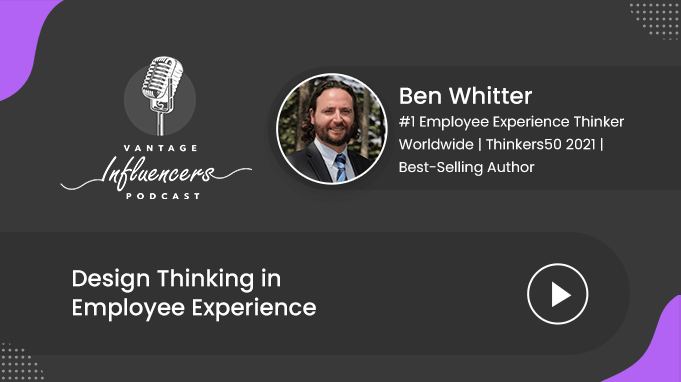
Ben Whitter, World's Leading Authority on Employee Experience, Author & Creator of the HEX Model
Ben Whitter was named one of the World's top 30 management thinkers to watch in 2021 by Thinkers50, one of the top 30 organizational culture speakers and professionals worldwide by Global Gurus, and one of the top 30 Most Influential HR Thinkers in 2021 by HR Magazine. He is independently recognised as the world's leading authority on employee experience, with more than 20 years of HR background and experience advising organizations around the world. Ben is the author of Employee Experience and Human Experience at Work, both of which debuted as the number one new HR books and went on to become international bestsellers. He is also the creator of the Holistic Employee Experience (HEX) model, a framework used and referenced by leading global brands to differentiate their business, brand, human, and societal outcomes, and he runs HEX Organization, where he leads HEX practitioner training programs.
Host
Susmita Sarma, Vantage Influencers Podcast Host
What You Will Learn
- Why treating employee experience as an abstract HR concept undersells its real business impact.
- How the shift from "employee experience" to "human experience" reframes work around what people actually need from their time and energy.
- Why alignment with customer experience and business strategy is a more meaningful measure of employee experience than raw engagement scores.
- What design thinking actually means in an HR context, and why it is a mindset rather than a one-time workshop.
- Why employees, not just HR or design teams, are often best positioned to spot what needs to be redesigned.
- Where organizations have successfully applied design thinking, from onboarding to technology to employee development.
Key Topics & Timestamps
| Timestamp | Topic |
|---|---|
| 00:36 | Introducing Ben Whitter and today's topic: design thinking in HR |
| 01:04 | Ben's background and what keeps him busy in employee experience work |
| 01:49 | What draws Ben to employee experience as a priority |
| 02:38 | From "employee experience" to "human experience at work" |
| 03:29 | How employee experience has shifted before and after the pandemic |
| 04:49 | How to measure employee experience through alignment |
| 05:52 | What design thinking actually means |
| 07:07 | Who should initiate the design process in HR |
| 08:19 | Real-world examples of design thinking in employee experience |
| 08:59 | Ben's closing message on prioritizing employee experience |
| 09:45 | Where to learn more about design thinking and employee experience |
| 10:15 | How to connect with Ben Whitter |
Full Transcript
Click to read the full episode transcript
Welcome to the Vantage HR Influencers podcast. This podcast is sponsored by Vantage Circle, the simple and AI-powered rewards and recognition platform for employee engagement.
Susmita Sarma: Design thinking is a beautiful concept implemented by different organizations in areas like performance management, goal management, product marketing, and so on. Its goal is to assist your teams in doing less and focusing more. Let's learn more about design thinking today, why it's important, and how it promotes critical thinking, collaboration, and innovation. Hi everyone, I'm Susmita, your host, and Ben Whitter, who is regarded as the world's leading authority on employee experience, an international keynote speaker, and one of the world's top management thinkers by Thinkers50, joins me in this week's podcast to understand design thinking in HR. Welcome to the show, Ben.
Ben Whitter: Great to be here.
Susmita Sarma: Thank you so much for joining me today. And I would request you to tell us a brief about yourself for our audience and what keeps you busy these days.
Ben Whitter: Employee experience, employee experience, and employee experience. That's essentially what I do, what I think about all the time, and the work I do with clients around the world to elevate the experience of work for people and businesses. So that's been my background and career, and I've worked 20 plus years from a HR background and perspective. But what I've been doing over the last, say, decade or so is really promoting the idea and concept of employee experience around the world, helping people become more human centric in their approach.
Susmita Sarma: So what exactly interests you in employee experience?
Ben Whitter: Well, for me, it's an absolute game changer for organizations. It's not some corporate abstract concept, an idea that doesn't really impact or resonate with employees. It is squarely focused on the thing that we should be really most concerned about as a priority, which is the experience of work and life. As human beings, we have a limited amount of time to make a difference, to make an impact. And our work life should enable that, should help us to fulfill our potential in life and work. So the employee experience, for me, is everything about what a business does and the standard it takes in the world to promote its products and services to make things a little bit better for people.
Susmita Sarma: Yeah. So employee experience to human experience at work, a small change in the term, you know, employee experience to human experience, that the book that you wrote in and got published in 3rd May of 2021, was it a result of your thinking during the Covid-19 era?
Ben Whitter: Yeah, absolutely. Because I wrote the book through the pandemic and a large outcome of the first book, employee experience, which I released in 2019, was the employee experience is all about a human being. So we have to focus on the human being. So the second book, we really went deeper into the research. We looked for great businesses that were not only taking the employee experience extremely seriously, but those that were really putting humans at the front and center of the business model. And that was the result, which was fantastic.
Susmita Sarma: Right, right. So how do you see the change in, you know, employee experience before and after the pandemic?
Ben Whitter: I think expectations have changed. Your life has changed for people and the employee experience will need to change with them. I think that's the big thing. So people have new opportunities, they have new options, and they have new mindsets about the way work interacts with other elements of their life. So I think that's what's been a major change with many people considering their jobs, considering what they really want to do in life. And I think it's accelerated that thinking. Usually people wait until kind of midlife to have some really deep conversations with themselves. But I think the pandemic and the really strong awakening that's happened in terms of the amount of time we have and what we do with it, I think has prompted people to question everything about their lives. So the employee experience will need to change and evolve with that. So looking at how we become creators of more autonomous workplaces, flexible workplaces, organizations where well-being is a high priority, but really helping people to tap into their full potential and make changes to the business that enable people to do that really.
Susmita Sarma: Right. So, you know, all these days, all these years, we have been talking about employee experience. But Ben, how exactly do we measure employee experience? Like how much is more, what is better and what is less employee experience?
Ben Whitter: The big thing for me, I think, is alignment. I think alignment is a great measure of employee experience. Is your employee experience aligned to your customer experience, to your business strategy? I think that's one measure that is underrated, but is absolutely fundamentally critical in the way that you design that employee experience. So alignment with what matters most to your organization, what matters most to your people, are critical measures of employee experience. And then there are various things and tools and techniques that we can use to mine data, to analyze data, to understand the performance of the employee experience. But what it really comes down to is alignment and accountability for the quality of that employee experience, to deliver superior business and human outcomes. That's the bottom line for me.
Susmita Sarma: Right. Brilliant. And coming to the topic today about design thinking in HR, would you like to describe in brief about what exactly is design thinking first?
Ben Whitter: Yeah, for us, I think design thinking is, you know, it's not a workshop or employee journey mapping or a one-off thing. It's an entire approach to creating human resource policy practices and experiences. So it's a mindset. It's an approach. It's something that you apply to design better experiences. So leading with empathy in that design process is absolutely critical to create those fantastic experiences that help businesses grow and develop their relationship with employees. So designing with intention, designing with purpose and real thoughtful consideration is a key element of design thinking. But, you know, the basics is, you know, from an idea to iterating that idea to deploying a new experience, you go through this design thinking process, which, you know, improves and creates new experiences that perform better within the organization.
Susmita Sarma: Right. So who can design HR? Who can initiate the design process in HR?
Ben Whitter: Yeah. Well, I think often it's employees who drive the design process because they have identified wants or needs that they need in order to do their best work. So I think the stakeholder or the user or the person at the end of the experience is the person who is prime time for starting a new product, a new service or a new experience. The designers really are cross functional so they can come from any functional team. They can come from HR. They can come from IT. They can go from estates or wherever it may be, marketing. And the thing about it is we have to think about our key users and stakeholders, whether that's customers or employees. We need to design things that work for them and work in the way they want them to. So that's the most important aspect of this rather than kind of who designs it. Generally, you have designers across the organization that are mobilized to develop and design these things. But it's great to have a number of these colleagues with design thinking skills and abilities so that they can apply it to their everyday work as well.
Susmita Sarma: Okay. So would you like to elaborate a few ways in which design thinking has been used by different organizations, especially in employee experience?
Ben Whitter: Yeah, I think in numerous ways. We've seen case studies from organizations that have disrupted their entire onboarding processes, the technology experience, the way they grow their employees, so the development experience. So you can basically apply it wherever you like to create better products and services. So yeah, I think there's no limits to where you can't apply this.
Susmita Sarma: Okay. So Ben, what would be your end note for our listeners today?
Ben Whitter: That's a good question. Well, I think the end note of this is to really position employee experience as a critical priority within the business, within the organization. Because ultimately, we've tapped into something here that is a huge privilege. We're affecting people's lives in ways that we couldn't imagine a few years ago. So I think focusing on the experience in everything that we do as leaders, as designers, as people, will create stronger outcomes for your business and for your people. And that ultimately creates admired, respected, and trusted brands. So I think that's one way we can use design thinking as a tool, as an approach, as a mindset to enable those outcomes to be unlocked for us.
Susmita Sarma: Would you like to talk about any reference book or a podcast or anything about design thinking to our listeners?
Ben Whitter: Yeah, so you can find out more about design thinking within the context of employee experience. In my books, employee experience and human experience at work, you can also find us at HEX organization, where we run HEX practitioner trainings and courses and various other things. So yeah, that's me.
Susmita Sarma: Thank you so much for sharing that, Ben. And finally, we'd like to know how our listeners can reach out to you.
Ben Whitter: You can connect with me on LinkedIn. You can collaborate with me at HEXorganization.com. You can find me at BenWhitter.com as well. So there's a few ways and means that you can get in touch.
Susmita Sarma: Brilliant. That was such a great time talking to you, Ben. Thank you so much for joining me and making this conversation happen.
Ben Whitter: Yeah, thank you very much. It's been an absolute pleasure.
Susmita Sarma: See you next time.
FAQ
What does Ben Whitter mean by "design thinking" in an HR context?
Ben Whitter describes design thinking as an entire approach to creating HR policies, practices, and experiences, not a single workshop or a one-off exercise like employee journey mapping. It is a mindset built on leading with empathy, and it moves through a process of taking an idea, iterating on it, and deploying it as a new experience that performs better within the organization.
Who should be responsible for designing HR experiences, according to Ben Whitter?
Ben argues that employees themselves often drive the design process because they are the ones who have identified the wants or needs required to do their best work. The designers involved are typically cross-functional, coming from HR, IT, real estate, marketing, or any other function, with the common thread being a focus on the people who will actually use the experience.
How does Ben Whitter say employee experience should be measured?
Ben points to alignment as the most important, and most underrated, measure of employee experience: whether it is aligned to customer experience and to business strategy. He notes that while data and analytics tools help track performance, the real test comes down to alignment and accountability for delivering strong business and human outcomes.
How has employee experience changed since the pandemic, according to Ben Whitter?
Ben says the pandemic accelerated conversations people would normally only have at midlife, prompting many to question their jobs and what they really want from their lives. He argues this shift means employee experience has to evolve toward more autonomous, flexible workplaces that prioritize well-being and help people reach their full potential.
Related Reading
Also listen on