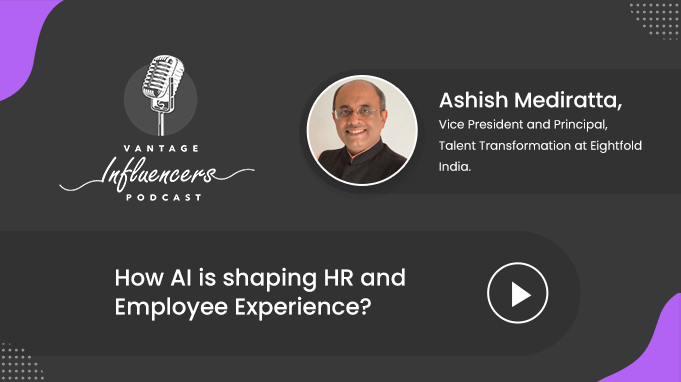
How AI is shaping HR and Employee Experience?
Episode Overview
Ashish Mediratta argues that AI's biggest value in HR is not automation for its own sake, but fixing a structural problem: HR functions run on fragmented point solutions that don't talk to each other. He walks through why organizations need a talent intelligence layer that can surface skills and potential from an existing candidate database, rather than relying on manual resume screening or a basic keyword search. He also addresses hiring bias directly, describing how masking candidate-identifying details such as photos and names, while still surfacing skills and experience, can make a hiring shortlist provably free of gender or ethnicity bias.
The conversation then moves into what AI means for employees, not just recruiters. Mediratta describes three ways AI can reshape day-to-day employee experience: surfacing internal job openings employees would otherwise miss, mapping current skills against future roles so people can upskill before they are at risk of layoff, and pairing that training with hands-on project marketplaces so new skills get tested before a formal role change. He closes with a pointed take on pandemic-era layoffs, arguing that skills forecasting should push organizations to retrain and redeploy employees before letting them go, not after.
Episode Highlights
- HR functions typically run on fragmented, siloed systems that don't communicate, making it hard for leadership to act on workforce data.
- The top three uses of AI in HR are identifying skills, surfacing the potential of employees and candidates, and improving the overall hiring process.
- AI can process thousands of applications at a scale no recruiting team can match manually, surfacing relevant candidates instead of relying on basic keyword searches.
- Masking candidate photos, names, and other identifying details while still showing skills and experience helps organizations build hiring processes that are provably free of gender and ethnicity bias.
- AI-driven internal job matching can alert employees to relevant openings inside their own company, reducing the number of people who leave simply because they didn't see the right opportunity in time.
- Skills forecasting lets organizations identify likely skill gaps months in advance, giving employees time to upskill and take on hands-on projects before layoffs become the default response to disruption.
About the Guest
Ashish Mediratta, Vice President and Principal, Talent Transformation at Eightfold India
Ashish is responsible for enabling global organizations to transform their HR functions using Eightfold's Talent Intelligence Platform. His career began in sales before moving into operations at GE Capital, which later became Genpact, and it was there that his path into HR started. Though trained as an engineer with an MBA in marketing and finance, he moved into recruitment in 2004 and has since worked across every part of HR. Before joining Eightfold, he spent 28 years across organizations including Tata Communications, where he was Senior Director, HR, Wipro, where he was Global Head of Talent Acquisition, and stints at Nokia Siemens and Genpact.
Connect with Ashish on LinkedIn
Host
Susmita Sarma, Vantage Influencers Podcast Host
What You Will Learn
- Why fragmented HR point solutions make it hard to act on workforce data, and what a talent intelligence platform solves for
- The top three applications of AI in HR according to Ashish Mediratta
- How AI-powered resume screening differs from traditional Boolean search based hiring
- How candidate masking can help remove gender and ethnicity bias from the hiring process
- How AI can personalize employee experience through internal job matching, skills forecasting, and hands-on project marketplaces
- Why upskilling employees before layoffs, not after, is a better response to workforce disruption
Key Topics & Timestamps
| Timestamp | Topic |
|---|---|
| 00:00 | Introduction and guest background |
| 01:18 | Ashish's career journey from sales into HR |
| 02:05 | Why organizations need to implement AI in the HR process |
| 03:30 | The top three applications of AI in HR |
| 04:00 | Using AI to hire better and reduce bias in recruitment |
| 09:05 | Will AI eventually replace human recruiters? |
| 11:24 | Personalizing and humanizing the employee experience with AI |
| 15:57 | Redesigning employee engagement in an organization |
| 17:35 | Eightfold's free platform connecting laid-off employees to new roles |
| 20:03 | One piece of advice for organizations adopting AI for talent management |
Full Transcript
Click to read the full episode transcript
Welcome to the Vantage HR Influencers Podcast. This podcast is sponsored by Vantage Circle, the leading employee benefits and engagement platform. Artificial intelligence has been an interesting topic of discussion across industries, and it has also reached the HR domain with some vast and ever-changing concepts. Recently, AI is being viewed as a viable tool in boosting employee engagement and improving the way people are being recruited, trained, and retained in organizations around the globe.
Susmita Sarma: Hello everyone, this is Susmita from the Vantage HR Influencers Podcast, and to know more about artificial intelligence and its role in shaping HR and employee experience, today I have with me Mr. Ashish Mediratta. Ashish is Vice President and Principal, Talent Transformation at Eightfold India. Presently, he is responsible for enabling global organizations to transform their HR functions using their Talent Intelligence Platform. Prior to Eightfold, Ashish spent a glorious 28 years of his career in different organizations of international repute. He has been the Senior Director, HR at Tata Communications, Global Head, Talent Acquisition at Wipro, and also worked for Nokia Siemens and Genpact. Welcome, Ashish.
Ashish Mediratta: Thank you so much for having me here.
Susmita Sarma: Before we start, please let us know a little more about yourself and your journey in HR.
Ashish Mediratta: I think you have given more than due justice already. Actually, my career started in sales, and from there I moved into operations in GE Capital, which later became Genpact, and over there I think the journey into HR started. Though by qualification I am an engineer and an MBA in marketing and finance, someone felt that I would do a good job perhaps in recruitment, which is something that I call HR sales. That's where, in 2004, my journey began in recruitment, and from there into all parts of HR.
Susmita Sarma: So let's start with the topic, Ashish: how AI can shape HR and employee experience. Most professionals today understand that the adoption of smart technology is actively changing workplaces. How would you like to explain this? Why, as an organization, do we need to implement AI solutions in the HR process?
Ashish Mediratta: See, HR globally, when you look at organizations, they have really fragmented systems, and it's no one's fault. That's how the structure has evolved over a period of time. Now there are functions within HR. So let's say talent management, talent acquisition, employee engagement, there is compensation and benefits, there is HR IT, there is learning and development. Now practically all of them have got different point solutions which don't talk to each other. As a result of that, the processes are broken, data is fragmented, and when it comes to top management taking decisions, that becomes very difficult to implement on the ground. So that's where what they require is something like a talent intelligence platform which can point them in the right direction. And that's where I guess players like Eightfold AI have, I think, a huge future ahead.
Susmita Sarma: Okay, so according to you, what are the top three applications of AI in HR?
Ashish Mediratta: I would look at it this way. One would be to identify skills. Next would be to identify the potential of employees and candidates. And thirdly would be to enhance and improve the hiring process of organizations.
Susmita Sarma: Right, so AI can help in hiring better, right? Tell us more about it. How can it be used to achieve greater diversity in hiring by eliminating biases?
Ashish Mediratta: Absolutely true. So there are two parts to this. You said the first part being how does it help in hiring better. So the way I see it happening now and for the future is that organizations have a vast database of candidates with them already. What they struggle to do is bubble up or surface relevant candidates who could be in their database in the first place. Improving that talent network for them is important. Now look at the times today. There are not hundreds but thousands of people applying for every single job. Let's talk realistically: is it possible for any human being to go through all thousand resumes to select which one they want to forward to hiring managers for interviews? That's not going to happen. So what they need is AI support which can understand the skills in CVs. Mind you, this is far more advanced than what is typically done in business today as a Boolean search. AI doesn't do that. In our case, basis the algorithm that has been designed by our founders with neural networks and machine learning capability, this AI is powerful enough and understands more than a million skills, having studied more than 1.5 billion profiles globally. The AI understands skills, jobs, and roles. Now with this, what really is going to happen is that recruiters need not spend a whole lot of time worrying about going through profiles. The algorithm will pick them up and present them. So that is extremely useful to them.
Coming to the point on diversity: today, I think more than ever before, because of COVID and what we have seen across the world, and especially in the US, diversity has become such an important parameter or guiding force for organizations. Now, at this time, what organizations need is a process that can cover the fact of bias in hiring processes. What if hiring managers look at CVs and then simply drop the candidate on the basis of gender or ethnicity or whatever? Now for that, the diversity masking feature of Eightfold is extremely potent and powerful. With this, hiring managers will get to see only a profile of a candidate which covers their skills, qualifications, and experience. What is hidden or masked is the candidate's photograph, name, email ID, phone number, LinkedIn ID, or whatever which can give an indication towards gender or ethnicity. Now with this, when the hiring managers shortlist the candidate and they interview them and give their feedback, the entire process is then covered and tracked along with data end to end. So you know what the drop-off or the leakage is at each step of the hiring process. I think this will allow the management of organizations, the CXOs, to really stand up in any forum and make the statement that their hiring process is bias-free, and I think that's a huge achievement.
Susmita Sarma: Yeah, it's an achievement for even the candidates, right?
Ashish Mediratta: Absolutely. You know, there's another fact that we acknowledge, which is that typically, if it is a job which is commonly seen by both men and women, women would perhaps apply for a job when they see that the skills they possess are at least an 80 percent match with the job, whereas for men it is noticed that they have a propensity to apply even at a much lower percentage fitness as per their own view compared to women. Now, with the focus on skills, women need not worry about what they feel is their quality of match versus the job description. The AI will take care of that.
Susmita Sarma: Right, very nicely explained, Ashish. So there's a lot of forecasting going on when it comes to the future of AI. According to you, in what different ways will AI keep coming back in the future? Will AI eventually replace human recruiters, or is it going to take over human resources altogether?
Ashish Mediratta: Oh, that's an amazing point you have raised, and a big apprehension in everyone's mind, especially in HR. The way I see the future is that AI is going to be a very powerful ally of HR. Today there are so many operational, transactional activities that HR folks are involved in which should be automated in such a way that they are able to evolve to the next level of providing HR as a service to their businesses. For instance, if a recruiter today is spending almost 30 percent of their time scheduling interviews, and another 30 to 40 percent of their time sourcing candidates or just working to identify the right people for the job, what if a whole lot of those operational activities could be supported by AI? That's where I think recruiters will be able to evolve themselves as TA business partners, people who are sitting with the business on the same table, talking about strategies on how to build the workforce of the future, how they will be able to make relevant contributions in market mapping, skill mapping, and then partnering with their business leaders to build the future of the organization. Today, if a whole lot of HR's effort is into operational activities, how do you move that into strategic activities? That's what AI will enable them to do.
Susmita Sarma: So coming to the topic of employee experience and the role of AI: personalizing and humanizing employee experience is critical to HR. How would you like to talk about how AI can improve the overall employee experience in an organization?
Ashish Mediratta: Allow me to give you three examples, and I'm sure any listener who has been in the corporate world for a while will be able to relate to it. Number one, the one thing employees do care about is their career inside the organization. Now imagine that one has to look at the intranet of the company all the time to find out relevant jobs for themselves, if they have been in a role for two or three years and want to do something else. So what do they do? They keep looking over their shoulder all the time, and whenever they are busy, as luck would have it, a brilliant job will come and go and they will have missed the opportunity because they were busy with office work. Now, what if that same experience is enhanced using AI? What if the algorithm is able to search and match employees with relevant new job openings in the company every day and just give them a nudge that this is something that might be of interest to them? What it does is it really enables employees to build their career. Number two, it allows HR leaders to tell them that the organization cares for them and would want them to develop their career inside the organization rather than outside. This is the first experience that has to be enhanced very urgently and immediately for people, especially now in the COVID situation when companies are thinking of layoffs. Why lay off now when you may have to hire them again in three or six months' time, because COVID is not going to stay forever?
That's use case number two. What if the algorithm tells HR and employees the current skills of employees and what potential jobs they can aim for in the near future? What are the skill gaps, and what are the associated trainings which can bridge those skill gaps? Now imagine if this kind of opportunity is available to employees and they know that they can train themselves as a self-service and be ready for jobs that are likely to appear three to six months down the line. Why have a fear of redundancy when you can upgrade yourself? Now the third thing I would want to add to this is that okay, you have trained yourself, but so what, you don't have hands-on experience. That's where the talent intelligence platform comes with a project marketplace, where business managers can provide projects and people who have upskilled through training can actually do projects hands-on. Let's take an example: a business wants to hire people with Angular JS or similar tool knowledge, maybe six months down the line, and wants to hire some 30, 40, or 50 people. Now what prevents them from first getting existing employees who know Java, Python, or Node JS trained over a period of, say, two months, and then, over the next three to four months, given hands-on projects, for example through the project marketplace, where hiring managers or other business managers get a first-hand view of employees who are showing potential and who are fully committed to their own success, and should be given opportunities? I think there is a phenomenal play available for organizations who can think through this and prepare for what's required six to eight months down the line.
Susmita Sarma: So Ashish, employee engagement is a very important aspect of employee experience. I hope you'd agree to that, right? So how can AI redesign employee engagement in an organization?
Ashish Mediratta: See, employee experience is in every aspect of what they do. HR, as a portfolio of services, touches an employee before hiring, during the interviews, sourcing them, right down to the exit. Now, what if employees had a sort of single-window solution to all their needs? What if they could reach into a platform and it takes care of whatever their ask is? I think if organizations are able to think deeply about this and come up with that uberized experience, if I may use that word, because no one ever thought a few years ago that you could literally wish for a cab and it would be standing outside your door. If that kind of experience, like Netflix as another example, this piece of getting AI to give them a single-window solution will be absolutely mind-boggling, and I think there are enough examples that Eightfold has already provided that show we are well and truly on that path.
Susmita Sarma: So as you've already mentioned, considering COVID-19 and mass layoffs, people worldwide are searching for jobs that match their skills and requirements, and Eightfold is doing a magnificent job of getting laid-off employees connected with the right positions by providing the platform absolutely free of cost. Please let us know more about it. How do you see it as an opportunity, and are there any challenges Eightfold is facing right now?
Ashish Mediratta: Well, this is actually an incredible time in the sense that we started seeing this first in the US, where it was reported that millions upon millions had gotten laid off. That's where we partnered along with McKinsey to launch our Talent Exchange platform, where companies are able to register themselves and float their jobs, and people who are looking for openings can be in touch with such companies. The beauty of this platform is that the algorithm is doing the matching. So again, like I mentioned earlier, if there are thousands of CVs coming in, how does a recruiter solve for that? That's what the algorithm is doing, providing the best candidates upfront. I think the organization has taken a massive step in terms of providing this platform free during this particular crisis to companies which are in need, and on top of it, organizations are now looking at this as an opportunity to do transformation. We see an incredible amount of interest from corporates all over the world. It's absolutely incredible, the kind of support we are getting from the corporate world at a time when one would have thought that perhaps people would want to conserve and wait it out and see how things happen, but we are finding an amazing amount of interest from corporates to take this as an opportunity to drive transformation, and it's actually working well for Eightfold.
Susmita Sarma: Okay, so what would be your one piece of advice for organizations planning to adopt AI for talent management?
Ashish Mediratta: My one piece of advice would be: please care for your people, care for their skills. If we are able to forecast future jobs, especially three to six months down the line, we can easily sit together and figure out ways to upskill existing employees. So before we lay them off, let's figure out ways to retain them, perhaps even at lower compensation, but before laying them off, I would say please look at the possibility of training them, upskilling them, and preparing them for jobs that will be available six months down the line. I think that will be a huge service to families at a social level. I think this time is absolutely incredible, and we have never experienced it before, and I hope we never have to experience it again, but this is the time when we have to really show that we care for our people.
Susmita Sarma: Okay, so there's a lot more to know from you, Ashish. How can our listeners reach out to you?
Ashish Mediratta: Well, I'm there on LinkedIn, I'm there on Facebook, my email ID and phone number are also available, so it's actually quite easy to reach out to me. All my coordinates are in the public domain, so I'm happy to be available as a support to anyone who would like to reach out.
Susmita Sarma: Okay, that was a great conversation with you, Ashish. Thanks a lot for joining me.
Ashish Mediratta: Entirely my pleasure. Thank you so much.
Susmita Sarma: Thanks for listening to the Vantage HR Influencers Podcast. Please do subscribe to the Vantage HR Influencers Podcast on Apple Podcasts and Spotify for new episodes.
FAQ
What are the top three applications of AI in HR according to Ashish Mediratta?
Ashish Mediratta identifies three priority applications: using AI to identify employee and candidate skills, using it to surface the potential of employees and candidates, and using it to enhance and improve the overall hiring process.
How does AI help reduce bias in hiring?
By masking identifying details such as a candidate's photograph, name, email address, phone number, and LinkedIn profile, hiring managers see only skills, qualifications, and experience. This lets organizations track hiring decisions end to end and demonstrate that shortlisting is based on merit rather than gender or ethnicity.
Will AI replace human recruiters?
No. Ashish Mediratta argues AI is better understood as a powerful ally that automates operational, transactional work such as interview scheduling and candidate sourcing, freeing recruiters to become talent acquisition business partners who work on workforce strategy alongside business leaders.
How can AI improve employee experience during layoffs or workforce disruption?
AI-driven skills forecasting can flag likely skill gaps months in advance, giving organizations time to retrain and redeploy employees into new roles instead of laying them off, an approach Ashish Mediratta recommends for any organization facing workforce disruption.
Related Reading
Also listen on