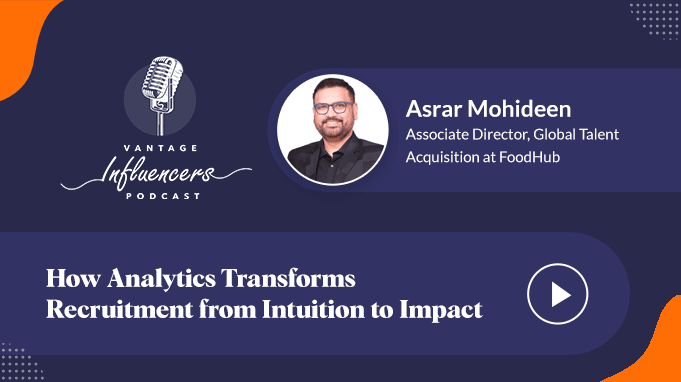
How Analytics Transforms Recruitment from Intuition to Impact
Episode Overview
Asrar opens with a question every talent acquisition team wrestles with: when we say "recruitment analytics," what are we actually measuring? Speed, quality, fairness, or business performance? His answer is that none of these can stand alone. Teams that optimize purely for time to fill end up rushing into the first reasonable candidate, while teams that ignore speed lose strong candidates to faster-moving competitors. He argues that quality of hire cannot be judged in a single interview. It has to be tracked into the first 12 to 16 months, measured by how the person performs, how long they stay, and whether they get promoted. A resume from a big-brand company can look glamorous and still fail in a smaller, faster-moving environment, while a less polished background can outperform it. That gap between how a candidate looks on paper and how they actually perform is, in his view, exactly what analytics is built to close.
He also walks through where hiring pipelines quietly leak good candidates: slow handoffs between recruiter and hiring manager, unstructured multi-round interviews that drag on for a second or third opinion, and long silences between the final interview and the offer. Each delay is a point where a strong candidate accepts another offer. Asrar frames data as the tool that turns this from a vague complaint into something a talent acquisition professional can bring to a hiring manager as a concrete, actionable number. On artificial intelligence, he is direct that its biggest near-term impact is in sourcing and resume screening, freeing recruiters to spend their limited time where judgment and human connection actually matter: the interview itself and the candidate's experience throughout the process.
Episode Highlights
- Recruitment analytics has to balance speed, quality, and fairness together. Optimizing for one factor alone, especially time to hire, leads to weaker hiring decisions.
- Quality of hire should be measured after the hire, not during the interview. Look at 12 to 16 month performance, retention, and promotion, not how well someone interviewed.
- A polished resume from a well-known company does not guarantee success. Some candidates from smaller, less structured companies adapt and contribute faster.
- Most lost candidates disappear at three predictable points: the gap before scheduling, drawn-out multi-round interviews, and delays between the final round and the offer.
- AI's clearest near-term value in recruitment is sourcing and resume screening at scale, not replacing the interview or the human judgment it requires.
- Recruiters do not need to become data scientists, but they do need to read data well enough to translate it into a business story for hiring managers and leadership.
About the Guest
Asrar Mohideen, Associate Director, Global Talent Acquisition at FoodHub
With over 19 years of experience in talent acquisition, Asrar Mohideen specializes in transforming recruitment from a cost center into a strategic growth function. He has built and scaled high-performing teams for technology companies across startups, growth-stage businesses, and global enterprises. His expertise spans end-to-end recruitment for complex and high-stakes roles across technology, engineering, leadership, and sales, including CTOs, VP Engineering leaders, cloud and data architects, DevOps professionals, full-stack developers, R&D specialists, automotive and aerospace engineers, C-suite executives, Sales VPs, and business development leaders. At Foodhub, he played a key role in scaling global teams by hiring over 600 technology and leadership professionals in just eight months, helped achieve more than £1 million in annual savings by building a zero-vendor recruitment model, increased employee referral rates from 6% to 26%, and led C-level hiring while managing a team of 14 across five regions. He is passionate about using data, process optimization, and inclusive workplace practices to build recruitment functions that are efficient, scalable, and human-centric. His certifications and experience include Hogan assessment expertise, hands-on work with Zoho and SuccessFactors, and POSH facilitation.
Connect with Asrar on LinkedIn
Host
Riha Jaishi, Vantage Influencers Podcast Host
What You Will Learn
- Why recruitment analytics must balance speed, quality, and fairness rather than optimizing for one alone
- How to define and measure quality of hire using post-hire performance, retention, and promotion data instead of interview impressions
- A real example of how analytics overturned a gut-feel hiring decision based on brand-name bias
- The three stages of the hiring funnel where top candidates most often drop off
- Where AI currently delivers the most value in recruitment, from sourcing to resume screening
- What data literacy skills recruiters need to develop to become effective business partners
Key Topics & Timestamps
| Timestamp | Topic |
|---|---|
| 03:07 | What recruitment analytics really measures |
| 06:30 | Defining quality of hire with data |
| 13:01 | When analytics beats hiring intuition |
| 18:17 | Finding where top candidates drop off |
| 27:10 | AI's biggest impact in recruitment |
| 34:51 | Data skills recruiters need today |
Full Transcript
Click to read the full episode transcript
Welcome to the Vantage Influencers podcast. This podcast is sponsored by Vantage Circle, the simple and effective recognition platform for employee engagement.
Riha Jaishi: Hello, everyone. Welcome back to another episode of the Vantage HR Influencers podcast. I'm your host, Riha. And today we're diving into a topic that's transforming the way we approach recruitment, that is, how analytics is transforming recruitment from intuition to impact. In today's fast-paced business world, relying solely on intuition for recruitment decisions is no longer enough. With the rise of data analytics, HR professionals now have the tools to make more informed, objective, and impactful hiring decisions. Now, the question we must ask ourselves is, how can analytics change the way we approach recruitment? How can analytics help us move beyond gut feelings to create a data-driven, results-oriented recruitment strategy? And to explore this further, I'm joined by Asrar Mohideen, Associate Director, Global Talent Acquisition at Foodhub. Welcome to the show, Asrar. It's a pleasure to have you with us today.
Asrar Mohideen: Very good morning, Riha. Thank you for having me. And I'm looking forward to this conversation.
Riha Jaishi: We are equally delighted, Asrar. Okay. Now, to kick things off, can you briefly take us through your professional journey so far? We are eager to learn about your journey.
Asrar Mohideen: Amazing. Great. To start off with, Riha, I have close to two decades of experience in talent acquisition and also in HR. I started off my career in the hotel industry with recruitment, taking care of both HR and recruitment. Post that, I have experience in consulting, services organizations, and OEM. For the last seven years, I've been associated with a product company, Foodhub. So I have experience across different domains: startups, services, consulting, OEM, and product. I've been heading global talent acquisition for the last 10 years now, and also HR for close to 10 years. So that's about me in short.
Riha Jaishi: That's such an inspiring venture, Asrar. So thank you for sharing your experience. Now, with your permission, I would like to delve into our topic further, shall we?
Asrar Mohideen: Yeah, please.
Riha Jaishi: Okay. So Asrar, when you say recruitment analytics, what are we measuring here? Speed, quality, fairness, or business performance? What do you have to say?
Asrar Mohideen: See, honestly speaking, all together, all four play a major role. But you cannot take speed alone, because sometimes when you're focusing more on speed, you might end up hiring the wrong candidate. Quite a lot of people, especially when it comes to analytics and recruitment, talk about time to hire and time to fill. But if you're going to be very fast, the candidate whomever you're interviewing at the first instant will probably end up getting hired. That's not actually the right approach. In terms of quality, you have to look at how long the candidate stays with you in the first 12 to 16 months, and how they perform post interview. A lot of people give a good interview and try to impress, but it's not about impressing in the interview. It's about how they contribute and impact the business afterward. And yes, fairness is very important too, because a lot of people carry biases. They tend to prefer candidates from similar backgrounds, colleges, or brand-name companies. So it's a combination of all these factors, not just one.
Riha Jaishi: Okay, Asrar, you have given a very valuable distinction here. It's more like focusing on all the factors is key to a more balanced and data-driven recruitment strategy, right? A balanced mix of everything, the importance lies in all the factors.
Asrar Mohideen: Yes, you're right. You need that balance. Most of the time, when the hiring manager or organization comes up with a requirement, recruiters are under pressure to close the role. But it's not about closing the role, it's about getting the right candidate onto the team, because the impact on the business is very important. One wrong hire costs more and takes more time. So you should not worry only about speed, but ensure quality is taken care of, along with factors like diversity hiring. That's why I say analytics won't replace the talent acquisition specialist entirely, because sometimes intuition, or gut feel, still matters. This is where the emotional quotient comes in. The recruiter knows the culture of the organization and is in a better position to tell whether a candidate is the right fit.
Riha Jaishi: Okay. Thank you for your perspective. Amazing perspective, Asrar.
Asrar Mohideen: Thank you.
Riha Jaishi: Okay. So moving ahead, Asrar, how can organizations define and measure the quality of hire in a way that removes subjectivity and focuses on objective, actionable data?
Asrar Mohideen: See, again, this is a very interesting question. Quality is a subjective thing. During an interview, in maybe one hour or one and a half hours, no one can really tell whether a candidate is going to bring a lot of value, because they can impress with jargon. What actually matters is how the candidate performs over the next 12 months and how they get along with the team, and how the team's culture improves. So data plays a major role here, and the talent acquisition specialist has to play the role of a talent acquisition business partner. Earlier, recruitment used to be more transactional, but now it has moved toward being a strategic business outcome. Once the hire is made, a transactional recruiter considers the job done and moves to the next open role. But a business partner will go and find out what value this person has brought to the business, whether they're contributing to revenue, whether they're contributing to a positive culture, and whether they get promoted after a year. If someone leaves within six months, that tells you it wasn't a good hire. That's where analytics helps define quality in terms of retention, attrition, and future business impact.
Riha Jaishi: Asrar, you have shed light on a valuable point here, connecting quality of hire to the post-selection phase. Most people focus only on the hiring phase itself, but you've highlighted that the post-selection phase is far more significant, and that's a unique factor many overlook.
Asrar Mohideen: Yes, you're absolutely right. We are working on very niche skills in the market right now, and this analytics helps you become even more critical over time. Someone might come from a big brand but may not be very successful in a startup kind of environment, because they're used to process and procedure rather than being given a free hand with a budget to make decisions. So talent acquisition specialists have to sit with the hiring manager as a business partner and ask the right questions about how a person is actually doing, not just where they came from. It's slowly changing, and very soon talent acquisition specialists will have a seat at the table when it comes to reviewing new-hire performance after six months or a year. That would be a good thing, because recruiters will finally understand the value they're bringing. Tell me, Riha, what do you think is important for any organization to be more successful?
Riha Jaishi: I believe culture is very significant. Culture comes with people, right? It's not culture alone, but the starting point is people. When people come together, then you talk about culture, values, and mission.
Asrar Mohideen: Exactly, people play a major role. The talent acquisition team is the first point of contact, the brand ambassador. When I'm speaking to you, you may not even be aware of the company I work for, and afterward you'll go and do your own research. So talent acquisition professionals are not just marketers or salespeople, they're career counselors too, because they need to sell a vision around career opportunities, market the company, and explain its direction. It's multitasking, and it's quite challenging. Some people think talent acquisition is easy, that you just pick up job boards, show CVs, and get people hired. That's not how it works. Even at the eleventh hour, people can drop out. Storytelling matters a lot at this point. If you give wrong information to a candidate during hiring, things go downhill from there. You have to be very clear, cautious, and transparent throughout the process.
Riha Jaishi: Those are some amazing perspectives you have given, Asrar. That's so true. Okay, so moving ahead, Asrar, can you share an example where analytics changed a hiring decision that intuition would have gotten wrong, if there's anything you would like to highlight?
Asrar Mohideen: Absolutely. Most of the time, recruiters are expected to have a superpower of reading minds in an interview, which isn't going to happen. In the past, when a candidate came in for a startup, small, or mid-sized company, we would just go by the brand on the resume: he's come from a well-known company, handled a team of this size, and everything looks glamorous. We'd assume he's the right fit. Meanwhile, another candidate from a smaller, less glamorous company might not stand out on paper. But when you look at the pattern over time, the person hired for their brand-name background often didn't last six months, because they came in expecting more process and structure and weren't flexible enough, and their actual output didn't match what was on the resume. Meanwhile, the candidate from the smaller, humbler background often contributed more, sometimes increasing sales by 10 to 20 percent. This happens a lot. So especially at senior and leadership levels, when a role keeps getting filled and vacated, you need to do a root cause analysis and look for the pattern. Often you'll find people from big brands struggling to adjust to a mid-size or startup culture where they're given a free hand and a budget but expected to move without the layers of approval they were used to. So it's not just about following gut feel anymore. Analytics is now playing a bigger role, because in the past a lot of people went with intuition, assuming that someone from a big brand was automatically the right pick. That doesn't hold up anymore, and thankfully, more talent acquisition professionals are starting to look at the pattern behind why a hire succeeds or fails. Unfortunately, not everyone is doing this yet, but if they're not, they need to start, because it genuinely helps get the right people on board.
Riha Jaishi: Absolutely, Asrar, that's such a powerful example you've given here, drawing comparisons between hires and the kind of intuition or preconceived notion we have of employees representing a particular brand.
Asrar Mohideen: Yes, sorry to interrupt. What happens is when people come from a top brand, they often arrive with a lot of expectations, assuming all the support will be given to them. But the reality here could be quite different, whether it's the budget or other resources, so there can be a mismatch. That has to be communicated clearly during the entry process.
Riha Jaishi: Exactly, absolutely. And this really shows the importance of analytics, which is growing. It highlights the importance of data in challenging assumptions and making hiring decisions that are more aligned with actual performance indicators.
Asrar Mohideen: Yeah, absolutely. You cannot just aim blindly. You need information to forecast what skills are required, and you can only forecast well when you have data. Today there's a lot of data available within any organization, whether in finance, marketing, or any other field. You can also do your own research on the people you've interviewed and see which ones performed better. But unfortunately, not everyone knows how to use data effectively. Once you know how to handle it and put it into perspective, you can do a lot of good and create real business impact with it.
Riha Jaishi: Well said, Asrar, thank you. Okay, now moving ahead, Asrar, at which stage do most companies lose the best candidates, and how can analytics really pinpoint it?
Asrar Mohideen: That's a very interesting question. Honestly, this is a day-to-day activity for talent acquisition professionals, because they put in a lot of effort in sourcing, screening, and then scheduling interviews with hiring managers. Then there are multiple levels of interviews. What happens is, we rarely lose a candidate during sourcing or screening itself, but once screening is done and there's a time gap before the hiring manager's interview, say two or three days, the best talent isn't going to wait, because they're in high demand right now, especially for niche skills like full stack development or AI. So the first place analytics matters is the time between submitting a candidate for an interview and when that interview actually happens. Then there's the interview process itself, if there are four or five rounds and it's unstructured, where one interviewer isn't convinced and asks for a second or third opinion, you'll end up losing the candidate if that continues. And the third stage is right before the offer, where the hiring manager wants to see a few more candidates before deciding. The candidate isn't going to wait indefinitely, and if another opportunity comes along, they'll take it. So the time from the final interview to the offer stage is another point where you can lose someone. Once a recruiter sends a CV to the hiring manager, it should take less than 24 hours to schedule an interview. You need a structured interview process, clearly defined levels, maybe combining level one and two to save time, because the candidate has other options and won't wait around. And once you've selected a candidate, tell them promptly whether you're extending an offer. If you make them wait after three or four rounds of discussion, that's not a great candidate experience. So the candidate experience journey matters a lot, and talent acquisition professionals need to look at all these aspects, not just fill the role but actually manage the process as a business partner. They need to go to hiring managers with data and say, we've taken 10 days to interview a candidate and we're losing interest because of it, so we need to bring that down to three days. This kind of data helps educate hiring managers, who are often busy with their own projects, deliverables, and meetings. Talent acquisition partners need to constantly bring this up with data rather than just telling them verbally, because data makes it much easier for a hiring manager to understand.
Riha Jaishi: Asrar, that's such a critical insight you have given here. This shows how, using analytics, organizations can exactly pinpoint where the bottlenecks are and refine their recruitment process to ensure top talent isn't slipping through the cracks.
Asrar Mohideen: Yeah, that's true, because that's the key thing. As a talent acquisition professional, you cannot afford to lose a good candidate because of too much waiting time, because that's frustrating for them. There are companies, and I won't name any, that openly say it will take 10 working days for them to get back to an applicant. I sometimes wonder if that's really necessary, because some industry leaders take pride in saying they spend a long time reviewing CVs. But in that process, they might end up losing a good candidate, because the candidate experience journey isn't great, and that tells the story of your employee value proposition. So you have to be cautious, because we're dealing with people, and success comes from dealing with people well. That's going to be a key factor going forward. Make sure the process is simple, the interview is structured with clear SLAs, tell the hiring manager that feedback should come within 24 hours, and after the interview, the candidate should hear back within 48 hours. Once the final discussion is over, you should be in a position to make an offer within a reasonable number of days. Any further delay is a real risk, you could lose a lot of talented candidates in the market. And it's not only that, in today's social media world, people write about their experience publicly. You'll see posts on LinkedIn where people say they waited too long and the experience wasn't great. So when we talk about candidate experience journey, which is also a factor for the recruitment team, they need to take it very seriously.
Riha Jaishi: This emphasis you've placed on candidate experience journey is something very few leaders or HR professionals really consider. You've really drawn light on an important aspect that many people don't even think about.
Asrar Mohideen: Yeah, that's the second point. Say, for example, you're going through multiple levels of interviews, and in the past you would have interviewed with other companies too. If you didn't have a great experience, even if the compensation package is really good, you may not join, because it reflects their culture, you'll know how they're going to treat you. So it has to be important, you have to give a customized experience, value candidates, and treat them with a lot of respect. You need several touchpoints. Once you've made an offer, it doesn't mean you stop talking to the candidate. You need constant check-ins, understand how things are going for them, ask about their family, maybe invite them to the office for tea. Those things play a major role. It's not that once you've made the offer, your job is done and you just wait for them to join. That's not how it works. They'll likely have several questions, so you could organize a team lunch or dinner with the whole team even before they join, so they feel valued and part of the team already. And if the company hits a milestone or achieves something, you can share that news with the candidate through WhatsApp, email, or whatever channel, so they feel kept in the loop about what's happening in the organization. That builds a lot of interest. So these are the candidate experience touchpoints we're talking about, even before someone joins, they should know the company has received an award or hit a milestone. That plays a major role.
Riha Jaishi: Yes, absolutely. Well said, Asrar.
Asrar Mohideen: Yeah, thank you.
Riha Jaishi: Okay, so moving ahead, Asrar, like you mentioned earlier about sourcing, screening, scheduling, and interviews in your answer, where do you see AI making the biggest impact in these recruitment processes?
Asrar Mohideen: Okay, Riha, to be very honest, the buzzword right now is AI. Everywhere you go, people are talking about AI. Even when I go to a college for campus hiring, people ask whether it's going to replace jobs. Some of my current and former team members call me and ask the same thing. I think people are quite scared of AI right now, especially after COVID. Yes, I agree to some extent that AI is going to change the way we work in the future, but AI is here to stay, so the only option is to embrace it. We can't say we don't want to use it. We have to take it to our advantage and learn it. People who learn AI will keep their jobs, and those who don't embrace it will have to make way for people who are eager to learn it. That's how it's going to be going forward. AI is going to be a predominant force across all fields and industries. And recently I saw that a CEO from an AI company mentioned that AI can now do end-to-end development work, testing, coding, debugging, all of it. It's quite interesting, and a lot of people worry they'll lose their jobs because of it. But I don't see it that way. If you learn how to use AI, it actually helps improve your productivity. It's the same in recruitment. For example, if you're posting a job for a senior talent acquisition professional, you might receive 100 to 200 CVs, and realistically, a recruiter won't have time to screen all of them, it's too time-consuming. Even at an average of three to four minutes per CV, screening all of them could take three to four days. This is where AI comes in. It doesn't need breaks, it doesn't ask for work-life balance, you just tell it to screen every CV and hand you a shortlist of the top five candidates by the next morning, and it does the job. So you have to think about how it improves your productivity rather than fear it, because at the end of the day, HR and talent acquisition are about human touch, empathy, and emotion, and those things still matter. Imagine AI gives you an excellent shortlist of top candidates, but candidates are smart too, they look at the job description and ask a tool like ChatGPT to tailor their resume to match it exactly. That's where talent acquisition professionals still come in, because during interviews they need to ask the right questions to figure out whether someone actually has the experience they claim, or whether it's inflated or automated. That human element only comes into play through the interview, so the talent acquisition professional's role in that stage remains essential. The job isn't going away, they just need to think about how to use AI to the fullest in sourcing and screening, and then use the interview process to move faster. I'd say sourcing is where it helps most first, because today a recruiter might be handling ten open requisitions at once, and AI can take on the sourcing load, reaching out to passive candidates on LinkedIn, searching platforms like GitHub, and pulling together a strong list of top candidates. That frees up time to focus on attracting the right candidate with quality attention.
Riha Jaishi: Asrar, you've given such a beautiful perspective on the immense role of AI in recruitment. AI's potential really is immense, and like you said, embracing it is the need of the hour, not for everything, but for those routine and mundane tasks where we can use it to our advantage. I really liked how you highlighted screening and sourcing as the areas where we can use AI most fully, improving efficiency and ensuring candidates are assessed objectively.
Asrar Mohideen: Absolutely, yeah, that's where recruiters spend most of their time. Imagine 300 or 400 CVs coming in for one open role while a recruiter is juggling ten open positions. If AI can screen those and send automated messages to candidates who aren't suitable, it makes the recruiter's job easier, and candidates get timely feedback so they can move on to other opportunities. That's candidate experience again. Recruiters who don't learn AI are going to struggle. This is what we're talking about today, it's not about intuition, it's about the impact you bring to the business. So you need to know how to use the technology available to you, because it's all there, it's about how you choose to use it.
Riha Jaishi: That's a very valid point. Okay, so before we wrap up our session, Asrar, with analytics becoming a crucial part of recruitment, what new skills should recruiters develop to effectively leverage data in their hiring processes, what do you think?
Asrar Mohideen: I touched on this earlier, storytelling with data is very important. Recruiters have to go back to the hiring manager and say, for example, that candidates hired from branded companies haven't stayed with us, because the hiring manager is often too busy with delivery, the team, and their projects to remember all of that. So data has to be translated into a business outcome, told as a story, explaining what's happening and how the process could be made more effective. I'm not expecting a talent acquisition professional to become a data scientist, but they should be able to read the data, interpret it, and present it well to the business so they can genuinely contribute to business impact. That's going to be very crucial. I'd say it's very important for recruiters to understand and read data, especially around time to hire and time to fill, research where the delays are happening, and educate the hiring manager about it. These are the critical things right now. They have to interpret the data well enough to present it to management, because that's what earns them a seat at the table, being able to clearly explain how the data helps grow the business and the kind of impact it can create. So recruiters need to know their data, that's my closing statement. They don't need to be data scientists, but they do need to read and interpret it.
Riha Jaishi: That's such a great perspective, Asrar. I guess from your perspective, it's safe to say that data literacy is the need of the hour and a real game changer, and upskilling in analytics will help recruiters make more informed decisions.
Asrar Mohideen: Absolutely, they have to upskill in analytics. For example, if you're going into an appraisal review, you won't just go in with a story, you'll go in with data: how many positions you closed, your time to fill, the business impact, the leadership hires you completed, and how you saved costs, whether through agencies or by closing roles yourself. That's the data you bring to a review process. It's the same everywhere, data is going to be the next big thing. In fact, I don't think you can replace data, because it's so rich, and with it you can achieve a lot. Data is genuinely fascinating, and I expect every talent acquisition professional to stay focused on analytics and data, because it's going to change how recruitment works in the future, especially alongside AI.
Riha Jaishi: Well said, Asrar, thank you.
Asrar Mohideen: Thank you.
Riha Jaishi: Okay, so Asrar, we have finally come to the end of our podcast session. Thank you so much for joining us today and sharing your incredible insights. It's been more than a pleasure hearing your perspective on the power of data and analytics in transforming recruitment from intuition to impact. We really appreciate your time and expertise, and I'm sure everyone tuning into this session is inspired and walking away with a wealth of information to think about.
Asrar Mohideen: Thank you so much for having me, and I hope it was useful to you and your listeners. I'm looking forward to many more conversations in the future. I really enjoyed it, thank you so much for having me again.
Riha Jaishi: Thank you once again, Asrar, it was an engaging and insightful session. And to everyone out there, thank you for tuning in. We hope you found today's conversation as enlightening as we did. So until next time, take care, and we'll see you soon.
Thanks for listening to the Vantage Influencers podcast. Be sure to subscribe on Apple Podcasts, Spotify, and our Vantage Circle YouTube channel for the latest episodes.
FAQ
What does recruitment analytics actually measure?
According to Asrar Mohideen, recruitment analytics has to account for speed, quality, fairness, and business performance together. Optimizing for a single metric, especially time to hire, tends to produce weaker hiring outcomes because it pressures recruiters to rush a decision instead of finding the right fit.
How should organizations define quality of hire?
Quality of hire cannot be judged from an interview alone. Asrar recommends tracking a new hire's performance, retention, and progression over their first 12 to 16 months. If someone leaves within the first six months, that is a signal the hire was not a good fit, regardless of how strong the interview was.
At what stage do companies typically lose top candidates?
Asrar points to three common drop-off points: the gap between screening and the hiring manager's interview, unstructured multi-round interview processes that drag on for extra opinions, and the delay between the final interview and the offer. Long waits at any of these stages push strong candidates toward other opportunities.
Where is AI making the biggest impact on recruitment right now?
Asrar sees AI's clearest value in sourcing and resume screening, tasks that involve high volume and repetition. He is clear that the interview itself still needs a human, because judgment, empathy, and the ability to verify a candidate's real experience are not tasks AI can take over.
Related Reading
Also listen on