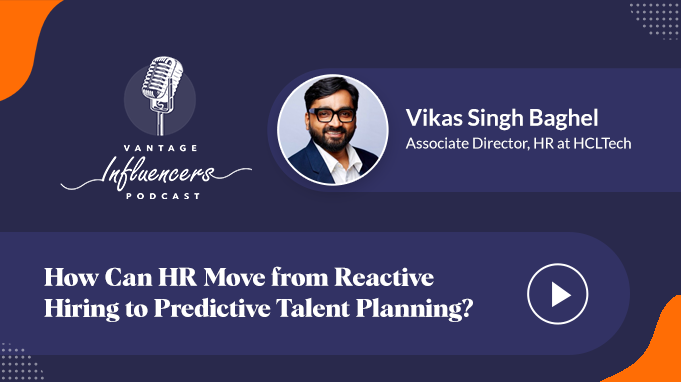
How Can HR Move from Reactive Hiring to Predictive Talent Planning
Episode Overview
Most hiring in services-driven organizations still runs on the same script: a role opens, a team feels the pressure, and recruiting scrambles to fill the gap. Vikas argues this reactive pattern persists because product-based businesses can forecast demand from a roadmap, while people-driven businesses cannot forecast a human being the same way. A candidate can accept an offer and still walk away at the last minute, and that unpredictability, combined with volatile macro conditions, pushes hiring managers to wait until demand is fully confirmed before acting. The result is a workforce built on urgency rather than intent, and quality suffers because teams end up hiring whoever is available rather than whoever is right.
The fix, in his view, starts with reading an organization's own hiring history rather than waiting for certainty. Vikas points out that a large share of any company's hiring, often the majority, repeats the same skills year after year, which means that portion of demand can be created proactively instead of reactively. He walks through how workforce analytics can surface skill inventories, competency levels, and early disengagement signals so HR can build talent pipelines ahead of need, hire for fungible skills that can be redeployed if demand shifts, and use AI to handle high-volume, low-judgment tasks like resume screening and interview scheduling. Predictive planning, he stresses, is less about a perfect forecast and more about giving HR the visibility and agility to close gaps before they turn into a crisis.
Episode Highlights
- Reactive hiring is more entrenched in services businesses than product businesses because people, unlike a product roadmap, can change their minds at any point in the process.
- Roughly 70-80% of hiring needs repeat historically, so that share of demand can be created proactively instead of waiting for a confirmed business need.
- Workforce analytics should map skill inventory and competency levels first, then flag disengagement signals like frequent leave or missed meetings before they turn into attrition.
- Hiring for fungible, transferable skills lowers risk because those employees can be redeployed if a specific demand does not materialize.
- AI is already being used across the hiring funnel for resume screening, candidate scheduling, and offer-to-joining follow-up, freeing recruiters for higher-value conversations.
- Business leaders, not HR, own the talent decision, so HR's real leverage is influencing that decision with data and market reality rather than owning the call outright.
About the Guest
Vikas Singh Baghel, Associate Director, HR, HCLTech
Vikas Singh Baghel is an HR leader with 19 years of experience across Talent Supply Chain, HR technology transformation, process re-engineering, global delivery models, and large-scale change management. He currently leads the Global Talent Supply Chain and HR Technology CoE at HCLTech, where he drives global technology implementation across talent supply chain, HR processes, automation, and employee lifecycle systems. His work includes shaping digital and social talent sourcing strategies, selecting global sourcing channels, setting usage benchmarks, improving ROI, and partnering with talent acquisition leaders across geographies to address external hiring challenges. Vikas also brings deep experience in HR application governance, off-the-shelf product implementation, in-house HR product design, and change management for business stakeholders. In his earlier roles, he built social sourcing teams from the ground up, established a global sourcing offshore unit for Europe, led the enterprise social network HCL MEME, managed the global implementation of IBM Kenexa iTAP, and oversaw recruitment lifecycle and sourcing operations for one of HCLTech's largest global service delivery units.
Connect with Vikas on LinkedIn
Host
Riha Jaishi, Vantage Influencers Podcast Host
What You Will Learn
- Why reactive hiring is more common in services organizations than product companies, and what geopolitical and market volatility have to do with it
- How to identify the share of hiring demand that repeats historically so it can be planned for proactively
- How workforce analytics can reveal skill inventory, competency gaps, and early attrition signals
- Why hiring for fungible, transferable skills reduces business risk
- Where AI genuinely helps in the hiring process, from resume screening to offer follow-up, and where human judgment still matters
- How HR can influence business leaders to take a more proactive approach to talent planning, even under short-term pressure
Key Topics & Timestamps
| Timestamp | Topic |
|---|---|
| 03:00 | Why Reactive Hiring Still Persists in Services Organizations |
| 07:04 | Aligning HR with Future Business Needs Through Historical Data |
| 11:57 | Using Workforce Data to Predict Skill Gaps and Attrition Risks |
| 17:04 | Balancing AI Tools with People-Led Hiring Decisions |
| 22:33 | Planning Talent Needs in Fast-Changing, High-Pressure Industries |
| 26:02 | Moving from Short-Term Hiring Fixes to Long-Term Workforce Readiness |
Full Transcript
Click to read the full episode transcript
Welcome to the Vantage Influencers Podcast. This podcast is sponsored by Vantage Circle, the simple and effective recognition platform for employee engagement.
Riha Jaishi: Hello, everyone. Welcome back to another episode of the Vantage HR Influencers Podcast. I'm your host, Riha. And today we are diving into a topic that is becoming increasingly important for modern HR teams. That is, how can HR move from reactive hiring to predictive talent planning? So for a long time, hiring has often been treated as a response to immediate business needs. A role opens, a team feels the pressure, and HR steps in to fill the gap. But in a fast changing talent market, this approach is no longer enough. The real question is, how can HR anticipate the future? How can HR anticipate workforce needs before they actually become urgent? Because talent planning today is not just about filling vacancies, it is about understanding future skills, business priorities, internal capability, and the risks that may affect workforce continuity. The challenge is that many organizations still rely on short-term hiring decisions, even when the business needs long-term talent readiness, and that is where this conversation becomes important. And to help us unpack this, I'm joined by Vikas Singh Baghel, Associate Director, HR at HCL Tech. Welcome to the show, Vikas. It's a pleasure to have you with us today.
Vikas Singh Baghel: Thanks for having me, Riha. And team, pleasure is all mine and looking forward for our discussion.
Riha Jaishi: Okay, great. We are also looking forward to it. So to kick things off, Vikas, can you briefly take us through your professional journey so far? We are eager to learn about your journey.
Vikas Singh Baghel: So for me, it's been almost around 18 years in industry. I started as one of the rookie recruiters with a bootstrap firm, learned the tricks of recruiting for about two years. And then I moved to corporate. And for the last 15, 16 years, I've worked with HCL Tech. I've worked with one of the startups based in Europe for about two years. And overall, if you talk about my functional experience, I have done recruiting, I have done HR technology, I have done HR tech product management and product development as well. I have managed talent supply chain center of excellence, so looked at the entire gamut of talent supply chain from HR technology, operations, and governance point of view. So that's about my overall experience here.
Riha Jaishi: Thank you so much for sharing your experience with us, Vikas. Now, with your permission, I would like to delve into our topic today. So let's go ahead and dive into the topic further, shall we?
Vikas Singh Baghel: Yeah, please go ahead.
Riha Jaishi: Okay, great. Okay, so Vikas, what does reactive hiring look like in most organizations today? And why does it continue despite better access to workforce data? What do you have to say about this?
Vikas Singh Baghel: Yeah, so primarily, if you see, the reactive hiring problem is more on the services side of the business. Wherever you have product based companies, they perhaps still have some line of sight to say what does the product roadmap look like, what skill would they need for that roadmap, and there is some proactive planning there. But on the services side, where actually your human is the product, the person you get determines what your business outlook is going to be. And there, what happens is that more often than not, we work in a reactive hiring environment. Of late, it has become a little more prevalent because there is so much volatility at the macro and micro level. It is very difficult to predict what is going to happen next quarter in the current scenario, whether it's geopolitical, whether countries are at loggerheads about tariffs and whatnot. All of that impacts irrespective of what business you're in, especially if you have any cross-border business. And therefore, on the demand side, it is very difficult to get the demand forecast. And even if you get the demand, unless it is truly logged in and you're 100% sure that this business is going to come your way, people are a little risk-averse. So they don't create that demand proactively. Only when they are 100% sure that the business is logged in do they say, now I need these people hired from the market, and then the hiring happens, maybe at the last moment. So in general, I think in services organizations, just-in-time hiring has been the issue historically, and it is primarily due to the lack of processes and systems for demand forecasting. And it is quite ironic that some of the best IT companies, who build very sophisticated software for their end customers, are struggling to create a model or software that can meet their own hiring needs. Somewhere it can dampen your quality of hires because you're always in a haste to hire from the market, and typically you will hire somebody who's available rather than waiting for the right person to come along. So yes, it is a problem, and many companies are at it, trying to solve for it, because they know it's not sustainable and it's not good for the business outcome. So the work is in progress, but it has been a perennial issue for the industry.
Riha Jaishi: Thank you for sharing such an insightful perspective on reactive hiring and why companies are more prone to it. You've mentioned a very significant point about how service-based companies are more prone to reactive hiring than product-based ones, because of the geopolitical situation and circumstances going around. Things are unpredictable at the moment, right?
Vikas Singh Baghel: That's correct, yes.
Riha Jaishi: Okay, so now moving ahead, how can HR work more closely with business leaders to understand upcoming capability needs instead of only responding to vacancies?
Vikas Singh Baghel: Sure. So more often than not, if you look at it, your past is what repeats in the future in a cyclical manner. So irrespective of the business you are in, you need to develop your own skew for that. For example, imagine a mom and pop shop guy who sells fast consumer goods. He is able to stock his inventory to say how much toothpaste do I need to stock, how much oil do I need to stock, and he's also doing some predictive modeling to say I need to stock enough so that I don't waste it, and I should be able to sell it as and when the customer walks in. We need to figure out the same thing. The only difference is that our product can emote, our product can think, our product is a human, and therefore there is always a degree of unpredictability and complexity when you deal with a product that can emote, think, and decide for itself. Especially when you're dealing with a human, somebody is willing to sell, somebody is willing to buy, but the product has the right to refusal. I am willing to hire somebody, and somebody is willing to give that person to me, but the person himself, at the last moment, can decide to say I will not go to company X, I will go to company Y. So the product has a right to decision, and therefore there is that complexity. But I think as an HR, if you read your past data to see what kind of skills you have hired historically, you will invariably find that 80% are repeat skills, and there may be 20% new skills, a new component which keeps coming in. But 75 to 80% is a repeat skill hire, at least. Then you need to work with your business to say, historically, I have looked at the last three, four years of data, we've been hiring these 80% of skills and competencies, which some or the other customer will always consume. So don't wait for the customer to come and commit, go ahead and create at least this demand proactively, because we know that this 70% will come 365 days a year, some of these demands will keep coming from customer A, customer B, customer C. Considering that, let's create this 70% proactively, and then we need to hire the fungible skills, not the super niche or new skills, at least fungible skills, where you can say, if there is no demand today, can I convert this person from skill X to skill Y, can I upskill him, can I cross-train him horizontally in some other skill. As long as the person comes with fungible skills, you can lower your degree of risk, and if tomorrow the demand doesn't come, you can always convert that person into some other skill and make use of them in some other aspect. So I think these are some of the things. And now you have AI, which can process a large set of data to give you some of that insight, and HR has to come up with some predictability model around what your attrition is going to be. We know that a certain number of people will definitely leave, so at least those demands we should create proactively. We should not wait for a person to actually resign and then start creating demand. So there are ways and means by which we can build some predictability into the system, but I think it's less about data and more about getting that behavioral shift done with your business stakeholders. As long as they are on the table and they get the data to say, okay, I can understand 30% is unpredictable, but 70% has predictability which the data shows, and at least for that 70% we need to proactively create instead of waiting for just-in-time hiring, that data approach and that consultative approach with the business gets everyone on the same page to move forward on this journey.
Riha Jaishi: Because first of all, I really liked how you categorized the different kinds of skills that companies need these days, and secondly, your perspective sheds light on the importance of data and how HR can utilize it to predict changes, particularly the behavioral change, and what hirings or skills are required for the upcoming needs.
Vikas Singh Baghel: Yes, that's right.
Riha Jaishi: Okay, so now going ahead, Vikas, what role does workforce data play in helping HR predict skill gaps, attrition risks, and future hiring demand?
Vikas Singh Baghel: So I think that plays a very important role. As your organization grows larger, unless you have workforce analytics in place, you will not have a pulse on your organization. First of all, you need to know what skill inventory you hold, and what the competency of the people you have for those skills is, because that is your product. In a services organization, typically your people's skill is what you sell and build your business around. So you need workforce analytics to know your skill mix, what skills you need to build your business, what competency level you hold within those skills. There may be people who are expert, intermediary, advanced beginner, or beginner. You need to know at what competency level these people stand, and then you need to decide build versus buy. To say, I have a certain skill inventory available in-house, some people are at an advanced beginner competency level, but my customer is asking for a more competent or expert level, so I need to build and work with my advanced beginner or beginner workforce to upgrade them to become competent and proficient. You will not be able to do any of this unless you have this data and analytics in place. So first, you need to know your skill inventory and competency. Second, you need to do some analytics on who are the people who are engaged and disengaged, who are most likely to resign in the next few months, and start picking up those signals to work proactively with those individuals. If somebody is getting disengaged, maybe because of their reporting manager, maybe because of the role or the project they're on, and they're not happy, the employee does give these signals in a subtle manner. Somebody is taking frequent leave, somebody is not coming to office, somebody is not joining meetings. All of that is a signal. You need to create some model around it to start reading those signals and tagging your people to know who is green, who is red, meaning they might resign, and who is amber, potentially undecided, and you need to work on those cases to convert them. Third, like I mentioned in the earlier question, once you read your past demand and supply data to see what your end customer looks for, you'll be able to predict the future for at least 60 to 70%, because that much of it is repeat skill. So a mix of all three: you should know your skill inventory and competency so you know whom to train and upskill and how much you need to build versus buy. Second, you should look at your existing workforce and create some ring-fencing and predictability around who is going to stay and who is about to jump ship, and do some interventions to course correct. And third, look at your past historical demand, supply, and hiring trends to predict your future and get that predictability into your total talent supply chain. You can orchestrate all of this only when you have smart workforce analytics, and there should be people who understand data, who can really work with the data, get insight from it, and drive these decisions.
Riha Jaishi: Because you have heavily emphasized the importance of workforce analytics, which is crucial to understanding hiring patterns and the skills necessary for companies. You emphasized extracting competency levels and skill inventories, then reading signals from engaged and disengaged employees, and lastly, reading past data to predict future trends. So these are some essential pointers you've covered on the importance of workforce analytics and how it can give an overall view of how things can move on in the company.
Vikas Singh Baghel: Yeah, that's right.
Riha Jaishi: Okay, great. So moving ahead, Vikas, how can HR professionals use AI and technology to predict future talent needs while still making people-led hiring decisions?
Vikas Singh Baghel: See, so I think now it's not a choice, right? It's table stakes. If you're not using it, you're way behind in the race. So it's not anymore about can you use it, should you use it. I think you don't have a choice, you have to use it because it is imperative for your business in the future. How should we use it? I think there are many places where HR can definitely use this. One, like I said, you can feed those data signals into an AI model, which can give you a risk status of potential attrition. That could be one. Second, in the hiring process, we are definitely using this for upstream resume screening. Today there are heaps of jobs available, heaps of candidates available, and yet so many positions go unfilled. There's a huge gap between demand and supply, and we need smart tools to bridge that gap, to say which demand should go to which supply. Humanly, it's not possible for us to synthesize so much data. In the desperation of finding a job, a candidate applies to every job possible, whether they match or not, they don't care. Then it becomes a recruiter's problem to go through all those resumes and figure out which one is right to take forward. Now with AI, you don't have to do any of that. AI will take that workload, sift through the heaps of data, and tell you these three resumes are best suited for these three jobs. And then there are tools, bots, that can make calls to candidates on behalf of the recruiter and do further probing, to ask have you worked on these skills, what projects have you worked on, how did you use that skill. All of that contextual, audio-bot-based screening is available for candidates. So when the recruiter's job starts, the bot says, here are the three best matching resumes, I've spoken to these three, two are interested in exploring this opportunity, here is their salary expectation, here is their notice period. And that's where the recruiter's job comes in, to talk to the candidate, do some context setting, tell them why this company is better for them, which role they should go for, and then start scheduling. So scheduling is another area where we use AI, synchronizing the calendars of the candidate and the interviewing panel is a big task. Sometimes the panel isn't available, the candidate isn't available, so you have a bot that talks to both of them and figures out, hey, does Saturday three o'clock work for you, and then goes ahead and blocks the calendar. So you don't need a recruiter for that job either. Post-offer follow-up, once you make an offer to a candidate, whether they'll accept it or not, whatever conversation happens between the time they get an offer and the time they join, a bot is taking over. There's a bot that talks to the candidate every now and then to ask, have you resigned, are you happy with the offer, have you submitted your background verification documents, have you filled the required forms. All of that conversation the bot handles with the candidate. And whenever the bot senses a question it can't answer, like if the candidate says you offered me this amount but I'm looking for more, the bot can't decide that, so it nudges the recruiter to say this candidate has this query, why don't you jump in and have a conversation with them. So these are some of the areas where a massive amount of essential, sometimes non-value-added and sometimes value-added, work has been taken over by machines, especially AI, and the recruiter can free up bandwidth to have those meaningful human conversations that a bot isn't there for yet, to contextualize the answer, like why this company is offering this role and not that role. So across the entire talent supply chain, there are many areas where HR and the recruiting function can use these technologies to free up bandwidth, do more value-added work at a human level, and create a better experience for all stakeholders, including the candidate, the hiring manager, and everyone else involved.
Riha Jaishi: Vikas, I must say you have given a very detailed explanation on how AI can be best utilized with the best advantage in the hiring process. Whatever you've mentioned about the use of data signals, bridging the gap between demand and supply, using AI for screening resumes, scheduling, and everything, that's a very detailed process of how AI can be best utilized for all of these tasks, and definitely how more value-added and meaningful conversations can be brought in by us humans. So a balance of both, right?
Vikas Singh Baghel: That's correct.
Riha Jaishi: Okay. So moving ahead, Vikas, in a fast growing or high pressure industry, how can HR plan talent needs when business priorities change so quickly? What do you have to say about this?
Vikas Singh Baghel: See, I think the reality is that the talent decision is not with HR, the talent decision is with the business. They are the demand owner, they decide when they need talent and what talent they need. HR is facilitating that talent. I think the way HR can really go and influence this is we need to influence the decision maker with data, with market reality, and tell them that some of these decisions need to be a little more proactive. You need to take certain risks, hire some of those fungible skills, and do away with this just-in-time, high-pressure recruiting, where we are bound to make mistakes together, both of us. And if a mistake is made, at the end of the day, the business is going to suffer. So as an HR function, your job is to do that consultative work with the data, with use cases, with examples, and get everyone on the same page about why it's important to do proactive hiring, to be able to manage cost better, get better margins, have better hiring predictability, and satisfy the end customer. All of that is the advantage when you do proactive hiring. And we need to tell the business that even if there is some degree of risk, it is worth taking, instead of pivoting to non-predictive, just-in-time hiring. So I think HR's job is to influence the decision maker, because we are not the decision maker on talent, somebody else has to take that decision, and we need to facilitate that talent. But I think we play a very important role because we bring that outside-in perspective, where the talent is, at what cost talent will be available, and all of that. And I think this high pressure, there are pressures you can't do away with, which emanate from outside, at an industry level, trends happening that you can't do much about, you just have to ride those waves. But internally, there is a lot that is controllable, which you can really manage. So as a function, you need to articulate those controllables with your business stakeholders and say, these are the things we can't do much about, we'll deal with them as they come, but these are the controllables which we need to manage together, and whatever decisions we can take together to be a little less pressured and do a better job with better predictability is what we should do, collaboratively, and then take some of those decisions.
Riha Jaishi: Because the emphasis that you have laid on predictive planning and how HR is central to that role shows that predictive planning is not only about having a perfect forecast, it is more about building enough visibility and the agility to respond to those gaps before they become critical.
Vikas Singh Baghel: Yes, that's correct, that's right.
Riha Jaishi: Okay, great. Okay, so before we wrap up our session, Vikas, what advice would you like to give our HR leaders who want to move from short-term hiring fixes to long-term workforce readiness?
Vikas Singh Baghel: See, I think all of us need to realize that some of those short-term hiring fixes we've been doing are going to get disrupted, because whether you realize it or not, you have threats not only within your industry but across cross-functional industries. There are people building solutions that can disrupt your own business model, and therefore whatever we've been doing up until now, we need to take that realization that it will not take us anywhere in the future, the way industries and business models are getting disrupted with everything happening in the tech space. So all of us need to sit down and decide what our core business is, and we need to ask that fundamental question again: what business are we in, what is my differentiator, what do I bring to the table that my competition is not able to bring. And it may be simple things, it could be your culture, how you fabric it, how differently you treat your people and how your people feel within your organization, it could be any of those softer aspects as well. And then those are the points you need to take, highlight, and build your business strategy around, because if you don't ask these fundamental questions and continue doing what you've been doing, which made you grow this far, the reality is it's not going to work another six months down the line, and that is because we are all at an inflection point. Unless we do that self-reflection as a business and as a function, and partner with the business to together devise, and maybe redevise and rewrite, some of our business strategies, it is going to be a difficult time, because all of us are in for a lot of headwinds, and it will continue this way for the foreseeable future. And therefore we need to be very clear about how we are differentiated. All of us may be in the same business, but there may be some USP that you carry as an organization, as a function, and you need to keep running with that and bring everybody together with a common objective, and have nimble strategies. I think the days are gone when you create a three-year plan or five-year plan, now you have to create a plan every quarter, on what you're going to do next to win the battle in the market. And I think that's the level of rigor we're talking about. So the only message I will give is, be on your toes, don't rest on your heels. I think the times require all of us to be on our toes, keep our eyes and ears open to see how the market is behaving and what new trends are coming, and then be proactive about some of those technology waves and the technology curve that's coming into the market, irrespective of the vision you're in, and keep finding new ways and means to keep pivoting your strategy and keep moving forward. I think that's the only way to survive in the new world.
Riha Jaishi: Absolutely, absolutely, well said. Because you have shared such a strong key takeaway, thank you so much for sharing such a powerful message.
Vikas Singh Baghel: Thank you, thanks for having me.
Riha Jaishi: Okay, so because we have finally come to the end of our podcast session, thank you once again for joining us today and sharing your incredible insights. It's been more than a pleasure hearing your perspectives on how HR is transitioning from reactive hiring to predictive talent planning. We really appreciate your time and your expertise, and I'm sure everyone tuning into the session is inspired by your expertise and walking away with a wealth of information to ponder.
Vikas Singh Baghel: Thank you, Riha, thanks for having me, and I had good fun answering all the questions, I hope it was useful.
Riha Jaishi: Yes, I also had fun asking the questions, and thank you for such an insightful session. And to our listeners, thank you for tuning in. We hope you found today's conversation as enlightening as we did, so until next time, take care and we'll see you soon.
Thanks for listening to the Vantage Influencers Podcast. Be sure to subscribe on Apple Podcasts, Spotify, and our Vantage Circle YouTube channel for the latest episodes.
FAQ
Why does reactive hiring persist even when companies have access to workforce data?
Reactive hiring is more common in services organizations because the "product" is a person, and people can change their minds at any point, unlike a fixed product roadmap. Combined with volatile macro conditions that make demand forecasting difficult, many businesses only commit to hiring once demand is fully confirmed, which pushes recruiting into a last-minute, just-in-time cycle.
How much of a company's hiring demand can actually be predicted?
Historical hiring data typically shows that 70 to 80% of skill needs repeat year over year. That portion can be planned for proactively instead of waiting for confirmed business demand, while the remaining 20 to 30% represents genuinely new or niche skill requirements.
What role does workforce analytics play in predictive talent planning?
Workforce analytics helps HR map its skill inventory and competency levels, decide where to build versus buy talent, and pick up early disengagement signals, such as frequent leave or missed meetings, that can indicate flight risk before an employee resigns.
Where does AI genuinely help in a predictive hiring approach, and where does it not replace human judgment?
AI is effective for high-volume, low-judgment tasks like resume screening, candidate scheduling, and offer-to-joining follow-up conversations. Recruiters remain essential for context-setting conversations, such as explaining compensation decisions or persuading a candidate why a specific role or company is the right fit.
Related Reading
Also listen on