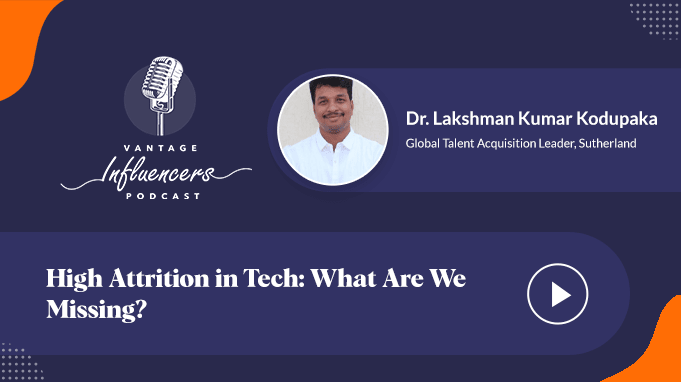
High Attrition in Tech: What Are We Missing?
Episode Overview
Dr. Lakshman Kumar Kodupaka does not accept the easy explanation for why people quit tech jobs. Everyone points to compensation and better offers elsewhere, and while those factors are real, he argues they only delay the problem rather than solve it. In this conversation, he lays out why leadership behavior and organizational culture, not paychecks, are the strongest predictors of who stays and who walks. He references research showing these two factors account for more than 70 percent of attrition, echoing the old line that people leave managers, not companies. Even during periods when companies offered massive salary jumps to lure candidates, he saw the same hesitation and churn, because money buys a moment of satisfaction, not lasting commitment.
The discussion moves into what actually keeps people engaged: meaningful work, workload balance, mental health support, and career paths that do not force employees to wait a decade for growth. He talks candidly about how the expectations of a workforce that is now 40 to 50 percent Gen Z are reshaping everything from dress codes to promotion timelines to hiring processes. He also pushes back on the idea that tech careers have a naturally short shelf life, arguing instead that people are redefining what a long career looks like, often trading full-time roles for consulting or entrepreneurship without ever leaving the industry. The conversation closes with a clear message for HR leaders: reskilling, internal mobility, and investment in people will do more for retention than another round pay hike ever could.
Episode Highlights
- Compensation is not the root cause of attrition. It only delays the problem, since leadership behavior and organizational culture together account for more than 70 percent of why people leave.
- Retention tactics like salary hikes and retention bonuses tend to work only temporarily because they do not address the underlying dissatisfaction driving people out.
- A workforce that is now 40 to 50 percent Gen Z is reshaping workplace norms around flexibility, dress codes, and how quickly people expect to grow into new roles.
- Career growth no longer has to mean a decade-long wait for a management title. Structured internal job postings let employees move into new tracks without leaving the company.
- Tech careers are not inherently short. People are redefining longevity by shifting into consulting, advisory work, or entrepreneurship while staying connected to the industry well into their 60s.
- Skill-based hiring is gaining ground over degree-based hiring, and this shift is expected to accelerate over the next two to three years.
About the Guest
Dr. Lakshman Kumar Kodupaka, Senior Director of Talent Acquisition, Sutherland Global Services
Dr. Lakshman Kumar Kodupaka is a seasoned Talent Acquisition leader and currently serves as Senior Director of Talent Acquisition at Sutherland Global Services, where he leads hiring for Digital Engineering Services. With extensive experience in building high-performing teams, he has been instrumental in driving large-scale talent strategies across global markets, leveraging data, AI, and innovative sourcing models to meet evolving business demands. He is known for his strategic mindset, operational excellence, and ability to align talent acquisition with business growth objectives, and he actively contributes to thought leadership in the HR and L&D space, including speaking engagements at forums like the GSDC Global L&D Summit on topics such as Generative AI, Industry 5.0, and the future of work.
Connect with Lakshman on LinkedIn
Host
Sanjeevani Saikia, Vantage Influencers Podcast Host
What You Will Learn
- Why compensation is not the deepest driver of attrition, and what factors actually contribute more than 70 percent of the problem.
- Why common retention fixes like raises and bonuses often fail to solve the real issue.
- How Gen Z's presence in the workforce is changing expectations around flexibility, career timelines, and workplace policy.
- How organizations are redesigning career paths and internal mobility to retain talent without waiting years for promotions.
- Why the idea of a "short" tech career span may be a misconception rather than a fact.
- How skill-based hiring is starting to compete with degree-based hiring, and where that shift is headed.
Key Topics & Timestamps
| Timestamp | Topic |
|---|---|
| 01:18 | The deeper reasons employees leave beyond compensation, perks, and better opportunities |
| 04:02 | Why higher salaries and flashy benefits often fail to fix attrition |
| 06:40 | What organizations may be missing about employee expectations and workplace needs |
| 09:15 | Have career paths and role design evolved with how tech professionals want to grow today |
| 14:42 | How much of tech attrition is actually a leadership and culture issue |
| 17:20 | The role of managers, trust, recognition, and belonging in retention |
| 19:55 | How companies can redesign roles, careers, and employee experience to reduce attrition |
Full Transcript
Click to read the full episode transcript
Welcome to the Vantage Influencers Podcast. This podcast is sponsored by Vantage Circle, the simple and effective recognition platform for employee engagement. Attrition in the tech industry has almost become a constant conversation. Companies are hiring aggressively, yet they are also losing talent just as quickly. And while market demand is definitely one part of the story, many HR leaders are beginning to realize that the real reason behind attrition might be much deeper than we think. To unpack this, I'm really excited to welcome Dr. Lakshman Kumar Kodupaka, Global Talent Acquisition Leader for Digital Engineering Services at Sutherland. With his experience working closely with tech talent and global teams, he brings a valuable perspective on what might actually be driving attrition today.
Sanjeevani Saikia: Hi Lakshman, thank you so much for joining us today.
Dr. Lakshman Kumar Kodupaka: Pleasure is mine. Thank you so much, Sanjeev.
Sanjeevani Saikia: Thank you, Sanjeev, for hosting me today. It's a pleasure to have you on the show.
Dr. Lakshman Kumar Kodupaka: Thank you so much once again.
Sanjeevani Saikia: Before we begin today's conversation on the topic, could you kindly walk us through your corporate journey so far?
Dr. Lakshman Kumar Kodupaka: Sure. Myself, Dr. Lakshman Kodupaka. I carry close to 22 years of talent acquisition experience, predominantly into the IT and IT space. So in my experience, I manage geographies like India, USA, and APAC regions, and very fairly on the US. I also manage the Europe and the Middle East. So to keep it in a nutshell, I manage to work across regions, and I work for both captive as well as information technology services side, as well as on the BPO side. So in my current role, I am heading the talent acquisition for digital engineering services for Sutherland Global Services. So in this role, I manage both India, USA, and other regions outside MENA.
Sanjeevani Saikia: Wonderful. Thank you so much for sharing your journey with us, Lakshman. With your permission, can we dive straight into the topic today?
Dr. Lakshman Kumar Kodupaka: Sure, please.
Sanjeevani Saikia: Great. Wonderful. You know, when we talk about attrition in tech, the conversation often starts with compensation or better opportunities elsewhere. While we know that those factors definitely matter, they don't always tell the full story. So when we talk about attrition in the tech industry, the conversation often revolves with compensation or better opportunities elsewhere. Somewhere we know that those factors definitely matter, but they kind of fail to tell us the full story. So it's important to understand beyond compensation and opportunities, what do you think are the deeper reasons people are choosing to leave in this particular industry?
Dr. Lakshman Kumar Kodupaka: I think you've fairly touched upon the point. See, compensation is not the only reason. It is like moving the problem or delaying the problem. So most of them have the perception that every individual goes for a better opportunity is only because of compensation. I don't agree with that. In fact, there are many reasons. And even if you look at the survey which LinkedIn has done in the recent past, a major trigger or a major impact that would really be the real reason for attrition is on the leadership behavior and the kind of culture that the organization has. I think these two factors contribute more than 70%. In fact, there's a very old saying that employees leave managers but not the companies. So echoing that, so it is fairly because of the lack of opportunities. So today, after the COVID, if you look at 2001, 2002, we have seen the great resignation era. So there were days where we offered more than 35, 40, 50%. Somebody who was at 8 lakhs, 10 lakhs were offered up to 30 lakhs. But still there is an uncertainty of people joining us. We were keeping our fingers crossed. So this is because the candidates are busy in shopping. But at the same time, they are very clear what they want. So the first thing which really comes on top of my mind is the culture. And second one is the opportunities. And third or fourth would be a compensation or a brand. So it all depends upon how they can be scaled up in the framework of the organization is what every individual looks at. So that is one of the major trigger factors for attrition or even people taking up an opportunity in a new company. And the most important thing is the moment they feel that their efforts are not valued. They are not recognized in the system. I think that is one more trigger where people tend to explore opportunities in the market.
Sanjeevani Saikia: Okay. You know, what's interesting is that many organizations still respond to attrition in a very predictable manner, if I could say so. If people are leaving, the immediate reaction is like, you know, increase the salaries, introduce retention bonuses or, you know, kind of add more perks. But in reality, these solutions often work only temporarily. People might stay for a while, yet the underlying dissatisfaction doesn't always go away. Particularly in this industry, but it is also seen in other specific fields as well. I think it's quite true overall. So from your experience, why do these strategies often fail to address a real problem behind attrition?
Dr. Lakshman Kumar Kodupaka: Yeah, as I said, these particular strategies only address the current problem. Say, money as such, if you look at individual, it is a kind of, I would say, an activity or an incident that can only give you happiness for some point of time. Later, definitely that will not carry for a longer. And even in case, even if you look at your own life, if somebody gives you money, you will feel happy for that moment. But over a period of time, what really looks at is the satisfaction in that moment. And next, what you have. So these companies fail to understand sometimes that only money is the driving factor. So what every individual looks at is beyond the learning and a meaningful work. There should be also a good workload balance. And in this global era now, most of us are working and aligning towards the global calendars. So we often get drained out. So mental health is also very important where companies need to emphasize. And companies which are emphasizing on that, employees tend to pay more attention on that. So very recently, a lot of companies also have kind of, they kind of partnered with a lot of wellness companies. And they are trying to give them awareness of how important is the physical and mental health for them to be more strong. So it's like kind of giving opportunity. It's like you might be the biggest company in the world, but when you are not able to get the attention of smaller things, I think that is where we tend to fail.
Sanjeevani Saikia: Yes. So all the points that you have mentioned, which are essential, is something that, you know, as we can see the Gen Zs entering the workforce. For them, these things are priority. They really prioritize mental health. For them, pay is just one of the factors. It cannot be the be-all and end-all. So like, you know, what kind of shift are you seeing when the Gen Zs entering the workforce? Particularly if I could say tech Gen Zs.
Dr. Lakshman Kumar Kodupaka: Yeah. So I think I was about to bring that topic. Good that you brought this topic. So today, especially in kind of the organization where I work, I have all the generation of Gen X, millennials, Gen Z. About 40% of my workforce is Gen Z. 40 to 50% of workforce. So your ideology or thought process should not be sticking around to the old school model. Rather, you need to make sure that how agile it can be. It can be as simple as your infrastructure. Right? From the way you work, you sit, or the kind of the policies which we have around the workforce model. So today, Sutherland, especially if I take about my organization as an example, we are very much a people-centric organization. We have a complete flexibility on working from home. So we never force anybody to work from office unless, until there is a project mandate. But as such, as an organization, we are very flexible on that. So that is one more good aspect which helps us to keep our employees. Keep our employees motivated because they can save a lot of travel time. And that can be focused on their mental health and their physical fitness as well. And outside that, it also happens about your friendly policies. Like what you say is about your, so people also carry very small things. It's about like your attire. Gone are those old days where people used to be in business formals. And like they look like kind of very strong wristbands. Strong restrictions which we had, right? So I think Gen Z doesn't like that. Or I would say they are not so mindful about going into that. And the other most important thing is your career path index. So there used to be good olden times when we started our careers. We had often this indicative range of experience. So somebody wants to move in their ladder. You need to have at least 10 years, 12 years, 14 years of experience to do the people management and all. So I think that is something which we need to look at the era of managing Gen Zs. Because they are not okay to wait for such long time in terms of getting their careers into a manager or technology role. The timeline which they are anticipating, I think they will not be able to have that kind of patience. Or maybe the generation is moving very fast. I would not say patience. But the generation is moving very fast. The technology shift which we had about a decade. Now it is moving very fast. So you need to be very much technology driven as an organization. And make friendly policies. And ensure that even if you look at our own application tracking system which we do. First of all when we wanted to fill a job, we used to fill almost 4-5 pages application form. So now on a single click in mobile, you will be able to upload your own profile. And sometimes you can even just put the link. So that is where the transformation is happening. So especially if you want to attract the Gen Z or retain the Gen Z or manage the Gen Z. You should be ahead in the game in terms of managing this workforce.
Sanjeevani Saikia: Yes, absolutely correct. Another angle that is becoming more visible is how professionals think about growth today. Tech talent especially tends to look for learning, experimentation. And if I could say the ability to move across roles. Or skills much faster than traditional career paths allow. Like you already have mentioned. But many organizations still operate with fairly structured job roles. And linear career ladders. There is a job description. You have to follow that kind of stuff. So do you think the way organizations design roles and career paths has kept pace with how tech professionals want to grow today.
Dr. Lakshman Kumar Kodupaka: So basically every individual how I look at is there are career anchors or career drivers for every individual. So your career drivers will keep changing as you age. As you evolve and as you move based upon your priorities on the family and priorities of the individual. So when you started your career money would be the top most priority for you. Because you wanted to earn as much as. And then parallelly could be your meaningful work. And then the expertise you want to carry. Maybe after a decade or so you want a kind of a power, a management, and a kind of a growth. A growth that will help you to sustain. Maybe after two decades you feel that maybe job security is more important for you. You want some family space. You want some opportunities that can help you more stable and more secure. So nothing is wrong and nothing is right. Because these drivers keep changing. So in the era of modern world what we are in today, the drivers could be the technology. I think as long as you are able to engage these people in the technology and give them a career path. Today what we do is we no longer wait for anybody to get into a management role for 10 years or 12 years. So we have given a standard career path in our job architecture. Like we call it as level 1, level 2. So until level 3 it is a standard one where every individual can get the exposure of technology. And from there we have two tech tracks. Either I go into management track. Or I go into technology track. And after some point of time. You also experienced a good technology experience. And you want to experiment or explore into management. The companies will help you. We call it something as internal job posting. So with that job posting. So our objective, I am just narrating about my own example in the company. So we give the opportunity. The first priority towards the internal employees. Where they can apply. And through that they get opportunity to grow vertically or horizontally in the career. So that will help us to manage our attrition. At the same time. There is also a benefit and a cost factor towards that. Instead of waiting and hiring from the market. There is a cost associated. And you need to invest time. Rather I will have my own employee. And this person individually will be more motivated. And the morale will be very high.
Sanjeevani Saikia: So I have a question. That I don't know how relatable it is to the context. But just a couple of months back. I was in one of the conference things. On this particular platform. That the career span of a tech professional is anyway less. So they would not want. Because you have to keep updating. So maybe at 50 or 45 a person may not want to maybe redo or restudy or something. So the span is anyway less compared to a person working in customer, client success or something like that. So do you think you agree with that? That tech professionals anyway have a less career span.
Dr. Lakshman Kumar Kodupaka: I would not completely agree that the tech span of an individual is less. Even today I have people who work as a consultant with age 60-65 years. Who do part time and advisory for us as a part of their interest. It's all about the changing world. So the kind of growth which I waited for 22 years. Which I got today. Is happening in 10-12 years. So if I am not investing on my skills. And if I am not putting efforts to upgrade myself. I will definitely perish. Okay. So that doesn't mean that my life cycle as an individual is pertaining towards the industry. So what the shift I have seen post COVID is. Most of the people tend to make some choices. Which will help them to give work life balance. They are not leaving IT. But they are leaving their full time jobs. And rather they want to do their own consulting. Or kind of engagement that will help them to manage their basic. Or I would rather say not basic. But their social and self-esteem needs. But not looking at self-actualization needs in the corporate side. But still over a period of time. That hunger. Somebody will want to get into entrepreneurship. So those all untouched desires which they have. They are kind of experimenting. But doesn't mean that the lifespan of IT is less.
Sanjeevani Saikia: Okay. I understand. Thanks for responding to my query. Now shifting gears. Lakshman. Help us understand. How much of tech attrition do you think is really a leadership or cultural issue. Rather than a talent or market issue. You know in many cases leadership style, team culture and the everyday work experience. Might be playing a much bigger role than we actually openly think or acknowledge. So what do you have to say about that?
Dr. Lakshman Kumar Kodupaka: So as per the recent survey which was done by LinkedIn. About 30 to 35% or up to 40% is purely a leadership problem. And rest 30% is on the culture side. And rest you have all of the factors. So about 70% is predominantly the people driven by culture. Which the organization has the complete hold. And the leadership style. So again leadership style. I would not say this is good or that is bad. Because it depends upon the work model we have it. But people expect a lot of agility. So in the current generation what we have. No longer the bureaucratic and the age old leadership traits will not work. So we should be very much focusing on participative leadership style. And the situational leadership style. So you need to have a kind of a trait. Where you need to be able to influence more. Rather than dictating what you want. So I as an individual, as a leader. What I really focus is on the participative leadership style. So what I really do is I analyze the strengths of individual. I see what I can extract from the individual. Rather than enforcing what I really want. So that way I clearly know what the individual has. And from there what is the desired outcome. And wherever the gaps are. If the individual is able to perform. We will be definitely utilizing his services through training or enablement. But if you see a consistent gap. So that is where we need to see how you can rebuild that gap. Either through engaging that workforce. Additional workforce. Or enabling a tool. But if you see there is a lot of transformation that is happening in the market. Especially I will take one example of talent acquisition with your permission. A lot of work is getting automated. So today you no longer need to have. Like you don't need to be a master of all. If you are having ability to use what is available. So I would say AI is one such opportunity for us. To see and use that platform. So first of all when I started my career. When I want to source one candidate. Right. So I often used to play along with the keywords. What a candidate really thinks. That is my skill. And that is my own inherent trait. Today if I put a job description in the chatbot. And you would write and give a prompt saying that. Hey I am hiring this particular role. Can you give me the Boolean keyword search. Which I can use in LinkedIn. Or you can put industry specific. So you are trying to give prompting. So those kind of activities which were the most important traits. Became a kind of redundant. And will continue to become redundant. So what is that you are trying to use. Is how you can be agile in using those tools. So generation Z is in that. And again we will be also coming into industry 5.0 very soon. So we were still digesting industry 4.0. Now there is a lot of effort that is happening on industry 5.0. So we call it as cobot. C-O-B-O-T. So where machine. Sorry where man and the machine work together. Like it could be even robots or agents or bots. So don't be surprised. Maybe in a year or two. Or even less than that. Your team members will be agents. And you will have one of your very familiar person. Their primary job is to manage these agents. I think that is where the technology is changing. We are only talking about Gen Zs or workforce. But I am seeing the kind of transformation the world is going to happen very soon. And other important thing is beside this. There will be lot of gig workforce that is going to come. So gig workforce is kind of a temporary work which they do. They come, they finish and they do the piece of work and they go. So your role as an individual is not just to manage the attrition of the person who is leaving. Because the bigger problem is also is to see how the world is transforming. So your clients are not ready to invest money. They don't want to get any of their price hiked. So your object is to see how maximum you can elevate. Or maximum you can get the productivity at the same cost. So attrition is not just only money. But it is all about how you can reskill your people. How you can focus on investing on their career in terms of enabling them. And again we should come out of hiring this degree based hiring. Or study based hiring rather the skill based hiring. I think that is the evolution which the market is going to take. Very soon a radical shift in the upcoming days.
Sanjeevani Saikia: So you have underscored a very important point towards the end of this particular response. Is that people are moving towards skill based jobs. They are skill based career growth. So right now in this particular industry how prevalent it is that people are actually opting for skills over degrees. Because degree is like a full criteria. Many people can't get in without having that privilege. Because it is still there. If you see on job rules it is still there. But how much are they willing to do away with that. The whole degree thing and rather focus more on the skills.
Dr. Lakshman Kumar Kodupaka: See I would not say that it is 100% we are there like we are focusing only on skills. But it will evolve and it will move very very fast. I have seen very recently I don't want to mention the company names going to the sensitivity. But there are some finishing schools who are enabling people who have passed out plus 2. They have a collaboration with a university. And plus 2 means from 13th year onwards or maybe plus 1. Like after plus 2 is where they are learning technology. Where they are doing high end technology work. And then they are doing projects. So technically they are earning from the age of 18. And they are learning technology. And by the time they finish this 4 years course they are already earning. They are already making money and they already have experience. So that is a baby step which the companies or the finishing school is experimenting. And once that model is proven right. First of all we used to go for campus recruitment in the final year. Then it came in situation where we are hiring pre-final year students because of lack of talent or the shortage of talent. Right talent basically. So if that system error continues. We will hire people. Even before they get into college. I think that is the kind of situation which we are in. So to keep it short. I think the evolution is happening on the skill based. Only thing is it takes some time. And especially if you are a freelancer or a kind of multi skills person. It is easy for you to because you can go and play around depending upon the opportunities you have. So especially if you are doing freelancing. Or a kind of engaging yourself into gig workforce type. Your skills play a very very vital role.
Sanjeevani Saikia: Yes. I think it is safe to say that there is a long way to go.
Dr. Lakshman Kumar Kodupaka: I would say long way to go but not very long. Maybe a matter of 2-3 years.
Sanjeevani Saikia: Okay. Great. So Lakshman we are arriving at the end of today's episode. I want to zoom out and look at the bigger picture now. If organizations truly want to address attrition. What shifts do you think companies need to make in how they design roles, careers or the overall employee experience?
Dr. Lakshman Kumar Kodupaka: Yeah. So first thing is I think we need to move towards skill based hiring. And build the capability rather than always buying. So one of the reason why the attrition is happening is because the kind of work pay that is happening. I think that is also causing one of the reason for attrition. And there are many companies which especially if take example like startups. They don't pay very high but they still were able to retain the talent. It is because of the inclusivity which they give. And they are able to own them. And give them a kind of hope that they are there whenever there is a need for that. And the second one is you need to build that very strong organization culture. A people driven culture. So that way you can also manage and retain some of this top talent. And invest in continuous learning. So don't wait until there is a project that is coming or scheduled. But rather see how you can invest in your current talent landscape and enable them. I think that is something which is most important. And create opportunities internally before you go and hire from the market. Because what happens is most of the times we tend to want it as it is from the market. But rather we fail to understand sometimes. It is easy to invest in training this person for 2-3 months rather than getting from market. I think that is something which we should do. And upskill and reskill. I think these are the two things which companies should focus on at the same time as an individual. We need to also see where the market is driving towards this transformation of the latest technologies. And accordingly we also need to align. I think these are my takeaways.
Sanjeevani Saikia: Yeah, great. Lakshman. We have arrived at the end of today's episode. Thank you so much for joining us. And you have responded lucidly to all the queries and the questions that we had. So prior to wrapping up. Is there any final message for our listeners? Anything that you would like to say before going?
Dr. Lakshman Kumar Kodupaka: See if companies really invest only in paychecks. Like in terms of mentioning that they wanted to retain somebody only by giving a hike. Or giving by a benchmark. Or giving by a benefits or a reward. I think those kind of strategies will not work in the long run. You need to see how you can enable people. How you can reskill them. And how you can invest in them for future. I think this is my important takeaway.
Sanjeevani Saikia: Great, Lakshman. Thank you so much for joining us. It was a pleasure having you on the show. And all the best for your future endeavors.
Dr. Lakshman Kumar Kodupaka: Thanks a lot. Thank you so much. Bye.
Thank you.
FAQ
What does this episode say is the real reason behind high attrition in tech?
Compensation and better external offers are often blamed, but the episode argues that leadership behavior and organizational culture are the stronger drivers, together accounting for more than 70 percent of attrition according to LinkedIn research cited in the discussion.
Why do retention bonuses and salary hikes often fail to fix attrition?
These fixes address the symptom, not the cause. Money creates temporary satisfaction, but underlying issues like poor culture, lack of recognition, and limited growth opportunities remain unresolved, so employees who stay for a hike often leave again once the effect wears off.
How is Gen Z changing what tech companies need to offer employees?
With Gen Z now making up 40 to 50 percent of some tech workforces, companies are adapting policies around flexibility, dress codes, mental health support, and faster access to career growth, since this generation is less willing to wait a decade for a management role.
Is it true that tech professionals have shorter career spans than other fields?
The episode pushes back on this idea. While tech requires continuous upskilling, professionals are extending their careers well into their 60s through consulting, advisory roles, and entrepreneurship, rather than exiting the industry altogether.
Related Reading
Also listen on