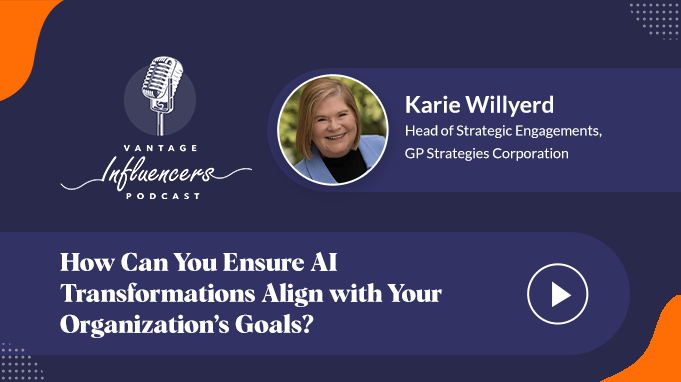
How Can You Ensure AI Transformations Align with Your Organization’s Goals?
Episode Overview
Karie Willyerd argues that most of the anxiety around AI failure rates is misplaced. In this episode of the Vantage HR Influencers Podcast, she explains why the current "trough of disappointment" in AI adoption is not a warning sign, it is what happens when organizations finally start testing the technology against real work instead of just talking about it. Drawing on three years of conversations at the TED AI conference, she makes the case that small, low consequence experiments, not sweeping enterprise rollouts, are what keep AI transformation tied to genuine business priorities instead of passing hype.
The conversation then moves from mindset to mechanics. Willyerd explains why treating AI as "just another technology" misses the point once it starts operating as a colleague, a boss, or an intern, and why systems thinking, not task delegation, is what actually unlocks return on investment. She shares a real example of attaching metadata to training content so AI agents could turn a multi day conference recording into finished training modules within about two days, and closes with candid advice on the capabilities leaders and employees need to build if they want AI to serve business outcomes instead of drifting away from them.
Episode Highlights
- AI adoption is likely moving through its "trough of disappointment," but Karie Willyerd sees that as proof organizations are finally testing the technology against real work, not a reason to slow down.
- High failure rates on AI pilots are not automatically bad news. If a project is a genuine learning experiment, some failure is expected, and avoiding failure altogether usually means falling behind.
- The safest path to alignment is starting with small, low consequence experiments framed as learning projects rather than full-scale implementations.
- Leaders need to move from delegating tasks to AI toward designing whole systems where AI and people work together, an approach Willyerd calls thinking from an AI native perspective.
- At GP Strategies, attaching metadata to training content let AI agents turn a multi day sales conference recording into finished training modules within about two days.
- Leaders who have not updated their view of AI in the last year and a half are easy to spot, and staying current takes hands on practice, not just reading about it.
About the Guest
Karie Willyerd, Head of Strategic Engagements at GP Strategies Corporation
Karie Willyerd has served as Chief Learning Officer six times across her career, most recently at Visa, and previously at organizations including Sun Microsystems, SAP, and Heinz. She also led SAP's Global Education business unit and worked as a Workplace Futurist at SuccessFactors. Earlier in her career, she founded and served as CEO of Jambok, an early video based informal social learning platform that was acquired by SuccessFactors in 2011. She holds a doctorate in business, sits on the board of a business school, and has written two books on the future of work, including one on the 2020 workplace published in 2010 and a second, called Stretch, on how people can prepare for what comes next. Today, as Head of Strategic Engagements at GP Strategies Corporation, she works with enterprise learning functions to build AI agent systems.
Connect with Karie on LinkedIn
Host
Riha Jaishi, Vantage Influencers Podcast Host
What You Will Learn
- How to tell the difference between AI initiatives built for genuine value and those chasing a trend
- Why a high failure rate on AI pilots can actually be a sign of healthy experimentation, not a red flag
- The most common mistake organizations make when trying to align AI transformation with business goals
- How to build a culture that treats AI as a collaborator instead of a threat
- What "AI native" systems thinking looks like in practice, and why it matters more than simple task delegation
- How to assess whether your organization's data ecosystem is ready to support AI initiatives
- What capabilities leaders and employees need to build so AI actually supports the outcomes it is meant to serve
Key Topics & Timestamps
| Timestamp | Topic |
|---|---|
| 00:00 | Cold open and episode introduction |
| 01:06 | Karie Willyerd's professional journey across six Chief Learning Officer roles |
| 03:40 | Distinguishing genuine AI value from trend driven initiatives |
| 08:59 | The most common mistake organizations make when aligning AI with business goals |
| 11:24 | Building a culture that embraces AI instead of fearing it |
| 16:14 | Assessing whether your data ecosystem is ready to support AI |
| 20:16 | Capabilities leaders and employees need to build for AI driven outcomes |
| 25:34 | The AI trend to watch over the next three to five years |
Full Transcript
Click to read the full episode transcript
Welcome to the Vantage Influencers podcast. This podcast is sponsored by Vantage Circle, the simple and effective recognition platform for employee engagement.
Riha Jaishi: Welcome back to another episode of the Vantage HR Influencers podcast. I'm your host, Riha, and today we're tackling a question that sits at the core of every serious business decision right now: how to ensure AI transformations actually align with your organization's goals. AI has moved beyond experimentation. Leaders are under great pressure to show clear outcomes, better decisions, sharper efficiency, stronger employee experiences, and measurable business value. But without direction and discipline, AI can drift easily. And the real challenge is not adopting AI, it's making sure that the transformation is rooted in strategy, purpose, and a clear understanding of what the organization is trying to achieve. So to help us unpack this with insight and practicality, I'm joined by Karie Willyerd, Head of Strategic Engagements, GP Strategies Corporation. Welcome to the show, Karie. It's a pleasure to have you with us today.
Karie Willyerd: Thank you. I'm joining from very warm Palm Springs, California today, where I'm in an Airbnb for the holiday season.
Riha Jaishi: Oh, that's great. Yeah. Okay. So to kick things off, Karie, could you briefly take us through your professional journey so far? We are eager to learn about your experience.
Karie Willyerd: Oh, well, thank you very much. So my short headline is I'm a six-time Chief Learning Officer, most recently for Visa, but also companies like Sun Microsystems, SAP, Heinz, and other organizations. So my deep background is in helping people learn and grow inside the enterprise. Along the way, I've always had an interest in the future of work and technology. So my first book, co-written and published in 2010, was about the 2020 workplace. We made predictions of what was going to happen, and one of our wild cards was a global pandemic that would forever change how we think about going into work. My second book is on how people can prepare for the future, called Stretch. And at one point along the way, when Sun was sold to Oracle, I decided to do an entrepreneurial event, a little jaunt, and became CEO of a startup called Jambok, which we sold to SAP. It was a social platform. So for any of your listeners who are entrepreneurs, I know what it's like to be the Chief Everything Officer as well.
Riha Jaishi: That's such an inspiring venture, Karie. Thank you so much for sharing your experience. So now, with your permission, I would like to delve into our topic further, shall we?
Karie Willyerd: Let's do.
Riha Jaishi: Okay, great. So how can leaders distinguish between genuine AI-driven value and AI initiatives that are simply trendy, but misaligned with organizational priorities? What do you have to say about this?
Karie Willyerd: All right. So just because I think it's fun to raise a little controversy, I'm going to bring up something. This topic was discussed quite heavily at the TED AI conference. I've gone to all three years of the TED AI conference, the most recent one being in October. And of course, people were talking about this. For one thing, they say, are we in the trough of disappointment? In other words, in almost any technology adoption, there's a lot of excitement at the beginning. AI was adopted faster than any other technology. And then you start trying to apply it, and some people have success, some don't. But typically, in any adoption curve, there is that middle part. So many of the people at the TED AI conference were anticipating that 2026 is going to be the year of adoption. So that's part of the story here: it's a very good question, because people are seeing both sides of the equation.
The second thing is that if you think about how people went from on premise to cloud computing, that took nearly a decade, decade and a half, and people brought it in slowly. Now, even if the larger enterprise hasn't approved of tools, people are using them on the side because they can use them on their phone and so on. So there's lots of AI coming into the enterprise before we have plans for it. It's so affordable to bring it in. As a result, you'll see studies from MIT and Stanford that talk about the high rate of failure of AI projects, and that is true. The counter to that is that people are bringing in small prototypes and experimenting. And if we believe that experimentation is good and is a learning practice, then you would anticipate high failure rates. So I always take these "there are so many failures out there" stories with a bit of a grain of salt, because if you're not experimenting, then you are behind the curve. If you are not failing with AI, you are behind the curve, because you don't have to do great big projects. So to get directly to your question, I think the way to make sure you're aligned is to start with small experiments that don't carry a lot of consequence, more of a learning project than an actual implementation project. Because as we move into 2026, I think there are going to be a lot more families of agents working together to create real ROI. Does that make sense?
Riha Jaishi: Yes, it does. I really like this pointer where you mentioned how AI is all about experimentation. And that experimentation is key here because, yes, it can lead to failures, but that is what it is all about. Experimentation leads to innovation, and failure is part and parcel of it. So that is a very crucial point to take into account here.
Karie Willyerd: And when you think about how you learn anything... because I've come to a warm place for the winter, I'm picking up pickleball. So I went to a camp this weekend and nearly killed myself playing pickleball for two four-hour days. And I made so many mistakes. But I learned from those mistakes. Those mistakes are what we're geared to remember, it's how our brains operate, to remember mistakes more. You probably remember some of the biggest mistakes you've made in your life, and that led you to say, "I'm never doing that again." So it's not that we should be disappointed with mistakes. We should face them as great learning opportunities, as long as we've put guardrails around it so that the mistake won't be too costly.
Riha Jaishi: Yes. Well said, Karie.
Karie Willyerd: Thank you.
Riha Jaishi: Okay. So in your experience, Karie, what's the most common mistake organizations tend to make when they try to align AI transformation with business goals? And how can they really avoid that?
Karie Willyerd: I think this is a really interesting question. It's interesting because, let's be honest, nobody is an expert in AI except for the very few people who are actually the creators of AI. And it's a real challenge for business schools too. I happen to be on the board of a business school and know how difficult it is to keep up. Last year I took a course in AI and strategy from MIT, one of the finest universities in the world, and even their courseware was behind. They had to supplement it with live instruction to make it relevant to today.
So I think the thing to realize is that the way you learn AI now is you just have to get your hands on it and go, and get around other people who are getting their hands on it and doing it too. There are some really great people in universities doing good work. I personally follow a professor at Penn who I think writes one of the best newsletters out there, really helping people keep up. He's not a technologist, but he sits in the bridge between the technologist and the practitioner and evaluates different LLMs to help you stay current. I think eventually this is going to catch up and the schools are going to have real great guidance for us. But in the meantime, you've got to get in there and get your hands dirty and practice, practice, practice.
Riha Jaishi: Okay. That's a great take there on this answer. Thanks. Okay, now moving ahead, how can organizations build a culture that embraces AI instead of fearing it? And how does this cultural shift support that alignment with business goals?
Karie Willyerd: So I think one of the most interesting and prevalent discussions I'm hearing is about mindset, and how our mindsets are going to have to shift. It's really easy to make the mistake of thinking of AI as another technology that we adopt, and as it looks now, that is not going to be the case. It's going to be our colleague. It might be our boss. It's certainly going to be our intern. So there's a whole new way of having to think about it. One is, what is the role of AI, that's a mindset shift. And the second is, if we're really going to get the ROI out of AI, what we need to be able to do is not just delegate small tasks to it, but think from an AI native perspective. From an AI native perspective, you look at the whole system and ask, if I had no people to do this, could I still get the work done? And then where do I bring people in to enrich the system and enrich the lives of the people managing it?
So one of the things I think business schools can offer the greatest advancement of skills for is in teaching systems thinking. Some of the classic design thinking is still very relevant, but systems thinking matters because machines don't know how to make the connection of what systems should be working together the way humans do. I heard a fantastic presentation by a woman who was a lawyer, this was at a TED conference in Maine. She was diagnosed with a genetic disease that would eventually, when it triggered, take her mind within 18 months. She and her husband quit their jobs, went back to school, got PhDs, and went to study her disease. Using some AI tools, they were able to figure out at what chromosome things had gone wrong and start targeting therapies for it. Brilliant, wonderful. But when she looked at what it would take to actually bring that solution to market, she found over 175 different systems she'd have to go through, all the testing, all the things it takes to clear government regulations, and so on. So AI isn't built yet to understand that full human complexity.
I think this is where business schools come in. I have a doctorate in business myself, and that's really where I learned how complicated the world is. It opened me up to thinking about how we don't sit in a little vacuum inside any organization. We are part of a larger system of businesses, and I think the schools can really help open up people's mindset around that.
Riha Jaishi: Absolutely, absolutely. Well said, Karie. I guess this alignment is basically not only about systems, right? It's about people too, like you mentioned. Without people involved in it, you really cannot proceed with it, right?
Karie Willyerd: Right, right.
Riha Jaishi: Cool. Okay, now moving ahead. So how can organizations assess whether their current data ecosystem is strong enough to support AI initiatives aligned with their goals? What do you have to say?
Karie Willyerd: That is the million dollar question we have. I'm learning more about this myself right now, so I'll give you the first answer, which is making sure you know where your data is. There are great tools out there, people are using things like Databricks to build a data lake so they know where to go and find their data.
One of the companies I work with is GP Strategies, and we've got a family of agents working with learning functions to help do the administration of many of their tasks. The interesting thing we've found is that AI works better if you can help it recognize things. So what we're doing is attaching a lot of metadata to content. Let's say you have a course, or let's take something pretty easy. We just did this for Microsoft. They have a large sales conference that generates hours and hours of videotape. Typically, you'd have to have someone go in and sort it out. You could just feed the whole video into AI and tell it to go find things, but if it doesn't have context, it's hard for it to know what to find. So we've got tools that apply to every content piece, they recognize that this was one person speaking, and attach meta tags to it. Now, when you go to search later, it's looking through the meta tags, not the content itself. So as we're developing content, we're thinking about how we can get meta tags in place so AI can find it more easily.
The net effect is we can take an entire conference, and two days later have training modules completely built and available with almost no human intervention, because we have agents designed specifically for the training environment to attach those meta tags. So again, this was practicing and learning. We found that AI is better if it's got some tagging to help it find things in the context of our needs. Every few months, you learn something new about the best way to work with our new AI colleagues.
Riha Jaishi: Yes, absolutely. You've given that example about meta tags that really stands out in understanding how AI is working, the process and the importance of data, and how to distinguish whether organizations are well developed enough to install and get introduced to AI. That's the fundamental piece here, right?
Karie Willyerd: Yeah.
Riha Jaishi: Okay. Now moving ahead. So Karie, what capabilities do organizations need to build in both leaders and employees to ensure that AI supports the outcomes they're aiming for?
Karie Willyerd: I have a couple of thoughts on this, from hearing someone talk at a TED AI conference again. First off, I think leaders are going to increasingly need to understand their business thoroughly. The day of "I'm a generic, good leadership person, I can move around and lead in any function" is kind of going away, because our workforce is no longer solely human. Our workforce is both human and digital. And to understand what tasks and assignments we give to humans versus what we give to our digital agents requires understanding the work itself. So leadership is now going to have a stronger need to be really aware of the processes and systems within their work. Know your stuff is one of the things I think leaders are going to need to internalize.
The second thing: if we fulfill the bright side of AI rather than the dark side, it will be that we have superpowered humans. So part of being a leader is to superpower the people around them, to make them the best they can possibly be. I think that's a very inspiring goal, one that all leaders should aspire to: how can I make the people around me perform at their very best, enabled by AI?
The third thing is the mindset shift leaders are going to have to go through around understanding what is actually possible with AI. I can usually tell within three to five minutes of talking to someone whether they're keeping up with AI or not, because if they're still talking about a hallucination they had, I know they're describing a version of AI that's a year and a half old. They formed an opinion and held on to it without seeing what the advances since have been. Yes, AI can still hallucinate, but it hallucinates differently than it used to. So I can tell just by how someone describes it, or I can tell if they haven't figured out how to use it productively, at least as an intern, to assist them.
Riha Jaishi: Karie, this particular point really caught my attention, about leaders needing to understand their processes of work. So now it's high time, right? In order to adapt to AI, they need to get into their work and get to the gist of it, know and understand each process in detail, so that it can help them in their AI adoption process, right?
Karie Willyerd: Right. Building their ability. I think people have always appreciated when a leader took interest in how their work was done. I remember, for example, when I went in to be Chief Learning Officer at Sun Microsystems, we had a call center for enrolling and training people who were going for a job certificate. I went in and sat in the call center, double miked in, and just listened to calls and talked to people about the typical calls that came in and what they were doing. People care that you care. So knowing how the work is actually done helps you think about how you can make the life of that real person better by bringing AI in. And I know that, because I sat and listened in on calls and got involved in the work myself.
Riha Jaishi: Yes, absolutely. Well said. Okay. So now, before we wrap up our session, what's that one AI trend organizations should really pay attention to if they want to stay aligned with future business goals over the next three to five years? What do you think, Karie?
Karie Willyerd: Yeah. I think we're not done inventing AI. And that was a very interesting point at TED AI this year: the people doing the inventing, if they're not coming from the schools themselves, are working with the schools to understand where machine learning and artificial intelligence can go. And of course, you've heard of AGI, general intelligence, where AI will be almost human-like. We're not there yet, but we're getting close. So I think the biggest thing to say is we all have to stay connected to understanding where the technology is going, or you'll be like the person I can tell within five minutes doesn't know what's going on today, because it's just so new and interesting and evolving that you have to stay on top of it.
And then I think the other piece for alignment is, as I said, this is something we're all learning together. Business schools have the time to sit, experiment, and learn, and they have the resources of students they can put on understanding what's going on. So I think collaboration and experimentation together is key. I'm a big fan of bringing business school students into the enterprise to work as interns and practice with the latest technologies, a kind of mutual learning. There's a lot of opportunity out there, and things are moving fast. We all have to move fast: the enterprise, and business schools too.
Riha Jaishi: Yeah. Those are some amazing insights that you've given, and particularly your stress on collaboration and experimentation. I guess that sums up the entire AI conversation: collaboration and experimentation is the key.
Karie Willyerd: Yeah. Right. Cool.
Riha Jaishi: Okay. So with this, we have finally come to the end of our podcast session, Karie. First of all, thank you so much for joining us today and sharing your incredible insights. It's been more than a pleasure hearing your perspective on how to ensure AI transformations align with organizational goals. We truly appreciate your time and your expertise, and I'm sure everyone tuning into the session is inspired and walking away with a wealth of information to ponder.
Karie Willyerd: Oh, thank you very much. It's been a pleasure to be here and to think about these things from a different angle and a different lens.
Riha Jaishi: Yes. Thank you once again, Karie. And to our listeners, thank you for tuning in. We hope that you found today's conversation as enlightening as we did. So until next time, take care, and we'll see you soon.
Thanks for listening to the Vantage Influencers podcast. Be sure to subscribe on Apple Podcasts, Spotify, and our Vantage Circle YouTube channel for the latest episodes.
FAQ
How can leaders tell if an AI initiative is creating real value or just following a trend?
According to Karie Willyerd, the clearest signal is scale and consequence. Genuine value tends to come from small, low-stakes experiments treated as learning projects, while trend-driven initiatives often skip straight to big, high-visibility rollouts before anyone has validated that the technology solves a real problem for the business.
Why do so many AI pilots fail, and is that necessarily a bad sign?
Not always. Willyerd points to research from MIT and Stanford showing high failure rates on AI projects, but argues that failure is expected when organizations are genuinely experimenting and learning. The risk is not failure itself, it's avoiding experimentation altogether and falling behind as a result.
What does it mean to think about AI from an "AI native" perspective?
Rather than delegating individual tasks to AI, an AI native approach starts by looking at an entire system or workflow and asking whether the work could get done without people at all, then deciding where humans should be brought back in to add value. Willyerd contrasts this with simply automating pieces of an existing human-run process.
What should organizations do to make sure their data is ready to support AI initiatives?
Willyerd recommends starting with visibility: knowing where your data actually lives, often through tools that create a centralized data lake. She also points to attaching metadata to content, so AI systems can search and act on context rather than raw content, as a practice that measurably improved AI performance in her own work with learning content.
Related Reading
Also listen on