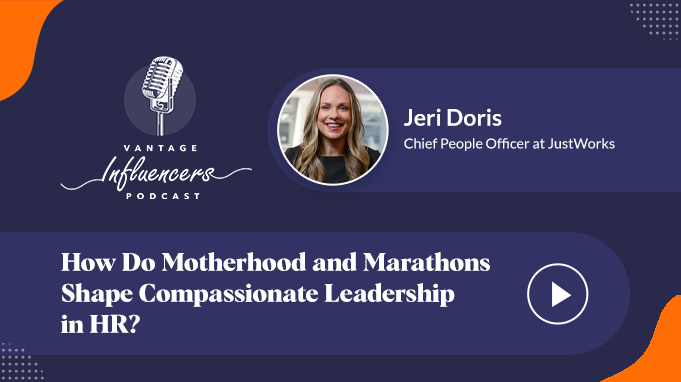
How Do Motherhood and Marathons Shape Compassionate Leadership in HR?
Episode Overview
Jeri Doris argues that leadership consistency is not an abstract virtue but a trained habit, one built the same way marathon training builds endurance: through repetition, recovery, and showing up the same way regardless of mood or pressure. Across this conversation, she connects the physical discipline of long distance running and the emotional demands of parenting to the everyday decisions HR leaders make when a team is watching how they show up, not just what they say.
She also pushes back on the idea that compassion and high performance sit at opposite ends of a spectrum. For Jeri, clarity is a form of kindness, and creating psychologically safe teams is inseparable from holding people to a real standard. The discussion moves through peak performance research, boundary setting practices, and the vulnerability required to lead authentically, closing with a candid reflection on what it means to give yourself grace while juggling caregiving and an executive career.
Episode Highlights
- Marathon training and motherhood share one core lesson: consistency, not intensity, is what makes people trust a leader's decisions.
- Periods of stress need to be followed by periods of recovery, a principle from peak performance research that Jeri applies to boardrooms as much as race day.
- Kindness and clarity are not opposites. Jeri treats direct, honest feedback as one of the most compassionate things a leader can offer.
- Protecting boundaries, like a fixed cutoff for after hours messages, is what lets a leader show up fully present in the moments that matter.
- Sharing personal struggles openly, rather than projecting constant strength, gives teams permission to be human and builds a psychologically safer culture.
- Naming personal values explicitly gives leaders a consistent way to evaluate decisions and creates trust that compounds over time.
About the Guest
Jeri Doris, Chief People Officer at Justworks
Jeri Doris is the Chief People Officer at Justworks, a leading HR technology company, where she oversees people strategy, workplace culture, and DEIB initiatives. A certified Executive Coach and seasoned global HR leader, Jeri has developed people strategies for over 70 companies worldwide, spanning high growth startups and Fortune 500 organizations. Her career began with HR consulting in Tokyo and an MBA, followed by leadership roles at GE, Deloitte, Groupon, Rakuten, Delivery Hero, and The Aspen Group, before she joined Justworks in New York City. With a focus on creating inclusive, high performing workplaces, Jeri is recognized for her expertise in global people strategy, employee engagement, and benefits innovation. She is a passionate advocate for mental health, women in leadership, and the evolving future of work, and outside of the boardroom she is a dedicated marathon runner and mother.
Host
Riha Jaishi, Vantage Influencers Podcast Host
What You Will Learn
- How marathon training and motherhood can build the discipline that shows up in day to day leadership decisions.
- Why periods of stress must be followed by periods of recovery to sustain long term peak performance.
- How to hold high performance standards while leading with compassion and kindness.
- Practical ways to set and protect boundaries as a leader, from communication cutoffs to calendar design.
- Why sharing your own struggles as a leader can create a more psychologically safe, humane culture.
- How naming your personal values can give you a consistent framework for decision making and building trust.
Key Topics & Timestamps
| Timestamp | Topic |
|---|---|
| 00:00 | Cold open and episode introduction |
| 01:20 | Jeri's global HR career journey, from Japan to Chief People Officer at Justworks |
| 04:25 | How motherhood and marathon training built Jeri's leadership consistency |
| 08:50 | Applying endurance and routine to high pressure HR situations |
| 12:35 | Staying compassionate without lowering performance standards |
| 16:35 | Setting boundaries and protecting personal energy as a leader |
| 23:00 | Creating psychological safety through authenticity and vulnerability |
| 25:45 | Building a humane culture across the wider organization |
| 31:55 | A message for women balancing leadership and caregiving |
| 37:05 | Closing thoughts and sign-off |
Full Transcript
Click to read the full episode transcript
Welcome to the Vantage Influencers Podcast. This podcast is sponsored by Vantage Circle, the simple and effective recognition platform for employee engagement.
Riha Jaishi: Hello, everyone. Welcome back to another episode of the Vantage HR Influencers Podcast. I'm your host, Riha, and today we are exploring a powerful and deeply human topic: how motherhood and marathons shape compassionate leadership in HR. Leadership today is not just built in boardrooms. It is shaped by lived experiences, resilience, discipline, empathy, and endurance. The journey of motherhood builds emotional intelligence in ways no training program can, and the discipline of marathons builds mental strength that directly reflects in leadership style. When these worlds come together, they redefine what compassionate leadership truly means in the workplace. To help us explore this unique intersection, I'm joined by Jeri Doris, Chief People Officer at Justworks. Welcome to the show, Jeri. It's a pleasure to have you with us today.
Jeri Doris: I'm happy to be here. Thanks so much for having me.
Riha Jaishi: We are equally delighted. Okay, so to kick things off, can you briefly take us through your professional journey so far? We are eager to learn about your journey.
Jeri Doris: Happy to. I usually jokingly say I have supported or touched every part of the world except for Antarctica, and there's no time yet for that to happen. I've had the privilege, and honestly the joy, of having a really global career. But my beginnings start in a really tiny town in East Texas, and I was always that person who was really curious about the rest of the world. I was a high school exchange student in Japan, and that unlocked this desire to get to know people on a different level and really learn more about the world.
After undergrad, I took one of those career counseling tests, the kind that tells you what career you should take. Mine was quite funny. It came out HR manager, consultant, or a rabbi. I obviously did not take the rabbi route, though I guess there's still time for that. I did the second best thing: I combined HR and consulting and found a job in Japan. That really unlocked a lot of my curiosity and also gave me an understanding of where I can make the biggest impact at an organization.
That start doing HR consulting in Tokyo led me to some really big companies. I did my MBA, landed at GE, and went to Deloitte. Those two experiences gave me an understanding of what great looks like when it comes to the employee lifecycle, and also just leadership and how we can invest in our people.
I've spent the broader part of my career since then in global scale-ups, from Groupon to Rakuten, which is a Japanese company, to Delivery Hero, which is based in Europe and is one of the largest food delivery businesses in the world. I've helped these organizations scale, thinking about their people processes but also scaling in a way that is sustainable and smart. It's been a lot of fun.
Little did I know that in my desire to see the world, I would end up in a lifelong career within the people space, but I am so grateful for it. I currently serve as the Chief People Officer at an HR tech and services company called Justworks, based here in New York City. It feels like a full circle moment where I'm able to apply both my subject matter expertise and my commercial curiosity to helping solve and serve our small business partners.
Riha Jaishi: That's such an inspiring journey, Jeri. Thank you so much for sharing your experience.
Jeri Doris: My pleasure.
Riha Jaishi: Okay, so now, with your permission, I would like to delve into our topic further. Shall we?
Jeri Doris: Yeah, likewise. Happy to.
Riha Jaishi: Okay, great. So, Jeri, how have motherhood and marathon training reshaped the way you lead, not in theory, but in the decisions you make every day?
Jeri Doris: Yeah, I mean, I think both motherhood and marathon training are incredibly humbling. I aspire to be great at both, and I am neither great at either, but I always desire to do both. I think the interesting parallel between the two is the consistency in the way you approach problems and the consistency in the way you show up as a leader.
Anybody who has trained for a marathon knows that if you ask what makes a successful training cycle, it is truly just consistency. When I think about what makes a great leader, it's often in those moments where people expect you to be consistent, in how you're showing up and what they can expect from you. We've all probably had leaders where you walk into the room and think, I wonder what their mood is like today. I think marathon training and motherhood have given me the ability to be thoughtful and intentional about how I show up, by taking a consistent approach to both my decision-making and my leadership.
Riha Jaishi: That's such a fresh and interesting approach, Jeri. I really like how you drew that parallel between motherhood and marathon training around consistency. That really is key, particularly in leadership.
Jeri Doris: I just want to add one more thing on that. I think so many of us in the people space have gone through periods of really understanding what peak performance looks like. Early in my career, I think it was my first true C-level role, I was at Delivery Hero, and the company was going through a massive scale-up. We were scaling the business from about 5,000 people to 30,000, moving into 70 different markets across the world. I had young babies at home, a nine-month-old and a daughter who was about three and a half at the time. It was hard. It was really hard. I remember thinking, how do I be great on all fronts?
That took me through a period of doing a lot of research on how amazing professional athletes, or just people we all aspire to be like, sustain these levels of greatness and peak performance. If I draw the parallel with marathon training, and with us as professionals in general, I did a lot of research around peak performance: the environment, the routines, the consistency, how you show up as your best self. For me, I was trying to create an environment where I could show up in a way I was proud of. Going back to that research on peak performance, there's some really great material out there: periods of stress need to be followed by periods of recovery. That is how you sustain peak performance. It's not about being at your best all the time. It's about being really thoughtful and intentional about that balance. It goes back to consistency, and how that comes through. That has really stuck with me, and I coach other leaders on making sure their routines are consistent, so that in periods of stress, they know how to be consistent too.
Riha Jaishi: That's really inspiring, Jeri. Thank you. Now, as you know, both roles demand long-term endurance. So how has that endurance shown up in your leadership during high-pressure HR situations?
Jeri Doris: Yeah, I mean, I think it goes along with establishing those routines. I think success is often found in the tedium. If you ever talk to a runner, and Riha, I don't know if you run, we love to talk about running. Nobody really cares, but we love to talk about it. I think the realization is that it's not the actual race itself, it's the miles you put in when nobody else sees them, that helps you in moments of stress. That's how it manifests within marathons, and obviously race day is a celebration. But I often joke that in periods of high stress within companies, whether it's fiscal year planning, acquisitions, or a reorganization, and you're in these marathon meetings (literally, excuse the phrase), you're in all-day meetings, and you just have to be consistent and continue to show up and stay locked in.
I really find that the routines, being able to center myself, and having that same meditative mindset that I take when I'm doing really long runs, is something I apply to meetings. I often joke with my colleagues that I'm really glad I'm a marathoner on days like this, because it's so common. We all complain about being in endless meetings, but often they're incredibly productive. It's about being able to show up in moments of intensity and be consistent. It's the moments you have outside those rooms, your routines, your boundaries, your prep, that determine how you show up. What does your prep look like, so that when it comes to race day, or these moments of intense pressure, you can be consistent, because your body and mind are already ready for it? You're able to show up in a very centered way. I know we all have moments where we don't show up in a centered way, but it's about how you reflect on that, so that when you do have moments of stress or high pressure, you can be consistent. I'm a believer that everything you do outside of that room plays a part, the food you eat, the sleep you get, what you consume on a daily basis from a reading or visual perspective. That's all fuel for how you show up in that room. For me, it's been a journey to apply similar, for lack of a better term, nutrition strategies to how I show up in a boardroom or an executive meeting. I take those same principles so that when I have high-pressure moments, I'm consistent.
Riha Jaishi: Jeri, I really feel that your experience here highlights that when we talk about endurance, it is not just physical or mental, but more emotional, right?
Jeri Doris: Oh, I mean, totally. I'm in the business of people. People don't come to us often when things are going well. You have to be consistent even from an emotional standpoint. It's okay to show emotions, but it's about consistency in those emotions and understanding how to regulate them.
Riha Jaishi: Definitely. Absolutely. Okay, now, as we move on, how do you stay compassionate, Jeri, without lowering performance standards, something HR leaders generally struggle with?
Jeri Doris: Yeah, I mean, gosh, I'll tie this back to... I think, again, it's one of those things where one of my core values is kindness. People meet me and think, oh, you're really nice. Kindness can manifest in a lot of different ways, but my fundamental belief is that I didn't wake up to be mediocre, and I hold those same standards with my team and my peers. I've often reflected on this: our job as a leader is to get people in the boat, and when they look to the left and the right, they're excited and motivated to be in that boat. But as a leader, we also have an expectation of exciting and motivating the people in that boat. For me, that often shows up as compassion or kindness, but that doesn't mean I shy away from hard conversations. I believe kindness can be in the form of clarity. Kindness is clear, and clarity is kind. I find that having direct conversations, being clear with people about expectations and how they're showing up, and really having a coaching conversation, can be the most compassionate thing you can possibly do.
I think most leaders know that hard conversations are part of the job. Earlier in my career, when I've had to have these conversations, I remember the look of relief, and the openness that came from having a conversation about when things aren't working out. That has been one of the most compassionate and kind things I've possibly done. So I don't lean away from those conversations, I definitely dig in, because we're leading by example. I also believe that expecting people to do great work is just clarity, and clarity is kind.
Riha Jaishi: Well said, Jeri. This really shows that compassion and kindness don't dilute performance. They actually help in sharpening or building that accountability and trust.
Jeri Doris: Totally. For me, again, I go back to clarity is kind, but my team knows exactly what to expect. My peers know exactly what to expect. There's a level of trust you build in those moments, and in tiny little moments too, but that goes back to consistency. If you're consistent, people are going to continue to trust you. I think there's a misconception sometimes that compassion and high performance are at different ends, when in reality it goes back to being clear about expectations. As a people leader, I get to do the best part of the job. I get to support the best part of the business, and being able to create spaces... I often think about how I would explain what I do for my job to my mother or my kids, and I say I help create spaces and an environment where people can do their best work. So I say to my team, I want you to reflect on your time here and say that was the best work I've ever done. What needs to be true for that to be true? Then we co-create what great looks like. If I'm consistent, and I'm compassionate with my feedback, and I'm honest with that feedback, both can be true. You can be compassionate and also demand high excellence, because you've co-created what that standard looks like together.
Riha Jaishi: Well said, Jeri. Okay, so, Jeri, both roles demand certain boundaries. How have these experiences influenced the way you set boundaries with your team and yourself?
Jeri Doris: Yeah. Motherhood is incredibly humbling. I'm sure most of our listeners have done a psychometric test, whether it's StrengthsFinder or whatever else. Empathy was one I always scored substantially low on. I jokingly say this, but I'm so grateful, on a number of levels, for motherhood, because it has highlighted where I've fallen short in not providing space for people to set boundaries so they can do their best work, because I've had to do it myself. I'm one of those people who, like many executives, are overachievers. We're trying to outperform, to get it done at any cost. You realize you cannot be great on all fronts at all times. It's just not possible, and it's incredibly humbling. Marathon training is also humbling. I'm mediocre at both, but I aspire to be great at both.
If I take the analogy with running, I used to never take rest days. I just wouldn't. But if you run, you know you need at least one or two rest days a week, and it's the same with any type of training. I've realized that recovery is absolutely essential, and it goes back to that research I did on what peak performance looks like. Peak performance needs periods of stress to be followed by periods of rest. Rest can be manifested by creating boundaries. I'll give you a basic example: my team knows that if they message me after 8:30, they're not going to get a response until the next morning. It's very early the next morning, because I'm an early-to-bed person, but I know I need to protect my sleep, because sleep is the ultimate recovery.
That may look different for different people. It might mean 15-minute walks. There are some great stories about Albert Einstein being an avid walker, and the same with Monet, two very different, amazing people, both finding their own periods of rest and recovery, and creating boundaries and space for that. Maybe that's think time, maybe that's just reading time, doing things that are mindless. But creating those boundaries and protecting them is so important. When I think about both motherhood and marathon training, recovery isn't optional, it's essential. I get that some parents might say, well, what if I have an infant, and there are weeks that are genuinely hard, but it's about not overexerting yourself and being able to create boundaries and hold them. I struggled a lot with overcommitting. I still do, I'm terrible at it, I overcommit all the time. It's about reflecting and realizing we can create boundaries and get good at them. That's also a kind thing to do for myself, applying the same kindness to myself that I apply to others. So boundaries are so, so important. It goes back to how I want to show up both at home and at work in a way I'm proud of. I'm often mediocre at both marathon training and motherhood, but I aspire to be great, and boundaries play an absolute key role in making sure I'm showing up in a way I'm proud of.
Riha Jaishi: Jeri, I really liked your perception on boundaries. I truly feel boundaries are necessary. You gave the example of your rest time and having a specific time to respond to people, and that should be respected. I really feel this kind of boundary helps protect your energy and focus directly on improving leadership quality.
Jeri Doris: Yes, for sure. I also say to people that you have to be thoughtful about the energy you're bringing into a room as a leader. Even being intentional about your calendar. I had to go through a period of asking which meetings don't give me energy, and how can I spread them out through the week so it's not back to back to back. As an executive, and earlier in my career often being the only one in the room who looked like me, representing a different part of the population, I needed to be really intentional about the energy I was bringing into the room. Often, people leaders are change agents, we're transformation people, so we have to be thoughtful and intentional about the energy we bring into that room. You have to protect it. Thinking about which meetings give you joy and which don't, and how you can spread them out and be intentional, even a 15-minute reset, or a 10-minute buffer, or even five minutes to do a cleansing breath before the next meeting. Within this space, we're often having really hard conversations, giving space to other people, and trying to create that safe space. That takes a certain amount of energy, and being cognizant of that is what allows you to be creative. I always say to my team, you can't give what you don't have. If your own cup is empty, you have to figure out what you're doing to fill your cup back up, so that when you walk into that room, you're not running on empty. What are you protecting to make sure your cup is full?
Riha Jaishi: Yes, that safe space, I guess that's the best way to put it, keeping that space for yourself, at least taking a break, is very necessary too.
Jeri Doris: For sure. I'll date myself a bit here, Riha. I spent quite a bit of my early career in Asia doing HR consulting, as I mentioned, but once I came back, I was in corporate America. Corporate America two decades ago was still trying to come to terms with how we bring... it was Sheryl Sandberg who talked about bringing your whole self to work. I remember you couldn't necessarily be human at work, and I thought to myself, the amount of energy it takes to produce a persona A and a persona B, your work persona and your home persona.
I remember how freeing it felt when a coworker said to me, just show up, remove the armor, and just show up. I think what he was doing was giving me permission to create that safe space. When I think about the spaces I try to create for my teams, being vulnerable and being authentic can't be held against somebody. You connect better, you're a better leader, when you connect. Creating those spaces goes back to what I said about my job: it's to create an environment where people can do their best work. They're not going to do that if they're worried about which persona to show up as. Creating that safe space is paramount as you think about the ingredients for doing your best work and reaching peak performance.
I call it safe space. My team will tell you I always ask about their personal lives, whether or not they're open to sharing. But to understand what's happening outside of work, I need to give space for that, because it comes into work regardless, since you're one whole human. I'm always thoughtful and intentional about the environments we create in our workspace, so people can do their best work. Often that manifests as creating a safe space, a safety of being able to be me and show up in a way that's authentic. Before I took this role, one of my mantras was: I am at my best when I am authentically me. If we take a moment and think about that as leaders, what is your authentic self, and how do you create space so people can be at their best? Often that's manifested in a safe space where people can be authentically themselves.
Riha Jaishi: Well said, Jeri. Okay, now, moving ahead, how do these lived experiences help you shape a more humane, psychologically safe culture in HR and the wider organization?
Jeri Doris: Yeah, I've discussed a lot of it so far, but let's go deeper. I often say I'm pretty transparent, overly transparent is probably the word I'd use for myself. I think being authentic and sharing as a leader, when things are hard and when you're going through tough times, is important. So often as leaders, we believe we've got to be the strong one, which is true, but that doesn't mean you can't show strength while being vulnerable. I think so often we believe that being vulnerable and authentic doesn't show strength, but in fact it shows courage. Both can be true.
I've been really intentional about showing up consistently, but also in times when I need to say, guys, my cup is empty today, I need to protect my peace, I've got stuff going on at home, and being able to share my own story gives people permission to create those spaces too, while also making sure I'm creating a culture built on consistency, that clarity with kindness, as well as grace. I've learned, as I said before, you can't give what you don't have, and motherhood has taught me how to show up with grace as much as I can, because I often don't give grace to myself. If I'm not giving grace to myself, how can I give grace to others? So I'm really intentional about creating those spaces, and about the fact that there are just periods that are hard, and being able to create spaces that are much more humane, where people can share.
You find connectivity in these moments where you can share experiences, because I find a lot of people are going through very similar things, even if it manifests differently. Being open to share your lived experiences gives people permission. If I connect with the people I lead, I'm going to be able to support them better. I have a hard time leading people I don't connect with, so I have to create a space full of trust, grace, and kindness. As a people function leader, we are whole-company leaders first and foremost. I often say I'm a business leader first who just happens to oversee the people function. I've talked about the boat and our role in it, but I also think about how we're amplifying the spaces we need to create, and how we show up as leaders within our own peer set, for those of us who are executives. What am I doing in a meeting that can inspire and motivate my peers to look at their own performance differently? I think so often as executives we miss that part, we think about the whole company, but we don't think about our own table. What am I doing to inspire and motivate, to create spaces so my peers can do their best work too?
As I think about creating something humane, leading by example, I share a lot of stories. I had parent-teacher conferences this week, so I showed up a little late, and anyone with kids knows there's a period every year where schools forget that we work. Sharing stories and making things more human helps people connect. We get so busy with transactional moments that we miss the chances to connect on a personal level. That goes back to the question about stress: when you have moments of stress and chaos, people go back to those moments of humanity, of knowing your kids' names, knowing what someone loves to do. I think we underestimate the ability to connect on a human level and how that translates in moments of high stress.
Riha Jaishi: You've made such an important point here, Jeri. I believe this psychologically safe culture isn't built through policies alone. It's through behavior, like you said, and your experience clearly demonstrates that personal values, when translated into the workplace, can have that necessary cultural impact.
Jeri Doris: Oh, totally. I lead with my personal values. That's how I evaluate my leadership, that's the barometer for how I operate, and I talk about them all the time. I talk to leaders about making sure the environments they create are congruent with their own personal values as well as the values of the company. I encourage anyone who hasn't done a personal values workshop to do one, there are lots of good worksheets out there you can use on your own. Knowing your north star, and how you evaluate and make decisions, is generally based on your own value set. Being clear about mine, for example, kindness, optimism, and growth, means I know how I show up, how I make decisions, and how I create environments are all built around those values. I'm super clear about it, and I think they're so important.
Riha Jaishi: That's great. Okay, now, Jeri, before we wrap this session up, do you have any message you'd like to give our listeners? What do you think this dual journey can send to women out there who are navigating leadership while juggling personal responsibilities?
Jeri Doris: Oh, gosh, yeah, I mean, I've said a lot of it already, but I do tell this story often. Anyone who knows me knows I'm probably a huge Brené Brown fan. I'm from Texas originally, and I just feel like I see myself in her so much, and I aspire to a lot of her leadership studies. When I think about the duality, I was reading one of her books at the time this story I'm about to tell was happening. It was during my first C-level role. I was working an insane number of hours, I had a young family at home, and I felt like I had to be perfect on all fronts. I felt like I was failing. We had just moved to a brand new country, Germany, with my entire family. I remember feeling like I was failing, but I was reading her book Dare to Lead. If you've read that book, she talks about Teddy Roosevelt's "man in the arena" passage, and she also talks about removing the armor.
I had a coworker, my CTO at the time, I don't know if he knows I tell this story, but I'm going to do it anyway. He said to me, unbeknownst to him that I was reading that book, "Jeri, you always show up and make sure everybody knows the work you're doing and how good you are. You can just remove your armor. You can just show up as you." I remember that being the first time I had permission to think, oh gosh, if I'm having a bad day, I can be okay with that. It was the permission to be authentically me.
I think so often, not to gender stereotype, but as a parent, or at least in my own journey, I felt like I had to do it alone. I hadn't had an example anywhere in my life of a partnership, of having a village. All the things I have now are absolutely paramount. I realized in that moment, one, I can show up as me, and two, what do I actually need to do myself, versus what can I outsource, what can I lean on others for, how can I ask others for help? For me, it was a permission to show up as myself, but also to ask for help and give myself grace. It was so important for me to take a moment and reflect on how I give myself grace, how I show up in ways that are me, and what I need to protect so I can be proud of how I'm showing up as a mom too.
I think so often we believe we have to do it all, and do it all perfectly, when in reality your kids often just want your time. So being able to create boundaries so that when I am present, I am fully present, and the same can be true at work. If I go back and do a full circle moment about everything we've talked about, creating those routines, those boundaries, those sacred moments, so you're constantly filling your cup, because whether you're a mom, an executive, a parent (regardless of whether you're a mother, father, or caregiver, because I think right now a lot of us are shouldering both parenting and caregiving responsibilities), your cup often gets empty. Understanding how to create and protect the duality of being both a caregiver and an executive, and understanding that your cup matters, and the grace you give yourself, will show up in ways that are so, so important. Hopefully that makes sense to everybody, and if you hadn't given yourself permission to have grace, hopefully that resonates with someone today.
Riha Jaishi: That's such a powerful message, Jeri, and a much-needed one, about becoming authentically you, seeking help, and creating boundaries. I think these are important pointers that all the women out there juggling multiple responsibilities, particularly juggling parenthood and being an executive, will be able to connect with. That's quite a strong message. Thank you.
Okay, so, Jeri, we have finally come to the end of our podcast session. Before we wrap up, first of all, I would like to thank you for joining us today and sharing your incredible insights. It's been more than a pleasure hearing your wonderful perspective on the role of motherhood and marathons in shaping compassionate leadership in HR. We truly appreciate your time and expertise, and I'm sure everyone tuning into this session is inspired by your expertise and walking away with a wealth of information to ponder.
Jeri Doris: Thank you. It's been my pleasure.
Riha Jaishi: Thank you once again, Jeri. And to our listeners, thank you for tuning in. We hope you found today's conversation as enlightening as we did. Until next time, take care, and we'll see you soon.
Thanks for listening to the Vantage Influencers Podcast. Be sure to subscribe on Apple Podcasts, Spotify, and our Vantage Circle YouTube channel for the latest episodes.
FAQ
What is the connection between marathon training and leadership consistency?
Jeri Doris explains that marathon training teaches you that a successful cycle depends on consistency, not intensity. She applies the same principle to leadership: teams trust leaders who show up the same way regardless of mood or pressure, so she treats her routines, recovery, and daily habits as the foundation for how she leads in high-stakes HR moments.
How can HR leaders be compassionate without lowering performance standards?
Jeri's approach is to treat clarity as a form of kindness. She holds her team to real standards while having direct, honest conversations about expectations, arguing that clear feedback, even when it is hard to deliver, is one of the most compassionate things a leader can offer. Compassion and accountability, in her view, are built together rather than traded off.
Why are boundaries important for people leaders?
Jeri points to peak performance research showing that periods of stress must be followed by periods of recovery. She protects her own boundaries, such as a fixed cutoff for after hours messages, and encourages her team to do the same, arguing that recovery is not optional if leaders want to sustain their energy and judgment over time.
What is Jeri Doris's advice for women balancing leadership and caregiving?
Jeri encourages women to give themselves permission to ask for help and to extend the same grace to themselves that they extend to others. Drawing on her own experience moving her family abroad during her first C-level role, she stresses that protecting time to be fully present, at work and at home, matters more than trying to do everything perfectly on every front.
Related Reading
Also listen on