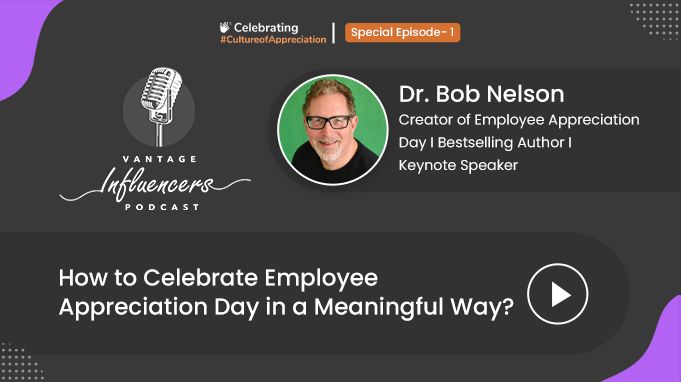
How To Celebrate Employee Appreciation Day In A Meaningful Way?
Episode Overview
Dr. Bob Nelson returns to the Vantage Influencers Podcast to explain why so many year-end and appreciation moments end up feeling forced, even when the intentions behind them are good. His central argument is that recognition loses its impact when it becomes a repeat performance: the same holiday party, the same across-the-board gift card, the same generic thank you delivered simply because it is that time of year again. Nelson, who created Employee Appreciation Day and has spent his career studying workplace motivation, says the fix rarely requires a bigger budget. It requires context, naming the specific project, person, or moment that made the contribution matter, and saying it with genuine feeling rather than reading from a script.
His sharpest, most concrete example comes from his own management experience. With sixteen direct reports, he once spent a couple of hours writing each person a personal note describing exactly how they had excelled that year, and two employees were moved to tears reading it. He backs that anecdote with workplace research showing that employees in a genuine recognition culture feel roughly five times more valued, are about six times more likely to recommend their employer to others, stay with the organization at close to seven times the typical rate, and report eleven times higher commitment to the company's mission. He also points to WD-40, a company he has worked with, as a real-world example: engagement there runs near 93 percent, about three times the average company, because recognition is built into daily practice rather than saved for a single day.
Episode Highlights
- Recognition that just repeats last year's format, the same party, the same flat-rate gift card, starts to feel routine rather than special, even when the intentions behind it are good.
- Personalizing a moment costs little extra money: a short, specific note about someone's actual contribution can matter more than doubling a gift card's value.
- Adding real context, what someone did, why it mattered, and how it made you feel, turns a generic thank you into recognition people actually remember.
- Breaking a large gathering into smaller, team-level recognition sessions lets managers speak to specific work instead of vague generalities.
- Letting people choose their own reward, or pass along a token of thanks to teammates who helped them, spreads appreciation further than a single top-down award.
- Employees at companies with a genuine, everyday culture of recognition report feeling far more valued, more likely to recommend their employer, and more likely to stay for the long term.
About the Guest
Dr. Bob Nelson, Creator of Employee Appreciation Day, Bestselling Author
Dr. Bob Nelson, who invented Employee Appreciation Day 25 years ago, is considered a leading advocate for employee recognition and engagement worldwide. He has sold over 5 million books on those topics, including 1501 Ways to Reward Employees, The 1001 Rewards & Recognition Fieldbook, 1001 Ways to Energize Employees, The Management Bible, 1001 Ways to Engage Employees, and his book Work Made Fun Gets Done! Dr. Bob has been featured extensively in national and international media, including The New York Times, The Wall Street Journal, CNN, CBS 60 Minutes, MSNBC, ABC, PBS, and NPR, on how to motivate today's employees. He has presented on six continents and worked with 80 percent of the Fortune 500 companies.
Host
Susmita Sarma, Vantage Influencers Podcast Host
What You Will Learn
- How to tell when a recognition program has become perfunctory, and what to change first
- Why adding specific context to a thank you makes it more memorable than increasing its dollar value
- How to structure team-level recognition moments so managers can speak to real contributions
- Ways to let employees personalize or choose their own reward instead of a one-size-fits-all gift
- How to extend recognition beyond the employee to the people who support them, at work and at home
- What the data says about how a genuine recognition culture affects engagement, advocacy, and retention
Key Topics & Timestamps
| Timestamp | Topic |
|---|---|
| 00:44 | Welcome back and catching up with Bob Nelson |
| 02:04 | Why year-end recognition programs often feel forced |
| 07:09 | The biggest myth about employee recognition |
| 09:01 | The power of a personal, handwritten note |
| 10:05 | A gift with a twist: cash to spend on yourself |
| 11:55 | Personalized recognition versus big, generic ceremonies |
| 13:23 | A memorable (and funny) mystery gift exchange |
| 14:46 | Reinventing the holiday party as a casino night |
| 16:21 | Stretching the budget with executive-donated prizes |
| 18:04 | Why rewards that include family matter more |
| 18:57 | Letting recognized employees honor their own team |
| 20:56 | The research behind a true culture of recognition |
| 24:07 | WD-40's 93 percent engagement story |
Full Transcript
Click to read the full episode transcript
Welcome to the Vantage HR Influencers Podcast. This podcast is sponsored by Vantage Circle, the simple and AI-powered rewards and recognition platform for employee engagement. As the year wraps up, it's the perfect time to recognize the incredible efforts of our team members. But let's be honest, so many year-end recognition programs can feel a bit forced, right? You know, the ones that feel like they're just ticking a box. So today we are going to talk about how to make those moments actually meaningful, how to create recognition that feels authentic, memorable, and maybe even a little fun.
Susmita Sarma: Hi everyone, I'm Susmita, here for the show, and I'm thrilled to welcome you back to another exciting episode of the Vantage HR Influencers Podcast. Joining us today for the second time is the one and only Bob Nelson, a best-selling author of over five million copies, a keynote speaker, and an all-around expert on employee engagement and recognition. Bob, it's so great to have you back. How are you doing?
Bob Nelson: I'm doing excellent. Yourself?
Susmita Sarma: I'm fine too. And just to start, what do you typically do around this time of the year?
Bob Nelson: This time of the year? I guess this is when most companies start looking to wrap things up. If there's a time that people do recognition, and a lot of companies don't do it very well, it's usually year-end, maybe along with a bonus or a gift of some type. So that's kind of the moment, and there's advice we give people to make that more effective in their organization. I hope we can talk about that some.
Susmita Sarma: So great to hear, Bob. Now let's dive right into our discussion. One of the things I know you are passionate about is making employee recognition feel genuine. So let's start with this: many year-end recognition programs often feel a bit forced or even insincere, despite the good intentions behind them. What do you attribute that feeling to, and what can leaders do to shift their approach and make these programs feel more authentic and meaningful for their teams?
Bob Nelson: Great question. For a lot of companies, it's done as a formality at the end of the year: we have to have a holiday party, we have to do a gift exchange, the same thing we did last year and the year before. That tends to make it less special. I'd say if you could put a little thought and effort into customizing the recognition for the group or the individuals involved, that would go a long way further than just saying, "we're all celebrating because it's the end of the year and we need to have a holiday party." Any party, unless it's specifically to celebrate the completion of a goal or some kind of milestone, if it's just a gathering, a potluck, because it's the holidays, then you're already missing the point a little. But you can save it by making sure you do something more individualized within the context of that celebration.
If you do have a potluck, for example, I'd certainly ask whoever is running the event to have a top manager say a few words about the significance of the year and what the team achieved, and call out the people who helped make that possible. That's a good use of any kind of gathering, including a holiday get-together. Where possible, single out individuals or departments who have stood out and describe what they accomplished. So if there's preparation to be done, it's probably in prepping the leader who's going to speak, with a summary of the highlights for the company, department, or people, and giving them names and specifics about the projects and what distinguished each person's success.
That's often the missing ingredient in the perfunctory holiday party, where people are just sharing a meal and maybe doing a gift exchange. Bring it back to context: all recognition is more powerful when you explain why it was significant. Essentially, you're saying, "I saw what you did." A lot of the time, people don't know what it was that got their manager's attention. Say, in your own words, why you value that, and then explain why it's so important, how it helped the team meet its goals for the year, or how it shows commitment to a value like teamwork or collaboration. If you really want to leave a mark and reach people's feelings, present the evidence, things you saw, heard, or read that told you success was achieved, and then make it impactful by bringing your own emotions into it. Say something like, "This is how it makes me feel, so proud of this team for the work they've done together. We had some challenging times, but we pulled through, and we couldn't have done it without everyone having the attitude of being in it together." That kind of emotional charge gives more meaning to the recognition. It's not just words; it's context rooted in real success, and the feelings make it personal, coming from a respected leader.
Susmita Sarma: That's a great insight, Bob, and I think there's a lot of truth in that. When it comes to employee recognition, especially around year-end, there's often pressure to do something big or extra special. But there seems to be a myth that holds companies back from getting it right. In your experience, Bob, what's the biggest myth about employee recognition that continues to be perpetuated, and how does it prevent companies from truly nailing it, especially with those big year-end recognition efforts?
Bob Nelson: Sure. It ties into what I said earlier: if we're basically doing what we did last year, and the year before that, it's not going to be very exciting to anyone. You're just going through the motions, so you have to shake it up a bit and make it more significant, more meaningful, more fun, more special.
Instead of just saying, "last year we had a cafeteria serving dinner, this year we'll have it plated," which isn't really going to make a difference, use the same opportunity to ask each of your leaders to write a note to each person who reports to them. In that note, they go over the specifics of how that person excelled over the last year, in their own estimation, and give it to them personally, maybe at the holiday get-together. That has a lot more significance. I've done that several times myself. At one point I had sixteen people reporting to me, and it took maybe a couple of hours to write something thoughtful for each person, thinking about the interactions we'd had over the past year and the projects and successes they'd had. Two of the people I gave those notes to actually cried. It was very moving to them that someone had noticed what they did during the year and thought highly of them, not just for what they helped the company achieve, but as people.
So the thing that really makes recognition meaningful is adding that personal touch, that individualized aspect. You're not going to get that by going from a twenty-five dollar gift card to a fifty dollar gift card; it's still a gift card, and everyone gets one. That sameness means you're not distinguishing performance, unless you frame it in the context of the team working together and give real examples of how that played out. If everyone just gets the same thing on a flat budget of thirty or fifty dollars a person, it feels tired and empty. You could at least add some fun to it. One thing I learned while working with the Blanchard companies is that for the holidays, we'd give every employee fifty dollars in cash and ask them to pair up with someone they didn't know well and go buy something for themselves, not for their kids or spouse, which is what people usually spend holiday money on, but something for themselves.
Afterward, people would come back and share the experience, having had fun getting to know a colleague better while doing it. When people came back, they'd share what they bought and why, and it was just a lot of fun. That camaraderie, from sharing stories and getting to know each other, is night and day compared to just handing out gift cards. It has much more impact when you build in an activity like that, along with the personalization of letting people choose for themselves. Whenever someone gets to choose what they want, it's more motivating than if you decide for them, even if what you decide is something nice. It can be more meaningful with less money if you put some thought behind it.
Susmita Sarma: Exactly, that's interesting, and I completely agree that sometimes the simplest gestures are the most meaningful. If I asked you to choose between two very different types of recognition, a big public award ceremony with all the bells and whistles, versus something quiet, personalized, and customized, like a genuine thank you from a leader along with a thoughtful gift, I'm sure you'd pick the personalized option, right?
Bob Nelson: Yes, a moment like that, especially if it's tied to the company's success over the last year, would be great. But just going through the motions of a holiday party isn't going to make people feel special, and it's not that hard to add something that brings out the specialness. Even within the context of a large company gathering, you can have each manager break out into a smaller group with their own team for a personal recognition session, since managers know the details of what their people have actually done. You could take an hour for that, with everyone dividing into their teams. Or if you're doing something like a gift exchange, you can add an element of play to it: if someone gets something and wants to swap it with someone else, once they've shared what they got, they can trade. That adds a whole new, fun dynamic and generates conversation about what people received. One year at my own company we did a mystery gift exchange, and the mystery gift I opened turned out to be a box of hissing cockroaches. It was funny once we figured out that the person who received my gift in return kept lizards and needed to buy special, and quite large, cockroaches to feed them. I gave it back to him after the meeting, and it was certainly funny at the time.
Susmita Sarma: I'm sure that has a bigger, longer-lasting impact on employee motivation and their sense of being valued, especially when you make it memorable and personal.
Bob Nelson: Right, giving individual feedback about what someone has actually done is what people hold onto, the same way they hold onto a written letter. That's something they can take home and share with their family, save in what I call a "victory file," and on a bad day at work, they can go back and read some of the comments they've received, not just from the holiday party but throughout the year, and use that to get themselves re-engaged with the job.
Susmita Sarma: Great ideas, Bob. So recognition really doesn't have to come with a hefty price tag. You've seen tons of recognition programs in your career, Bob. Before we wrap up, do you want to share any unique, creative, or out-of-the-box ideas you've encountered?
Bob Nelson: Oh boy, let me think of some beyond what I've already shared. One that comes to mind: my wife's company was planning a Christmas party, and she told me what they had in mind, which was pretty standard, a hotel venue, a nice spread, and a sit-down dinner together. I told her we could do better than that, and she took it back to her company, and they said, "okay, you're on." So what we did was take all the furniture out of our house and turn it into a casino night. There was gaming and mingling instead of a heavy sit-down meal where you're stuck next to the same person all night, so people were walking around and the food was more snacks, nuts, and finger food. That let us stretch the budget a long way, because it didn't cost as much as a sit-down dinner with appetizers, which meant we could put a big chunk of the budget toward door prizes. It turned out that about one in every three people who attended, and it was a couple hundred people, received some kind of door prize.
You can have fun with the prizes too, instead of just handing out a flat cash amount. I went to the company's executives and asked each of them to put up something of personal value that could be shared with employees. For example, if an executive has a cabin they only use a couple of weeks a year, they could offer someone a week at the cabin. Or if another executive has a boat, they could offer the winning team a trip out on the boat with them at a mutually convenient time. That makes it personal and extends the experience beyond the event itself, letting employees connect with company leaders in a different way. I know companies that have done things like that and it's become legendary, something employees look forward to for years. So again, it's about personalizing it, in this case by tapping into the executives and giving them some ideas, so it becomes something fun and exciting for them too. If an executive likes golf, for example, they could offer a golf outing to the winner.
I also believe in giving people choices where you can, and in giving things that can be shared with loved ones and family, since the holidays are a family time. It's much more meaningful, for instance, to give the top salesperson the ability to take their family to Disneyland, which might be a lot closer to home and cost less, than to send them on a trip to Hawaii without their spouse or family when they already travel all the time and may be dreading another trip. It won't cost as much, but it will be far more meaningful, because you're also paying back the people at home who support that employee. Including or thanking the people around an employee is another way to stretch what you have.
Here's another idea I've seen that's quite good: when you honor someone, you can also let them honor somebody else. Going back to the sales example, the salesperson is already going to get more money for hitting their sales goal, but within that recognition you could also give them something like a Starbucks card that they can pass along to people on their team who helped with the proposals that made the sale possible. That sets them up to thank and honor the people they worked with over the past year, instead of taking those people for granted, which matters because those people may not be as excited to help again next year otherwise. So it's about spreading the recognition, making it personal and individualized, and then letting that effort be shared in interesting and creative ways.
I'll add one more thing: this applies throughout the year too, not just around the holidays. If someone receives a letter of compliment from a customer, you can post it on a wall in the building, or have an executive write a note thanking the person for the great job they did with that client. Those are simple ways to extend the power of recognition, and none of it needs to be tied specifically to the holidays.
Susmita Sarma: All these creative ideas make a huge difference, right, always?
Bob Nelson: Well, if you can go beyond doing this for just one period of the year and really create a culture where recognition is happening all the time, that's when it becomes part of the culture, which I define as "the way we do things around here." You get to a point where, if you ask anyone, they'll say, "oh yeah, we always take time to call out excellence, to thank people for a good job, to do a spontaneous celebration, to think of someone at the start of a meeting," and that becomes something leaders are doing constantly within their own sphere of influence. When you reach that point, it becomes part of the organizational advantage, a genuine culture of recognition that everyone feels is part of who that organization is.
There's research showing that companies with a true culture of recognition, where people are thanked when it's due for good work, have employees who feel roughly five times more valued than employees at companies without that frequency of recognition. Those employees are also about six times more likely to act as brand ambassadors, meaning they're excited to tell friends, neighbors, and relatives about where they work. They're about seven times more likely to stay with the organization for their careers, which matters a great deal given how short the supply of skilled labor is right now, so this becomes a real tool for retention. Other research I've read found that this level of impact can be reached with something as simple as making sure every employee receives around four instances of recognition per quarter, which is roughly the bare minimum, close to once a week. And for employees to feel recognized about once a week, the leader actually has to be recognizing people more often than that, more like every day, to get around to everyone. Finally, that same research found roughly eleven times higher commitment to the organization's mission in a genuine culture of recognition, one that ties recognition to the mission, to your clients, and to the societal benefit of the work, because I guarantee every company, whatever it sells, has some way to show the value it brings to society.
I'll give you an example: I've worked with WD-40, headquartered here in San Diego. Ninety-nine percent of their employees are excited to tell others where they work, genuinely excited, even though the company sells lubricant. Their engagement level is around 93 percent, compared to an average of about 30 percent at most companies this year, roughly three times greater than average, because they take this seriously and work at it. So really, any company could be there if they take this seriously and don't just repeat what they did last year and the year before, but bring some freshness, creativity, and fun to it.
Susmita Sarma: The results are always visible, and that's probably why organizations around the world are taking recognition so seriously nowadays. Thank you so much for sharing your insights and taking the time to be with us today.
Bob Nelson: My pleasure. I'm confident our audience will walk away with some practical tips and fresh ideas to make their recognition programs more impactful and meaningful. Thank you so much, it's a pleasure, and thanks for having me on.
Susmita Sarma: And to our audience, thank you for tuning in. We'll catch you next time.
FAQ
Why do year-end recognition programs often feel forced or insincere?
Because most organizations repeat the exact same format every year, the same holiday party, the same across-the-board gift or bonus, without connecting it to anything specific. Dr. Bob Nelson argues that recognition loses its impact when it becomes routine rather than tied to real context about what a person or team actually accomplished. Adding a small amount of customization, even within an existing event, restores the sense that the gesture is genuine.
Does more expensive recognition mean more meaningful recognition?
No. Nelson is explicit that upgrading a twenty-five dollar gift card to a fifty dollar one changes nothing if it's still identical for every employee. What actually moves people is personalization and specificity, such as a handwritten note describing exactly what someone contributed. He recalls writing notes to sixteen direct reports in a couple of hours, and two employees were moved to tears reading them.
How can leaders make a large group event, like a holiday party, feel personal?
Nelson suggests breaking a big gathering into smaller, team-level recognition moments where each manager can speak to the specific work their own people did, rather than one generic company-wide message. He also recommends briefing whoever is speaking with real names and project details ahead of time, and adding an element of choice or fun, like letting people select their own reward, rather than issuing the same item to everyone.
What impact does a genuine culture of recognition have on a business?
Nelson cites research suggesting that employees at companies with a true, everyday culture of recognition feel roughly five times more valued, are about six times more likely to act as advocates for their employer, stay roughly seven times longer, and show about eleven times higher commitment to the organization's mission. He points to WD-40, a company he has worked with, as an example: employee engagement runs near 93 percent, about three times the average company.
Related Reading
Also listen on






You might also like
 Employee Recognition
 Humanizing the Workplace Through Recognition
 Employee Recognition
 Scaling Culture Without Losing Its Soul as Recognition Drives Growth Inside and Out
 Employee Recognition