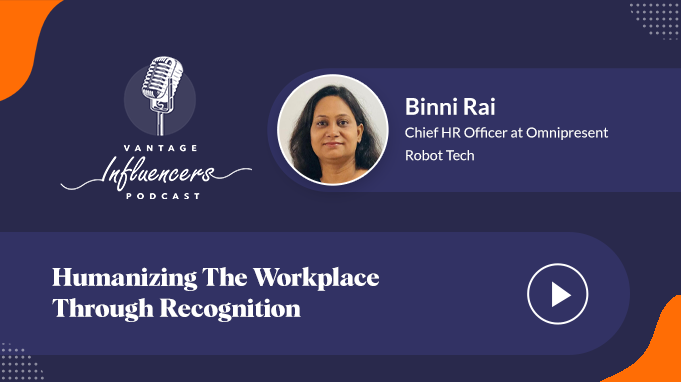
Humanizing the Workplace Through Recognition
Episode Overview
Binni Rai opens the conversation by asking what it actually means to humanize a workplace, and her answer starts before any policy or program: see the person, not the resume. She argues that recognition is the word to build around, not reward, because recognition lives ahead of rewards and speaks to the lived experience, emotion, and aspirations people carry into work every day. For Binni, an organization can only humanize the workplace once it treats recognition as a shared responsibility across the entire ecosystem, not a task assigned to managers alone. She distinguishes recognition, which she calls intangible and emotional, from rewards, which are tangible and structured, and walks through examples ranging from a Thanksgiving-style pause for gratitude to a simple deck of appreciation cards her own team used to spotlight specific behaviors like going above and beyond or being a strong collaborator.
The conversation then turns to why small, everyday moments of recognition often land harder than big annual awards. Binni explains that recognition delayed is recognition denied, and that being fully present, without checking a phone mid-conversation, matters more than any formal program. She connects this directly to psychological safety, describing how active listening and judgment-free spaces help introverted or overlooked employees feel seen, and points to onboarding buddy programs as one concrete way to build that safety early. She also names the biggest obstacle organizations face: information overload and constant urgency that push reflection to the bottom of the priority list. Drawing on a leadership habit she picked up from a Simon Sinek article about always asking who helped after a win, Binni closes by arguing that as recognition moves into hybrid, digital, and AI-assisted workflows, intention has to stay at the center or the human touch gets lost.
Episode Highlights
- Recognition should sit "before" rewards, rooted in seeing employees as full people rather than resources or roles.
- Humanizing the workplace means creating a psychologically safe ecosystem where people can speak freely and make mistakes.
- Small, everyday moments of appreciation, a quick thank you or a warm greeting, often build stronger emotional connection than annual award ceremonies.
- Delayed recognition is often experienced as denied recognition, making consistency more important than grand gestures.
- Buddy programs and judgment-free spaces for new hires help introverted or underrepresented employees feel included from day one.
- Information overload and constant urgency are the biggest obstacles to genuine recognition, and leaders should build a habit of asking "who helped" after every win.
About the Guest
Binni Rai, Chief HR Officer, Omnipresent Robot Tech
Binni's career spans across HR domains, including roles as an HR Generalist, HRBP, Head of CoEs (TA, C&B, Ops, Tech), and Head of HR in start-ups and fast-growing organizations across insurance, retail, e-commerce, and consumer internet. She is passionate about building people-centric workplaces and creating strategies that empower teams, streamline operations, and align HR with business goals.
Connect with Binni on LinkedIn
Host
Sanjeevani Saikia, Vantage Influencers Podcast Host
What You Will Learn
- Why recognition should be treated as an emotional, intangible experience distinct from tangible rewards
- How small, frequent moments of appreciation shape culture more than grand annual gestures
- Practical ways to build psychological safety for introverted and underrepresented employees
- What a four-principle workplace culture framework teaches about attitude, play, presence, and making someone's day
- Why intention matters more than tools when recognition moves into hybrid and AI-driven workplaces
- How leaders can turn "who helped" into a daily habit that reinforces collaboration
Key Topics & Timestamps
| Timestamp | Topic |
|---|---|
| 00:00 | Cold open and episode introduction |
| 00:58 | Binni's corporate journey across HR roles |
| 02:40 | What "humanizing the workplace through recognition" really means |
| 04:45 | Shifting recognition from a checkbox activity to a human experience |
| 10:14 | Why small, everyday moments of recognition matter more than grand gestures |
| 13:03 | Recognition's role in inclusion and psychological safety for overlooked employees |
| 16:09 | The most common obstacles to humanizing recognition at work |
| 18:45 | Keeping recognition human as work goes digital, hybrid, and AI-driven |
| 21:06 | Binni's closing message on putting recognition before reward |
Full Transcript
Click to read the full episode transcript
Welcome to the Vantage Influencers podcast. This podcast is sponsored by Vantage Circle, the simple and effective recognition platform for employee engagement.
Sanjeevani Saikia: You know, when we talk about work today, we often focus on performance, productivity, and outcomes. But somewhere along the way, the human side of work, how people feel, how seen they are, can quietly slip into the background. And although recognition is often mentioned as a solution, it's not always clear whether it's actually making work more human, or just more structured. That's why I wanted to start this conversation by unpacking what humanizing the workplace through recognition really means. And to help us with that, we have Binni Rai, Chief Human Resource Officer at Omnipresent Robot Tech. Hi, Binni, thank you so much for joining us today.
Binni Rai: Hi, thank you so much. Pleasure to be here today.
Sanjeevani Saikia: It's a pleasure to have you on the show. Thank you once again for joining us. Before diving into this topic, I'd be really glad if you could walk us through your corporate journey so far.
Binni Rai: Okay, so to start off, I come with two decades of HR experience, primarily across industries from insurance to e-commerce to media tech, retail, and now into a space tech organization. I've been in roles like HR head for emerging businesses. I was the head of tech transformation for Times Internet and shared services there. Currently I'm the chief HR here with Omnipresent. That's a brief about me.
Sanjeevani Saikia: Wonderful. Thank you so much for sharing your corporate journey with us, Binni. With your permission, I'd like to delve into today's topic. So to begin with, I think it's important to first pause and reflect on the bigger picture. We hear the phrase humanizing the workplace quite often, but it can mean very different things to different people. Sometimes it's about empathy, sometimes about flexibility, and sometimes about simply being acknowledged as a person beyond the role. And obviously, recognition seems to sit right at the center of all of this. But the question is, in your view, what does it truly mean to humanize the workplace, and where does recognition really fit into that bigger picture?
Binni Rai: Sure. So humanizing the workplace through recognition, and when we say recognition, the word itself, to me, is before rewards. As an organization, as a leader, we need to see the individual, not as a resource, or a resume, or maybe a role. We need to see that person beyond all of it, a person who comes with lived experience right from birth, who has been into different setups, who has their emotions, their aspirations, their dreams. So as an ecosystem, we need to first understand and acknowledge that fact, because one framework will not fit all. We need to understand where the person is coming from, what kind of emotion, what kind of requirement and need the person has. That's the first thing when it comes to humanizing a workplace through recognition. And once you've understood and acknowledged that, as an ecosystem we need to create space for the individual, where the person is free to speak, bring in their real self, and free to make mistakes. We create a psychologically safe place. That's what I think humanizing a workplace would be, in short.
Sanjeevani Saikia: Now building on that thought, many organizations do have recognition programs in place, but despite all of that, employees still say they don't always feel genuinely appreciated. Which makes me wonder whether recognition has become more of a checkbox than a lived experience, to be honest. How can organizations shift recognition from being simply a system-driven activity to a genuinely human experience? Because as of now, it is more like an objective that needs to be fulfilled rather than a complete system that helps people experience something better.
Binni Rai: So as I said, it is recognition, and I'm emphasizing the word recognition. When it is reward, people say it isn't fulfilling their aspiration, or that they aren't being catered to by the policy or the framework in place. But when we say recognition, it is something which is emotion, it is intangible. Recognition is about the vibe that you bring in as an ecosystem, and I'm using the word ecosystem, not leader or manager, because it's a co-owned thing. It has to be there in the culture for everybody to feel that vibe. What kind of energy do I bring in as a person entering a room? A warm greeting, or a warm thank you when somebody is helping you, makes a difference. That connection, that recognition, starts from there. The person naturally starts feeling more engaged, more positive. And when the person is feeling more heard and present in the ecosystem, collaboration and recognition happen. Then it has to be followed with rewards, which are the more tangible stuff. But recognition is purely your intangible, emotional thing, which people feel rather than count. And bringing that into your day-to-day habit matters. To give you an example, I want to point to Thanksgiving week, which is mostly celebrated in the US and Canada but is now celebrated more widely. It isn't just a celebration or coming together. It's an opportunity where people pause, reflect, and strengthen their connections. They pay gratitude, they strengthen human connection. When that happens inside an organization, it brings more positivity, something like a wall of fame, though if it isn't practiced in spirit, it may not yield that kind of result. I was also reading this book, and I've practiced some of it myself: The Fish Philosophy. It's a book by Dr. Stephen, Mr. Henry Paul, and John Christensen; the three of them wrote it together. It's based on the Pike Place Fish Market in Seattle, and it talks about four core principles. The first is choosing the right attitude, which says the situation or environment isn't always in my control, but I can absorb, understand, and respond intelligently. That's what we need to practice as an organization, as an ecosystem, and to do that we may need champions, role models, and a top-down approach depending on the organization's size and culture. The second principle is play, bringing the right energy and fun element into work the way it happens at that fish market. When you enjoy your work, you naturally collaborate and engage more. The third is making someone's day, through regular conversation and appreciation. In one of my organizations, we launched three or four types of appreciation cards. Each card carried a specific compliment and people could use them freely; something similar exists in a lot of online recognition tools too. One card would say thank you, another would say you went above and beyond to help me, and a third would say you're a great team player or you made a difference. Those things strengthen relationships and trust at the workplace. It isn't an immediate result, but it definitely adds a lot of positivity to the culture over time.
Sanjeevani Saikia: Really interesting. I think the principles you shared are fascinating, and I'm sure our listeners never knew about this. Even I didn't know about this, so it was a great learning. That actually leads me to the everyday reality of work. Not everyone is waiting for a big award or a public moment on stage; everyone is built differently. Often it's the small things, a message, a quick acknowledgment, a manager noticing effort, that stay with people the longest, and there are statistics to back that as well. So in your experience, do small, frequent moments of recognition have a bigger impact on making employees feel seen than grand gestures? And can you share examples of how everyday recognition shapes workplace culture?
Binni Rai: Sure. Smaller, everyday recognition makes a much deeper and lasting impact than any quarterly, half-yearly, or annual grand reward recognition. There are times it becomes just a tick in the box, as you also mentioned. But especially in today's world, where we're loaded with information and there's a notification every second, being there makes a difference, when somebody is with you, listening to you actively. Continuous recognition matters. In fact, one of the things I hear quite often is that when recognition is delayed, it is understood as denied. So it's very important that we do it continuously and regularly, and that as leaders, managers, or as an ecosystem, we're present. Because if I'm on my mobile, or reading something else, or listening to ten other conversations while talking to you, you will not feel valued. As an individual, I need to ensure that the person I'm talking to or dealing with feels seen, valued, and respected in my presence. That's very important. Recognition has to be continuous; people don't wait for the annual or half-yearly awards to feel seen. Even if someone is slightly disengaged, somebody coming up with a warm smile and a compliment can change their temperament. I've seen people transform, with the energy suddenly changing because of a positive compliment or a spot award. If somebody has really gone above and beyond the call of duty and supported someone else, acknowledge that, appreciate it, clap for that person on the floor. Organizations do a lot of wall-of-fame activities, but even more than that, just sitting or standing with that person and acknowledging their effort makes a real difference.
Sanjeevani Saikia: Shifting gears, I want to ask you how meaningful recognition contributes to inclusion and psychological safety, especially for employees who may feel overlooked, introverted, or underrepresented in organizations. The reason I ask is that at the end of the day, it isn't just about motivation; simply ticking a box so people feel motivated isn't the only thing. It also comes down to how people feel when they either get noticed or they don't. So what's the overall contribution of recognition to psychological safety?
Binni Rai: Okay, so here again, I may be repeating myself, but there's a lot of emphasis on being there and actively listening. It makes a difference when a person, even if they're an introvert, sees that I'm listening actively, without judging or practicing any biases. That creates a lot of space, a safe space, for an individual. And how do we do that? It has to be practiced across the organization, whether through a retention rate metric for leaders, or something like effective employee NPS, which directly captures employee experience and is proportional to customer experience, or by creating a space where an individual feels heard. Two examples come to mind. For a new joiner, a lot of organizations have structured plans for new-hire assimilation, and every stakeholder is held accountable for making sure the person settles in well. Larger organizations tend to have more structure and process around this; smaller organizations may not. But how a leader shows up and acknowledges someone's presence makes a lot of difference. A buddy program for a new joiner, for instance, creates a comfortable space where the person, without being judged, can ask any question, about the cafeteria, the way of working, or anything else. Giving people that comfort is very important, without the fear of judgment. That's the most important part: not judging people, and bringing everybody together irrespective of their background or education, because everybody is unique and brings something to the table. All the fingers aren't the same, but together they make a strong team.
Sanjeevani Saikia: Yes, absolutely, that was very well said. I have one other question for you. While humanizing the workplace through recognition, what are some of the most frequent obstacles that organizations usually face, the ones that keep coming up?
Binni Rai: Okay, so with this question, I'd say a lot of times we hear that we're loaded with work, priorities are different, and there's constant urgency with limited time on hand. Those things are really the biggest hurdles when it comes to genuine recognition. Reflection becomes optional instead of essential. To be present, you have to somewhere manage the load of information around you; every minute there's a notification, an email, a phone call, or someone approaching you. So the question is how do we navigate all of that and still be there, listen, observe, and acknowledge people's effort. I'll give you an example. Earlier this year I was reading an article by Simon Sinek, a bestselling author known for the book Start with Why, about one leadership habit that could transform 2026. It wasn't about big or grand gestures, but a smaller activity: whenever there's a win, your first response, without a second thought, should be to ask who helped. Whoever was part of that achievement should be acknowledged too, not just the key person who achieved it, but the entire team. Making that a habit, asking that question every time, builds a culture of trust and reinforces collaboration. People who might otherwise think "it's not my task" start collaborating more, because they know they'll also be acknowledged and valued as part of the achievement. It strengthens the culture. Small things, but they make a real difference.
Sanjeevani Saikia: Yes, absolutely. So we're arriving at the end of today's episode, but I need to ask you one more thing. As work becomes increasingly digital, with remote teams, hybrid setups, and now AI tools, it's easier than ever for recognition to become automated, templated, or even transactional. While technology can scale recognition, it also risks stripping away the emotional nuance that makes it meaningful in the first place. So as workplaces become more digital, hybrid, and AI-driven, what should leaders be mindful of to make sure recognition doesn't lose its human touch?
Binni Rai: This question really sums up everything we've discussed. I agree with you completely. Technology is there to amplify recognition, and it gives you a prompt when you're busy and might otherwise forget. But what matters most is the intention behind it. When the intentions are right, we'll do the right recognition, and the tone and context will fall into place automatically. It's obviously the tone that matters, how we come across as leaders, being there, listening actively, absorbing, and creating space, when the intention is right. We have to ensure that as leaders, we're creating that space even in a digital ecosystem. You have to stay continuous, stay in touch with your team, and show your presence to the people working for you. That's my summary: intention matters, because these are intangible, emotional things, beyond anything tangible or monetary. Recognition is directly linked to emotion, and emotion plays a much bigger role than we think when it comes to actually driving behavior, performance, or productivity.
Sanjeevani Saikia: True. You've answered each of my questions very beautifully. Thank you so much again for joining us. But before you leave, is there any thought or message you'd like to share with our listeners?
Binni Rai: I'd say, again, that intentions are really important. Flip the order: let recognition be at the top, and let rewards be fair, but recognition has to be the core. It can help drive a very positive culture and a highly productive environment; I've seen that transformation myself. Before we wrap up, I want to give one example. PIP, the performance improvement plan, is a very common HR term, and it usually comes with a negative connotation. But when it's done with the right intentions, to support an individual, I've seen people and organizations transform. So the one word I'd leave this conversation with is that intentions have to be right. When we carry that intention into our behavior, when we absorb and acknowledge, we're able to create a safe, psychologically safe, and productive workplace.
Sanjeevani Saikia: Binni, you've very beautifully highlighted the significance of intent, both in the previous question and in this closing message. I truly agree with that. Again, thank you so much for joining us. It was a pleasure to have you on the show. All the best.
Binni Rai: My pleasure. Thank you so much.
FAQ
What does "humanizing the workplace through recognition" actually mean?
Binni Rai frames it as seeing every employee as a full person, not a resource, a resume, or a role, and building a psychologically safe ecosystem where people feel free to speak up, bring their real selves to work, and make mistakes without fear.
Why does Binni say recognition should come before rewards?
Because recognition is intangible and emotional, tied to how a person feels seen and valued, while rewards are tangible and structured. Binni argues that a strong emotional foundation of recognition should exist first, with rewards following as reinforcement rather than substitution.
Do small, everyday moments of recognition matter more than big awards?
Yes. Binni explains that a warm greeting, a quick thank you, or someone noticing effort in the moment builds a deeper and more lasting impact than annual or grand recognition events, and that delayed recognition often feels like no recognition at all.
How can leaders keep recognition human as workplaces become more digital and AI-driven?
Binni's answer centers on intention. Technology can prompt and scale recognition, but leaders still need to stay present, listen actively, and show up consistently for their teams so recognition doesn't turn into an automated or transactional habit.
Related Reading
Also listen on






You might also like
 Employee Recognition
 Scaling Culture Without Losing Its Soul as Recognition Drives Growth Inside and Out
 Employee Recognition
 Beyond Paychecks: What Truly Keeps Employees Engaged | A deep dive into non-monetary motivators
 Employee Recognition