HR Can Enable Business Growth, Not Just Handle Policies and Paperwork
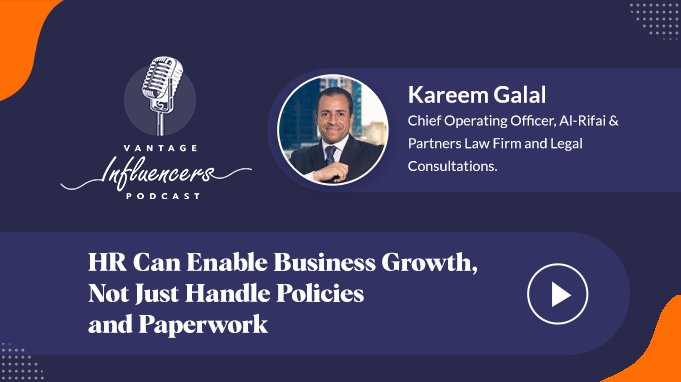
Episode Overview
Kareem Galal opens the conversation by reframing HR's history as a story: from the industrial era, when workers were selected purely for their tolerance of long hours and harsh conditions, through the rise of "personnel" administration after the World Wars, into the emergence of human resources management by the late 1970s, and finally into today's strategic, business-partner model. He argues that the shift from an administrative function to a genuine growth driver hinges on four pillars, productivity, leadership, retention, and scalability, which he maps onto the levels of Maslow's hierarchy of needs. When those four pillars align with a company's own growth goals, he says, HR moves from counting hours to shaping outcomes like revenue, market competitiveness, and organizational scale.
He then walks through what that alignment looks like inside GCC and MENA workplaces specifically, describing organizations built across dozens of nationalities, where fairness means treating people differently rather than identically, and where succession planning has to be a deliberate, tested structure rather than an improvised response to growth. Kareem also makes the case that digital systems, from applicant tracking to GPS-based check-ins and system-driven performance appraisals, free up the hours HR used to spend on manual screening and paperwork, so that time can go toward workforce planning and talent development instead. He closes with a reminder that employees who build their own professional visibility are, in effect, building the company's brand alongside their own, and that this kind of alignment between personal and organizational goals is what turns HR operations into a real growth engine.
Episode Highlights
- Kareem traces HR's evolution as a story: from counting hours and enforcing harsh working conditions before World War I, through the "personnel" era of pure administration, into the human resources management wave of the late 1970s, and finally into today's business-partner and AI-enabled stage.
- He frames HR's business impact through four pillars, productivity, leadership, retention, and scalability, and maps them onto Maslow's hierarchy of needs to explain how HR protects revenue and drives growth.
- Aligning talent strategy with business goals starts with building organizational capability, not just mindset, then layering in OKRs and workforce planning so individual career paths ladder directly into company objectives.
- Succession planning only works when it is tested through real, planned scenarios rather than training alone, and Kareem points to the UAE, Saudi Arabia, Qatar, and Bahrain as examples of young leaders rising through well-built structures.
- Working across a multicultural GCC and MENA workforce means recognizing that fairness is not treating everyone the same way, since motivation, from recognition to compensation to autonomy, varies from person to person.
- Digital HR tools such as applicant tracking systems, GPS-based check-ins, and system-driven performance appraisals free up hours once spent on manual screening and paperwork, redirecting that time toward workforce planning and talent development.
About the Guest
Kareem Galal, Chief Operating Officer, Dr. Fahad Al-Refaei & Partners Law Firm
Kareem Galal is a senior Human Resources and Organizational Development executive with over 17 years of experience across Saudi Arabia, the UAE, and Egypt. He currently serves as Chief Operating Officer at Dr. Fahad Al-Refaei & Partners Law Firm, where he leads firm-wide HR strategy, governance, talent development, performance management, and workforce transformation. He specializes in HR governance, KPI systems, competency frameworks, succession planning, employee experience design, and digital HR transformation, and has led large-scale people development programs and institutional restructuring initiatives for legal and commercial organizations across the GCC and MENA region.
Connect with Kareem on LinkedIn
Host
Shabana Shahnaz, Vantage Influencers Podcast Host
What You Will Learn
- How HR's role evolved from administrative labor management to a strategic driver of business growth
- The four pillars, productivity, leadership, retention, and scalability, that connect HR decisions to revenue and market competitiveness
- Why aligning talent strategy with business goals requires building organizational capability alongside mindset
- How to design succession planning and capability-building programs that are tested through real scenarios, not just training
- What employee experience and multicultural fairness look like in fast-growing GCC and MENA organizations
- How HR technology and data, from ATS to GPS tracking to system-driven appraisals, enable faster, smarter workforce decisions
Key Topics & Timestamps
| Timestamp | Topic |
|---|---|
| 00:00 | Cold open and introduction to the episode's theme: HR as a driver of business growth |
| 01:58 | Kareem's path from student activities and international sports events to regional HR leadership across the GCC |
| 07:32 | How HR evolved from labor counting and administrative "personnel" work into a strategic business partner function |
| 13:35 | The four pillars, productivity, leadership, retention, and scalability, that connect HR to revenue and market competitiveness |
| 17:57 | Building organizational capability, OKRs, and workforce planning to align talent strategy with business goals |
| 23:09 | Employee experience, succession planning, and multicultural fairness in GCC and MENA workplaces |
| 30:14 | How HR tech and data, from ATS to GPS tracking to automated appraisals, drive smarter workforce decisions |
| 40:20 | Kareem's closing thought on unlocking human potential as HR's real mandate |
Full Transcript
Click to read the full episode transcript
Welcome to the Vantage Influencers podcast. This podcast is sponsored by Vantage Circle, the simple and effective recognition platform for employee engagement.
Shabana Shahnaz: Hello, and welcome back to another episode of the Vantage HR Influencers podcast. I'm your host, Shabana Shahnaz, and today we'll be discussing how HR can enable business growth and not just handle policies and paperwork. To head into this conversation, we have an exceptional leader, Mr. Kareem Galal. Kareem is a senior HR and organizational development executive with over 17 years of experience across Saudi Arabia, the UAE, and Egypt. He has been serving as the COO at Dr. Fahad Al-Refaei and Partners Law Firm, where he leads firm-wide HR strategy, governance, talent development, performance management, and workforce transformation. With deep expertise in HR governance, KPI systems, competency frameworks, succession planning, employee experience design, and digital HR transformation, he has driven large-scale people development programs and institutional restructuring efforts across the GCC and the region. Kareem is also fluent in multiple languages and known for aligning human capital strategy with sustainable business outcomes. Kareem brings a distinctive perspective on how HR can be a true catalyst for growth. So Kareem, a very warm welcome to the show. It's a pleasure to have you with us today.
Kareem Galal: Thank you so much, and I would appreciate this introduction.
Shabana Shahnaz: Kareem, it's a pleasure truly, and you're most welcome for that. So before we dive into the conversation, would you like to share a bit about your professional journey so far? I'm sure our listeners would be looking forward to that.
Kareem Galal: Okay, sure. You just put the spotlight on my outcomes, but the journey started far away, like 20 years ago. When I started, I was in student activities, and this is a phase I always encourage all students about, because it's not just about sharpening skills or enlightening the mind. It's about discovering new areas in your personality. When I started that, I picked up a lot of skills I didn't know I had. The character I have now had already started to be shaped. When you start doing something like this, you need to start with the base, and that base comes from rehearsing life. You're running a demo of business life without actually being in business, and student activities are exactly that. Once I started, I became aware of team management, team selection, how to make a presentation. Change management existed in a small way, but not yet as a business discipline.
Later on, I got involved with FIFA. I worked on the FIFA World Cup U-20 in Egypt, around 2009. Working there opened up another level of experience, another way of understanding people, understanding different cultures, and understanding the differences between personalities. Culture shapes our personalities. It's not always about the environment we're raised in, but the perspectives we're raised by, and the differences between countries and cultures affect that. I went on to work with an international sports federation across five international competitions, and that was another huge discovery. At FIFA I was a team member, but at that federation I was head of a committee and had to follow up on many things. That was another expansion.
When you take all of that experience into business life, and I started as an HR administrator, an officer collecting data, preparing paperwork, the personal side of the work, all of that prior experience influenced and guided me through my HR journey. When I moved into a regional training manager role in Saudi Arabia, with a large group there for a couple of years, all my background helped me absorb different cultures. When you work in the Gulf, you're not facing one single culture. You're in a multicultural environment. You meet Indians, Pakistanis, Bangladeshis, Egyptians, Yemenis, Saudis, Emiratis, Filipinos. You need to blend in with that. You need to understand that in HR or training, it's not easy to treat everyone the same way, because fairness isn't about treating everyone identically. Fairness is about treating different people in different ways. When you're talking with your team and you need to empower or motivate them, there isn't just one way to do it. Some people are motivated by appreciation, some by money, some by recognition, some by autonomy. You can't assume everyone is motivated the same way. Working in the GCC expands your understanding that we are not all the same, but we are all equal.
Shabana Shahnaz: Great. Well, that was insightful. You are absolutely right, and your experience has been so enriching. I'm so inspired. So Kareem, let's head into the conversation. I'd like to start with the very first question. How has the role of HR evolved from being an administrative function to becoming a strategic driver of business growth?
Kareem Galal: Okay, I'd love to answer that as a story. Before the manufacturing and industrial revolutions, employees were selected not by skill or experience, but mostly by their capability to work in inhumane environments, twelve to eighteen hour days, poor lighting, hard conditions. That was before World War I, before 1914. After that came a term called labor management, the baby version of HR. At that stage, it was just counting people, counting hours, working to very basic standards. After the World War, the term became "personnel," administrative work handled through each country's traditional mindset, highly specialized and narrow in scope, nothing like today.
Imagine meeting someone from the future who tells you there are no more airplanes, that people just move from place to place instantly. You'd think they were crazy. It's the same if you went back five hundred years and told people you and I are talking right now through a small metal device. They'd think it was sorcery. People today can't fully grasp that HR used to be just a record of headcount and hours, with a very narrow scope of functions and skills. That lasted until the end of the seventies. After that came the term human resources management, and that's when things really started moving. By the beginning of the millennium, new terms exploded every year: strategic HR, HR business partner, value-added, proactive, multidisciplinary succession planning. We started talking about talent acquisition instead of recruitment, and there's a real difference between the two. Now we're moving into terms like AI in HR and applicant tracking systems, and people wonder what that means, whether AI will replace human beings the way science fiction imagines. It's not like that. Traditionally, HR worked on payroll, policy, and compliance, right up to the mid 2010s. After that came strategic terms: leadership, culture, restructuring the company at a wide level, none of which existed as HR territory before the millennium. Now HR is a partner. When people hear "HR business partner," they're confused about why HR should be involved in business terms at all. It's because skills, behavior, succession planning, training, and culture all impact the business positively or negatively. So HR's growth is like a story: starting as a baby with documents and basic coding, moving through a teenage phase where everything blends together without a clear identity, and finally reaching maturity, where everything is identified, sorted, and refined, as it is today.
Shabana Shahnaz: Great. Thank you, Kareem. I think you've beautifully stated the evolution. So maybe let's explore how this plays out in real business scenarios. My second question: what are the most impactful ways HR can directly influence an organization's revenue, scalability, or market competitiveness?
Kareem Galal: Okay, let me connect this to Maslow. You know Maslow's hierarchy of needs, five levels, each representing a level of safety and security. That same satisfaction structure can be reflected in HR through four pillars of impact. The first is commercial priority and revenue growth, strong anchors on their own. Then there's productivity, leadership, retention, and what we can call scalability. When you merge these four pillars with Maslow's hierarchy, you get a clear picture. Productivity is about extracting the right output through the right hiring, proper onboarding timelines, and performance management. You can't ask an employee to work harder and grow without good leadership empowering them, because strong leaders drive faster execution. Protecting revenue comes down to keeping employees proactive, and that happens through retention. Employees are an investment, and you can't let them slip away without a real retention plan. None of this works without structure. A company with ten people, two per division, might look simple today, but what's the plan for ten, twenty, thirty years from now? You need to build that structure now, even if it feels premature, so you can open it up as the company grows. At its core, HR's impact comes from aligning talent, leadership, retention, and scalability with revenue growth and with the company's larger goals, because every business has its own goals and its people have their own goals too. Aligning both together across all four pillars is what shapes and refines everything into one direction.
Shabana Shahnaz: Speaking of impact, I think we can dive deeper into what's behind it, like the leaders you mentioned. Kareem, in your experience, what HR models or frameworks are most effective in aligning talent strategy with business goals, especially in fast growing or transforming organizations?
Kareem Galal: Okay, this comes down to integration. The HR model has to be integrated with the business strategy and the frameworks we've discussed. First is capability: is the organization built on capability or just on mindset? If it's built on mindset alone, without capability and a well-structured hierarchy, you'll find gaps that eventually collapse the structure. So you need to understand how to build skills and differentiate against your competitors, because that's the core. Second, you need objectives and key results, OKRs, to set, track, and achieve ambitious goals. Being strategically driven means aligning with people's attitudes and performance, and that never happens without reshaping behavior through culture, so that individual goals ladder directly into business outcomes. That's the same alignment I mentioned earlier between the company's goals and people's goals. On the capability and skills side, you need strategic workforce planning. You can talk about fast growth and transformation, but none of that executes without a career growth path for individuals. You need to map out growth scenarios for every level and every employee, understand the future skills you'll need, and reshape your team to align with those scenarios. One more obstacle that keeps stopping growth: most people don't realize that HR operations are the core of growth. If you're stuck in daily routine, you're wasting effort, time, and money. You need a system that lets you respond faster to organizational change, to global change, and to changing client needs, because business is built on clients, and HR's first lesson is that you have both internal and external clients. HR business partnering is about how the external client is served by the people inside the company, and how the internal clients, meaning the employees, are served by your HR team. So in short, it comes down to skills building, OKRs, strategic workforce planning, and the HR operating model.
Shabana Shahnaz: You've really made that point clearly, thank you, Kareem. That alignment brings us to capability building. How can HR leaders drive meaningful capability building and succession planning programs that empower people and accelerate business performance? I think that connects strongly with employee experience too, so let's touch on that next. What role does employee experience, from onboarding to engagement, play in enabling sustainable business growth, especially in the GCC and MENA context?
Kareem Galal: Okay, if we're talking about business sustainability and growth in the GCC specifically, we need to look at how much the world has changed. Before 2020, the whole world, including the GCC, ran on a different HR model. Virtual interviews didn't really exist before. Remote working has since gone viral everywhere. Flexible shifts used to apply to a few specific roles, and now you hear about flexible shifts across every job title and level, which is a beautiful shift for HR. Online training used to be an ancient idea, and now it's built into company platforms alongside team engagement activities. Succession planning has also changed given the broader tech revolution reaching HR. Career paths are now mapped out for each role, aligned with specific skills and criteria on a set timeframe, so an employee might suddenly face an on-the-job assessment that feels unplanned but is actually deliberately designed to measure their skills, because a real succession plan isn't about how you train people, it's about how people actually act when a case arises. A real succession plan produces delegation and human understanding. In the GCC, this started in the UAE, and now Saudi Arabia, Qatar, and Bahrain are becoming leaders and entrepreneurs in this space too, with young leaders rising quickly into senior roles through well-built structures and succession plans. None of that expansion happens without speeding up onboarding and productivity through HR operations. You can't build strong performance without understanding the reality of a genuinely multicultural region like the GCC, where I work alongside people from many nations and cultural backgrounds. Even within my own country, Egypt, Upper Egypt has a different culture from the coastal cities, and you'll find the same regional variation within Saudi Arabia, between the east, the west, and the central region. That's natural. People from the desert differ from people who farm, who differ from people near the coast. You can't build organizational reality the same way across all of that; it has to account for the multicultural context. There's another factor too: helping employees build their own personal brand. When an employee builds a public profile, speaks on stages, or even appears on something like a podcast, and mentions their name alongside the company's name, that visibility grows the company too. As someone builds their own career and professional skills, they're building the company right alongside themselves. That's part of how sustainability and growth happen: by understanding multicultural needs, building organizational reality accordingly, and grounding succession planning in a strong structure for both the present and the future.
Shabana Shahnaz: That was great, thank you. That was a wealth of information, and I'm sure our listeners found a lot of insight today. That brings me to my last question for today's episode. I believe no conversation on modern HR is complete without discussing technology. With digital HR transformation gaining momentum, in your experience, how can organizations leverage HR tech and data to make smarter, faster, and more growth-focused decisions?
Kareem Galal: Okay, earlier I mentioned the ATS. A lot of people hear that term on LinkedIn or on messaging platforms, being told to align their resume with the ATS, and they get confused about what it actually is. It stands for applicant tracking system. When you apply online and send in your resume, HR screening is an exhausting phase. Imagine receiving twenty to thirty resumes a day. You need to screen each one, find the required qualifications, categorize them, and that alone can take an hour for just thirty resumes, when in reality it's often hundreds. That hour could instead go toward HR operations and talent acquisition improvements, which is where a system helps. It supports HR by screening resumes and tracking keywords, so if someone applies for a finance role with an HR-focused resume, the ATS will filter it out because there's no match to the required criteria. Digital HR is transforming everything this way. Previously, wages were tied to attendance tracked by fingerprint or physical presence, but that doesn't work for remote employees. Some companies now use very precise tracking systems that monitor actual work activity, like document edits or timestamps, and flag how much working time is left in the day. Some people find that restrictive or inhuman, but it's really about productivity. If someone is coming to work just to chat and have tea, there's no growth happening for them or for the business, and that's a reality everywhere. So the question becomes how to protect a human approach while closing that gap, and systems help there too. After the pandemic, people became more conscious of their health, so now GPS-based tracking software simply confirms someone is checked in and checked out at the company, which is much simpler. Leave requests used to be printed documents that required tracking down a manager for a signature and waiting days for a response. Now it's one click to request leave, and if it's approved or rejected, you get a notification by email either way. The same applies to tracking KPIs and the most complicated task of the year, the annual appraisal, which used to bring complaints, arguments, and accusations of bias. Now systems compare previous appraisals against current performance directly. Some companies have even redesigned recruitment around games rather than interviews or questions, measuring mindset and cultural fit through thirty-five to forty-five minutes of gameplay, not because you need to be a good gamer, but because it filters for people-oriented, team-oriented candidates, since someone who isn't a team player becomes a liability. People used to spend hours traveling just to apply for a job, and now they can apply from bed with a single click, with resumes moving globally. So digital transformation genuinely helps HR: optimizing workforce costs, measuring the ROI of talent investment, giving leaders real-time visibility, and helping HR understand the actual time each task takes when scaling or designing roles. When we talk about digitalization and being data-driven, it comes down to forecasting skills, investing in people, building leadership dashboards, and supporting every phase of HR through IT and digital transformation, because HR improvement is business improvement. HR reflects on employees, and employees reflect on the business. It's a chain.
Shabana Shahnaz: It's no doubt transformed the way organizations work, making processes faster and smarter. Thank you for the wealth of examples you've shared. It's exciting to see how automation and data-driven insights are helping HR teams and employees focus less on process and more on people themselves and their experiences. That's a great point to wrap up on. Thank you so much, Kareem, for sharing such insightful perspectives on how HR can truly become a business growth engine. Your experience across the region, and your strategic lens on people, process, and performance, offer tremendous value to our listeners. To everyone tuning in, we hope today's conversation inspires you to rethink HR, not as a support function alone, but as a powerful enabler of organizational success. Thank you so much once again, Kareem.
Kareem Galal: It's my pleasure, and as you mentioned, you're always overwhelming me with kind words about my insights. The closing thought I want to leave is this: the modern mandate of HR isn't about organizations simply having people. It's about organizations that know how to unlock human potential, to empower people to align their own goals with the business's goals. That's the real work we all need to do in the business world.
Shabana Shahnaz: Thank you so much for your final thoughts, Kareem. It was a wonderful conversation. With that, we'll wrap up today's episode. This is Shabana signing off from the Vantage HR Influencers podcast. Until next time, stay curious, stay inspired, and keep driving meaningful impact in the world of work. I'll see you next time.
Thanks for listening to the Vantage Influencers podcast. Be sure to subscribe on Apple Podcasts, Spotify, and our Vantage Circle YouTube channel for the latest episodes.
FAQ
How has the role of HR evolved from an administrative function into a strategic growth driver?
Kareem Galal traces HR's evolution through distinct phases: labor management before World War I, an administrative "personnel" era through the 1970s, human resources management as HR became more strategic, and today's business-partner model shaped by terms like strategic HR, talent acquisition, and AI. He argues HR's core scope expanded from counting hours to shaping leadership, culture, and business restructuring.
What are the four pillars Kareem Galal uses to explain HR's impact on business growth?
He identifies productivity, leadership, retention, and scalability as the four pillars, mapping them onto Maslow's hierarchy of needs. When these pillars align with a company's revenue and growth goals, HR moves from an administrative function to a direct driver of business outcomes.
How does succession planning actually work, according to Kareem Galal?
Kareem Galal argues that a real succession plan isn't built on training alone. It has to be tested through real, planned scenarios that reveal how employees act under pressure, producing genuine delegation and human understanding rather than a checklist of completed courses.
How is HR technology changing day-to-day HR operations?
Kareem Galal points to applicant tracking systems, GPS-based attendance tracking, and system-driven performance appraisals as tools that remove hours of manual screening and paperwork from HR's workload, freeing that time for workforce planning, talent development, and other higher-value work.
Related Reading
Also listen on