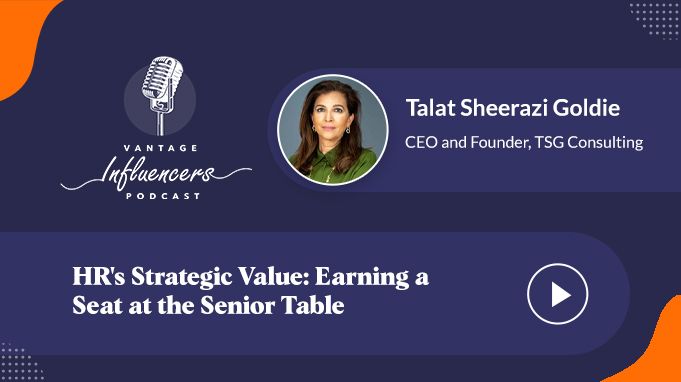
HR's Strategic Value: Earning a Seat at the Senior Table
Episode Overview
HR often struggles to prove it belongs in the room where the big decisions get made. In this episode of Vantage Influencers, host Sanjeevani Saikia speaks with Talat Sheerazi Goldie, CEO and Founder of TSG Consulting, about the concrete, measurable ways HR actually drives business results, and what it takes to move from a support function to a genuine strategic partner.
With over 25 years across oil and gas, pharma, aviation, banking, and education, including preparing a company's HR function for an IPO, Talat lays out exactly why "HR doesn't move the needle" is a myth, and what specifically needs to change for HR to earn real influence at the leadership table.
Episode Highlights
- HR contributes to the bottom line in three measurable ways: employee engagement and productivity, reduced turnover and hiring costs, and effective performance management tied to business KPIs.
- Around 90% of HR directors, by Talat's estimate, are still buried in operational work, employee relations, payroll, policy enforcement, leaving little time for actual strategic conversations with the C-suite.
- Middle management, not the C-suite, is where culture actually lives or dies. Employees leave managers, not companies, and most managers are promoted with zero training in how to manage people.
- People rarely leave a company over a 10-15% salary bump elsewhere if the culture, recognition, and sense of being cared for are genuinely strong. Talat cites a multinational bank client where average tenure was 12-15 years.
- Handling layoffs well comes down to an objective, defensible process, honest communication about why, and real support like redundancy packages, interview skills training, and outplacement assistance, not just the size of the severance check.
- HR can no longer opt out of understanding basic financials. Every HR initiative needs to be sellable to the CFO and CEO in terms of its actual impact on revenue and cost.
About the Guest
Talat Sheerazi Goldie — CEO and Founder, TSG Consulting
Talat Sheerazi Goldie is a Human Capital Leader with over 25 years of experience across oil and gas, pharmaceuticals, aviation, banking, manufacturing, and media. Known for pragmatic solutions and driving culture change, she balances employee and business interests to achieve strategic goals. A champion of HR business partnerships, she designs initiatives that improve both financial outcomes and organizational growth, with particular expertise in communication, engagement, and execution.
Connect with Talat on LinkedIn
Host
Sanjeevani Saikia — Vantage Influencers Podcast Host
What You Will Learn
- Three concrete, measurable ways HR contributes directly to the bottom line
- Why HR gets stuck in operational work instead of strategic conversations, and how to break out of it
- Why middle management, not the C-suite, is the real battleground for culture
- How to handle layoffs with both compassion and accountability
- Why business acumen (reading a P&L, understanding what drives revenue) is now essential for HR leaders
- What AI, data analytics, and DEI mean for the future of HR
Key Topics & Timestamps
| Time | Topic |
|---|---|
| 01:45 | Talat's corporate journey so far |
| 04:36 | How HR leaders can showcase their contributions in ways business leaders actually respond to |
| 08:14 | The evolving role of HR, and how it benefits both HR and the business |
| 13:06 | Keeping HR initiatives aligned and central to business goals |
| 20:05 | Balancing compassion and accountability in difficult HR decisions |
| 24:45 | How business acumen is shaping the future of HR |
| 27:48 | A forward-looking conversation on where HR is headed |
Full Transcript
Read the full transcript
Sanjeevani: Welcome to the Vantage HR Influencers Podcast. This podcast is sponsored by Vantage Circle, the simple and AI-powered rewards and recognition platform for employee engagement.
Sanjeevani: Welcome back to the Vantage Influencers Podcast. I'm your host, Sanjeevani Saikia, and as always, we're here to dive into the topics that matter most to HR professionals and business leaders alike. Today we're talking about something that's often discussed but rarely explored in depth: HR's strategic value, and how it earns a seat at the senior leadership table. HR today goes far beyond hiring, payroll, and compliance, it's about shaping an organization's culture, driving growth, and leading transformative change. Yet despite this expanded role, HR often faces challenges being recognized as a strategic partner at the leadership level. Why is that, and more importantly, how can HR truly claim its place at the table where the big decisions are made? To help us unpack this, we're joined by Talat Sheerazi Goldie, CEO and Founder of TSG Consulting. With her extensive experience, we'll explore what it takes for HR to move from a supportive function to a critical player in driving business success. Hi, Talat.
Talat Sheerazi Goldie: Hi, Sanjeevani, how are you?
Sanjeevani: I'm fine, how are you doing today?
Talat Sheerazi Goldie: Very well, thank you.
Sanjeevani: Thank you so much for being here today, it's a pleasure to have you on our show. We've got a very interesting topic to dive into, HR's strategic value and earning a seat at the senior table, and I can't wait to hear your thoughts. But before we jump in, could you share a bit about your professional journey so far?
Talat Sheerazi Goldie: Where do I start? I could take up the whole podcast, but I'll keep it short. I got into HR in the '90s, and going back 25 or 30 years, HR was a very different animal at the time, definitely far more admin-focused. If you've heard of the guru Dave Ulrich, even back then when he started writing his books, he always spoke about how important it was for HR to be aligned with the business, how CEOs had a left hand and a right hand, finance and HR, and how critical it was for finance, HR, and the business to work together for a company to succeed. My own journey started many years ago at a bank as a training and development manager, then I moved to head of HR for an oil company, BP, then to heading HR for a global pharmaceutical company, GlaxoSmithKline, where I was HR director before moving to the UAE. I've been here almost 18 years now, across all kinds of companies, real estate, healthcare, and my last position was in education, where I was brought in to prepare the business for a public listing, an IPO, from an HR perspective. When a company goes public, there's a lot of scrutiny and governance needed around policies, SOPs, and processes, and they wanted everything in order before we went public. Thankfully, we had a fantastic IPO, and the share price has done well since, I'd like to take a bit of credit for contributing to that, especially since it's an education business, and all we really offer is people services, great teachers, because great teachers produce great outcomes for kids. So in a nutshell, that's my journey, and today I run my own business, TSG Consulting, which is doing well. I do a lot of work for different companies on organizational restructuring, corporate training, and helping businesses prepare for IPOs. Very busy, but good.
Sanjeevani: Wonderful, thank you so much for sharing your journey, it's been amazing to hear. With your permission, I'd like to begin today's conversation.
Talat Sheerazi Goldie: Absolutely, please go ahead.
Sanjeevani: Let's begin with a question that's often debated in HR circles. Many argue that quantifying the impact of HR initiatives in tangible business terms is genuinely challenging, some even question whether HR directly contributes to the bottom line at all. From your experience, is that true, and how does it actually play out?
Talat Sheerazi Goldie: This is a real question, and you see it in companies all the time, whenever they're trying to cut costs, what's the first thing that gets hit? Marketing budget, training budget, or people, "let's get rid of a hundred people and hit our numbers." That's really sad, because I believe there are several very direct ways HR contributes to the bottom line. Start with employee engagement and productivity: there's a huge amount of research showing that good HR practices, strong onboarding, good training and development, fair development programs, lead directly to engaged, competent staff. And there's a well-documented link between engagement and productivity. If HR creates an environment where that's happening, you're getting higher-quality work from people who are less likely to leave, and that produces immediate financial performance. Second: reducing turnover and hiring costs. A new employee typically takes about six months to become fully productive, and hiring itself costs real money, so high turnover is genuinely expensive. If HR has a strong strategy for retention, competitive compensation benchmarked against the market, recognition, real career development, you lower those costs because you're not constantly hiring. Third: performance management. A strong system with SMART objectives, real accountability, and clarity about what's expected means people are more likely to meet or exceed targets that are aligned with actual business KPIs, which again contributes directly to the bottom line. So those are three very tangible, direct ways HR contributes.
Sanjeevani: I completely agree. I've noticed, talking to HR professionals over time, that they're no longer just playing a support role, they're clearly evolving into strategic partners, and that transition is driving meaningful change, both within companies and for people themselves. Given your diverse industry experience, how do you view this shift, and how does it benefit both HR and the business?
Talat Sheerazi Goldie: Absolutely. When I joined HR in the old days, it was definitely just a support function, admin and ops. Even today, honestly, I'd say 90% of HR directors are still working on operational things, employee relations issues, legal matters, payroll problems, putting a policy in place. Every day it's more operational, and the more you're stuck in that admin role, the less time you have to actually sit down with your CEO and C-suite and talk real strategy, really understand the business. I've spoken at so many conferences about how important it is for HR to genuinely be a business partner, and there are four or five key abilities that requires. First: HR needs to be agile and adaptable. An HR function stuck in a black-and-white world struggles in a business environment that has to change quickly, we're in what I call a VUCA world, volatility, uncertainty, complexity, ambiguity, and that's everywhere, every industry. HR needs to be able to drive change management, especially now with things like M&A and constant organizational restructuring, making sure employees stay engaged and aligned with the new direction even as things shift. That same agility applies to workforce planning too, anticipating what skills you'll need as the business grows geographically or into new products, and preparing for trends like automation, remote work, and the gig economy.
Second is focusing on employee experience and engagement, the entire employee lifecycle, from how recruitment goes, how people are onboarded, how performance is set and managed, to how people are exited, with respect and within a legal framework if they leave. Doing all of that transparently creates a genuinely positive culture people want to stay in. And finally, aligning your people with actual business goals. An HR person who only knows "we make air conditioners" isn't enough. When I was at GlaxoSmithKline, I actually went out on sales calls with reps in my first three months, seeing how they sold to doctors, what questions came up, what the advantages of the product were. That gave me real insight into what training and influencing skills those people actually needed. HR has to dig into the actual detail of the business and the product, only then can you meaningfully contribute to business strategy discussions, and only then can you build the right HR strategy.
Sanjeevani: You mentioned HR in venture-capital-backed organizations. Do you think HR's role naturally becomes more strategic in that context, given the nature of those operations, especially since retention tends to be a particularly visible challenge there?
Talat Sheerazi Goldie: It comes down to asking why retention is actually an issue. Are people leaving purely because compensation isn't competitive, are other companies simply paying more? Often what's missing is enough focus on culture. People genuinely won't leave over a 10-15% salary bump if they have a supportive structure, feel appreciated and recognized, have good relationships at work, and a positive, non-political culture. So the real question is how HR ensures there's a strong enough culture that people want to stay. I recently did a corporate training assignment for a multinational bank where the average employee tenure was 12 to 15 years, which felt almost unheard of in 2024. I asked them directly what made them want to stay, given they clearly had other options in a strong market, and they said it was because they felt the company genuinely cared for them, even through the hardest times. That's how you build real loyalty.
Sanjeevani: That's a really important point, culture really is where everything comes down to.
Talat Sheerazi Goldie: It is, but I'd push back on one thing, everyone assumes bad culture is automatically HR's fault. It's not, it's the entire C-suite's responsibility, and everyone under them. At the end of the day, an employee deals with their direct supervisor, not the C-suite. You could be an amazing leader at the top, but if the managers underneath you are disrespectful, don't understand diversity and inclusion, communicate poorly, and don't give real feedback, the company isn't going anywhere good. It's everyone's responsibility, especially once you become a manager, that's part of why you're paid more than an individual contributor.
Sanjeevani: You've touched on some of the most crucial pointers already, but would you elaborate on how to actually build a great culture?
Talat Sheerazi Goldie: What every employee expects, fundamentally, is transparency and honesty from management. The moment you create a culture of hiding behind walls, sugarcoating things, applying policy inconsistently, that's when morale really drops, especially if people sense certain nationalities or genders get paid or promoted unfairly, or there's no clear framework for what it actually takes to move up. People just want to know: here's the framework, here's what I need to achieve and by when. Empty promises and dishonesty are the worst thing for culture, because it spreads fast. The second piece is getting middle management right. Everyone assumes the C-suite is the most important leadership layer, but honestly, middle management matters more, people leave managers, not companies. Unfortunately, people get promoted into management constantly with zero training on making decisions, managing conflict, communicating, or actually managing a team, and then when they fail, leadership blames them without acknowledging the company never set them up to succeed. Support has to come from the top, but middle management carries a lot of that weight, you need the right people in those seats.
Sanjeevani: Leadership in HR often involves tough calls, layoffs, performance issues, and those situations can be genuinely hard on the human side. How do you balance compassion with accountability and integrity in those moments?
Talat Sheerazi Goldie: This applies to every manager, not just HR, everyone in a position of responsibility eventually has to make tough decisions. If those decisions come from a place of transparency, fairness, and honesty, you're in reasonable shape. Unfortunately a lot of senior managers, because they've never been trained to handle tough conversations, hide behind excuses instead of exiting someone with respect and integrity. Management often assumes employees won't notice, but people usually know more than management gives them credit for, if what you're saying in a town hall isn't the truth, you lose respect fast. So honesty comes first. If the business is genuinely struggling and costs need to be cut, the real question is: what objective process did you follow? Don't base who stays or goes on who you personally like, have a defensible process, and if you've got the paperwork to back up performance issues, you're in a reasonable position. The second piece is how you treat people through that process. At BP, we once had to let go of about 150 staff, many with 15 to 20 years of tenure, genuinely difficult. We focused on honest communication about why, whether it was a product line closing or a branch shutting down, we put together real redundancy packages, we realized many of these people hadn't interviewed in 15 years, so we ran interview skills training for them, and we contracted a third-party firm to help outplace people we were letting go, since many of them were genuinely excellent employees we simply couldn't keep for business reasons. We didn't get a single legal case. People said, even though they wished they hadn't been let go, they understood the reasons and appreciated everything the company did to support them. Companies that try to cut corners on redundancy packages often don't realize how much reputational damage, and the resulting impact on revenue, that can cause. In short: transparency, honesty, and integrity are the most important things when making tough calls.
Sanjeevani: You've highlighted some really important points on staying compassionate and empathetic while dealing with people. Shifting gears, I recently did an episode about why HR professionals need strong business acumen as they move into more strategic roles, which ties in perfectly here. What's your take on this shift, and how do you see business acumen shaping HR's future?
Talat Sheerazi Goldie: If HR doesn't build business acumen, it's genuinely tough going forward. HR people have a reputation for not being great with numbers, hand someone a P&L or balance sheet and watch them get nervous. There's really no excuse anymore for any HR professional not to have basic numeracy, we're not asking you to become a CFO, but there are so many courses now, online and in person, that teach the basics of profit and loss, how to read a balance sheet, what revenue, net profit, and gross profit actually mean. If you don't understand the numbers, it's very hard to have meaningful conversations with your CFO and CEO, they'll dismiss HR as coming up with "fluffy" ideas that just cost money. But if you understand the numbers, you can actually sell an initiative by connecting it to how it impacts those numbers, if you're running training for a sales team, how does that training eventually translate into them selling more, and contributing to the bottom line? Beyond understanding what the business actually does, you need to understand your cash cows, your 80/20, which 20% of products or services drive most of the value, which ones are struggling, and why, is it a skills gap, a training issue, the wrong people in the wrong seats? HR only has real bottom-line impact once it understands the products, the services, and the basic finances behind them, what makes money, and what loses it.
Sanjeevani: As we get toward the end of today's episode, we can't let you go without asking: what does the future of HR look like to you, and how can HR professionals best prepare for what's coming?
Talat Sheerazi Goldie: A few things are happening quickly. With ChatGPT, HR technology, and AI now a real, everyday reality, HR functions need to be upskilling their teams fast. First, there's going to be a much heavier reliance on data and analytics, HR metrics genuinely matter to the C-suite, they want to see real analysis, not anecdotes, so HR analytics is going to be a big part of the future. On AI specifically, there are now tools that can predict turnover, flag which employees are likely to stay versus leave, and personalize employee development plans through chatbots, mentors, and coaching platforms. There's no shortage of tools, the real question is which one actually fits your company, and how you upskill your team and yourself to use it well. Automation and AI are a big piece of that, and so is having genuinely digitized HR systems, if 40-50% of your operational work is still happening through Excel sheets and manual back-and-forth, you'll never have time to focus on business strategy or sit down properly with the C-suite. I also think diversity, equity, and inclusion will only become more central to HR strategy, especially somewhere like the UAE, which is genuinely global, with people of many nationalities and languages working together, though honestly, even within a single country like India, there's enormous cultural variation across regions and provinces within what looks like "one culture" from the outside. Staying current on DEI research, and actively building a culture where people feel safe to speak up, matters. I ran an unconscious bias training for about 250 people recently, for a global green energy company, and it was genuinely striking how much unconscious bias, affinity bias, confirmation bias, shapes decisions people don't even realize they're making. And I think the newer generation coming into the workforce is also going to push hard for some form of remote or hybrid working model going forward.
FAQ
Does HR actually contribute directly to a company's bottom line?
Yes, in at least three measurable ways: driving employee engagement and productivity, reducing turnover and hiring costs through better retention strategies, and running performance management systems that keep people aligned with business KPIs.
Why does HR struggle to earn a seat at the senior leadership table?
Because most HR directors remain buried in operational work, employee relations, payroll, and policy enforcement, leaving little time for the strategic conversations with the C-suite that would establish HR as a genuine business partner rather than a support function.
Is culture really the C-suite's responsibility, or HR's?
It's the entire organization's responsibility, especially middle management. Employees leave managers, not companies, so poorly trained middle managers can undermine culture regardless of how strong leadership is at the top.
Why does business acumen matter for HR professionals now?
Because HR initiatives only get real traction with the C-suite when they're framed in terms of financial impact. Understanding basic P&L concepts, what drives revenue, what's losing money, lets HR sell ideas credibly instead of being dismissed as "fluffy."
Related Reading
This episode is part of the Vantage Influencers Podcast, where we bring HR thought leaders to discuss engagement, compensation, benefits, and everything related to HR.
Also listen on