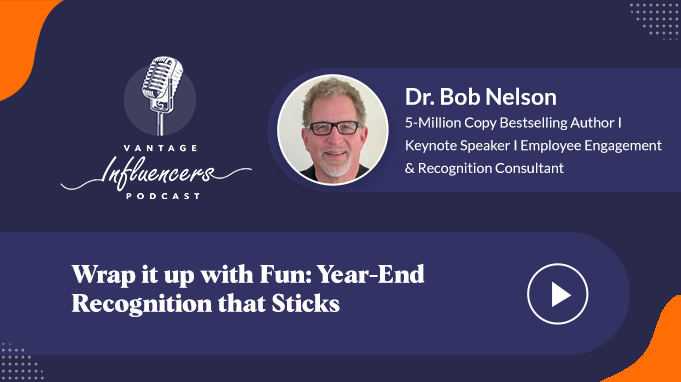
Wrap it up with Fun: Year-End Recognition that Sticks
Episode Overview
Dr. Bob Nelson returns to the Vantage Influencers Podcast to tackle a familiar year-end problem: recognition that feels obligatory instead of genuine. He argues that repeating last year's holiday party or handing out the same gift card program is exactly what drains a moment of its meaning, and that a little customization, thinking through who did what and why it mattered, can turn a routine gathering into something employees actually remember. Instead of treating year-end recognition as a single event to check off, he pushes leaders to build context into every gesture: naming specific achievements, explaining why they mattered, and letting a touch of real emotion come through instead of a generic thank you.
The conversation then turns to what actually separates memorable recognition from forgettable recognition. He walks through examples: personal notes from managers instead of identical gift cards, a themed celebration built around letting employees choose something for themselves, and even a mystery gift exchange that became one of his favorite office stories. Along the way, he makes the case that public ceremonies and bigger price tags matter less than personalization, and that applying the same care consistently through the year, not just in December, is what turns isolated gestures into a genuine culture of recognition.
Episode Highlights
- Holiday parties that just repeat last year's format are the biggest reason year-end recognition feels forced; a little customization changes everything.
- Great recognition needs context: naming specific projects, calling out who was involved, and explaining why the work mattered.
- A personal, handwritten note from a manager beats an identical gift card, even when the dollar value is the same.
- Letting employees choose something for themselves creates more excitement than handing everyone the same fixed prize.
- A big public award ceremony isn't always more motivating than a smaller, personalized moment of appreciation.
- Companies with a genuine, year-round culture of recognition see far stronger employee pride, advocacy, and retention than those that treat it as a once-a-year event.
About the Guest
Dr. Bob Nelson, President, Nelson Motivation Inc.
Dr. Bob Nelson is the world's leading authority on employee recognition, engagement, and retention. He has consulted with 80% of the Fortune 500, co-founded Recognition Professionals International, and created Employee Appreciation Day. He is a bestselling author of over 5 million books, including 1,001 Ways to Reward Employees, and a sought-after speaker and media expert whose work has been featured in outlets like The New York Times, Fortune, and CBS 60 Minutes. Recognized as a top global thought leader, he is an executive coach to Dr. Marshall Goldsmith and a long-time collaborator with Dr. Ken Blanchard. Dr. Nelson holds an MBA from UC Berkeley and a PhD in management from the Drucker Graduate School.
Host
Susmita Sarma, Vantage Influencers Podcast Host
What You Will Learn
- Why year-end recognition often feels forced, and small changes that make it feel genuine
- The biggest myth holding most recognition programs back
- How to add personal context to recognition so it actually lands
- Whether public recognition or personalized recognition motivates people more
- Creative, low-cost ways to make year-end celebrations memorable
- Why building a year-round culture of recognition beats one big annual event
Key Topics & Timestamps
| Timestamp | Topic |
|---|---|
| 02:04 | Why year-end recognition often feels forced, and how to fix it |
| 06:54 | The biggest myth about employee recognition |
| 11:27 | Public recognition vs. personalized recognition: which motivates more |
| 14:32 | Creative, out-of-the-box recognition ideas |
| 20:38 | Building a year-round culture of recognition |
Full Transcript
Click to read the full episode transcript
Welcome to the Vantage HR Influencers Podcast. This podcast is sponsored by Vantage Circle, the simple and AI-powered rewards and recognition platform for employee engagement. As the year wraps up, it's the perfect time to recognize the incredible efforts of our team members. But let's be honest, so many year-end recognition programs can feel a bit forced, right? You know, the ones that feel like they're just ticking a box. So today we are going to talk about how to make those moments actually meaningful, how to create recognition that feels authentic, memorable, and maybe even a little fun.
Susmita Sarma: Hi everyone, I'm Susmita, and I'm thrilled to welcome you back to another exciting episode of the Vantage HR Influencers Podcast. Joining us today for the second time is the one and only Bob Nelson, a bestselling author of over five million copies, a keynote speaker, and an all-around expert on employee engagement and recognition. Bob, it's so great to have you back. How are you doing?
Dr. Bob Nelson: I'm doing excellent. Yourself?
Susmita Sarma: I'm fine too. And just to start, what do you typically do around this time of the year?
Dr. Bob Nelson: I guess this time of the year, most companies are starting to look back. And if there's a time that people do recognition, a lot of companies don't do it very well. Not most, but there's a time that they do it, usually it'll be year-end, maybe along with a bonus or a gift of some type. So that's kind of it, and there are things, advice we give people to make that more effective in their organization. So I hope we can talk about that some.
Susmita Sarma: So great to hear, Bob. Now let's dive right into our discussion. One of the things I know you are passionate about is making employee recognition feel genuine. So let's start with this. Many year-end recognition programs often feel a bit forced or even insincere, despite the good intentions behind them. So what do you attribute that feeling to, and what can leaders do to shift their approach and make these programs feel more authentic and meaningful for their teams?
Dr. Bob Nelson: Great question. For a lot of companies, they do it kind of as a formality at the end of the year. We have to have a holiday party, do a gift exchange, the same thing we did last year and the year before, that kind of thing. And that tends to make it less special. So I would say if you could take a little thought and effort into trying to customize the recognition for the group or for the individuals involved, that would go a long way further than just saying we're celebrating because it's the end of the year and we need to have a holiday party. Any party, unless it's specifically to celebrate the completion of a goal or some type of milestone, if it's just a gathering or a potluck because it's the holidays, then you're already missing the point a little bit. You can save it though by making sure you do something more individualized within the context of that celebration. So if you do have a potluck, for example, I'd certainly ask whoever's running the event to have a top manager say a few words about the significance of the year and what the team achieved, and call out the people who helped make that possible. That would be a very good use of any type of gathering, including a holiday get-together. Then, where possible, single out individuals or departments that have stood out and what they accomplished. So if there's preparation to be done, it's probably in prepping the leader who's going to speak with a summary of the highlights, the specifics about projects, and what distinguished people's success, and who was involved. That's often the missing ingredient in the perfunctory holiday party where we're just sharing a meal together and maybe doing a gift exchange. Coming back to context, all recognition is more powerful when you provide a reason for why it was significant. It's a bit like the basics of good praising: I saw what you did, here's why I value it, and here's why it's so important, because it helped us make our goals for the year, or it shows our commitment to teamwork and collaboration. If you really want it to land at the level of feelings, present the evidence, the things you saw, heard, or read that told you success was had, and then bring your emotions into it. Something like, "this is how proud I am of this team for the work they've done together. We had some challenging times, but we pulled through, and we couldn't have done it without everyone having the attitude of being in it together." That added charge gives more meaning to the recognition. It's not just words, it's context rooted in success, and the feelings make it personal, both to the person and their respected leader.
Susmita Sarma: That's a great insight, Bob, and I think there's a lot of truth in that. When it comes to employee recognition, especially around year-end, there's often pressure to do something big or very special, but there seems to be a myth that holds companies back from getting it right. In your experience, what's the biggest myth about employee recognition that continues to be perpetuated, and how does it prevent companies from truly nailing it, especially with those big year-end recognition efforts?
Dr. Bob Nelson: Sure. I touched on that a bit already by saying that if we're basically doing what we did last year and the year before that, it's not going to be very exciting to anybody. You're kind of going through the motions, so you have to shake it up a bit and make it more meaningful, more fun, more special. Instead of just saying, "last year we had a cafeteria serving dinner and this year we'll have it plated," which isn't going to make much difference, use the same opportunity to ask each of your leaders to write a note to each person who reports to them. In that note, go over the specifics of how they've excelled over the past year, give it to them personally, maybe at the holiday get-together, and that would have a lot more significance. I've done that several times myself. I remember one year I had about 16 people reporting to me, and it took maybe a couple of hours to give thought to each person, thinking about the interactions we'd had over the past year and the projects and successes they'd had. I remember two of the people I gave that to cried. It was very moving to them that someone remembered and thought highly of them as a person, on top of what they helped us achieve. So the thing that really makes recognition land, that makes it more meaningful, is that personal, individualized touch. You're not going to get that by going from a $25 gift card to a $50 gift card. It's still a gift card, and everyone gets one. That signals that you're not distinguishing performance, unless it's again in the context of the team working together with examples of how that played out. If it's just the same thing for everybody on a fixed budget, it ends up feeling tired and empty. You can still have some fun with it, though. One thing I learned working with the Blanchard companies is that we'd give every employee fifty dollars cash around the holidays and ask them to pair up with someone they didn't know well and go buy something for themselves, not the usual holiday shopping for kids or a spouse, but something for themselves. Then people would come back and share the experience, getting to know someone better in the company, sharing what they bought and why. It was just a lot of fun, and that camaraderie from sharing stories and getting to know each other, as opposed to just passing out gift cards, is like night and day. It has much more impact when you build in an activity and a personalization that people get to choose for themselves. Whenever someone can choose what they want, it's more motivating than if you just decide for them, even if what you decide is a nice thing.
Susmita Sarma: Interesting, and I completely agree that sometimes the simplest gestures are the most meaningful. When we talk about recognition, if I asked you to choose between two very different types, a big public award ceremony with all the bells and whistles, or something quiet, personalized, and customized with a genuine thank you from a leader, I'm sure I know which one you'd pick.
Dr. Bob Nelson: Yes, unless it was tied to the company's success over the last year, in which case a bigger moment would be fine. But I find that just going through the motions of a holiday party together isn't going to make people feel special, and it's not that hard to add something that brings out that specialness. Even within the context of everyone getting together as a company, you could have each manager break out with their team for a personal recognition session, since managers know the details of what their people have done and can share that in a smaller group within the larger meeting. You could take an hour to do that, with everyone dividing up. Or if you do a gift exchange, you can make it more fun by adding an element of play, like letting people swap gifts once they've seen what everyone got. That adds a whole new dynamic and brings up conversation about the things that were done. One year at my own company, we did a mystery gift exchange, and the gift I opened turned out to be a box of large feeder cockroaches. It was funny at the time. It turned out the person who gave it had pet lizards and had to buy these oversized cockroaches to feed them, so I gave them right back after the meeting.
Susmita Sarma: I'm sure that has a bigger, longer-lasting effect on employee motivation and sense of value when you make it more memorable and give individual feedback about what they've done.
Dr. Bob Nelson: Yes, that's something they can hold on to, like the written letter I mentioned earlier. They can take it home, share it with their family, save it in what I call a victory file, and on a bad day at work, they can read some of the comments they've received, not just from the holiday party but throughout the year, and use that to get themselves back in the game and excited about the work.
Susmita Sarma: Great ideas, Bob. So recognition really doesn't have to come with a hefty price tag. Before we wrap up, you've seen tons of recognition programs in your career. Do you want to share any unique, creative, out-of-the-box ideas you've encountered?
Dr. Bob Nelson: Sure, let me think of one I haven't already mentioned. My wife's company was planning a Christmas party, and she told me what they were planning, basically a dinner at a hotel. I said we could do better than that, and she went back to her company and told them, and they said, "okay, you're on." So what we did was take all the furniture out of our house and create a casino night. There was gaming and mingling instead of a sit-down dinner where you're stuck next to the same person all night, so people were walking around, and the food was more snacks and appetizers. That let us stretch the budget a long way because it didn't cost as much as a sit-down dinner, so we could put a big chunk of the budget toward door prizes. It turned out that about two out of every three people who came to the event, and it was a couple hundred people, received some type of door prize. We had fun with it too. Instead of just handing out a $200 prize, I asked each of the executives to put up something of value that could be shared with employees. For example, someone with a cabin could offer a week at the cabin since they only used it a couple of weeks a year anyway, or someone with a boat could offer the winning team time out on the boat with them at a mutually convenient time. That makes it personal and stretches the impact beyond the event itself, letting people connect with company leaders in a different way. I know companies that have done things like that and it's become legendary, something people look forward to. So again, it's about personalizing it, in this case by tapping into the executives and giving them some ideas so it's fun and maybe something that's exciting for them too, like offering a golf outing if they enjoy golf. And I always believe in giving people choices. Another thing is giving things that can be shared with loved ones and family, since the holidays are a family time. It's much more meaningful to give someone, say, the top salesperson, the ability to take their family to a closer destination like Disneyland, rather than a solo trip to Hawaii when they already travel all the time for work and might dread another trip. It costs less but means more, because you're also paying back the people at home who support that person while they're working. Another idea I've seen work well is that when you honor someone, you let them honor somebody else. Going back to the sales example, the salesperson is already going to get more money for hitting their goal, but within that, you give them something like a gift card they can pass along to people on their team who helped with the proposals that made the sale possible. That sets them up to thank and honor the people they worked with over the past year, instead of taking those people for granted, which matters because otherwise those people may not be as excited to help next time. So it's about spreading the recognition, making it personal and individualized, and then finding creative ways to let that effort be shared. You can build on this throughout the year too. If someone gets a compliment from a customer, you can post it on a wall in the building, or have an executive write a note thanking the person for the job they did with the client. Those are simple ways to extend the power of recognition, and in that case it's not even specific to the holidays.
Susmita Sarma: All these creative ideas make a huge difference, Bob.
Dr. Bob Nelson: If you can go beyond just one period of time and really create a culture where recognition is happening all the time, that's when it becomes part of "the way we do things around here," which is how I define culture. You want to get to the point where everyone would say, "yeah, we always have time to call out excellence, to thank people for doing a good job, to do a spontaneous celebration, to think of someone at the start of a meeting," and that our leaders are all doing it in their sphere of influence constantly. That's when it becomes an organizational advantage, a true culture of recognition that everyone feels is part of who that organization is. There's research on companies with a genuine culture of recognition, where people are thanked when it's due for good work, that found their employees feel about five times more valued than employees at companies without that frequency of recognition activity. They were also about six times more likely to act as ambassadors for the company, sharing with neighbors, friends, and relatives how excited they are about where they work. They were about seven times more likely to stay with the organization for their careers, which matters a great deal given the shortage of skilled labor, since this becomes a way to hold on to people longer. Other research I've seen suggests this can be achieved with something as simple as every employee receiving around four types of recognition in a given quarter, which works out to roughly once a week as a minimum. For people to actually feel recognized once a week, though, a leader really has to be doing it much more often than that, probably every day, to get around to everyone once a week. Companies with that level of recognition also showed about eleven times higher commitment to the mission of the organization, tying recognition to the mission, to clients, and to the broader societal benefit the company offers. Whatever product a company has, there's always a way to bring out the richness of the contribution that company is making to society. For example, I've worked with WD-40 Company, headquartered here in San Diego. First of all, 99% of their employees are excited to tell others where they work, genuinely excited, even though it's a company that sells lubricant. Their engagement level runs around 93%, compared to an average of around 30% for companies this year, so that's about three times greater than the average company because they take this seriously.
Susmita Sarma: The results are always very visible, and that's probably why organizations globally are taking recognition so seriously nowadays. Thank you so much for sharing your insights and taking the time to be with us today.
Dr. Bob Nelson: My pleasure. I'm confident our audience will walk away with some practical tips and fresh ideas to make their recognition programs more impactful and meaningful. Thank you so much, it's been a pleasure, and thanks for having me on.
Susmita Sarma: And to our audience, thank you for tuning in. We'll catch you next time.
FAQ
Why do year-end recognition programs often feel forced?
Because many organizations simply repeat the same holiday party or the same generic gift every year without adding personal context, so the moment starts to feel routine rather than meaningful.
What is the biggest myth about employee recognition, according to Dr. Bob Nelson?
That recognition has to look identical every year and can be improved by simply raising the dollar value of a gift. More meaningful recognition comes from personalization, not a bigger budget.
Is public recognition more effective than personalized recognition?
Not necessarily. Dr. Nelson argues that smaller, more personal moments, like a handwritten note or an individual conversation, often resonate more than a large, formal recognition ceremony.
How can companies make year-end recognition memorable without a big budget?
By adding personal touches such as manager notes, letting employees choose their own reward, or turning the celebration into an interactive experience rather than a standard dinner or gift exchange.
Related Reading
Also listen on






You might also like
 Employee Recognition
 Humanizing the Workplace Through Recognition
 Employee Recognition
 Scaling Culture Without Losing Its Soul as Recognition Drives Growth Inside and Out
 Employee Recognition